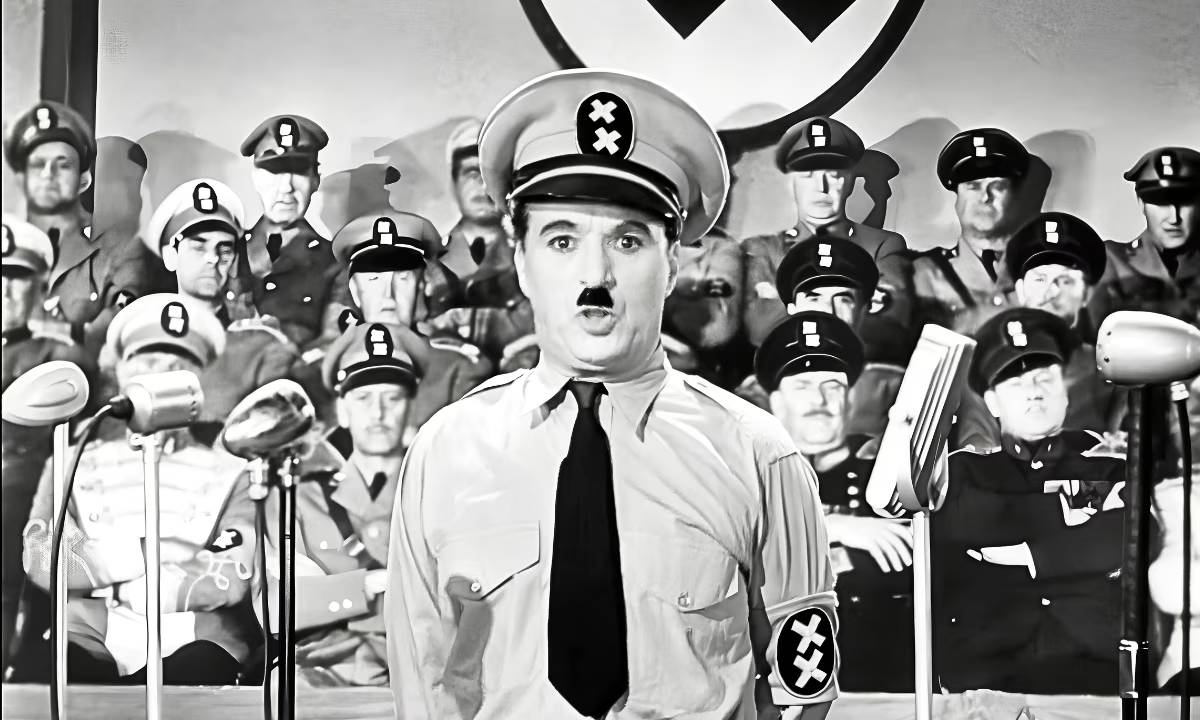

The Great Dictator is the 1940 film in which Charlie Chaplin, the most famous silent comic on earth, finally opened his mouth on screen and used his first real talkie to mock Adolf Hitler while America was still officially at peace with Nazi Germany. He wrote it, directed it, produced it and paid for it himself.
He played both the dictator and the Jewish barber who gets mistaken for him. And then, in the last few minutes, he dropped both characters and spoke straight to us. I have watched Charlie Chaplin’s The Great Dictator more times than I can count, and it still unsettles me, though not always for the reasons the film intended.
Below I break it down through four angles that most reviews skip: the double-crossed identity at its centre, the concentration camp scenes Chaplin wrote and then cut, its slapstick diplomacy on screen and off, and the strange physical life of that balloon globe.
Table of Contents
The Great Dictator Snapshot
What it is: The Great Dictator is a 1940 American political satire written, directed, produced by and starring Charlie Chaplin. It was his first true sound film.
The setup: Chaplin plays two men who look alike. One is Adenoid Hynkel, dictator of Tomainia (a parody of Hitler). The other is a Jewish barber with amnesia who survived World War I.
The numbers: It premiered in New York on October 15, 1940, earned about $5 million in worldwide rentals, sold 9 million tickets in the UK and 8,360,048 in France in 1945. It got five Oscar nominations and won none.
The four angles: The “Double Cross” emblem is a pun on betrayal and on Chaplin’s own mirror image with Hitler. Chaplin drafted whole camp comedy routines in 1938 and 1939, then cut them down to three brief scenes, and later admitted he did not know the truth. The diplomacy gags (barber chairs, English mustard) were matched by real diplomatic panic around the film. The globe balloon echoes a real, very expensive Nazi-era globe.
My verdict: Still essential. The comedy is sharper than its reputation, the camp scenes are its blind spot, and the final speech is either the bravest or clumsiest ending in Chaplin’s career depending on your mood. I lean brave.
The Great Dictator Quick Facts
| Detail | Fact |
|---|---|
| Release | World premiere October 15, 1940, at the Capitol and Astor theatres, New York |
| Writer, director, producer | Charlie Chaplin |
| Cast | Charlie Chaplin, Paulette Goddard, Jack Oakie, Reginald Gardiner, Henry Daniell, Billy Gilbert |
| Runtime | 125 minutes |
| Budget | Reported figures disagree: $2.2 million (Variety, 1940), $1,403,526 (Jeffrey Vance, Library of Congress essay), $1.5 million of Chaplin’s own money (Roger Ebert) |
| Box office | $3.5 million in US and Canada rentals, about $5 million worldwide rentals |
| Filming | Began September 1939, days after World War II broke out, and wrapped in early 1940 |
| Oscars | 5 nominations (Outstanding Production, Best Actor, Original Screenplay, Supporting Actor for Jack Oakie, Original Score), 0 wins |
| Honours | National Film Registry (1997), AFI “100 Laughs” No. 37 (2000), Cahiers du cinéma 100 greatest films No. 24 (2008), BBC critics’ poll of greatest comedies No. 16 (2017) |
| Rotten Tomatoes | 92% from 53 reviews (as cited on Wikipedia when I checked) |
Suggested audience for The Great Dictator
The Great Dictator might be a good choice for anyone curious how Hollywood handled Hitler before Pearl Harbor, fans of Chaplin’s silent work who want to see how he moved into sound, students of satire, propaganda and political film, and viewers who liked Jojo Rabbit (2019) or To Be or Not to Be (1942) and want the film that came first
The Great Dictator may not be enjoyable to viewers who need historical accuracy about the Holocaust (the film was made before the full horror was known, anyone allergic to direct-to-camera speeches and people expecting the Little Tramp in his old form.
What Is The Great Dictator About?
The Great Dictator is about two men with the same face living on opposite ends of power in a fictional country called Tomainia. Hynkel shouts his way into world domination fantasies. The barber just wants to shave customers and court his neighbour Hannah. History, plus a lot of mistaken identity, pushes them into each other’s place.
Chaplin opens with a written note telling us that any resemblance between Hynkel and the barber is “purely co-incidental.” That line is the first joke in the movie, and it also tells you exactly what the movie is going to do.
The Great Dictator Plot Summary
1918: The Soldier Who Could Not Do Anything Right
The film starts on the Western Front in 1918. A Jewish soldier serving Tomainia is part of a crew firing Big Bertha, an enormous gun aimed at Notre-Dame in Paris, roughly 75 miles away.
The first shot destroys an outhouse. Sent to check a dud shell, he finds that the shell’s nose keeps swinging to follow him wherever he steps. He fumbles a live grenade. In the smoke, he wanders into a line of enemy soldiers and marches with them before realising his mistake.
His one heroic act is helping a wounded pilot, Commander Schultz, who carries documents that could win the war for Tomainia. They take off together. The plane flies upside down for a long stretch, which the soldier only figures out when loose objects float and the sun seems to be “shining upwards.”
They crash. Schultz learns that Tomainia has surrendered. The soldier wakes in a hospital with no memory and stays there for about twenty years.
The Rise of Hynkel
While he sleeps through history, newspaper headlines tell us what happened outside. Depression. Riots. The Hynkel party takes power. We meet Adenoid Hynkel, the “Phooey” of Tomainia, delivering a speech in a German-sounding gibberish full of words like “wienerschnitzel,” while an interpreter politely softens his hatred into calm English.
Hynkel’s circle is a pair of sharp caricatures. Garbitsch (Henry Daniell) is his cool, unflappable Minister of the Interior and of Propaganda, a version of Joseph Goebbels. Herring (Billy Gilbert) is his bumbling minister of war, a version of Hermann Göring, whose weapon demonstrations always fail.
The Barber Comes Home
The barber finally walks out of hospital, unaware that two decades have passed and that the ghetto is now under stormtrooper control. His shop has been boarded up and painted “JEW.” When he tries to get rid of it, troopers attack him. Hannah (Paulette Goddard), a young laundress who lives nearby, swings a frying pan at the troopers from her window. She hits a few of them and then hits him too, and he staggers down the street in a daze.
The troopers are about to hang him when Commander Schultz, now a powerful figure in the regime, arrives and recognises the man who saved his life in 1918. Schultz orders the troopers to leave the barber and Hannah alone. For a while, the ghetto breathes.
The Globe, the Loan and the Shave
That pause has a cold political reason. Hynkel wants to invade the neighbouring country of Osterlich and needs money, so Garbitsch suggests borrowing from a Jewish banker named Epstein.
To get the loan, Hynkel eases off the persecution. Meanwhile, alone in his huge office, he dances with an inflatable globe of the world to the Prelude from Wagner’s Lohengrin, tapping it into the air with his hands, feet and head, until it bursts in his arms and he weeps.
Then Epstein refuses the loan. Hynkel explodes and orders the ghetto purged. When Schultz objects on moral grounds, Hynkel has him arrested and sent to a concentration camp.
Back in the ghetto, the barber shaves a customer in perfect time with Brahms’s Hungarian Dance No. 5. It is one of the most joyful two minutes Chaplin ever filmed. He is falling for Hannah, too, but their evening out ends with Hynkel’s broadcast tirade and stormtroopers setting the barber’s shop on fire. The two of them hide on a rooftop.
The Pudding Lottery
Schultz escapes and hides in the ghetto. He proposes a suicide plot: one of the local men will plant a bomb in the palace. To pick the volunteer, Schultz has five puddings served, and the man who finds a coin in his portion must go. The barber finds a coin.
He swallows it. The others, equally scared, slip their coins onto his plate, and he swallows those too, until the coins rattle every time he hiccups. It turns out Hannah put a coin in every pudding because she thinks the plan is madness. The plot dies at the table.
It does not save them. Troops search the ghetto and arrest Schultz and the barber. Both are sent to a concentration camp. Hannah escapes with the Jaeckel family to a vineyard in Osterlich.
Hynkel Meets Napaloni
Hynkel’s invasion is complicated by Benzino Napaloni (Jack Oakie), dictator of Bacteria and an obvious Mussolini parody, who wants Osterlich for himself. Napaloni arrives by train for a state visit, and his train keeps lurching past the red carpet. In the palace barber shop, the two dictators sit side by side and keep pumping their chairs higher so neither has to look up at the other.
At a buffet, Hynkel accidentally spreads hot English mustard on his strawberries and Napaloni does the same on a sandwich. Their argument over Osterlich becomes a food fight.
In the end they sign a treaty, and Hynkel orders the invasion. Soldiers reach the vineyard and beat Hannah’s family.
The Swap
Schultz and the barber escape the camp in stolen uniforms. Near the Osterlich border, Hynkel is out duck hunting in civilian clothes. His own soldiers mistake him for the escaped barber, knock him out and drag him off to the camp. The barber, dressed in uniform with his small moustache, is mistaken for Hynkel.
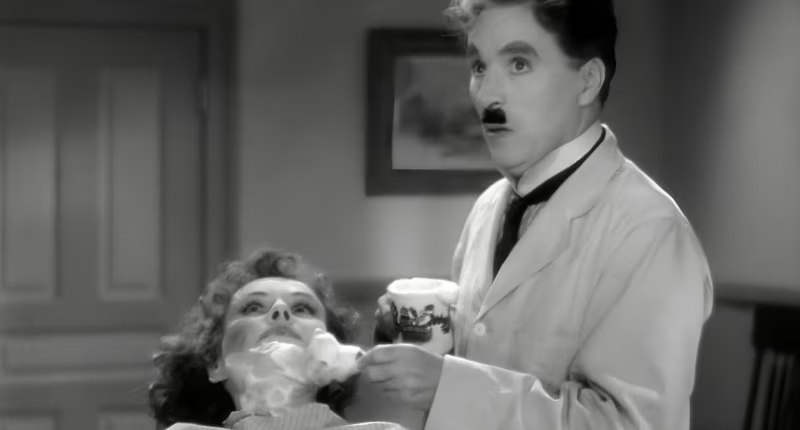
The army takes him straight to a victory rally in conquered Osterlich, where a huge crowd and radio microphones are waiting. Schultz tells him that he has to speak, because it is the only way they survive.
The Speech
The barber steps up and starts with a refusal: “I’m sorry, but I don’t want to be an emperor.” He then delivers a long appeal for kindness, democracy and human brotherhood, telling soldiers not to give themselves to men who despise them. His voice rises. Chaplin is clearly speaking as himself now.
At the end he speaks directly to Hannah, telling her to look up. In Osterlich, Hannah hears his voice on the radio. She turns toward the rising sun and tells the others to listen. The film ends there. We never learn what happens to the barber, Schultz or the real Hynkel.
Why Did Charlie Chaplin Make The Great Dictator in 1940?
Charlie Chaplin made The Great Dictator because Hitler had made himself impossible to ignore, and because, in a strange way, Hitler had taken something from Chaplin. The two men were born four days apart in April 1889, both rose from poverty, and both wore that toothbrush moustache. Cartoonists noticed. Chaplin noticed too.
Chaplin’s son, Charles Chaplin Jr., later wrote that his father thought of Hitler with a mix of horror and fascination, and would say, “he’s the madman, I’m the comic.” Then he would add that it could easily have gone the other way. That remark sits in my head every time I watch the film.
The Nazis had already targeted him. A 1934 propaganda book, The Jews Are Looking at You, labelled Chaplin “a disgusting Jewish acrobat.” He was not Jewish. His friend Ivor Montagu sent him a copy and always believed that book pushed him toward the film.
According to Jürgen Trimborn’s biography of Leni Riefenstahl, Chaplin watched Triumph of the Will at New York’s Museum of Modern Art alongside René Clair. Luis Buñuel later recalled that Clair was horrified. Chaplin laughed out loud, and went back to the film again and again to study Hitler’s gestures.
The industry was nervous. Rumours of the project reached the press in late 1938. Gossip columnist Hedda Hopper attacked it, studio executives tried to talk Chaplin out of it, and by March 1939 he was close to dropping it.
Around that time, Warner Bros. boss Jack L. Warner passed along word that President Franklin D. Roosevelt hoped to see the film made. Filming began in September 1939, just days after war broke out in Europe.
The Great Dictator‘s Double-Crossed Identity, Who Is Really Who?
The Great Dictator is built on a double cross in three senses: the regime’s symbol, the betrayal it stands for, and Chaplin’s own face split between victim and tyrant.
Start with the flag.
Hynkel’s party does not use a swastika. Its emblem is two crosses, the “Double Cross,” which the vexillology site Flags of the World describes as usually a black symbol on a white oval over a red field. In English, a double-cross is a betrayal. So every banner, armband and cap in Tomainia quietly announces what the regime really is.
I love that Chaplin made the joke visual and verbal at once, and never stops to explain it.
The second double cross is casting.
Chaplin plays both men, and the film never lets you settle comfortably on which one is “really” Chaplin. Critic Michael Wood points out in his Criterion essay that the barber briefly looks more murderous than Hynkel ever does. I did not see it on my first viewing.
Now I cannot unsee it.
Then there is the Tramp question. Is the barber the Little Tramp in his last outing? Chaplin said in 1937 that he would not play the Tramp in a sound picture. Yet in his 1964 autobiography he wrote that as the Tramp he could stay more or less silent while Hynkel did the talking. Roger Ebert flatly said Chaplin was “technically not playing the Tramp.” Biographer Stephen Weissman saw Chaplin abandoning the character.
Thomas Schatz, Colin Shindler and J.P. Telotte all read the barber as the Tramp turned into a specifically Jewish man. Eric Flom argued Chaplin kept the resemblance partly to draw audiences who had never seen a silent picture. I side with Flom. The bowler hat and cane are doing marketing work.
The deepest layer is Jewish identity itself. In a 2021 essay in Jewish Film & New Media, Alexis Pogorelskin of the University of Minnesota Duluth argues that the barber, even after he takes Hynkel’s place, never stops being a Jew, and that identity “even when hidden, waits only to resurface.” That reading changed how I hear the final speech. The man telling the world to stop hating is still the man whose shop window said “JEW.”
There is one more double-cross, and it is legal. Writer Konrad Bercovici sued Chaplin for plagiarism, claiming he had come up with the dictator idea and a dance with a globe. The case was settled in 1947, with Chaplin paying $95,000 and Bercovici conceding that Chaplin was the sole author.
Oddly, neither side mentioned that Chaplin’s half-brother Sydney had already played a dual role of barber and ruler in a 1921 film called King, Queen, Joker.
Were There Lost Concentration Camp Scenes in The Great Dictator?
Yes. Chaplin wrote far more concentration camp comedy than ever reached the screen, and the archive suggests at least some of it went in front of the camera. What survives in the release is a thin slice of a much bigger plan, and the story of how it shrank is one of the most revealing things about The Great Dictator.
The person who has dug furthest into this is Steven Alan Carr, a professor of communication at Purdue University Fort Wayne who also directs its Institute for Holocaust and Genocide Studies. His research project, “Complicated Dictator: The Untold Story of the Concentration Camp Scenes from Chaplin’s 1940 Hollywood Anti-Fascist Comedy That Audiences Never Saw,” was presented at the Society for Cinema and Media Studies conference in Chicago in 2013.
Working through the Charlie Chaplin Archive in Bologna, Russell Birdwell’s press books in Montreux and the United Artists papers at the University of Wisconsin-Madison, Carr found a treatment dated October 29, 1938, titled simply “Concentration Camp.” Its comedy rested on sabotage, which Carr describes as both conscious and unconscious, played as slapstick.
By the summer of 1939, according to Carr, Chaplin had pushed the gags further. One had a pie landing in a German officer’s face. Another had an officer stepping into a boot full of beer. In the finished film, by Carr’s count, all of this shrank to “three very brief scenes set in a prison camp.”
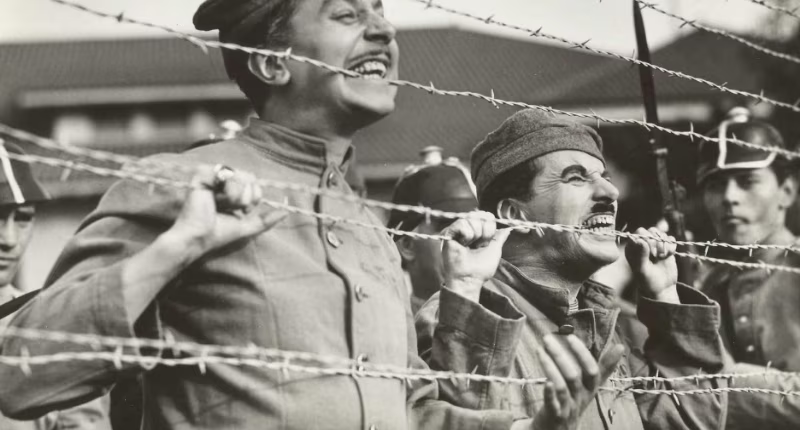
I wanted to check this against the archive myself, and the catalogue backs it up. The Charlie Chaplin Archive lists an 11-page typescript screenplay titled “Concentration camp,” dated June 20 to August 4, 1939 (item ECCI00312663).
That lines up with Carr’s summer 1939 drafts.
The same archive holds an out-take production still, also catalogued as “Concentration camp,” showing Reginald Gardiner as Schultz and Chaplin as the barber (item ECCI00026300). An out-take still tells us the camp material was at least staged for the camera. It does not prove how much of the sequence was shot, so I will not claim more than that.
Turner Classic Movies adds one more piece. In a 2007 trivia article, Frank Miller writes that press reports and photos from the time document scenes that never made the final cut, including the barber trying to escape the camp by chewing through a barbed wire fence. Chaplin cut a lot from this film in general.
The archive’s own 2021 feature on unseen scenes lists a blimp ride, a beer garden sequence and a pet chimpanzee wrecking a concert, and notes that set photographs by assistant director Dan James show some of these were filmed.
Why did the camp gags go? Carr reads the cuts as a sign of Chaplin’s changing awareness of Nazism, and of a growing doubt about whether slapstick could handle the camps at all. He argues the film should be treated as an early barometer of how Hollywood dealt with Nazism and the Jewish side of the Holocaust.
That is his interpretation, not a statement Chaplin left behind, but it fits the timeline. Filming started in September 1939. Germany had invaded Poland. A pie in an officer’s face looked very different by then.
The camp scenes that did survive are mild. Prisoners wear pyjama-style uniforms and are drilled in an exaggerated goose step. Schultz and the barber escape by putting on officers’ uniforms. Critic Brian Eggert describes the camp as looking “no more oppressive or dehumanizing than a federal penitentiary.” Knowing about the deleted pie and beer-boot gags changed how I watch these few minutes. I used to think they were too light. Now I think they are what was left after Chaplin had already started taking the jokes out.
Chaplin knew it. In My Autobiography (1964) he wrote that had he known the real horrors of the German camps, he could not have made the film, adding: “I could not have made fun of the homicidal insanity of the Nazis.” That sentence matters. It is a filmmaker admitting that his comedy depended on ignorance.
It is worth being fair about what he did know. The Wikipedia history notes that European Jewish friends had told Chaplin about Nazi persecution through the late 1930s. The film says “concentration camp” out loud, shows a ghetto with burning shops, and shows stormtroopers ready to hang a man in the street.
Brian Eggert points out that audiences at the time saw it as an anti-Nazi statement no Hollywood studio was willing to make. Filmmakers, according to the same history, then struggled for nearly 20 years after the war to find the right tone for satirising this period.
The other famous piece of lost footage is the ending. Sydney Chaplin shot colour home movies on the set, which surfaced publicly in the 2002 documentary The Tramp and the Dictator by Kevin Brownlow and Michael Kloft. Variety‘s review of that documentary reports that the footage includes glimpses of Chaplin’s original ending, which he changed in response to the fall of France in June 1940 and replaced with the speech.
The exact content of that abandoned ending is only partly visible, and I would rather not guess at details I cannot confirm.
There is also footage that was lost to one country by choice. Scenes with Madame Napaloni (Grace Hayle) were cut from Italian prints out of respect for Mussolini’s widow, Rachele, and stayed out until 2002. And inside the ghetto, some shop signs are written in Esperanto, a language Hitler condemned. That detail is easy to miss, and once you know it, you cannot stop seeing it.
How Does Slapstick Diplomacy Work in The Great Dictator?
Slapstick diplomacy in The Great Dictator means turning international power politics into physical comedy, and it worked so well that the film caused real diplomatic trouble on three continents.
On screen, the Hynkel and Napaloni scenes are pure pecking-order farce. The visiting train will not stop at the red carpet. The barber chairs go up and up because neither dictator can stand to be lower.
The mustard on the strawberries forces both men into teary agreement. The whole dispute over Osterlich echoes the real July Putsch of 1934, when Austrian Nazis killed Chancellor Engelbert Dollfuss in a failed coup and Mussolini moved troops to the Austrian border to warn Hitler off.
Jack Oakie, loud and back-slapping, steals virtually every scene he shares with Chaplin, as Cineaste‘s reviewer also noticed, and so did the Academy, with a Best Supporting Actor nomination.
What I find funnier is how Hynkel behaves around him. Michael Wood notes that Hynkel is too timid even to talk to Napaloni on the phone. The Great Dictator is, at heart, a nervous host.
Off screen, the diplomacy was not funny at all.
Germany: Nazi consul Georg Gyssling complained to Joseph Breen of Hollywood’s Production Code Administration and hinted that American films might lose access to the German market.
Britain: Neville Chamberlain’s government said it would ban the film under its appeasement policy. By release time Britain was at war, and the film drew 9 million British cinemagoers.
The United States: The country stayed officially neutral. Roosevelt sent his aide Harry Hopkins to meet Chaplin. In January 1941, Chaplin read the final speech at a gala for Roosevelt’s third inauguration.
Latin America: Historian Willie Hiatt’s 2018 article in the Journal of Latin American Studies, titled “Slapstick Diplomacy,” documents how pro-Axis groups from Mexico to Argentina met the film in early 1941 with tear gas, Nazi salutes and antisemitic abuse. Hiatt argues that the film’s rocky circulation exposed cracks in the “Good Neighbour” policy that Washington was trying to hold together.
Europe: The film was banned in occupied Europe. When it finally reached France in 1945, it became the most popular film of the year with 8,360,048 admissions. According to Jeffrey Vance, it was not shown in Germany or Italy until a 1958 reissue.
And Hitler himself? Vance reports that a refugee from the Nazi film bureaucracy told Chaplin that Hitler watched it twice, alone. Albert Speer denied that he ever saw it. Hitler’s reaction is not recorded. Chaplin said he would give anything to know what Hitler thought.
The political cost to Chaplin came later. His wartime speeches in support of a second front for the Soviet Union, combined with attacks from Hedda Hopper and J. Edgar Hoover’s FBI (NPR reports the bureau’s file on him ran to 1,900 pages), eroded his standing in America. He was pushed out of the United States in 1952.
Why Does the Globe Scene Still Matter? The Materiality of the Globe
The globe scene matters because the globe is a real object treated as a toy, and that is exactly the point Chaplin was making about dictators.
Look at what the prop is. Not a painting, not a map, but a balloon printed as the Earth. It is light, it bounces, it has no weight at all, and it pops. Hynkel holds the whole world on his fingertips, bounces it off his foot and head, and then hugs it too tightly. When it bursts, he collapses onto his desk crying. Brian Eggert compares him to a child who has broken his toy, and I cannot improve on that.
No dialogue explains this. NPR critic Bob Mondello called it Chaplin’s last great moment of silent-style pantomime, and it sits inside his first sound film.
The object has a real-world twin. Wikipedia’s entry on the Columbus Globe for State and Industry Leaders, a giant globe made in Berlin in the mid-1930s, says Hitler had one in his Reich Chancellery office from early 1939 until April 1945, and it explicitly connects Chaplin’s balloon to that globe.
One of these globes, allegedly from Hitler’s summer retreat, sold at auction in 2007 for $100,000 against an estimate of $20,000. Put those two objects side by side and Chaplin’s choice looks even sharper. The real dictator’s globe was huge, expensive and built to impress. Chaplin’s version was air.
The gag was not new for him, either. Cineaste notes that Chaplin did a similar balloon-globe routine at a party in the 1920s, and that footage survives. He sat on the idea for years until he found the right villain for it. Even the theatrical poster plays with the image, with Chaplin’s dictator perched on a giant globe.
The music completes the thought. The globe dance plays over the Prelude to Wagner’s Lohengrin, which the Library of Congress essay calls Hitler’s favourite Wagner opera. Chaplin cuts the music off when the globe pops. He uses the same Prelude again at the end, when Hannah hears the barber’s speech, and this time it plays through to its climax. Scholar Lutz Koepnick argued that Chaplin refused to hand Wagner to the fascists, using the same music to mark both domination and hope.
Then compare the barber. While Hynkel plays with the planet, the barber works with real, small things: a razor, lather, a customer’s chin, all in time to Brahms. Composer Meredith Willson recalled that the orchestra’s music for the shaving sequence was captured in what turned out to be “the first and only ‘take’.” One man grabs the world and loses it. The other handles one face with care.
That contrast is the film’s argument in miniature.
Does the Final Speech of The Great Dictator Work?
The final speech works as a moral act and only half works as cinema, and I think Chaplin knew that and did it anyway.
Bosley Crowther, reviewing the film for The New York Times in October 1940, called it “a truly superb accomplishment by a truly great artist.” Roger Ebert, decades later, gave the film four stars but said of the speech: “It didn’t work then, and it doesn’t work now.” Michael Wood describes the ending as “peculiarly perched on the edge of bathos,” with Chaplin smuggled into his own film as himself.
My own view is somewhere between them. The first time I saw it, the speech felt like the film stopping. On later viewings I started watching Chaplin’s face rather than listening to the words, and it reads differently. This is a man who built his career on never speaking, deciding that silence was no longer an option.
Chaplin spent months writing and rewriting it, according to the official Chaplin website, and defended it in a letter to The New York Times the week of release.
The world agreed with him in its own way. The speech has been sampled in more than 40 songs, played by U2 and Coldplay during live shows, and used by Lavazza in a TV advert. An NPR photo from October 2025 shows a scene from the film projected at a Berlin demonstration in May 2025. A speech that critics called a mistake became one of the most quoted things Chaplin ever said.
Strengths and Weaknesses
What works:
The physical comedy is first-rate: the upside-down plane, the frying pan, the pudding lottery, the barber chairs.
Jack Oakie gives one of the funniest supporting turns of the period.
The globe and shaving scenes are perfect visual opposites.
It was made by a single filmmaker risking his own money against studio, censor and diplomatic pressure.
What does not:
The surviving concentration camp scenes are inadequate, even after Chaplin trimmed the gags, and he later admitted the film could not have been made with full knowledge.
The pacing sags in the middle, especially around Schultz’s plotting.
The ending abandons the story. We never learn what happens to anyone.
Paulette Goddard’s Hannah, despite the frying pan, is mostly there to be rescued and to listen.
How The Great Dictator Compares to Other War and Satire Films
If you want to see how differently cinema approached the Nazi era once the truth was known, pair this with Spielberg’s Schindler’s List (1993). Chaplin laughed at Hitler before the camps were understood. Spielberg had no laughter left.
Hannah Arendt’s idea of the “banality of evil” is useful here too. Hynkel is a ridiculous tyrant, but the stormtroopers who paint “JEW” on a shop window are ordinary men following orders, which is the uncomfortable subject of my piece on Eichmann in Jerusalem.
The film’s World War I opening also connects to All Quiet on the Western Front (1930, 1979 and 2022), the sober version of the war Chaplin played for laughs. For another resistance story set against the Nazi machine, Laurent Binet’s novel HHhH retells the real plot to kill Reinhard Heydrich.
For political cinema built on paranoia rather than laughter, The Manchurian Candidate (1962) makes a strong companion. And if you want to see how The Great Dictator sits alongside the period’s other giants, Citizen Kane (1941) arrived just a year later. I have also placed classics like these in my list of 101 Best Films You Need to See and 25 Best Iconic Films That Shaped Cinema.
The film’s descendants are easy to spot. Ernst Lubitsch’s To Be or Not to Be (1942) also used a Hitler double. Wikipedia lists The Dictator (2012), The Interview (2014) and Jojo Rabbit (2019) among the films it inspired.
Is The Great Dictator Worth Watching in 2026?
Definitely yes. The Great Dictator is worth watching in 2026, and not as a museum piece.
It turns 86 on October 15. Some of it has aged badly, and the camp scenes will make you wince. But a lot of it feels uncomfortably current: a leader who speaks in noise while a translator makes it sound reasonable, ministers who flatter him, rival strongmen measuring their chairs, a frightened industry deciding whether to make a movie at all. Jeffrey Vance called it “the cinema’s first important satire.”
I would add that it is one of the few films where you can watch an artist realise, in real time, that comedy is not enough.
When I finish it, I am never thinking about the gags. I am thinking about a man who looked exactly like the most dangerous person alive, and decided to use that face to tell the world to stop.
FAQs About The Great Dictator
What is The Great Dictator (1940) about?
It is a political satire in which Charlie Chaplin plays both Adenoid Hynkel, a Hitler-like dictator of Tomainia, and a Jewish barber who is mistaken for him and ends up giving a speech for peace and democracy.
Was The Great Dictator Charlie Chaplin’s first talkie?
Yes. Chaplin kept making silent films well into the sound era, and The Great Dictator was his first true sound film with full dialogue.
Did Hitler ever see The Great Dictator?
Possibly. Chaplin biographer Jeffrey Vance reports a refugee told Chaplin that Hitler watched it twice, alone. Albert Speer denied it. Hitler’s reaction is not recorded.
Were concentration camp scenes cut from The Great Dictator?
Yes. Research by Steven Alan Carr found a 1938 treatment titled “Concentration Camp” and 1939 drafts with slapstick gags, such as a pie in an officer’s face. The release keeps only three brief camp scenes. The Charlie Chaplin Archive holds a 1939 camp screenplay and an out-take still of Schultz and the barber.
Did Chaplin regret making The Great Dictator?
He wrote in his 1964 autobiography that he could not have made the film had he known the true extent of the Nazi concentration camps.
What is the “double cross” in The Great Dictator?
It is the emblem of Hynkel’s party, replacing the swastika. It is also a pun, since a double-cross means a betrayal.
Why is the globe scene in The Great Dictator famous?
Hynkel dances with a balloon globe to Wagner’s Lohengrin until it bursts. It shows a dictator treating the world as a toy, and many critics see it as Chaplin’s last great silent-style comic sequence.
How much money did The Great Dictator make?
It earned about $3.5 million in US and Canadian rentals and about $5 million in worldwide rentals, making it Chaplin’s most commercially successful film.
Did The Great Dictator win any Oscars?
No. It received five Academy Award nominations, including Outstanding Production and Best Actor for Chaplin, but won none. Chaplin did win Best Actor from the New York Film Critics Circle and the National Board of Review.
Who played Napaloni in The Great Dictator?
Jack Oakie played Benzino Napaloni, the Mussolini parody, and earned an Oscar nomination for Best Supporting Actor.
Further reading (not quoted above):
- Delage, Christian. Chaplin Facing History. Paris: Jean-Michel Place, 2005.
- Kaplan, Louis. “‘It Will Get a Terrific Laugh’: On the Problematic Pleasures and Politics of Holocaust Humor.” In Hop on Pop: The Politics and Pleasures of Popular Culture, edited by Henry Jenkins et al., 343-56. Durham, NC: Duke University Press, 2002.