
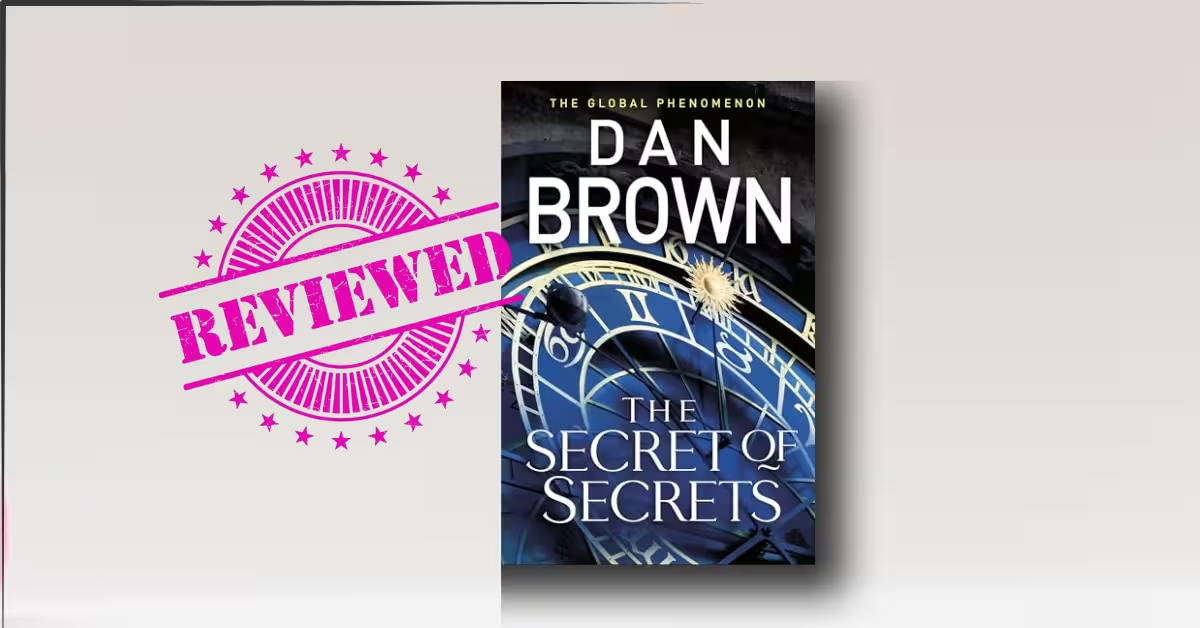
If you’ve ever wondered whether consciousness ends with the brain—or begins beyond it—The Secret of Secrets throws you into that debate with a runaway thriller set in a haunted, scholarly Prague. It dares you to ask: what if death isn’t the end, but the clue?
The Secret of Secrets argues—through codes, corpses, and cathedrals—that our greatest mystery isn’t hidden in a vault or a Vatican but in the nature of mind itself, and that following symbols can be a way of thinking, not just sightseeing.
Evidence snapshot
- Brown roots his fiction in real objects and lore: “FACT: All artwork, artifacts, symbols, and documents in this novel are real.”
- Katherine Solomon’s lecture frames the mind-question with brain-science numbers (billions of neurons and synapses) and the claim that art has long encoded altered states—“A ‘radiant crown’ … is pain.”
- Contemporary reporting and studies Brown riffs on: ~86 billion neurons (Herculano-Houzel et al. 2009/2012) and on the order of ~100 trillion synapses (Kandel et al.; Allen Institute/Scientific American). (PMC)
- Real-world “strange mind” cases echo Katherine’s thesis: post-coma language shifts and amnesia (Rueben Nsemoh; Michael Boatwright) and controversial reincarnation research (James Leininger). (TIME)
Best for: readers who devour puzzle-thrillers, Robert Langdon completists, Prague lovers, armchair philosophers of mind, and anyone curious about noetic science.
Not for: readers who want austere literary minimalism, airtight lab-grade science in fiction, or who disliked Brown’s propulsive, fact-peppered style (some critics remain unconvinced).
Table of Contents
1. Introduction
This is book six in the Robert Langdon series, a blend of mystery, conspiracy, art history, and science-curious thriller set primarily in Prague, with later beats in London and New York. Brown and Doubleday announced a large first printing and an international rollout, underscoring expectations for the series’ return after Origin (2017).
The Secret of Secrets is a classic Dan Brown caper—cliffhangers, codes, and cultural Easter eggs—but also his most overt meditation on consciousness. It’s messy, maximal, occasionally bonkers, and—if you meet it on its own terms—immensely readable. Critics split, readers swarm.
2. Background
Prague’s reputation as a crucible of mysticism and learning (from alchemy lore to Kafka and Charles Bridge) is central. Brown foregrounds this atmosphere from page one. Solomon opens her talk by calling Prague “an experience—a sort of ‘crossroads of culture’ and a ‘spirit of contraries’.”
The Author’s Note stakes Brown’s method: “FACT: All artwork, artifacts, symbols, and documents in this novel are real.”
From there, The Secret of Secrets weaves modern neuroscience’s big numbers (neurons, synapses) with old symbols (halos, golems, crowns of glory). For context: adults average ~86 billion neurons and ~100 trillion synapses—figures often cited in science communication and reviews. (PMC)
3. Summary of the Book
Dan Brown opens with shock and atmosphere: neuroscientist Dr. Brigita Gessner, floating above a snow-dusted Prague, realizes she’s in an out-of-body state. She remembers being strapped into a device of her own making while a clay-faced “monster” interrogated her about a covert project hidden beneath the city. She confesses—and he restarts the machine, leaving her to die. Her last coherent thought is that she must warn the others, but “this life [is] over.”
Cut to Robert Langdon in Prague’s Four Seasons with Katherine Solomon, who has just delivered a sold-out lecture in the castle’s Vladislav Hall arguing that the dominant model of consciousness is wrong: it’s not generated by the brain and is not confined to the skull. The lecture functions as manifesto and theme statement for the novel’s science-meets-symbolism plotline.
Langdon heads out for his ritual dawn swim, jogging alone across a pristine Charles Bridge, taking in the spires and the winter air—Brown’s classic travelogue-as-tension-builder. Back at the hotel, he notices heavy police presence and gets the first whiff that Prague is on edge.
In London, a silver-haired American intelligence veteran, Everett Finch, is also on edge: Dr. Gessner had warned him—cryptically—about Katherine’s coming book, then vanished. Finch orders a hack of Penguin Random House to steal Katherine’s manuscript, searching it for any reference to his clandestine operation. He’s relieved it doesn’t name the CIA or his program—until a search ping near the end spikes his panic. With the book now entering editing, control will be impossible; he mobilizes a plan.
That plan is the machine Gessner helped build: “Threshold,” a subterranean complex accessed through innocuous infrastructure in Folimanka Park, powered by a superconducting magnetic energy storage (SMES) system cooled with vast liquid-helium tanks. If the helium warms and vents, it becomes a pressure bomb. The science is chillingly exact: liquid helium expands roughly 750× when it flashes to gas—enough to fill seven Olympic pools—so unvented expansion can rip a vault apart.
Threshold’s aim: to harness near-death states and “nonlocal consciousness” for real-time long-range surveillance, the ultimate human-to-machine intelligence interface. As Finch will later boast with a gun in his hand, the first true H2M interface would create a new superpower.
Meanwhile, a second thread surges to the fore: the Golěm. He’s the clay-masked interrogator, an epileptic whose seizures he manages with an “epilepsy wand.” He scuttles through the Old Town in boots and cloak, the Hebrew letters אמת (“truth”) carved into his clay-smeared brow, promising to obliterate the “underground house of horrors” Gessner described. He sees himself as a guardian angel bound to “her”—Sasha Vesna—by a kind of quantum entanglement, bent on destroying the men who used her.
Katherine and Langdon, still glowing from her talk, are pulled into the undertow when Katherine prints her manuscript; Finch’s surveillance flags it instantly.
In the book’s Washington/Prague chessboard, Finch taps Field Officer Susan Housemore and other assets, and pressures the U.S. Embassy in Prague—particularly Ambassador Heide Nagel, a former CIA general counsel who has been coerced for years. Nagel was maneuvered into the ambassadorship by Finch and CIA Director Gregory Judd; Finch even planted classified files to hold treason over her head. She hates him—but has complied.
As bodies begin to fall, the Czech intelligence service ÚZSI opens a file. A senior official named Janáček is found dead by asphyxiation near the Vltava; fresh footprints suggest a struggle. Early “persons of interest” include a mysterious “Sasha,” finicky about medical privacy, and a man fitting Langdon’s description. The net is tightening around both the Americans and a phantom caregiver.
Langdon and Katherine follow a trail of art, texts, and Prague lore (the golem legend, the Old–New Synagogue, the Klementinum library), and Brown lets the symbology braid into the science: halos, radiant crowns, and “emanations of light” are reframed as visual culture’s way of talking about consciousness. The set-pieces are vintage Brown—gothic alleys, hidden basements, and historic interiors doubling as puzzles—and they aim the pair toward the impossible: a covert CIA death-lab beneath Folimanka.
They descend. Inside Threshold’s cathedral-like dome, pods ring the floor—EPR (“extended period resuscitation”) capsules that can hold someone in a suspended “death state.” Katherine frames it bluntly: “Are you studying death?” Langdon senses a darker purpose than pure research.
Then Finch arrives—gun out, voice cool—and corners them among the pods. He’s past NDA niceties: they’ve seen too much. Katherine snaps that Threshold pilfered her denied patent; Finch counters that the denial makes nothing “stolen.” He prods them toward the pods, promising an “enlightening” demo. The subtext: no witnesses leave.
From beneath the dome’s floor, the Golěm, on a pneumatic lift, hears the gunshot and the conversation overhead. He recognizes the targets: Dr. Katherine Solomon and Robert Langdon. The man with the gun—the “head of the snake”—is Everett Finch. The Golěm has only a single-charge stun device and a ticking clock: he’s already sabotaged SMES control—within minutes, the helium quench will turn Threshold into a pressure bomb. He weighs his impossible choice: kill Finch now or escape in time to “Release” Sasha from captivity.
He surfaces anyway—clay mask, cloak, and trembling hands—claiming to be “her protector.” Finch advances, taunting him with the seized epilepsy wand. The Golěm appears to seize, then snaps like a trap: he surges up, discharging the stun wand into Finch, whose gun fires into a pod as he drops, nose shattered, the weapon skittering away. For a breath, Finch is alive but helpless.
What follows is a scramble: Langdon and Katherine flee the dome’s catwalks and utility passages searching for egress while the Golěm races the countdown to get clear and find Sasha. Above ground, U.S. soldiers converge on the access points. When Langdon and Katherine run straight into a squad, a single American voice cuts through—“stand down!”—and the pair are pulled out alive. The Golěm vanishes into the labyrinth.
Then Prague lurches: a massive subterranean blast shakes the city, sending a geyser of vapor up through Folimanka’s R2-D2 vent and collapsing the hidden vault. The endpapers’ city map becomes a crime-scene schematic; inside the crater, there can be little doubt—Threshold has been erased.
Aftermath detonates in multiple capitals. In Washington, Director Judd moves to contain fallout. In Prague, Nagel swings from despair to resolve when a consulate staffer is found strangled in Sasha’s apartment—one more life crushed by the machine she’s been forced to defend. She decides, finally, “No more,” and begins to turn against Finch.
Finch’s own spiral is brutal. He discovers Housemore’s corpse—proof that Threshold is under attack—and realizes he’s lost control of the battlefield. In the dome, stunned and bleeding, he loses his gun to the clay-faced avenger. Whatever happens when the helium vents, Finch is still inside his own “death lab.”
Brown then resolves the human stakes. The Golěm’s mission wasn’t only vengeance; it was rescue. Sasha Vesna—an exploited subject who learned to surf the “Ether,” paying for it with seizures—is pulled from the apparatus’s orbit. In the coda, an Embassy voice dryly confirms her exfiltration: “Sasha Vesna is okay… She’ll be flown to the States… Along with her cats, Harry and Sally.” The line lands like a benediction after two days of terror.
Langdon and Katherine, bruised but alive, absorb the larger reveal. Threshold wasn’t science in service of life; it was a weaponized theology of afterlife experiences: engineer near-death, detach awareness, listen and look “remotely,” then yank the subject back. Katherine recognizes that parts of her own cutting-edge research were co-opted. Finch’s sneer about “bright people playing dumb” wasn’t wrong—he’d been listening to her and to Langdon all along, through bugs and backdoors and the embassy’s compromised loyalties.
Publicly, the blast becomes just another “underground utilities accident.” Privately, the dominos fall. Nagel’s paper trail—sure to be weaponized by Judd—is shaded by her coerced past; still, she’s the one who arranges Sasha’s quiet departure. Jonas Faukman, Katherine’s editor, sees the danger and urges Langdon to get out when open-source searches expose Nagel’s CIA past. Brown’s recurring publishing-world chorus—agents, editors, assistants working late—becomes a counter-surveillance network that gets the protagonists clear.
We’re left with fused images: Prague’s haloed saints and radiant crowns; a dome of pods that turned the “aureole” of consciousness into a wiretap; a clay-masked guardian who believed death was porous and truth was carved into his brow. Katherine’s thesis survives, though scarred by what was done in its name. Threshold is gone, but its idea—the secret of secrets—can’t be buried as easily as a vault.
In the epilogue’s quiet, Brown gives a final, human ledger. The Golěm—who “has died many times”—walks away not as a myth, but as an abuse survivor who refused to let the “house of horrors” stand. Sasha is alive and headed toward care beyond Prague. And Langdon and Katherine, back above ground, return to doing what they do: speaking plainly about symbols and science, and deciding—again—what truths the public is ready to hear.
Setting
Prague’s Gothic-Baroque skyline, bridges, towers, and subterranean hush are the book’s oxygen. Landmarks, museums, guild lore, and the Vltava under the Charles Bridge form a moving “map” that structures the chase and encodes the book’s favorite question: how old symbols can still govern modern minds. Brown’s quick-strike city essays serve as travelogue and ticking clock.
4. Analysis
4.1 Characters
Robert Langdon remains the same sharp, slightly square symbologist—reliable witness, decoder, and cultural translator. Critics note he sometimes rides shotgun to the science this time, and that’s fair; he’s our lens on Katherine.
Dr. Katherine Solomon is the beating heart. A returning figure with intellectual heft, she’s rendered as rigorous, wounded, decisive—a scientist caught between career-long evidence and the human cost of belief. Her plain-spoken demolitions of romanticized imagery—“A ‘radiant crown’ … is pain”—land because they’re humane, not combative.
Antagonists are a Brown mix: a golem-myth enforcer that doubles as symbol and threat; bureaucrats who speak in moral fog; a financier of secrets. Motives range from spiritual terror to prestige anxiety to raw control.
4.2 Writing Style and Structure
Brown writes in short, cross-cutting chapters with two engines: (1) expository set-pieces that embed real objects, facts, and etymologies; (2) action beats that guard the page-turn rate. The method risks “Wikipediaing,” and reviewers again split: some call it “weapons-grade nonsense” and still fun; others praise the self-aware energy.
That said, the craft has a sly wink this time. There’s metafictional play (an editor-character cameo), satire of conspiracy-chic, and a warmer emotional register between Langdon and Katherine. Pacing remains Brown’s superpower; it’s hard to stop.
4.3 Themes and Symbolism
- Mind vs. Brain. The novel asks whether consciousness survives bodily limits—or, more cautiously, whether subjective experience is broader than neuronal noise. Katherine’s lecture hinges on brains as vast networks (scientifically grounded), while the plot tempts faith with liminal experiences. (PMC)
- Pain and Glory. The “halo” as crown of pain collapses martyrdom, aura, and radiance into one image, underscoring the book’s thesis that symbols are compressed human experience. “A ‘radiant crown’ … is pain.”
- Authority vs. Inquiry. Intelligence agencies, universities, churches, and tech patrons each try to steward—or suppress—ideas. Brown’s neutral point: institutions want sovereignty over narratives.
- City as Text. Prague is a palimpsest: stones as pages, bridges as hyperlinks, towers as footnotes. “Prague is an experience … a ‘crossroads of culture’.”
4.4 Genre-Specific Elements
- World-building: It’s “near-now” reality with noetic labs, medieval iconography, and spookcraft—close enough to feel plausible, elastic enough for wonder.
- Dialogue quality: Workmanlike, blunt, sometimes knowingly campy; most exposition arrives via clever lectures and staged reveals.
- Conventions: Clues, anagrams, architectural puzzles, and inter-cut POVs return; the golem adds folkloric chill.
- Who should read: Fans of Robert Langdon, readers intrigued by consciousness debates, Prague travelers, and anyone who likes their thrillers with big “what if?” engines.
5. Evaluation
Strengths:
- Relentless momentum; the Prague atmosphere hits just right.
- Katherine Solomon as a credible scientist-protagonist—with humane motives and hard edges.
- The mind-question gives the puzzles emotional stakes.
Weaknesses:
- Occasional clunky lines and overexplaining; purists will bristle (and some critics did).
- The science is inspired by research, not a substitute for it; treat claims as thought experiments.
Impact (personal): The book left me mulling how symbols organize pain and meaning. A single line—“The smell of death is singular.”—lingered as a thesis about reality’s texture beneath theories.
Comparison with Similar Works: Closest cousins are Origin (science-heavy Langdon) and the art/mystery blend of The Da Vinci Code, but with a mood nearer to Prague noir and a thematic kinship to nonfiction debates around panpsychism and noetic research.
Reception and Criticism: Early reviews split: The Guardian calls it ridiculous and enjoyable; Washington Post finds Brown’s joy contagious despite errors. Kirkus is bullish.
Adaptation: Netflix has ordered a series set in the world of The Secret of Secrets, created by Dan Brown with showrunner Carlton Cuse. No box-office data applies (it’s streaming), but note the Langdon films’ precedent: worldwide grosses of ~$760M (The Da Vinci Code), ~$486M (Angels & Demons), and ~$220M (Inferno).
6. Personal insight with contemporary educational relevance
For students and general readers, The Secret of Secrets is a lively entry point into questions at the frontier of neuroscience and philosophy of mind.
Reading it alongside reputable sources (Herculano-Houzel on neuron counts; Scientific American/Allen Institute on synapses; AP/WaPo on author intent) turns a page-turner into a mini-seminar on how we know what we think we know. (PMC)
Reading The Secret of Secrets in 2025 felt like sitting in a seminar where art history, neuroscience, and media studies finally talk to each other. For educators, it’s a ready-made bridge between disciplines and a reason to practice epistemic humility in an age of overconfident headlines.
First, symbolism as a thinking tool. Have students trace one recurring image—halo, bridge, golem—from medieval art to today’s memes. Ask: what human need does the symbol compress? They’ll learn semiotics without the jargon, and they’ll see how images move hearts faster than statistics.
Second, evidence literacy. The novel drops big brain numbers and bold claims. Use that as a lab: “What counts as a primary source here?” Students compare a chapter’s claim with a real study abstract, map the uncertainty, and write the claim back in plain, cautious English. It’s a transferable skill for every field.
Third, city-as-text. Brown’s Prague becomes a syllabus. Assign a “micro-guide” to a local neighborhood, mixing history, architecture, and lived observation. When students treat streets as footnotes, attention sharpens; civic pride tends to follow.
Fourth, ethics of narrative power. Institutions in the story compete to control meaning. Stage a structured debate: When does “protecting the public” slide into paternalism? Tie the question to current issues—algorithmic feeds, brain-computer interfaces, wellness trends—so theory meets life.
Finally, care of the self. A quiet thread in the book is pain—bodily, cultural, private. Invite reflective writing on where their beliefs about pain and transcendence came from, and how symbols shaped them. Graded for sincerity, not agreement.
In short: The Secret of Secrets is not just entertainment; it’s a humane pretext to teach critical reading, evidence discipline, civic noticing, ethical debate, and self-knowledge—all in one assignment-friendly package. Used thoughtfully, it turns curiosity into method, and method into a habit of compassionate, intellectually honest citizenship everywhere.
7. Quotable lines
- “FACT: All artwork, artifacts, symbols, and documents in this novel are real.”
- “I have died. This is the afterlife.”
- “Prague is an experience—a … ‘crossroads of culture’ and a ‘spirit of contraries’.”
- “A ‘radiant crown,’ Mr. Langdon, is pain.”
- “This blob is your brain.”
- “The smell of death is singular.”
8. Conclusion
The Secret of Secrets is Dan Brown doing what only Dan Brown does—field-trip fiction that treats the world as a puzzle, this time with the mind as the final symbol. If you’re open to a smart, splashy ride that keeps asking what consciousness is—and why symbols move us—this delivers.
Recommended for fans of Robert Langdon, lovers of Prague, and curious skeptics who like their metaphysics with momentum. If you demand austere prose or bulletproof lab-science in fiction, you may join the critics who roll their eyes—then read it anyway.







