Vibe by Adam Grant is a 2026 book that answers one stubborn question: why do some people click instantly while others stay strangers no matter how hard we try? Its direct answer is that chemistry is not a trait you carry but a ritual you build with someone, and that most of us run the wrong ritual on the wrong “wavelength.” The hardcover came out from Viking on October 13, 2026, so it is barely nine days old as I write this.
In short, the book says similarity does not predict closeness, strong bonds can form in hours when two people feel something intense together, and time apart or a good argument can make a relationship stronger.
Below you will find the full argument, chapter by chapter, plus my honest verdict on whether it earns a place on your shelf.
Table of Contents
What are the main lessons of Vibe?
Here is the whole book at a glance.
- A Vibe is the quality of connection between people. Grant defines it that way in the Prologue and says it is created in interaction, not owned by one person.
- Four wavelengths. You connect as associates (shared needs), allies (shared goals), pals (shared interests), or companions (shared values and care). Trouble starts when two people want different wavelengths.
- Three myths. You do not need similar personalities, instant sparks, or hundreds of hours.
- Rituals decide the outcome. Origin stories, deep questions, pebbling (sharing small things that remind you of someone), and planned gatherings change what a relationship becomes.
- Distance, friction, and mixed feelings are workable. Short bursts of contact, honest disagreement, and “accept and contain” boundaries sustain ties.
- Groups need structure. Great gatherings are choreographed, communities grow by dividing into niches, and teams need aligned values more than affection.
- Families survive change through traditions that adapt.
- AI cannot be a wavelength partner. Chatbots have no needs, goals, interests, or care of their own, so they cannot replace human bonds.
Who should read Vibe, and who may bounce?
If you are an introvert, a recent mover, a manager, a parent, or anyone who has quietly wondered why friendships drift, this book is written for you, and I think you will finish it with at least three habits you want to try.
Team leaders and teachers will get the most practical material from the last third, where the stories about gatherings, schools, and squads read almost like case studies. You may bounce if you want a rigorous academic treatment with every claim argued in the main text, because Grant moves fast and leaves the citations to the endnotes, or if you dislike a jokey tone, since puns and pop culture references appear on nearly every page.
Readers hoping for dating tactics will also find less than the subtitle might suggest.
What is Vibe by Adam Grant about?
Vibe is a nonfiction book about the science of human connection, written by an organizational psychologist who has spent two decades studying how people bond. The full title is Vibe: The Secrets of Strong Connections in a Lonely World, and it is published by Viking, an imprint of Penguin Random House, with the hardcover dated October 13, 2026.

Apple Books lists it as a Time “most anticipated book of 2026”. Page counts vary by edition, so I will not quote one.
Grant is a professor at Wharton, and his publisher says he has been the top-rated professor there for seven straight years. His earlier books include Give and Take, Originals, Think Again, and Hidden Potential (front matter). The book’s central thesis, stated in the Prologue and repeated in the Epilogue, is simple: connection is a skill, “like shooting and dribbling a basketball,” and it can be learned and taught. I like that he opens with his own failure.
In eighth grade, a friend he had known since kindergarten stole his new NBA basketball and the group let him find out weeks later (Prologue).
Why does this book matter right now?
It matters because loneliness has moved from a private feeling to a public health topic. In May 2023, the U.S. Surgeon General issued an advisory on an epidemic of loneliness and isolation, noting that a lack of connection can raise the risk of premature death to levels comparable to smoking daily.
Grant adds his own numbers. He writes that loneliness in the U.S. has risen since the late 1970s, that the share of American adults with no close friends quadrupled from 1990 to 2020, and that teens now spend about half as much time with friends as they did a decade ago (Prologue).
I could not independently verify each of those figures, so treat them as the author’s reading of the studies listed in his notes.
What makes the timing sharper is AI. Grant says growing numbers of adults and teens now turn to chatbots for conversation and emotional support (Prologue and Epilogue). Vibe is partly his reply to that trend.
Summary: What does Vibe actually say
The Prologue: Why did Grant struggle to connect?
Grant describes a shy teenager who racked up acquaintances but few friends, hosted board game nights that produced no lasting links, and felt stuck. Everything changed in a personality psychology course taught by Brian Little, a famously introverted Canadian professor who, Grant says, hid in a bathroom stall after lectures to recharge. When Grant visited office hours, Little asked “How are you doing?” and then insisted, “No, really.”
Little’s secret was an interaction ritual called pebbling, named after penguins that present stones to mates. He sent Grant articles, a study “hot off the presses,” even an Olympic dive clip, each one tied to something Grant had mentioned. Grant also points to research on a “memory flex,” the small act of recalling a detail about someone. His summary line is the best sentence in the Prologue: being friendly says “I like you,” but being personal says “I see you.”
Grant then defines the key idea. “A Vibe is the quality of connection between people.” He says neuroscientists can trace synchronized brainwaves and heartbeats when people Vibe.
He lists the costs of failing to Vibe: professional golfers miss more putts alongside peers who do not share their politics, pilots make more errors when they have never flown together, and surgeons see higher patient mortality with new teams. He also notes that the more NBA players touch each other after plays early in a season, the better their teams perform.
Part 1 introduction: What are the four wavelengths of connection?
This is the framework that organizes the whole book. Grant says we usually label relationships by life domain (friend, neighbor, colleague), which tells us how we are connected but not why. His alternative is four wavelengths:
- Associates are transactional ties built on compatible needs, like neighbors who swap school drop-offs.
- Allies are partnerships built on compatible goals, like a podcast team or a startup crew.
- Pals are alliances of amusement built on compatible interests, like people who share a love of games.
- Companions are connections built on care and compatible values. You confide in them when things go wrong.
A two-by-two grid sorts them by focus (outcome versus process) and by reason for connection (convenience versus commitment). Grant adds that we become associates and pals mostly through convenience, and allies and companions through commitment. A relationship can sit on several wavelengths at once, and he says the more wavelengths you share, the stronger the tie tends to be.
Two practical claims stand out. First, Grant cites studies spanning over 50,000 participants to argue that we are happier with a balanced portfolio of relationships (Part 1 introduction). Grant puts it neatly: loneliness is the absence of companions, joylessness is the absence of pals, and aimlessness is the absence of allies. Second, mismatched wavelengths cause most of the hurt.
He says that in about half of our conversations there is a gap between what we want and what we get from others. His daughter Joanna coined a word for people who barge into the wrong wavelength: a “palvader.”
Chapter 1, Striking a Match: Do you need a compatible personality to click?
No, and this is the book’s first myth. Grant opens with astronauts Cady Coleman and Paolo Nespoli, who in 2011 had to catch an incoming supply ship with a robotic arm on the International Space Station.
When Paolo failed to give the expected signal, Cady slowed the arm without a word, and the capture succeeded. Yet NASA never screened the crew for compatibility, and trainers doubted the pair would work together at all.
She was calm and perfectionist, he was a headstrong parachutist.
The research Grant cites is blunt. In speed dating studies, nearly 200 pre-measured traits and preferences failed to predict who would feel a connection, and one researcher said, “We couldn’t predict compatibility at all.” A meta-analysis of more than 300 studies with over 35,000 people found that similar opinions and traits had minimal bearing on closeness once two people got to know each other.
Even astrology fails: a study of over 46,000 Swedish marriages found no link between sign “compatibility” and divorce.
His takeaway is the line I underlined: “Chemistry and closeness are properties of interactions, not individuals.” The “Nervous Nellie” example shows it. You may feel anxious around her, but most of that anxiety comes from your shared pattern of talking about doomsday headlines, not from her personality. Proximity matters more than profiles. Married couples in apartments were four times more likely to name next-door neighbors as friends than people four doors down, and police cadets seated next to each other alphabetically were almost twice as likely to become close.
The chapter’s other lessons:
Start with origin stories. The crew’s third member, Dmitry Kondratyev, a Russian fighter pilot, was aloof. A trainer asked all three why they became astronauts. Sharing pasts, not future goals, moved them from associates toward allies. Cady’s later description: “We weren’t friends, but we weren’t not friends.”
Pick the right mode. Face-to-face talk tends to lead to associate or companion bonds, while side-by-side activity tends to lead to ally or pal bonds. In a Heineken ad activity that the book says outperformed two dozen academic interventions in a large test, polarized strangers built a bar together before deciding whether to share a drink (Ch. 1; I did not verify the ad’s test results outside the book).
Grant also says even watching four minutes of such a video cut partisan animosity by about 10 percent (Ch. 1).
Drop the “best friend” myth. Grant says the idea of one best friend is a modern invention, and that people who seek different kinds of support from different friends are happier than those who rely on one.
Chapter 2, Fast Friends: Can closeness really form quickly?
Yes, when two people share an emotionally intense experience. The chapter’s anchor story is Durham, North Carolina, 1971. A young Black social worker, Bill Riddick, was asked to help the city find a peaceful path to school desegregation. He made two sworn enemies co-chairs of a committee: Ann Atwater, a Black civil rights activist, and C.P. Ellis, the local Ku Klux Klan leader. Riddick isolated them in an empty school for ten days, from morning past midnight. Exhausted, they let their guard down.
After a draining day, C.P. asked Ann how she was doing, and they traded stories of children bullied and families too poor to provide. Both cried. In Grant’s words, they went from adversaries to associates in weeks and became allies, pals, and companions in about ten days. At the end, C.P. tore up his Klan card. When he died in 2005, Ann gave the eulogy.
This is a story of one friendship, and I would not claim it generalizes cleanly, but Grant backs it with data.
Time is not the whole story. Jeffrey Hall’s study at the University of Kansas found roughly 50 hours of time together to move from acquaintance to casual friend, about 90 to become a friend, and more than 200 to become a close friend. Grant’s point is that these are averages: nearly a quarter of adults in the data made a friend within five hours. Labels differ slightly between Hall’s press summary and Grant’s retelling, so check the original paper if you plan to cite exact thresholds.
Intensity speeds attraction. In the classic suspension bridge experiment, men approached by the same woman on a swaying bridge 230 feet up were about four times more likely to call her than men on a sturdy low bridge. Grant notes later work suggests intensity amplifies existing feelings rather than creating fake ones.
Deep talk beats small talk. The famous “fast friends” procedure lasts about 45 minutes and has strangers answer increasingly personal questions. Grant’s own classroom exercise creates a connection for more than three quarters of students in 60 seconds, and he says a nine-minute deep conversation can be enough to click.
Vulnerability works if bounded. An analysis of 57 experiments found that people like us better when we show some vulnerability. Grant separates a “disruptive disclosure” (a surprising, honest share that resets a relationship) from a “trauma dump.” His borrowed rule from psychologist Susan David is the quotable one: “Share from your scars, not your wounds.”
Even enemies can bond. At the Seeds of Peace camp, researchers found that Israeli and Palestinian teens assigned to the same dialogue group were about 15 times more likely to become close (Grant gives 15.5). He also borrows the word “sonder,” the awareness that everyone has a life you cannot see.
Chapter 3, Love at Second Sight: Is your first impression final?
No. Chapter 3 tells how C. S. Lewis and J. R. R. Tolkien disliked each other at first at Oxford in 1926, then bonded in a Norse myth reading group and later formed the Inklings. They even made a pact, from a coin flip, to write fantasy stories. The friendship deepened for years, then faded after Lewis married a divorced woman and the weekly rituals ended. After Lewis died, Tolkien wrote that the loss felt “like an axe-blow near the roots.”
Grant’s argument has three pieces:
“Love at first sight” is lust at first sight. Snap judgments are poor guides: after a tenth of a second we form views of a face, and job interviewers often decide within minutes, yet managers’ predictions barely beat chance.
If-then signatures. Drawing on Walter Mischel’s work, he says personality shifts predictably across situations. A summer camp study watched kids for about 167 hours each over six weeks and found the same child could be friendly in one setting and aggressive in another, “consistent in our inconsistencies.”
Grant recommends trading “user manuals” about what brings out your best and worst, and learning each other’s triggers. In an experiment at a Fortune 500 tech company, teams that discussed what brought out the worst in them got along better.
Self-expansion. Great bonds change us. Grant’s own feud and reconciliation with Brené Brown shows it: after a public dispute in 2016, they reconnected in 2020 and now are friends who have learned each other’s if-then patterns. A research line cited in the chapter finds that people who fall in love broaden their self-descriptions, and that couples’ brains synchronize more as they grow together over about six months.
Part 2 and Chapter 4, Absence Makes the Heart Grow Fonder: Do you need constant contact?
No, and this chapter was my favorite. Grant opens with Pat DeReamer and Mary Kroger, who have passed the same birthday card back and forth since 1944, a ritual that earned them a world record. Hall’s numbers and the Surgeon General’s warning say we need contact, but Grant argues the quality of a touchpoint beats its frequency.
The proof is startling. In San Francisco, staff sent short, regular notes to patients who had left the hospital after a suicidal crisis and declined ongoing care. The original randomized trial by Jerome Motto and Alan Bostrom found a lower suicide rate in the contact group in all five years, and a Stanford summary reports 1.80 percent versus 3.52 percent after two years.
If you are struggling with thoughts of self-harm yourself, please reach out to a local crisis line or someone you trust today; a note from someone who cares is not a substitute for care.
Other lessons from the chapter:
Burstiness. The most productive remote and sales teams alternate between quiet stretches and intense bursts. Monty Python, Grant’s case study, split apart for months at a time and gained four things: rethinking, refueling, retooling, and reconnecting. The result was Life of Brian in 1979, and a live reunion in 2013.
Low maintenance, high meaning. Grant says most people can spend up to 75 percent of their time alone without feeling isolated. At Atlassian, data show office frequency had no bearing on team Vibe, but quarterly gatherings of three to five days did. Couples grew closer through novel activities, not more hours together.
Reconnecting is easier than you think. Many people drafted a message to an old friend but sent fewer than one third of them, yet in 90 percent of cases reconnecting turned out to be fun (Ch. 4). Three starter moves: commemorate a moment, send a pebble, or say what the person means to you.
Calling beats texting. His favorite ritual, the “group catch-up dinner” in each city he visits, helps old friends meet each other, and the three women he introduced in Australia became companions and later sent him a wedding photo.
Chapter 5, It’s Complicated: What do you do with mixed-feeling relationships?
Grant’s counterintuitive claim is that ambivalent relationships (part helpful, part hurtful) harm us more than purely negative ones. In a public speaking experiment, blood pressure did not rise after critical notes from a friend but spiked after mixed messages (Ch. 5). He sorts people into four boxes: positive, negative, indifferent, and ambivalent (the “frenemy”).
His remedy is accept and contain. The Detroit Pistons president Joe Dumars used it. Dumars acquired Rasheed Wallace in 2004, a player with a record of technical fouls, and told him he could vent for three quarters but must not get ejected or suspended in crunch time.
Wallace kept his head in the NBA Finals, and the Pistons beat the Lakers 4 to 1. Grant says the team won 61 percent of games without Wallace and 77 percent with him. The Gottmans, the marriage researchers, find 69 percent of couple conflicts are perpetual problems, so acceptance matters.
For Grant’s lateness versus his wife Allison’s punctuality, they agreed he would prioritize arrival time when others are waiting, and she introduced “worry time” for her anxiety. As parenting expert Aliza Pressman says, “All feelings are welcome, all behaviors are not.”
The second tool is finding the virtue in the vice. Justices Antonin Scalia and Ruth Bader Ginsburg were on opposite sides 93 percent of the time in a 5 to 4 term, yet they stayed friends.
Each praised the other’s strengths, and Scalia once hand-delivered a draft dissent early so she would have more time to answer it. Grant’s test for whether to keep a relationship: does this person violate your most important values?
Chapter 6, Good Vibrations: Is fighting good for relationships?
Done well, yes. In 2001 Metallica went to group therapy with Phil Towle, who told them the purpose of conflict “is to bring people closer.” The band’s bassist had quit, the drummer exploded at the frontman, and the group later released an album that debuted at number one. Grant says “friction is not a bug; it’s a feature.”
His evidence and tools:
We predict worse than reality. In experiments, people who gave honest feedback to someone close to them felt closer two weeks later, and so did the recipients. Married couples who spent 21 minutes reflecting on the good a fight could do stayed more satisfied over the next year.
State your motive first. A 19-word note, “I’m giving you these comments because I have very high expectations and I know that you can reach them,” made middle schoolers far more open to criticism.
Skip the compliment sandwich. Serve an “open-faced sandwich” that separates strengths from areas for growth. Also, being ghosted hurts more than being clearly rejected.
Invent fun friction rituals. Couples wear party hats during arguments, charge small “fines,” or blame an imaginary coworker named Ryan.
Use the ladder of inference. We climb from observation to assumption to conclusion, so ask open questions instead. The pizza conflict between author Glennon Doyle and soccer star Abby Wambach turned on Abby’s fear of food scarcity, and the fix was committing to eat the leftovers. Grant’s rule: agreeing to disagree avoids conflict, but disagreeing more agreeably can resolve it.
Part 3 introduction: Why do groups matter more than pairs?
Groups outlast pair bonds, and they give meaning that individual friends cannot. Grant cites a Harvard roommate study in which 45 percent of doubles stayed together sophomore year versus 29 percent of triples.
He also says a six-hour group belonging exercise improved loneliness and depression about as much as cognitive behavioral therapy over a year, citing work by Tegan Cruwys and colleagues. Sociologist Émile Durkheim’s “collective effervescence,” the electricity of moving in rhythm together, is the group’s payoff. Grant’s evidence for decline is vivid: about 40 million Americans have stopped going to church since 2000, and Philadelphia had three times as many block parties in 2008 as in 2023.
His line from sociologist Richard Hackman: groups are like amplifiers.
Chapter 7, Planned Serendipity: How do you design a great gathering?
By choreographing it. The hero is Jeff Zaslow, Grant’s former neighbor and a newspaper advice columnist, whose “Zazz Bash” singles parties in Chicago led to at least 78 marriages.
He used name tags with a favorite word, a shoe-matching game, and themed activities, and gathered over 1,300 people the first year. Grant says Zaslow died in a car accident in 2012 on his way home from a book event, and his family estimates his events brought more than 170 children into the world.
The craft lessons:
Know why you are gathering. Nearly a third of meetings may be unnecessary, and there are only four reasons to meet: to bond, learn, create, or decide. Priya Parker, author of The Art of Gathering, recommends a bold purpose, such as “Why Do Our Customers Hate Our Product? A Roundtable.”
Mixers do not mix without help. At a tracked cocktail party, 95 percent of guests said they would meet new people but were twice as likely to talk with people they already knew. At an IT conference, women who received a randomly chosen list of 16 people to meet made 57 percent more new connections and were 60 percent more likely to get a new job within a year.
Seating and norms shape talk. Thomas Jefferson used round tables and banned small talk. Grant’s own retreat norms: do not talk to people you already know, be a “circle opener,” and no devices (violators eat Bertie Bott’s jelly beans).
Silence helps. A journaling retreat used prompts that escalated from lighthearted to deeply personal, and a year and a half later the group still shared messages and dinners.
Test it. Look for FOMO (fear of missing out) among attendees and ROMO (regret of missing out) among the invited who declined.
Chapter 8, Unity Through Division: Why can splitting a group unite it?
Because people want to fit in and stand out at the same time. Psychologist Marilynn Brewer calls this optimal distinctiveness. In 2003 the principal of a California junior high, Paul Turnbull, faced bullying, fights, and gang recruiting among about 900 students. He split the school into four “houses,” Harry Potter style, each with about 230 students and its own logo, T-shirts, and weekly contests.
Two years later suspensions had dropped by nearly 50 percent and average test scores had climbed by 35 points. Grant also reports that bullying was actually more common in smaller classes (15 to 20 students) than in larger ones (25 to 30).
He cautions that Turnbull and his co-lead left by 2006 and the system faded, though other schools borrowed it.
Other examples include Serenbe, a Georgia community with four distinct hamlets, and the jigsaw classroom, where each student teaches one piece of a lesson. At the Morning Star tomato plant, employees rewrite their own job descriptions with buy-in from five to ten teammates. Onboarding works best when newcomers share their own “highlight reels,” and Grant’s former student found that “preboarding” before day one helps. The warning label is the Sorting Hat: grouping by similarity breeds tribes, so make each nest a cross-section of the community.
Chapter 9, All for One: How do you get a team in sync?
Align on purpose and values, not affection. Grant was called in by the U.S. Women’s National Soccer Team in spring 2020 to heal a rift between veterans and newcomers.
He cites a review of 195 studies covering more than 12,000 sports and work teams showing that commitment to the purpose and pride in the team mattered more than social cohesion. A study of over 100 nonprofit theaters found that what predicted survival was whether leaders agreed on their identity, not which identity they picked.
The team distilled four ranked values: leave it better, bloodbath mentality, do your sh*t, and don’t be an a**hole. Grant stresses that values need three things: express principles you care about, translate into specific behaviors, and carry accountability.
He cites a researcher finding that more than four values weakens performance. Accountability examples include League of Legends “reform cards,” where immediate, specific feedback led 92 percent of offenders to stop toxic play (compared with half when feedback was only a category). Airbnb’s founders learned a company is not a family; Grant also notes that firefighter “pal” squads responded faster while “companion” squads had fewer accidents. As John Amaechi told him, “Culture is defined by the worst behavior tolerated.” Grant is honest that the U.S. team’s later success under a new coach and new players may not be due to his work.
Chapter 10, Everything Is Relative: How do families keep their bond through change?
By forming and reforming traditions. Grant’s parents divorced right before he left for college, and their rituals vanished. Years later he watched a stranger story each Thanksgiving: Wanda Dench accidentally texted a teenager, Jamal Hinton, an invitation to dinner in 2016, and the two have celebrated together ever since, as chosen family.
The chapter’s tools: traditions say “this is who we are” while routines say “this is what needs to be done.” His own family ritual is asking at Friday dinner, “Who did you help this week?” and later, “Who helped you?” He cites research that family stories improve children’s well-being, that screens at the table hurt but co-viewing helps, and that one-on-one time with each child matters.
He recommends “Cousin Camp,” a grandparent-led summer program, and notes the couple relationship is the pair bond that shapes the rest. A course called Family Foundations, taken before a first child arrives, was linked to closer families a decade later.
The Epilogue: Will AI replace human connection?
Grant says no, but it could weaken us. He credits chatbots for helping people write and find ideas, then warns that “sycophantic” AI can make human communication feel like a slap in the face.
His 11-year-old son Henry told him people will be less happy with AI because they do not work for answers. Grant concludes that a chatbot cannot be an associate, ally, pal, or companion, because it has no needs, goals, interests, or care of its own. The ending is brief: “Long live human connection.”
Actions for Impact: What are the 40 takeaways?
The back of the book gives 40 numbered actions. The ones I would try first:
- Look for compatible needs, interests, goals, and values instead of matching traits.
- Swap origin stories, and skip “What do you do?” for “What do you love to do?”
- Send a pebble this week to someone you miss.
- Replace a daily catch-up with a rarer, richer one.
- Reconnect with one dormant tie by phone.
- Preface hard feedback with your motive.
- Walk down the ladder of inference: “Can you help me understand how you saw it?”
- Audit your recurring meetings.
- Write four values with matching behaviors for any team you lead.
- Start one dinner-table question that fits your family.
Critic’s analysis: Does Vibe deliver?
Vibe is a warm, funny, unusually practical book that treats friendship as a craft, and I mean that as high praise.
Does Grant support his arguments? Mostly, yes. The framework is clean, and the stories are matched to peer-reviewed work. Grant says he focused on randomized experiments and longitudinal studies, and favored findings that have been replicated or meta-analyzed (Prologue note).
He also hedges honestly in places: the movie night result needs replication, the soccer story may not show cause and effect, and the Goleta houses faded after the founders left.
A reader should still note that several cited studies are very recent preprints or working papers listed in the endnotes, and some effects come from single experiments.
Does it fulfill its purpose? I think so. The goal is to help us “Vibe with more of the people more of the time,” and the actions list makes it usable.
Strengths. The four wavelengths gave me vocabulary for relationships I had never named. The Durham story and the caring letters study are the moments I will remember. The advice runs from one-minute exercises to institutional design. I also appreciate how often he credits ideas from people such as Priya Parker and Jane Dutton.
Weaknesses. The humor can feel like a tic, and the book leans on U.S. examples despite its occasional nods to other cultures. Some chapters stack studies faster than the argument can absorb them.
The wavelengths model may over-neatly sort messy feelings, and the “no summary of every claim in the text” choice means you must flip to the endnotes to check anything. Finally, readers who are lonely right now might want more on the first scary step; the book mostly addresses people who already have a few ties to improve.
My rating: 4.5 out of 5.
What books are similar to Vibe?
The Art of Gathering by Priya Parker. The best companion to Chapter 7. Parker argues gatherings need distinctiveness and purpose rather than routine.
Friendship by Lydia Denworth. A science journalist’s survey of friendship’s evolutionary and biological roots. Publishers Weekly called the survey wider than it is deep, which is a fair contrast: Denworth gives the biology, Grant gives the practice.
Bowling Alone by Robert Putnam. Grant cites it for the decline of group life (Part 3 introduction). It is the grim sociology that Vibe tries to answer. I did not retrieve a link for it, so I am relying on Grant’s mention.
Adam Grant’s Think Again. Grant says in Chapter 6 that his earlier book showed how strong relationships enable healthy conflict, and Vibe shows that healthy conflict also strengthens relationships.
Conclusion: Who should read Vibe?
Read Vibe if you want a friendly, evidence-based guide to making, keeping, and repairing relationships in any part of your life. It suits general readers best, with extra payoff for managers, teachers, and parents. Specialists will want the endnotes, since the main text stays light on method.
If you only have an afternoon, read the Prologue, Chapter 2, Chapter 4, and the 40 actions. The book’s quiet promise is that you are probably not bad at connection; you are just running an old ritual.
FAQs
What is a “Vibe” according to Adam Grant?
The quality of connection between people, created in interaction rather than owned by one person (Prologue).
What are the four wavelengths of connection?
Associates, allies, pals, and companions, based on compatible needs, goals, interests, and values (Part 1 introduction).
Does Vibe say opposites attract or similar people click?
Neither. It says compatibility is built through how two people interact (Ch. 1).
Is Vibe good for introverts?
The author describes himself as a shy introvert in the Prologue, and several practices, like pebbling and structured gatherings, suit low-energy socializing.
Vibe: The Secrets of Strong Connections in a Lonely World
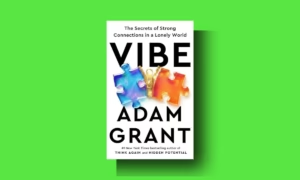
Vibe by Adam Grant is a 2026 book that answers one stubborn question: why do some people click instantly while others stay strangers no matter how hard we try? Its direct answer is that chemistry is not a trait you carry but a ritual you build with someone, and that most of us run the wrong ritual on the wrong "wavelength." The hardcover came out from Viking on October 13, 2026, so it is barely nine days old as I write this.
URL: https://www.sopranu.com/vibe-adam-grant-review-why-chemistry-fails/
Author: Adam Grant
4.5
Pros
- A clear framework (four wavelengths) that explains mismatched relationships
- Memorable true stories, from astronauts to Metallica to Durham
- Practical, low-effort rituals and a 40-item action list
- Honest about limits and about when evidence is thin
- Covers pairs, groups, teams, schools, and families in one book
Cons
- Moves fast, with heavy citation left to endnotes
- Humor and pop culture references can feel excessive
- Mostly U.S. examples
- Little on the first step for people with almost no connections
- Some cited studies are very recent and not yet widely replicated