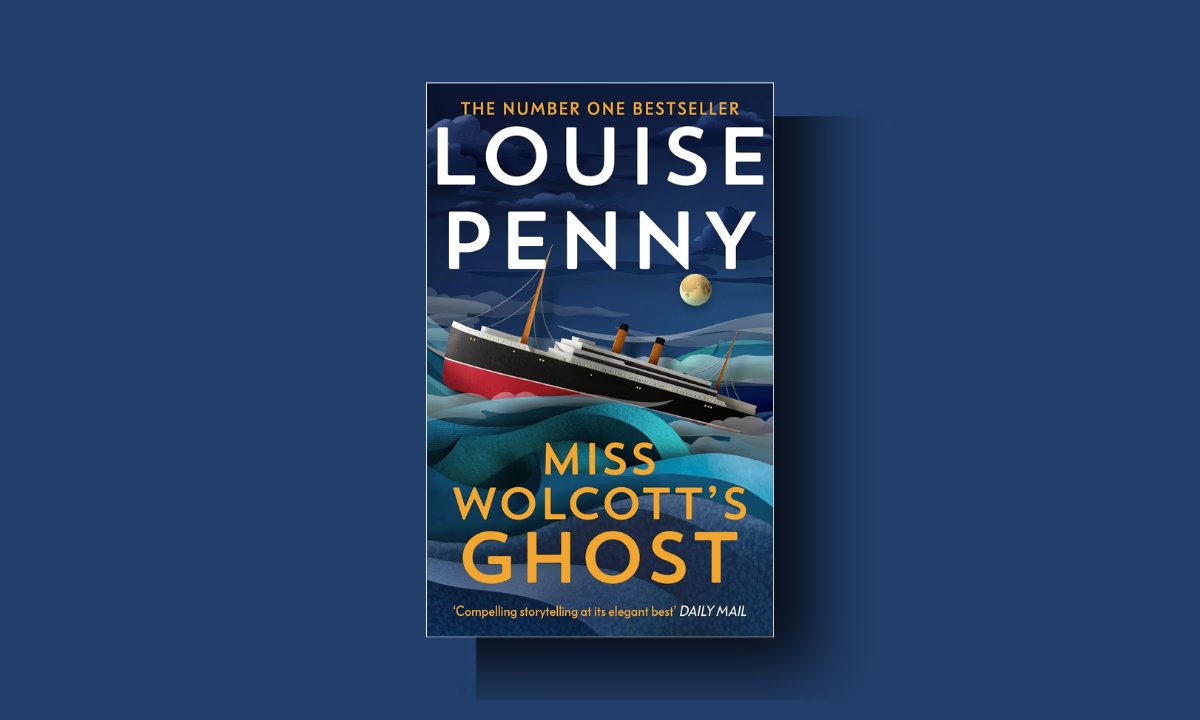
This Miss Wolcott’s Ghost review gives you the answer first. Louise Penny’s 21st Armand Gamache novel is a gripping, tender mystery in which a shipwreck nobody remembers, a Victorian botanist nobody believed and a cemetery nobody can find all lead to one murder in rural Québec.
It came out on October 20, 2026, and I finished it convinced that the ending carries more feeling than any twist in the series so far. The middle runs slack in places, and I will point to where.
At a glance
- Who killed Brian Fillmore? Dr. Aimée Lagacé, the botanist who helps Gamache, killed him with a shovel to steal a dead woman’s research.
- What is the ghost plant? It is Eryngium mnemosyne, named for the Greek Titan of memory. It is not a bioweapon. The research points toward a possible treatment for dementia.
- What does the date on the gravestone mean? May 29, 1914 is the day the Empress of Ireland sank. Wikipedia records 1,012 deaths among 1,477 people on board.
- Where were the documents? Sealed inside a concrete tombstone, not buried under it.
- My rating: 4.5 out of 5.
Quick Verdict
A clever, humane mystery that turns a forgotten disaster and an ugly weed into a story about memory. Recommended for Three Pines regulars and for anyone who likes history woven into crime fiction.
Should You Read It?
Yes, if you enjoy puzzles that stretch across a century. Here is how it balances out.
| Pros | Cons |
|---|---|
| A layered puzzle that joins a shipwreck, a plant and a murder | The middle chapters repeat clues and phone updates |
| Daisy Wolcott’s chapter is among the best things Penny has written | Jean-Guy’s recurring ship nightmares overstay their welcome |
| Shines a light on the Empress of Ireland disaster | The killer is a helper for most of the book, so the case rests on one trap |
| An ending that lands emotionally, not only logically | The Comeau subplot is slow to pay off |
| Warm Three Pines humor and food | Many series references for brand new readers |
What Is It About?
A frightened caller reports a body in a place nobody can find. Chief Inspector Gamache traces it to a forest cemetery, where a corpse in century-old tweed lies on a nameless 1914 grave, wrapped in a plant thought extinct.
The trail runs through a genealogy empire, a crooked salvage official and the long-forgotten sinking of an ocean liner.
Rating
4.5 / 5
Who wrote Miss Wolcott’s Ghost, and where does it sit in the series?
Louise Penny wrote it, and it is book 21 in the Chief Inspector Gamache series. Goodreads lists publication on October 20, 2026 from Minotaur Books, ISBN 9781250412607, and the UK edition is from Hodder & Stoughton.
Page counts vary by source, with BookBrowse giving 400 and Lesa’s Book Critiques giving 407.
What real history sits behind the story?
Three real threads run underneath it. First, Daisy Wolcott is invented, but Penny says in her acknowledgments that the plant and the woman were inspired by Ellen Willmott (1858 to 1934) and the giant sea holly nicknamed Miss Willmott’s Ghost.
Wikipedia notes that the tale of Willmott secretly scattering its seeds in other people’s gardens first appeared in the 1980s and has been debunked.
Second, the Empress of Ireland collided with the Norwegian collier Storstad in fog and sank in about fourteen minutes, which makes it the worst peacetime maritime disaster in Canadian history (Wikipedia).
Third, Penny writes that Lost Nation and its cemetery exist near her home, and that she is working with the Brome County Historical Society to help pay for their upkeep.
What happens in Miss Wolcott’s Ghost?
Part one, the call and the cemetery
At 3:17 on a late June Saturday morning, the phone rings in the Gamache home in Three Pines. A frightened young man says there is a body in Lost Nation, then the line dies. The number is registered to Clara Morrow, the Gamaches’ neighbor.
Armand and his son-in-law and second in command, Jean-Guy Beauvoir, search Clara’s cottage in the dark. A painted-shut trapdoor has been cracked open, and there is pink insulation caught in the attic hatch, so someone has been in both spaces recently. Nobody in the village has heard of Lost Nation. Myrna’s partner says his grandparents called it cursed.
Ruth, who claims to know nothing, points them to Peter Takacs, a chef in Knowlton who loves roaming the hills.
Takacs leads Armand up a slick slope and down the far side to a graveyard the forest has swallowed. On one grave, marked only with the date May 29, 1914, lies a badly decomposed body in an antique tweed suit. Every other stone has a readable name.
A tall grey spiky plant grows through and around the corpse. Coroner Dr. Sharon Harris finds seeds sprouting between the dead man’s ribs and confirms murder, with at least three blows to the head.
A Savile Row label leads to a tailor whose shop was bombed in the Second World War, and no suit has carried that label since.
Part two, the tape and the ghost
Clara’s list of recent visitors narrows to four names, and two cannot be found: Brian Fillmore, a second cousin who stayed one night in March, and Jeanette Bouchard, a self-described artist who came days later. A long March thaw makes the team realize the death may be months more recent than first thought.
Meanwhile, Reine-Marie and a young archivist learn that someone has taken the transcript of a 1967 oral history about Lost Nation.
They find the original cassette. On it, ninety-something Flossy Fuller says the place was once called Pleasant Valley until two itinerant preachers, run out of town, cursed it. Then she mentions a murder, and the tape ends.
The next day Flossy and her young interviewer, Solange Péladeau, died in a fiery car crash. The fuel line was intact, but the detachment commander who closed the file was Solange’s father.
Botanist Aimée Lagacé of the Montréal Botanical Gardens recognizes the plant as Miss Wolcott’s Ghost, a species thought extinct. She tells Daisy’s story. Daisy was the unloved only child of a rich industrialist, taught to love plants by a housemaid, also named Daisy, who left botanical drawings on her bed.
As a grown woman Daisy inherited a fortune, spent it on expeditions, learned remedies from Indigenous healers and was laughed out of the Royal Society of Botanists. She wore her father’s tweed suits and long dresses that hid sacks of seeds, died broke at sixty-five, and saw her papers burned or auctioned.
Her neighbors burned the weedy plant that appeared in their borders and named it after her. Gamache has a specimen planted in his own garden.
Part three, the Empress
Reine-Marie, Myrna and rookie agent Ferdinand each work out what the date means: the sinking of the Empress of Ireland.
Forensic accountant Samantha Eidinger finds that the genealogy company Réunion began with Brian Fillmore’s obsession with the disaster, and that the founder’s website photo is really James Clybourne, grandson of Aldous Clybourne, a mail room steward who survived the sinking.
At Réunion, Beauvoir spots a young man who bolts. It is Gaston Comeau, the former agent Gamache fired after he froze during a raid. Comeau is the midnight caller. He now works as a janitor at Réunion and says the body may be Jeanette’s.
Brian’s brother Charles eventually admits Brian has been missing for months and explains what Brian was chasing. Aldous’s uncle, Thomas Morrow, was the government’s Receiver of Wrecks. After the sinking he had divers bring up the mail instead of the bodies. Brian suspected stolen goods and a second, secret ledger. Clara’s late husband Peter was Thomas Morrow’s great-grandson, so Brian faked a family tree to get into Peter’s home. Jeanette, who worked at Réunion, followed him.
DNA from Brian’s hairbrush confirms he is the body.
Part four, the trail abroad
The Receiver of Wrecks reports that Morrow’s official accounts hold an erased word, “ghost,” and under it the faint marks of “Ghost in Lost Nation.” Judge Morin, afraid of graveyards and reluctant to disturb the dead, grants an exhumation order.
The grave turns out to be empty. In Aix-les-Bains, Gamache finds a 1906 letter from Daisy furiously threatening to take her papers back from a university that dismissed them, with a columbine drawn beside her signature.
In Suffolk he finds her ruined family home, the body of Jeanette Bouchard in the basement after a floor collapse, a ceiling carved with plant names, and the graves of Daisy and her cat Peduncle, both marked with rosemary.
Comeau turns up there, and Gamache keeps him close. Together they break the news to Jeanette’s dying mother, Janice. Back in Montréal, Beauvoir and Lacoste trace Daisy’s collection to Macdonald College. A professor named Russell, denied tenure twice, took her papers aboard the Empress to pass off as his own research.
He drowned. Years later Brian Fillmore gave the college almost a million dollars, and an empty steamer trunk held only a hooked seed. At a Cambridge pub, a botanist wonders aloud whether the plant could be a bioweapon.
Part five, the trap and the tombstone
Gamache’s sudden realization comes at home. A stake meant to prop up the ghost plant in his garden will not go into the soil, and below it he finds Thomas Morrow’s second ledger. He swaps in Morrow’s official ledger and calls Dr. Lagacé to “save” the sagging plant.
She crawls into a tent around it, takes the book and hides it in her satchel. Gamache and Lacoste arrest her. Lagacé claims Brian hired her, she hired Jeanette, Jeanette killed him, and she only hid the ledger.
The lab disagrees. Her prints are on the book and Jeanette’s are not, and the shovel found in Janice Bouchard’s shed carries Lagacé’s prints. Her motive mirrors Professor Russell’s: a stalled career and a dead woman’s research she hoped to claim.
Reine-Marie then gets Solange’s father to hand over a second cassette he kept. Réunion’s restoration lab repairs it, with Comeau’s help. On it, Flossy says she was Thomas Morrow’s cleaner, that Morrow sold stolen goods to the mob, and that he and Aldous Clybourne “made” a headstone to hold what came from the ship.
A mobster they feared killed both men in a cabin fire. Gamache catches the word “made,” checks with the judge and Clara, and concludes the stone is concrete.
On the summer solstice, forensic officers cut it apart in his garden. Inside is a canvas bag tagged with Professor Russell’s name: Daisy Wolcott’s papers.
Part six, the ending explained
In mid-July two professors, Agrawal of Cambridge and Lamontagne of Laval, tell the team the research is not a weapon at all. Daisy recorded medicines, including the periwinkle that decades later became important in cancer research, and nobody listened.
The ghost plant’s true name, Eryngium mnemosyne, points to Mnemosyne, goddess of memory, and the researchers believe it may help with dementia. Lamontagne asks for speed because of her own mother.
In September a jury convicts Lagacé of first-degree murder for killing Brian, but finds her not guilty of conspiring to murder Jeanette. Janice Bouchard collapses in court and dies the next day.
Comeau, who paid for her nurse and held her hand at the end, shakes Gamache’s hand at the funeral. A flashback shows how Beauvoir shot Comeau in the vest to save Armand during the raid. Among Jeanette’s belongings is a hand-bound book of flower drawings like the ones Daisy once received. The ghost plant takes root in gardens across Three Pines.
In the last scene, Jean-Guy dreams of the sinking once more. This time an old woman in a man’s tweed suit, with eyes the color of periwinkle, takes his hand and turns left, toward his family. Loose threads remain: the gangster behind the 1967 deaths is unpunished, though Lacoste opens a new inquiry.
Who are the key characters?
The main figures are Gamache, his team and a ghost from the past. Armand Gamache works as he always does, by listening, and he admits his own early cowardice to cadets.
His decision to give Comeau a second chance sits at the center of Miss Wolcott’s Ghost.
Jean-Guy Beauvoir is steadier than in past novels but haunted, and his nightmares of the sinking show a father afraid of choosing wrong. Isabelle Lacoste voices the doubt readers feel about Comeau. Gaston Comeau is the most complex figure. He lies, snoops and skulks, yet he calls Gamache for help and later cares for a dying stranger, so his arc moves from shame to something close to grace.
Aimée Lagacé is the most skillful piece of misdirection. She arrives as an enthusiastic ally and plays it so warmly that her guilt feels like a betrayal. Daisy Wolcott dominates her single chapter, and her housemaid namesake may be the novel’s quiet hero.
Brian Fillmore, gentle and obsessed, is killed for a hobby. Ruth Zardo keeps her place as the village’s bitter poet, with her “not the favorite child” theme echoing Daisy’s.
What do the themes and symbols mean?
Miss Wolcott’s Ghost‘s core idea is that forgetting is a kind of harm. Several themes carry it.
Forgotten history. Characters repeat the question “How could I not have known?” about the Empress of Ireland. Penny confesses in her acknowledgments that she once claimed to know Lost Nation when she did not.
Overlooked work. Daisy’s findings are dismissed because she is a woman. Professor Russell and Lagacé both try to take a woman’s research for themselves. The housemaid’s drawings, left on a bed, shaped a whole life.
Memory. Rosemary means remembrance in the language of flowers. The plant’s name honors the goddess of memory. The cassette tapes, the missing transcript and the burned “Ohio” tape all hold lost memory.
Fear and courage. Comeau froze, Beauvoir dreams of choosing safety over his family, and Captain Kendall of the Empress is compared to Gamache. The poster on Gamache’s wall, “Noli timere,” means do not be afraid.
What counts as a weed. Reine-Marie asks who decides, and the ugly plant turns out to be a medicine.
The symbols repay attention too. Columbine means folly, periwinkle blue marks Daisy’s ghostly return, and the peduncle, the stem that holds a flower together, names both Daisy’s cat and Jeanette’s.
Is Miss Wolcott’s Ghost worth your time?
My verdict in one line: Miss Wolcott’s Ghost is an audacious, tender and slightly overstuffed mystery that sets a murder inside a century of forgetting, and leaves you quietly checking your own memory.
Strengths
The best parts are Daisy’s chapter, the clever tombstone solution and the dementia reveal, which turns a pulpy plot into something personal. The village comfort scenes are as welcome as ever, and the Empress sections are vivid and moving.
Weaknesses
The center of Miss Wolcott’s Ghost is overstretched. Clues come by phone call and are restated several times, and the Réunion and Comeau sections slow the pace. Beauvoir’s ship nightmares repeat the same beat. Because Lagacé is a friendly helper for so long, readers may feel the case against her depends on one trap.
Impact and controversy
Reviewers have been warm. Lesa’s Book Critiques says it is the first Penny book in six years that she liked as much, and Aunt Agatha‘s calls it a return to form.
Penny’s acknowledgments mention decisions of hers in the past year and a half that were unpopular in some quarters, without naming them, so I cannot say more. Personally, the dementia reveal hit hardest.
Comparison with similar works
For the same blend of family stakes and a big case, try Penny’s own All the Devils Are Here. For an earlier Gamache novel that folds history into a murder, try Bury Your Dead. For the real Empress story, Penny credits Eve Lazarus’s Beneath Dark Waters.
What does Miss Wolcott’s Ghost teach us about forgetting?
The angle that stayed with me is that ignoring a person’s work can cost the world years of cures. In the novel, Daisy’s medicines wait a century for anyone to take them seriously, and the plant that might help the failing memory is the one her neighbors burned. The real numbers make the point sharper.
The World Health Organization reported in 2021 that more than 55 million people live with dementia, with a projected 78 million by 2030 and 139 million by 2050, at a yearly global cost of about $1.3 trillion (Reuters report via KSL).
The Empress adds a second, quieter lesson. More people died on that ship than on many disasters we learn about in school, yet few of us were taught its name.
Five lessons I took from it:
- Write your discoveries so a stranger can follow them. Daisy assumed her plant’s name explained its use, and it nearly cost us the cure.
- Credit the people who taught you. A housemaid’s drawings made a botanist. Name your maids.
- Treat forgotten history as unfinished business. When you ask “How could I not have known?”, go and find out.
- Do not wait for a respected man to bless good work. Do, however, leave records that survive you, as Daisy’s tombstone papers did.
- Look after the carers. Janice Bouchard’s nurse went unpaid until Comeau and Gamache stepped in. Grief bills arrive quietly.
Conclusion
Miss Wolcott’s Ghost earns its length. The puzzle is dense, the heart is real and the final reveal gives a weed a new meaning. I would recommend it to Gamache fans, to readers of historical mysteries, and to anyone who has watched memory fail in a family.
Newcomers can follow it, since the raid is retold in full, though Comeau’s arc lands harder if you know the series. It matters because it asks us to remember the Empress of Ireland, and to listen to the people we usually ignore.
Miss Wolcott's Ghost

This Miss Wolcott's Ghost review gives you the answer first. Louise Penny's 21st Armand Gamache novel is a gripping, tender mystery in which a shipwreck nobody remembers, a Victorian botanist nobody believed and a cemetery nobody can find all lead to one murder in rural Québec.
URL: https://www.sopranu.com/miss-wolcotts-ghost-review-louise-penny/
Author: Louise Penny
4.5
Pros
- Layered puzzle, Daisy Wolcott chapter, Empress of Ireland spotlight, emotional ending, Three Pines warmth
Cons
- Slow middle, repeated nightmare scenes, slow Comeau subplot, killer revealed through one trap, many series references