
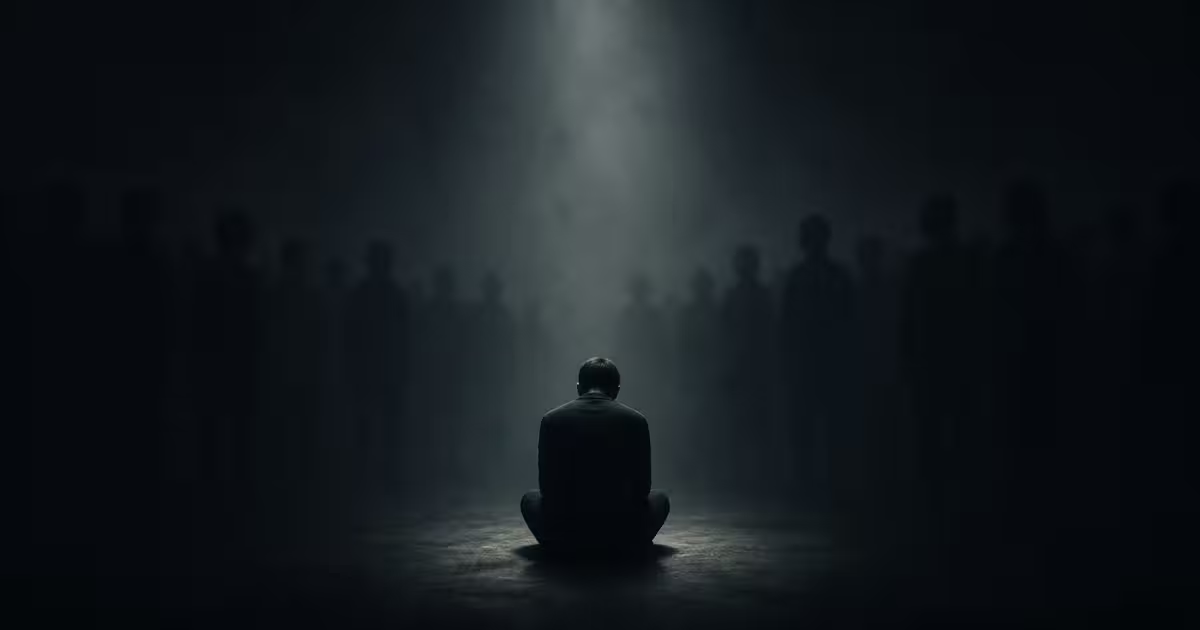

There is a painful question that returns whenever injustice becomes visible: Why do good people stay silent?
Not cruel people. Not people who openly support evil. Not people who enjoy harm. But ordinary, decent, thoughtful people—people who know something is wrong—who still say nothing.
They see a colleague humiliated. They hear a false accusation. They watch corruption become normal. They notice cruelty wrapped in respectable language. Yet they remain quiet.
This silence is often judged harshly, and sometimes rightly so. But philosophy asks us to go deeper. Silence is not always consent, but it can become consent-like when it protects wrongdoing.
Silence is not always cowardice, but it can become cowardice when fear becomes our moral compass.
The real question is not simply, “Why are people silent?” The deeper question is: What happens inside the human soul when conscience speaks, but the mouth refuses to follow?
Table of Contents
The Psychology of Silence: The Bystander Effect
One of the most studied explanations for public silence is the bystander effect. Social psychologists John Darley and Bibb Latané famously studied how people respond to emergencies when they believe others are also present.
Their 1968 research found that people were less likely to intervene quickly when they thought more bystanders were present, a pattern often explained through “diffusion of responsibility.”
Later summaries of this research identify three key mechanisms: diffusion of responsibility, evaluation apprehension, and pluralistic ignorance. In simple terms: people assume someone else will act, fear being judged if they act incorrectly, or interpret everyone else’s silence as evidence that nothing serious is happening.
This matters because silence is rarely born in a vacuum. It is socially contagious. When everyone waits for someone else to speak, silence becomes the room’s dominant language.
A good person may remain silent not because they approve of wrongdoing, but because they are trapped in a shared hesitation:
“If no one else is speaking, maybe I am overreacting.”
That sentence has protected many injustices.
The Fear Beneath Silence
Good people often stay silent because speaking has a cost.
The cost may be social: losing friends, reputation, status, or belonging. It may be professional: losing a job, promotion, opportunity, or institutional protection. It may be emotional: becoming the target of ridicule, anger, or isolation.
Most people do not want to be heroes. They want to survive the day.
This is where moral philosophy becomes uncomfortable. We like to imagine virtue as a stable possession: a good person will simply do the good thing when the moment arrives.
But real moral life is more fragile. A person may value truth and still fear telling it. A person may hate injustice and still dread becoming visible in the fight against it.
Silence often comes from the conflict between two instincts:
the desire to be good and the desire to be safe.
When safety wins too often, conscience begins to negotiate.
Silence and Complicity
Is silence the same as complicity?
Not always. There are cases where silence is strategic, temporary, or forced. A vulnerable person may stay silent because speaking would expose them to serious harm. Someone may remain quiet because they lack evidence, power, or a safe channel to act.
But silence can become morally troubling when it helps wrongdoing continue.
Contemporary philosophical work on complicity increasingly examines how silence may contribute to harmful systems even when the silent person does not directly cause the harm.
A recent paper in Philosophical Studies argues that standard accounts of complicity based only on intentional participation or causal contribution struggle to explain “silence as complicity,” and that philosophy needs a richer account of how silence can morally matter.
This is important. Many people defend their silence by saying, “I did nothing.” But sometimes that is precisely the problem.
There is a difference between being innocent of direct harm and being innocent of moral failure. Not every silent person is guilty. But not every silent person is clean.
Hannah Arendt and the Danger of Thoughtlessness
No reflection on silence, obedience, and moral failure can avoid Hannah Arendt.
Arendt’s controversial phrase “the banality of evil” comes from her book Eichmann in Jerusalem, first published after her reporting on Adolf Eichmann’s trial. The phrase is often misunderstood.
Arendt was not saying evil is trivial. She was examining how terrible evil can be carried out by ordinary people who fail to think critically about what they are doing.
The Internet Encyclopedia of Philosophy describes Arendt as a major twentieth-century political thinker whose work addressed totalitarianism, freedom, judgment, and the faculties of thought.
Her later writings returned to questions of moral judgment, responsibility, and the ability to distinguish right from wrong. Responsibility and Judgment gathers writings from the last decade of her life, including reflections on evil and moral choice after the controversy surrounding Eichmann in Jerusalem.
Arendt helps us see that moral failure is not always dramatic. Sometimes it is administrative. Polite. Procedural. Quiet.
Evil does not always ask people to become monsters. Sometimes it only asks them to stop thinking, stop judging, stop speaking, and keep functioning.
That is why silence can be dangerous. It allows people to preserve a good self-image while participating in a bad order.
The Comfort of Neutrality
Many silent people describe themselves as neutral. They are “not taking sides.” They are “staying out of it.” They are “being practical.”
But neutrality is morally complicated.
When one person is being harmed and another person is doing the harming, neutrality may not be neutral in effect. It may benefit the stronger party. It may leave the vulnerable person isolated. It may allow the aggressor to continue without resistance.
This does not mean every conflict is simple or that every accusation is true. Moral courage also requires judgment, evidence, humility, and restraint. But the language of neutrality can become a hiding place.
Sometimes “I don’t want to get involved” really means:
“I do not want the cost of being morally involved.”
Philosophy asks whether a person can remain good by refusing to act when action is possible. The answer is not always simple. But the question should disturb us.
Why Goodness Alone Is Not Enough
Goodness as intention is not the same as goodness as action.
Many people privately oppose injustice. They feel sympathy. They know who is being mistreated. They may even discuss it quietly with trusted friends. But private disapproval does not always change public reality.
Moral life requires more than correct opinions. It requires courage, timing, judgment, and sometimes sacrifice.
Rushworth M. Kidder’s book Moral Courage defines moral courage as readiness to endure danger for the sake of principle, involving core values, awareness of risk, and willingness to endure hardship.
That definition is useful because it does not romanticize courage. Courage is not the absence of risk. It is action despite risk.
A person who has never risked anything for truth may still be polite, kind, and socially respectable. But moral courage asks for something more demanding:
Are you willing to lose something for what you claim to believe?
The Inner Bargains of Silence
Good people rarely tell themselves, “I am choosing cowardice.”
Instead, they make inner bargains:
“I will speak later.”
“This is not the right time.”
“Someone else knows more.”
“It will not make a difference.”
“I have too much to lose.”
“I should stay calm.”
“I do not want drama.”
“I am being wise, not afraid.”
Some of these reasons may be valid. Not every silence is immoral. Sometimes patience is wise. Sometimes speaking too early can harm the truth. Sometimes the most ethical action is quiet preparation.
But self-deception is subtle. A person can call fear “prudence,” call comfort “peace,” and call silence “maturity.”
The moral danger is not only that we lie to others. It is that we become fluent in lying to ourselves.
When Silence Becomes a Habit
The first silence may feel painful. The second becomes easier. The third becomes part of one’s identity.
This is how moral numbness forms. People do not usually abandon conscience all at once. They train themselves to ignore it. Every time they see wrongdoing and choose comfort over truth, they weaken the muscle of moral response.
Eventually, silence stops feeling like a decision. It becomes personality.
“I’m just not confrontational.”
“I’m not political.”
“I don’t speak on these things.”
“I keep my head down.”
But sometimes what we call temperament is actually a history of avoided responsibility.
Is Speaking Always the Right Thing?
No.
A serious philosophy of speech must also recognize that speech can be reckless, performative, cruel, uninformed, or self-serving. Speaking up is not automatically virtuous. Some people speak not from courage but from vanity.
Some speak without understanding. Some speak to punish rather than to protect.
Moral speech requires more than volume. It requires truthfulness, proportion, timing, and responsibility.
The question is not, “Should I always speak?” The better question is:
What does justice require from me here, given what I know, what I can do, and what harm my silence may permit?
Sometimes the answer is public speech. Sometimes it is private intervention. Sometimes it is documentation, witness, refusal, protection, or solidarity. The opposite of silence is not always noise. Sometimes it is action.
How Good People Can Become Braver
Moral courage can be cultivated. It is not reserved for saints, activists, or historical heroes.
Catherine Sanderson’s work on the bystander effect argues that people can learn to move from passive bystanding toward action by understanding the psychological forces that keep them inactive. Her book The Bystander Effect: The Psychology of Courage and Inaction examines why people behave differently in groups and why good intentions often fail to become real intervention.
The first step is awareness. If we know that humans are prone to diffusion of responsibility, we can resist it.
If we know that fear of judgment silences us, we can name it. If we know that group silence distorts our perception, we can stop treating silence as proof that nothing is wrong.
A simple moral discipline is this:
When something wrong happens, do not ask, “Why is nobody speaking?”
Ask, “What is my responsibility?”
That question breaks the spell.
The Philosophical Core: Silence Reveals What We Worship
At the deepest level, silence reveals our hierarchy of values.
We may say we worship truth, but silence may show that we worship acceptance.
We may say we value justice, but silence may show that we value comfort.
We may say we respect courage, but silence may show that we fear inconvenience.
We may say we are good, but silence may show that we are mostly agreeable.
This does not mean we should condemn every silent person. Human beings are fragile. Fear is real. Power is uneven. Some people pay heavier prices for speech than others.
But it does mean we should be honest. Goodness that never risks itself may be less moral than we imagine.
A society does not collapse only because bad people act. It also collapses when good people learn to watch.
Conclusion: The Silence That Judges Us
Why do good people stay silent?
Because they are afraid. Because they are uncertain. Because they are socially conditioned. Because they diffuse responsibility. Because they want to belong. Because they confuse neutrality with wisdom. Because they hope someone else will carry the moral burden.
But the more difficult truth is this: good people stay silent because goodness is easier as an identity than as a duty.
Silence is not always wrong. But when silence protects injustice, it becomes part of the architecture of harm.
The moral life begins when conscience becomes more than a private feeling. It begins when a person decides that truth deserves a voice, that justice deserves a witness, and that being good must mean more than quietly disapproving of evil.
In the end, the question is not only why good people stay silent.
The question is: When the time comes, will we?
Best Books for This Topic
1. Eichmann in Jerusalem: A Report on the Banality of Evil by Hannah Arendt
Best for understanding how ordinary people can become implicated in evil through obedience, thoughtlessness, and bureaucratic normality. This is the origin of Arendt’s famous “banality of evil” formulation.
2. Responsibility and Judgment by Hannah Arendt
Best for a deeper philosophical treatment of moral judgment, conscience, and responsibility. The book gathers Arendt’s later writings on evil and moral choice.
3. The Bystander Effect: The Psychology of Courage and Inaction by Catherine Sanderson
Best for the psychology of why people fail to intervene, especially in groups. It directly addresses courage, inaction, and the gap between good intentions and action.
4. Moral Courage by Rushworth M. Kidder
Best for practical ethics. Kidder frames moral courage as acting from principle despite risk, hardship, and danger.
5. On Complicity and Compromise by Chiara Lepora and Robert E. Goodin
Best for advanced readers interested in complicity, compromise, and moral responsibility in complex real-world situations. Oxford Academic describes the book as analyzing the varieties and moral dimensions of complicity and compromise.
6. When Conscience Calls: Moral Courage in Times of Confusion and Despair by Kristen Renwick Monroe
Best for studying moral courage through portraits of people who acted under pressure. Oxford’s summary emphasizes how moral courage can emerge from deeply held values that become part of a person’s identity.
FAQ
1. Why do good people remain silent in the face of injustice?
Good people may remain silent because of fear, uncertainty, social pressure, diffusion of responsibility, or concern about consequences. Psychological research on the bystander effect shows that people are often less likely to act when they believe others are present.
2. Is silence the same as complicity?
Not always.
Silence can be forced, strategic, or cautious. But silence can become morally complicit when it helps wrongdoing continue or protects the wrongdoer from accountability.
Recent philosophical work argues that silence can matter morally even when it is not direct participation.
3. What is moral courage?
Moral courage is the willingness to act according to principle despite risk, danger, or hardship. Rushworth M. Kidder describes it as involving core values, awareness of risk, and willingness to endure consequences.
4. What did Hannah Arendt mean by the banality of evil?
Arendt used the phrase in connection with Adolf Eichmann to examine how grave evil can be carried out by ordinary individuals who fail to think critically about their actions.
The point is not that evil is harmless, but that it can appear in ordinary, bureaucratic, and thoughtless forms.
5. How can someone stop being a passive bystander?
A person can begin by recognizing the psychological forces that encourage silence: assuming others will act, fearing judgment, or interpreting group inaction as proof that nothing is wrong.
The practical shift is to ask, “What is my responsibility here?” rather than waiting for someone else to move first.