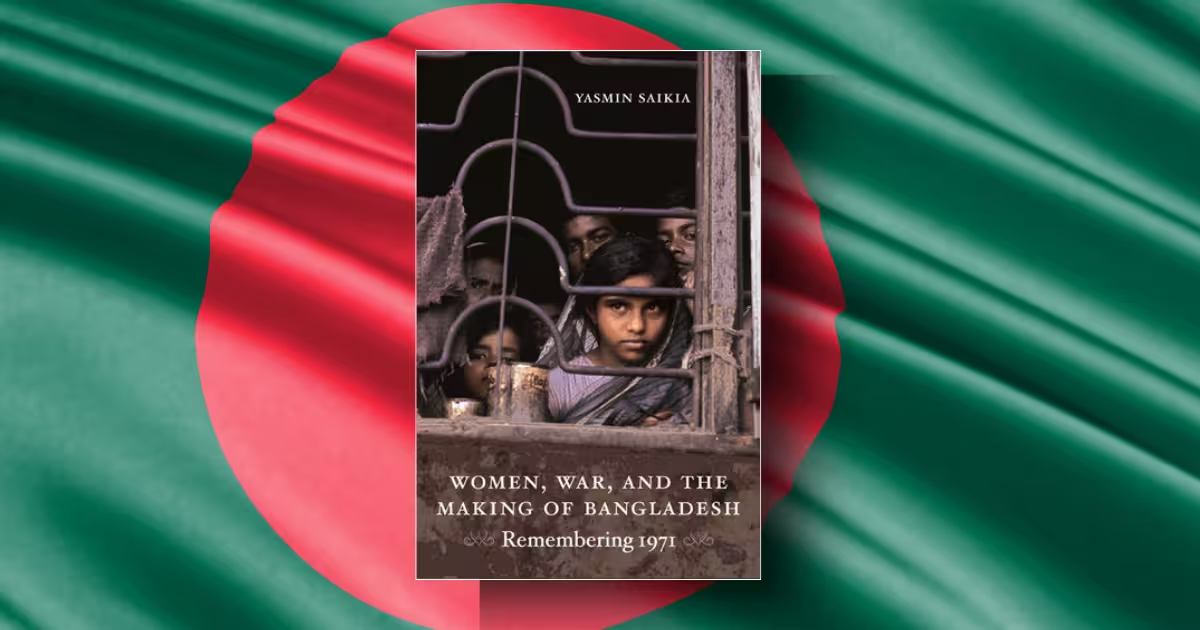
Do you ever wonder why some histories feel incomplete, like entire chapters have been deliberately torn out and burned? Yasmin Saikia’s Women, War, and the Making of Bangladesh: Remembering 1971 answers that question with devastating clarity. This isn’t just another academic book about a war you vaguely remember from a geography class. This is a reckoning.
Overview
Women, War, and the Making of Bangladesh: Remembering 1971 by Yasmin Saikia is a people’s history of the 1971 war that created Bangladesh.
Based on over 200 oral testimonies, it moves beyond official nationalist narratives to reveal the experiences of women who were systematically raped, tortured, and marginalized, both during the war and after liberation.
Saikia documents how the Bangladeshi government’s attempt to honor rape survivors as birangonas (“brave women”) backfired, marking them as social outcasts.
The book also includes the voices of perpetrators, Pakistani soldiers, Bengali fighters, and local militiamen, who confess their crimes and struggle to regain their humanity.
Central to the work is the concept of insaniyat (shared humanity), which Saikia argues offers a path toward reconciliation. Winner of the Oral History Association’s 2013 Book Award, this is essential reading for anyone seeking to understand gender violence, nationalism, and the human cost of war in South Asia.
For whom is this book? If you care about South Asian history, gender studies, oral history methodology, or simply want to understand how ordinary people survive the unthinkable, this book is for you. If you’re looking for a conventional military history with troop movements and battle strategies, you’ll bounce off it hard.
Saikia isn’t interested in generals and politicians. She’s interested in the women who were raped, the children born from that violence, and the men who later admitted their crimes.
Table of Contents
Introduction
Women, War, and the Making of Bangladesh: Remembering 1971 was written by Yasmin Saikia and originally published in India in 2011 by Women Unlimited. It was later published outside South Asia by Duke University Press. The book runs 311 pages and is available in both hardcover and paperback editions.
Context of Women, War, and the Making of Bangladesh
This book sits at the intersection of oral history, gender studies, and South Asian political history. Saikia is the Hardt-Nickachos Chair in Peace Studies and Professor of History at Arizona State University.
She’s also the author of Fragmented Memories: Struggling to be Tai-Ahom in India and numerous articles.
Her academic credentials matter here because she brings both rigorous historical training and a deeply personal connection to the region, she grew up in Assam, which shares a border with Bangladesh.
The book focuses on the 1971 war that led to the creation of Bangladesh.
This wasn’t a simple war. It was simultaneously a civil war between East and West Pakistan, an international war between India and Pakistan, an ethnic war between Bengalis and Biharis, and a gender war against women.
As the H-Net review notes, Saikia’s book “stands out for its people-centered approach as it provides fresh insight into this moment of conflict and violence, which moves beyond the official narratives of events that have been endorsed and promoted by the Pakistani, Indian, and Bangladeshi establishments”.
Purpose of Women, War, and the Making of Bangladesh
The book’s central argument is that official national histories of 1971 have systematically erased the experiences of women and other vulnerable groups. Saikia argues that we need a “people’s history” of 1971, one that privileges oral testimonies over state archives.
She draws on scholarship about the 1947 Partition, the Holocaust, apartheid South Africa, Rwanda, and Darfur to show that the violence against women in 1971 wasn’t unique but followed patterns seen elsewhere.
Background
To understand why this book matters, you need to know what happened in 1971. Between March and December of that year, East Pakistan (now Bangladesh) experienced a cascade of violence.
The Pakistan Army, backed by local militias like Al-Badr and Al-Shams, launched a brutal crackdown on Bengali nationalists. India intervened militarily, supporting the Mukti Bahini (Bengali liberation forces). By December 16, Pakistan had surrendered, and Bangladesh was born.
The official numbers are staggering. Bangladesh claims nearly one million Bengalis were killed, several million rendered homeless, and an estimated 200,000 to 400,000 women raped.
But as Saikia demonstrates, these numbers became abstractions, statistics that obscured the actual human suffering. The Bihari (Urdu-speaking) community, which had supported Pakistan, was also targeted. Over 250,000 Biharis were displaced and many remain stateless in camps to this day.
Women, War, and the Making of Bangladesh Summary
What I Learned from This Book
Let me be direct: reading this book changed how I understand war, nationalism, and what it means to be human. Here’s what I learned, point by point.
1. Official History Is a Tool of Power
Saikia opens with a devastating critique of how India, Pakistan, and Bangladesh have each constructed their own versions of 1971. In Bangladesh, it’s celebrated as the “War of Liberation.” In India, it’s framed as a humanitarian intervention and victory over Pakistan. In Pakistan, the war has been pushed into collective amnesia.
The problem isn’t just that these histories are incomplete. They actively silence certain experiences. As Saikia writes, “The tendency of national histories in Bangladesh, India and Pakistan is to partition the memories of 1971, allowing for blame to be relegated to the ‘other’”. This binary of “us” as good and “them” as evil prevents any genuine understanding of what actually happened.
2. Women Were Dehumanized Twice
The most heartbreaking aspect of Saikia’s research is how women were violated not just during the war but after it ended. The Bangladeshi government, led by Sheikh Mujibur Rahman, attempted to recognize rape survivors by calling them birangonas, a term meaning “brave women”.
In theory, this was supposed to honor their sacrifice. In practice, it marked them for life. As Saikia documents, “The labelling of some women as birangona also marked them, and they were increasingly seen by society as ‘fallen’ or ‘loose’ women. Thus they were reduced to the level of ‘corrupt’ women, equivalent to prostitutes.” Women who were raped became social pariahs.
Many were abandoned by their husbands or families. Others were forced into sex work.
The government also mandated an abortion program to terminate pregnancies resulting from rape. As one doctor, Dr. Syed Ahmed Nurjahan, told Saikia: “On a given day, we terminated more than 200 such cases of unwanted pregnancies. Wherever I looked, I saw pregnant women.”
These abortions were performed not as a choice for women but as a state policy to eliminate “bastard Pakistanis.”
3. The War Had Multiple Layers of Violence
Saikia makes clear that the violence wasn’t just Pakistani soldiers against Bengali civilians. There were four overlapping wars:
- Civil war between East and West Pakistan
- International war between India and Pakistan
- Ethnic war between Bengalis and Biharis
- Gender war against women
This complexity means there were no clear victims and perpetrators. Bengalis killed Biharis. Biharis collaborated with Pakistanis. Mukti Bahini fighters committed violence against their own people. Indian soldiers looted and, in some cases, assaulted women.
One freedom fighter told Saikia: “I did not join the Mukti Bahini to save women. I joined the liberation war to save my country.” When she reminded him that women were part of the country, he replied: “This is not a subject of history.”
4. The Testimonies Are Unforgettable
Part II of the book presents verbatim testimonies from ten women. These aren’t sanitized, academic accounts. They’re raw, painful, and often fragmented, because that’s how trauma works.
Consider Beauty, a “war baby” born from rape. Her mother, Nur Begum, was held in a camp where she was repeatedly raped. Beauty told Saikia: “I don’t have a human life, even though I may look human.” She was abandoned by her husband when he discovered her origins. She was mocked as the “daughter of a prostitute.” She told Saikie she had considered suicide.
Or consider Firdousi Priyabhasani, who was gang-raped by Pakistani officers. She survived and later testified publicly, but her family considered her “number one prostitute in Bangladesh.” She wasn’t allowed to attend weddings because she was considered inauspicious.
Or consider the Bihari women in Khulna. One woman, Nurjahan Begum, watched as her pregnant daughter was slaughtered with a sickle. The attackers tore open her stomach and killed the unborn child. “What had my daughter done to them?” Nurjahan asked. “She was innocent, like all other women in this country. Women are treated like cattle.”
5. Perpetrators Also Have Stories
Part III of the book is perhaps the most controversial. Saikia includes testimonies from men who committed violence, Pakistani soldiers, Bengali fighters, and local militiamen. She doesn’t excuse their actions. But she argues that listening to them is necessary to understand how ordinary people become perpetrators.
One soldier, Mohammad, described a battle scene: “I looked around, I saw the whole place was strewn with body parts. There were decapitated bodies, heads without bodies, dismembered arms and legs littered all over the place. Dogs were roaming about, dogs without any hair on them.
They were feeding on human beings. I thought, ‘He was a human being like me. Is this what a human being does to another human being?’”
Another soldier, Malik, admitted he had stood guard while his officers raped women. “I knew why they had gone inside the house; they went there to rape the women. But I could not stop them. I was a sepoy. It was not my place to disobey the commands of my officers.” Yet Malik also said: “My conscience would not let me commit such a crime.” He drew a line between following orders and committing rape.
6. The Concept of Insaniyat
Throughout the book, survivors repeatedly invoke the concept of insaniyat, a shared sense of humanity. It’s a word that appears in Urdu, Hindi, and Bengali, loosely translating to “humanity” or “humaneness.” Saikia argues that this concept offers a way forward.
As one Bihari woman told her: “In the war men victimised women. It was a year of anarchy. Insaniyat had died.”
Saikia draws on the Islamic concept of huquq al-ibad (rights of humans) to suggest that individual perpetrators must seek forgiveness from their victims. This isn’t about state amnesty or collective apology. It’s about personal responsibility. As she writes, “No one can absolve the perpetrator of the crime of rape except the victim.”
Women, War, and the Making of Bangladesh Analysis
This is an important book. Not groundbreaking in the sense of being flashy, it’s grounded, meticulous, and deeply humane. Saikia lets her subjects speak, and their voices carry the weight.
The Oral History Association clearly agreed, awarding it their 2013 Book Award. The citation praised it as “model community studies that counter nationalist and official histories”.
The book’s greatest strength is its refusal to take sides in the nationalist narratives. Saikia doesn’t demonize Pakistanis, heroize Bengalis, or whitewash Indians. She shows that violence was committed by everyone, and that everyone was affected.
Saikia conducted over 100 interviews with women in Bangladesh and over 100 interviews with military personnel in Pakistan. She also searched archives across Bangladesh, finding valuable documents in unexpected places like the Women’s Welfare Department in Sylhet. Her methodology, combining oral history with archival research, is rigorous.
That said, the bibliography lacks references to local archives, which some reviewers have noted. This is a minor weakness in an otherwise well-documented work.
Strengths and Weaknesses
Strengths
People-centered approach: Saikia moves beyond high politics to focus on individual experiences.
Inclusion of marginalized voices: She doesn’t just document Bengali women. She also includes testimonies from Bihari women, who are usually erased from the narrative.
Ethical framework: The concept of insaniyat offers a genuine way forward, not just academic criticism.
Clear writing: The book is readable despite its heavy subject matter.
Weaknesses
Limited archival documentation: Some reviewers have noted the absence of local archive references.
Potentially controversial: The inclusion of perpetrators’ testimonies may be uncomfortable for some readers. Saikia is careful not to excuse their actions, but the very act of listening to them can feel like giving them a platform.
Dense theoretical sections: Part I, which engages with Holocaust studies and partition scholarship, can be heavy going for general readers.
Comparison with Similar Works
Saikia’s book fits alongside other revisionist works on South Asian violence. It draws inspiration from scholarship on the 1947 Partition, which has done “a masterful job of weaving the story of violence into our understanding of the historical events of independence and partition”.
It also resembles oral histories of other genocides and mass violence, the Holocaust, Rwanda, Darfur. But Saikia’s use of insaniyat as a cultural framework distinguishes it from Western human rights discourse.
For a fictionalized account of the same period, Tahmima Anam’s novel A Golden Age covers similar ground. But where Anam creates a narrative, Saikia presents raw testimony.
And, while Susan Brownmiller’s Against Our Will broke new ground by framing rape as a systemic tool of patriarchal control and documented the mass rapes in Bangladesh as part of a global history of wartime sexual violence, Saikia’s work moves beyond the macro-analysis to give the survivors themselves a voice, allowing their fragmented, raw testimonies to form the core of the narrative rather than serving as evidence for a broader thesis.
Conclusion
If you’re a student of South Asian history, gender studies, or peace studies, this book is essential. If you’re a general reader who wants to understand how ordinary people survive extraordinary violence, it’s also for you.
But be warned: this isn’t comfortable reading. The testimonies will stay with you. You’ll think about Beauty, who asked: “Why are children like me born?” You’ll think about Nurjahan, who watched her daughter slaughtered. You’ll think about the Pakistani soldiers who later struggled to regain their humanity.
Saikia ends the book with a question: “Can we dare to write from within the abyss of violence a people’s history of the subcontinent and make it a site for understanding and claiming human dignity that is our due?” Her book is an answer, an imperfect, painful, but necessary one.