
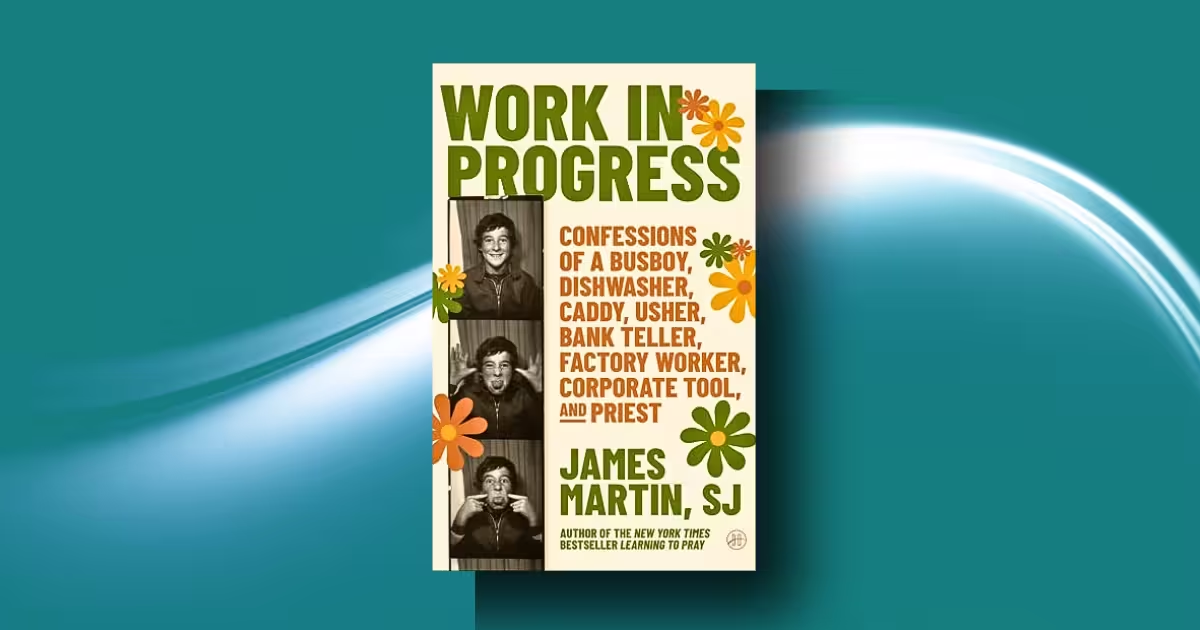

Ever wonder why you can’t shake the memory of that awful summer job—the rude customers, the broken machines, the paycheck that barely covered gas money? Did you think those humiliating moments were just something to survive? James Martin’s Work in Progress will make you rethink every shift you ever punched, every uniform you ever hated, and every tip you ever earned.
Work in Progress is best for anyone who’s ever worked a minimum wage job and wondered if it meant anything. Gen Z readers drowning in unpaid internships. Millennials who survived the gig economy and came out scarred. Boomers who remember when “working papers” were a rite of passage. Parents trying to explain to their teenagers why work matters.
Not for: Readers who prefer their memoirs strictly chronological and tidy. Anyone allergic to self-reflection. People who think a book about summer jobs shouldn’t make you cry on page 185. Those who believe business school is only for future hedge fund managers.
Table of Contents
I. Introduction
Let me be honest: I almost didn’t read this book.
Not because I doubted James Martin—the Jesuit priest, America magazine editor, and unlikely Catholic celebrity who’s somehow become a bridge between the Vatican and LGBTQ Catholics, between Stephen Colbert’s couch and my grandmother’s parish bulletin.
I’ve read his work for years. Jesus: A Pilgrimage sat on my nightstand during a particularly dark Lent. Learning to Pray taught me that contemplation isn’t just for Trappists.
Work in Progress isn’t a book about how summer jobs build character. It’s a book about how they reveal character—yours, and everyone else’s.
It’s about the people who taught you how to work, the people who made you want to quit, and the quiet ways grace shows up in the least likely places: a dumpster behind an ice cream parlor, a thunderstorm on a golf course, a conveyor belt spitting out sleeping pills, the exact moment you realize your $20,000 starting salary isn’t worth your soul.
Martin began keeping a journal in 1976, the summer he turned fifteen and got his first “real job” at the Ice Cream Inn in Plymouth Meeting, Pennsylvania. He filled two composition books that year, recording everything in ALL CAPS with multiple exclamation points.
Those journals—rediscovered after his father’s death, when his mother finally moved out of the family home—form the backbone of this memoir. He writes: “It was surprisingly moving to read the entries in preparation for this book, akin to meeting my fifteen-year-old self again, who was given to expressing strong opinions about almost everything, RECORDING IMPORTANT EVENTS IN ALL CAPS and using lots of exclamation points!!!” (p. 12, Work in Progress).
What emerges isn’t a linear success story.
It’s a mosaic. A Bicentennial Wagon Train that nearly costs him his job. A paper route where no one actually subscribes. A lawn-mowing business thwarted by wasps the size of basketballs.
A caddying career spent dodging lightning and angry golfers. A movie theater uniform so hideous it defies description. An assembly line where workers throw rulers into machines just to get a break. A bank teller position that teaches him how to count cash and handle bank robbers. A stockbrokerage that smells like money. A corporate job at GE that smells like compromise.
And then, Thomas Merton. An eight-day silent retreat. A question from a therapist: “What would you do if you could do anything you wanted to do?”
The answer, it turns out, was there all along—buried under decades of shoulds and ought-tos, hidden in plain sight like the meadow he biked through on his way to elementary school, where he once stopped, surrounded by Queen Anne’s lace and black-eyed Susans and grasshoppers, and felt something he couldn’t name.
Work in Progress is the story of how he finally learned to name it.
II. Background: The World That Made Jimmy Martin
To understand Work in Progress, you need to understand 1970s suburban Philadelphia—and not the way it’s usually remembered.
This isn’t American Graffiti or Dazed and Confused. This is Plymouth Meeting, Pennsylvania, population something-or-other, home to the Friends Meetinghouse where George Washington’s horse supposedly stayed during the Revolutionary War (the general himself stayed at what Martin calls “the somewhat less historic George Washington Motor Lodge”).
The Bicentennial was inescapable. Martin’s high school mascot was the Colonial. Students declaimed sixty-second snippets of American history over the loudspeaker every morning. A local acting troupe performed supposedly hilarious skits at assemblies; when an actor shouted, “Would you rather be here or in class?” one brave kid yelled, “In CLASS!” and received thunderous applause.
Into this world stepped fifteen-year-old James Martin, newly equipped with Pennsylvania state working papers (he’d had to undergo a physical exam, which he considered “excessive”). His starting wage: $2.30 an hour. His uniform: a white short-sleeved polyester smock with round metal buttons, worn over faded flared jeans and Adidas sneakers.
His primary responsibility: bussing tables and washing dishes. His secondary responsibility: consuming enough rum raisin ice cream to develop a permanent aversion to the stuff.
“Gradually, though, after consuming endless quantities of rum raisin, and also washing the huge plastic storage tubs and rinsing out half-eaten bowls of the sticky-sweet concoction, I’d had my fill. By August it turned my stomach. Today I can’t stand either the taste or the smell of rum raisin ice cream.” (p. 11, Work in Progress)
This is the voice that carries Work in Progress—not the measured, pastoral tone of Father Martin, SJ, but the voice of Jimmy, the fifteen-year-old who desperately wanted the older kids to think he was cool, who worried constantly about messing up, who kept his first paycheck envelopes in a dresser drawer for years as evidence of juvenile accomplishment.
He doesn’t need to say more. The book itself is the argument.
III. Work in Progress Book Summary
Chapter 1: How the Bicentennial Wagon Train Almost Got Me Fired (Summer 1976, Age 15)
The Ice Cream Inn, Plymouth Meeting’s beloved family-owned restaurant, is packed on the day the Bicentennial Wagon Train passes through town. Every customer, mid-meal, bolts outside to watch the Conestoga wagons roll down Ridge Pike.
Martin, diligently bussing tables, clears every single one—dishes, half-eaten burgers, melting sundaes, everything. When the customers return and find their food gone, chaos ensues.
“At a loss, I reached into the tray in the sink and pulled out what I imagined was his sundae. Out it came. And I remember this as clearly as anything from that summer: sticking out of a modest scoop of our famous homemade vanilla ice cream, still in its frosty little silver cup, where a cherry might be, was a wet cigarette butt.” (p. 19, Work in Progress)
A customer jams his finger into Martin’s stained smock and demands the meal be deducted from his paycheck. George, the patient assistant manager, smooths things over. But the moment stays with Martin for decades. “I thought: When I grow up, I will never treat anyone like this. Today I couldn’t imagine berating a fifteen-year-old dishwasher, or frankly a fifteen-year-old anyone or any sort of laborer. In an instant, I learned not to mistreat someone who has less power than me. My busboy humiliation was as effective a lesson against being mean or cruel or insensitive as a year’s worth of homilies.” (p. 20, Work in Progress)
His father picks him up at midnight. On the ride home, Martin explains what happened. His father sympathizes and says something he would repeat often: “Work isn’t supposed to be fun. Why do you think they call it work? If it were fun, they’d call it play.”
Decades later, Martin’s sister submitted that quote to a whiskey manufacturer’s nationwide contest inviting readers to share life lessons from their fathers. It made the full-page ad in The New York Times and The Wall Street Journal.
She framed it and gave it to him for his birthday. “It hung in our recreation room until he died twenty-five years later.” (p. 21, Work in Progress)
Chapter 2: How Not to Be a Shiftless Troublemaker (Ages 13–14)
Martin’s actual first job: delivering The Conshohocken Recorder and The Weekly Advertiser, two minuscule tabloids that operated on a business model he describes as “door-to-door begging.” No one subscribed. Papers simply appeared on doorsteps, and carriers were expected to collect payment—voluntary payment—from households that hadn’t asked for anything.
“My income was whatever I could collect, less the cost of the papers and rubber bands, which I paid the publisher. Sometimes my neighbors gave me nothing except a cold stare.” (p. 36, Work in Progress)
The job required rolling several hundred papers in the garage (rubber bands snapped and “stung your fingers like wasps”), jamming them into a fifty-pound canvas sack, and cycling through the neighborhood on his blue Schwinn Speedster.
He was chased by German shepherds. He was attacked by a golden retriever that took a bite out of his yellow windbreaker. He was lectured about his poor aim. He was told, repeatedly, that the experience was “building character.”
“When I told my father that I would say ‘sorry’ to the homeowners, he said, ‘What are you apologizing for? You haven’t done anything wrong.’ I was forever apologizing for things I hadn’t done, just to avoid conflict. I didn’t want to offend anyone or cause conflict. Even then, at thirteen, I wanted everyone to like me.” (p. 40, Work in Progress)
The chapter is interwoven with rich cultural history: the 1974 energy crisis that made daylight saving time permanent (meaning Martin collected payments in pitch darkness), the Sesame Day Camp where he made gimp lanyards by the dozen, the Cub Scout meetings where he created papier-mâché pumpkins and an ashtray featuring his own face (which his parents used for decades to stub out their cigarettes).
It’s also where we meet his family—his Sicilian grandmother who emigrated on the RMS Carpathia (the ship that would rescue Titanic survivors the following year), his mother who spoke French and taught him to appreciate good food, his father whose long business trips to India and Pakistan left the family both lonely and surrounded by exotic wooden carvings.
Chapter 3: How Poltergeists, Aliens, and Bigfoot Prevented Me from Getting Rich (Summer 1975, Age 14)
Martin’s attempt to launch a lawn-mowing empire, complete with a hand-drawn crest featuring a lawn mower and crossed rakes.
His first client: Mrs. Burke, a few doors down. His equipment: the family’s big red Toro, which he loved starting because it made him feel like an adult. His primary obstacle: wasps.
“When something buzzed angrily past my ear, I realized what it was: a nest of paper wasps the size of a basketball. Suddenly I noticed many more wasps flying in and out and around the huge, now seemingly malevolent, nest. In response, I did something I often did. I froze with panic: frightened, confused, and embarrassed.” (p. 62, Work in Progress)
He mows around the nest, ducking and holding his breath.
Later, at another house, he accidentally bangs the mower against a shed and dislodges a wasps’ nest hidden under the eaves. “Out they poured: an angry, living, evil cloud. Stung on my hand! On my back! On my face! As I flailed about, the lawn mower still rumbling, I said what every American teenager would say at that moment: ‘F—K!'” (p. 67, Work in Progress)
His mother applies ice to his rapidly swelling eye.
His lawn-mowing business fades into desultory occasional work. He spends the rest of the summer reading Brad Steiger’s books about poltergeists, vardogr (ghosts that enter rooms before you do), and Bigfoot.
He also reads Jean Shepherd’s Wanda Hickey’s Night of Golden Memories and develops a lifelong appreciation for humorous memoir—a genre he would eventually inhabit himself.
The chapter’s most quietly profound moment comes earlier, in a meadow near his elementary school:
“Suddenly I felt a strange sensation: a profound happiness coupled with a desire to stay in that meadow forever, to understand the source of this beauty, to know what was happening—to possess it all somehow. It was an odd experience that I didn’t understand. But it seemed to point me to something else, something more, something beautiful, though at the time I had little understanding of what that meant. I just knew that I wanted to stay where I was.” (p. 59, Work in Progress)
Fifty years later, he returns to that spot.
The meadow is gone, replaced by houses. But the diagonal, rutted path he took as a child is still there, carved into the ground by thousands of bike wheels and sneakers. “In a flash, the memory of that morning came back to me, and on that chilly day it was suddenly spring again.”
Chapter 4: How to Avoid Getting Struck by Lightning When Standing Next to a Bag of Metal Poles (Summer 1977, Age 16)
After a winter of complaining about the Ice Cream Inn, Martin decides he wants to work outside.
His mother suggests calling his cousin Tommy, an assistant golf pro at the Philadelphia Cricket Club—an august institution founded in 1854, “the nation’s oldest country club,” and Martin’s first encounter with serious wealth.
“The course was immaculately kept, with rolling hills and magnificent trees, and, well, you probably know what a golf course looks like. This would be one of the most enjoyable parts of the job: simply being there, walking on the soft green grass, admiring the majestic trees, and catching sight of an interesting bird. At night, I’d try to identify them in my Roger Tory Peterson guidebook.” (p. 80, Work in Progress)
There’s just one problem: Martin knows nothing about golf.
Tommy teaches him the basics—how to carry a bag over your right shoulder, pushed behind you so it doesn’t drag; how to retrieve balls from water hazards; where to stand when a golfer is putting. (“‘Look at either his belly button or his ass.’ Meaning, stand either directly in front of him or behind him.”) But Martin never shakes the feeling that he doesn’t belong. The other caddies talk about their handicaps and prep school golf teams.
Martin doesn’t own clubs. When they invite him to play on Caddy Day, he makes excuses.
Then there are the golfers themselves. Some are gracious. Others are, to put it mildly, not.
“He missed ten times (I was counting silently and I’m sure he knew it), his face reddening with each miss. I grew embarrassed for him, remembering how it felt to strike out in Little League. I tried to look nonchalant, but one of the problems for a caddy is that you can’t pretend not to see how poorly your golfer is doing. You’re supposed to be paying attention.” (p. 94, Work in Progress)
This particular golfer, after missing ten putts, asks for his driver—a cardinal sin on a green—tees up his ball, smacks it into a ravine, snaps his putter over his knee, hurls the pieces into the abyss, and then, for good measure, picks up his entire bag and throws it into the ravine too.
Then he turns to Martin and says, “We’re done.”
“Too astonished to respond, I followed him across the course, bagless, drawing stares from the other golfers and caddies. When we reached the clubhouse, he gave me a twenty-dollar bill and said, ‘I’m sorry for that, but I couldn’t take anymore. I’m done with this.'” (p. 95, Work in Progress)
The lightning storm arrives on a later shift. Martin, standing under a tall maple tree with a bag full of metal rods and a steel wand sticking out, suddenly realizes his position. He runs for shelter. The golfer is furious. Martin survives.
Forty years later, he returns to the Cricket Club. The caddy shack is now a storage room.
The course has fewer trees. Chip, the golf pro, remembers riding his bike to work at 6:30 a.m. Martin asks if he knew Tommy or Ricky. Chip remembers neither. “But I was glad to be there.”
Chapter 5: How to Pop Corn for Ten Hours and Not Lose Your Mind (Summer 1978, Age 17)
The summer after high school graduation, Martin lands a job at the Cinema on the Mall—the same theater where he’d seen Jaws and Star Wars, where his family had shopped at Strawbridge & Clothier on Clover Day, where the massive outdoor Christmas tree was visible from his sister’s bedroom window on cold December nights.
His uniform: white polyester button-down shirt, black polyester pants, too-tight pointy black dress shoes, an electric blue polyester blazer that “smelled like it had been dipped in popcorn butter,” and a clip-on bow tie “the size of an oversize butterfly.”
His primary responsibility: popcorn.
“The biggest fiction of the Cinema on the Mall (besides the one about cats from outer space) was that our popcorn was ‘Freshly Popped!’ as advertised in big yellow letters on a glass case at the candy counter. One could argue that at some point in history it was freshly popped, but by the time it was dumped into the display case, it was anything but. ‘Popped Last Month!’ wouldn’t have garnered many sales.” (p. 124, Work in Progress)
Popping corn occupies entire ten-hour shifts in a small, windowless room on the second floor.
The process involves fifty-pound sacks of kernels, industrial quantities of “butter” (a “disgusting mixture of various animal fats”), and a potent orange powder called Savarol that gives movie theater popcorn its distinctive taste. Martin reads the labels once. He never eats movie theater popcorn again.
“In an hour you were coated with orange salt and grease. Sometimes fellow ushers on their breaks would pop their heads in, ask after my welfare, and say, without fail, ‘God, I f—ing hate popping corn.'” (p. 125, Work in Progress)
The only solace: a transistor radio. That summer, the airwaves belong to Gerry Rafferty’s “Baker Street,” which Martin sings over and over, leaning on the lyric “But you’re cryin’, youuuu’re cryin’ now.”
“I had no idea what Gerry Rafferty was crying about, but being stuck popping corn for ten hours in an airless room seemed a good enough reason.”
The chapter also introduces Stanley, a developmentally disabled co-worker who was “really good at collecting tickets, but that was about it.”
Martin is never mean to Stanley, but he doesn’t go out of his way to engage him either. “I was more focused on earning people’s approval, especially the other ushers and candy girls, and talking with Stanley did not increase your social standing.” (p. 120, Work in Progress)
Decades later, reflecting on this, Martin writes: “With Stanley, I just didn’t bother. And I should have.” (p. 121, Work in Progress)
Chapter 6: How to Be a Man and Not a Mouse (Summer 1979, Age 18)
The summer of three jobs—and the first summer Martin spends as a University of Pennsylvania student.
Freshman year at Wharton has transformed him: he’s learned to dress preppy (“no unnatural fibers and no colors not found in nature”), developed a taste for beer, and discovered the joys of smoking marijuana. He’s also “killed the pope.”
The latter requires explanation. In September 1978, a few weeks into his freshman year, Martin is at a bar called Doc Watson’s, drinking with friends, when the conversation turns to Catholicism. “My conscience submerged in beer, I started to tell jokes about Jesus.”
Later that night, a hallmate bursts into his room: “Martin! The pope died!” Pope John Paul I, elected only thirty-three days earlier, has died of an apparent heart attack. Martin’s friends, still drunk, immediately connect the dots. “Martin, you killed him!”
“Deep down, though, I felt awful about it, like when a friend finds out that you have been making fun of him, and it’s true but you don’t want to cop to it.” (p. 136, Work in Progress)
His friends never let him forget it. Ten years later, when Martin tells them he’s joining the Jesuits, Andy immediately asks, “Do they know you killed the pope?” In 2019, when Martin meets Pope Francis, Andy sends a text: “Did you tell him you killed that other pope?”
“My college friends keep me humble and enjoy reminding me that I wasn’t always a Jesuit priest.”
The three jobs that summer: returning to the Cinema on the Mall, waiting tables at the Bakers Garden (a chain restaurant with rattan chairs and macrame hangings), and working the assembly line at Sharp Services, a packaging plant in Conshohocken that specialized in “blister packs” for pharmaceuticals.
The factory job is the most memorable—and the most grueling.
“You started your day positioned next to one of the massive packing machines that disgorged hundreds of boxes of pills an hour. Sometimes you would be assigned to the blister pack station. In that case, you first had to check the tub of pills that the manufacturer had sent to see if any were broken or damaged. (One morning’s highlight was someone finding a fly in one: ‘Hahaha! What do you think this cures?’)” (p. 143, Work in Progress)
Martin stands in front of a conveyor belt for hours, watching small boxes whiz by with alarming speed, straightening them, adjusting them, removing any that don’t have their quota of pills inside.
The work is so monotonous that workers routinely faint from staring too long. The solution: throw a ruler into the machine.
“Everyone would feign surprise. ‘Our machine is down again!’ someone would say. Then they’d all stand back from their stations and relax, perch on a stool, or lean against the wall and start chatting.” (p. 150, Work in Progress)
One day, a woman shouts from the top of the line: “Jimmyyyy! Fix the machiiine!” Martin protests—he almost lost a finger last time. She shoots back: “Jimmy! Is you a man? Or is you a MOUSE?”
“Eager to prove that I was not a mouse, I reached into the guts of the machine and shifted a cog, losing only a little piece of my finger. The machine loudly snapped back into place.” (p. 151, Work in Progress)
“Jimmy, today you is a MAN!” she says, and claps.
The chapter’s most devastating moment comes later, on the Unisom line. Martin is standing next to a woman in her late sixties, taciturn, with wisps of gray-blond hair escaping her hairnet. He notices a tattoo on her forearm—a series of faded numbers.
“‘Oh,’ I said, pointing to her arm. ‘What’s that mean?’
‘Dachau,’ she said.
I didn’t know what to say. As we stood over the conveyor belt, the machine whirring and clicking, I tried to imagine her life. For the next few hours, I felt a combination of pity, sadness, confusion, and discomfort, but mostly embarrassment over not knowing what to say.” (p. 148, Work in Progress)
He never mentions it again. Neither does she.
Chapter 7: How Not to Sacrifice Your Life for a Summer Job (Summer 1980, Age 19)
After two summers of manual labor, Martin decides it’s time for white-collar work.
He applies to Western Savings Bank and is accepted into teller training—a week-long program that teaches him to count cash at lightning speed (the ingenious method: mentally remove the zeros, count the reduced numbers, add the zeros back), balance his drawer to the penny, and handle bank robberies.
“This was a new wrinkle for my summer jobs. There weren’t many robberies at the Ice Cream Inn or the Cinema on the Mall, except for my own: stealing a spoonful of rum raisin ice cream from the storeroom or a few Good & Plentys from the candy display case, with the candy girls’ collusion.” (p. 158, Work in Progress)
The training covers “exploding 20s”—dye packs that burst purple ink when activated by a sensor at the bank entrance.
Martin learns about the robber who stripped off his purple-stained clothes and ran down Market Street in his underwear.
He hears about the addled miscreant who demanded $100 bills and, when told there were none, waited patiently while the teller “checked in back” and the police arrived.
His mentor at the Western Savings Bank branch is Ethel, a middle-aged woman with curly gray hair who greets the morning by sighing and asking, “Is it Friday yet?” On Friday, she asks, “Is it five o’clock yet?” At five o’clock, she sighs and says, “It’s almost Monday!”
“She did this every week, and it drove a few people crazy. I found it hilarious.” (p. 162, Work in Progress)
When a customer berates Martin for counting too slowly, Ethel calmly walks over and says, “Jim, remember for big deposits like that, you should count it at least three times.” The customer’s face blanches. She’s making it up. “And do it slowly,” she adds, smiling at him.
The summer is also notable for two events: a disastrous trip to Six Flags Great Adventure that leaves Martin falling asleep at his teller window, and a birthday celebration so debauched it requires a sequel the following night.
The Great Adventure episode: Martin stays up until 4 a.m., drinks beer, smokes pot, rides a roller coaster that goes “BACKWARDS!”, and arrives at work two hours later feeling surprisingly alert. “Wow! I feel fine! I stayed up all night and feel great!” At lunch, he devours a cheesesteak. Then:
“Suddenly an enormous torpor overwhelmed me, like an ocean wave. I rested my chin on my hands, wanting nothing more than to sleep. The next thing I heard was ‘Sir! Sir!’
I awoke with a start and saw long lines of customers at each of the other three windows, but only one man at mine. Apparently, I had fallen asleep so soundly that one after another customer stopped by my window and fruitlessly tried to wake me, gave up, and then sought service from the other tellers. I had been asleep for ten minutes.” (p. 166, Work in Progress)
“Nope!” says Ethel, laughing. “I’m not tired at all!”
The birthday celebration: Martin, John, Gordon, and Greg drive to New Jersey (drinking age: nineteen), purchase a case of Foster’s at Roger Wilco, visit a strip club, down rounds of kamikazes, drive back across the Walt Whitman Bridge, eat pancakes, go bowling, smoke pot in John’s Opel, and—when nature calls—find a new housing development under construction and urinate in the concrete foundations. “We’re the first people to use their bathrooms!”
The next day, Martin’s mother has bought his favorite birthday cake: vanilla with vanilla icing and blue roses. He’s so nauseated he can’t eat it. His parents are furious. His friend Bob calls, hears the story, and insists on a repeat performance. Martin goes.
“I share this story for a few reasons: It’s outlandish, it represents what teenage boys considered fun in the 1980s, it’s memorable for me, and it’s one of the stories I tell when people ask me, ‘Did you live a real life before you entered the Jesuits?'” (p. 172, Work in Progress)
“I also include this story because it shows that people are complex and can change and grow.”
Chapter 8: How I Became a (Sort of) Stockbroker and, Then, an Adult (Summer 1981, Age 20)
Junior year at Wharton, and the conveyor belt is moving fast. Penn’s Career Planning and Placement office makes finding summer internships absurdly easy: students slide résumés into wooden slots labeled with company names; if the company is interested, an interview materializes “as if by magic.”
Martin lands at The Pennsylvania Group, a discount stockbrokerage in Bala Cynwyd. His first white-collar job.
No more manual labor. No more uniforms.
He wears a suit and tie. He drives the Gran Torino to work. He eats cheesesteaks at Mama’s. He learns the difference between commercial banks and investment banks—a distinction that will haunt him during a notorious “high-pressure” interview with Salomon Brothers.
“The first interviewer was tall, blond, and immaculately dressed and asked, after dispensing with a few awkward pleasantries, where else I was interviewing. I offered a generic answer: other investment banks. I named a few and he nodded noncommittally. Also, I added, ‘First Pennsylvania, Chase Manhattan . . .’
‘Commercial banks?’ he said, as if I had mentioned a job with a circus—not Salomon Brothers but Ringling Brothers.” (p. 204, Work in Progress)
A second interviewer enters. They tag-team him. “This was a lesson I had to learn over and over. Just because someone is trying to make you feel dumb does not mean that you are dumb. At the time, though, I felt humiliated.” (p. 205, Work in Progress)
He receives a rejection letter. He pastes it on his bedroom door and eventually takes to throwing darts at it.
But it’s this chapter—sandwiched between teller training and corporate recruitment—that contains the book’s emotional core. On May 30, 1981, Martin is sitting on his back porch, barefoot, reading William Manchester’s The Glory and the Dream. His mother opens the screeching metal door. “Someone’s on the phone for you.”
It’s Andy.
Brad, Martin’s freshman-year roommate, has been killed in a car accident. Also killed: Mindy, the girlfriend of their housemate Michael.
Michael, the driver, walked away unscathed. Suzy, Brad’s girlfriend, was seriously injured.
“I could barely take it in. I burst into tears and raced downstairs to tell my parents. ‘Brad’s dead!’ My mother and father sought to comfort me. ‘Oh no!’ said my mother with a look of horror on her face. ‘What happened?’ said my dad.” (p. 184, Work in Progress)
Martin runs to his bedroom, slams the door, and kneels next to his bed. “I cried like a baby and felt like a child. But of course this was my introduction into adulthood and the life of suffering. Nothing like this had ever happened to me. I didn’t know how to take it in, to process it, even how to react.”
Brad was the one who taught Martin how to dress. Brad dragged him to showings of Hitchcock and Truffaut and Eisenstein.
Brad played Elvis Costello’s “Alison” over and over until Martin knew every lyric. Brad once convinced Martin to take off his shoes and walk barefoot through a rainstorm. “Brad was a direct guy, largely uninterested in what other people said about him. He tried to say what he meant and to do what he said he’d do. As I saw it, his aim was true.”
At Brad’s funeral, in a simple Episcopal church in Potomac, Maryland, Martin sits in a pew and feels something shift inside him. “I didn’t want to believe in God any longer. It was stupid.”
For the next few months, he doesn’t.
Then, standing outside the Quad on a snowy day, his friend Jacque asks whether he’s still not going to church. He tells her he’s angry at God—if God exists at all. He challenges her. He feels superior.
Jacque closes her eyes, opens them, and says: “I’ve been spending the last few months thanking God for Brad’s life.”
“Four decades later I can remember the subtle shift that happened in me right then. It was her way of saying, explicitly or implicitly, that you could believe in God even if you disagreed with God. Even if you were mad at God. You could even believe in a God who took your friends away. I don’t think I had ever thought of being in a relationship with a God I didn’t understand.” (p. 192, Work in Progress)
He starts going back to church.
Chapter 9: How I Graduated from College and Almost Met Grace Kelly (Senior Year, 1981–82)
The Annenberg Center box office. Bruce, Martin’s housemate and fellow Gonzaga College High School graduate (Jesuit-educated, though Martin doesn’t yet know what that means), has the perfect work-study job.
Martin desperately wants it. He applies, gets accepted, and spends his senior year selling tickets, answering phones, and occasionally glimpsing celebrities.
Jimmy Stewart. Frank Sinatra. Farley Granger. And, most memorably, Princess Grace of Monaco—Grace Kelly, the Philadelphia native whose father, Jack Kelly, was a bricklayer turned Olympic gold medalist whose slogan “Kelly for Brickwork” adorned countless T-shirts.
Martin’s mother often counseled his sister: “If you don’t know what to do in a social situation, ask yourself, ‘What would Grace Kelly do?'”
“She passed near the box office window on her way to the event, and she was beautiful: by this point a more mature woman than the slim movie star of Rear Window but still drop-dead gorgeous in a gold lamé dress with her golden coronet of hair.” (p. 202, Work in Progress)
The job is pleasant, easy, and a welcome respite from the intensity of Wharton’s corporate recruitment season.
Investment banks, commercial banks, consulting firms—they all come calling. Martin interviews with Salomon Brothers (disaster), Wachovia (friendly), Arthur Andersen (tempting), and General Electric.
What seals the deal for GE is an interviewer’s question: “You know what they’ll put on your tombstone if you work for Arthur Andersen?”
Martin shakes his head.
“‘Here lies Jim Martin. He worked for Arthur Andersen. PERIOD!’ He paused for dramatic effect. ‘Because that’s all you’ll have time for!'” (p. 206, Work in Progress)
The starting salary: $20,000—”at the time a princely sum.” His housemate Rob has also accepted a job in New York. They’ll be roommates. It’s perfect.
“So I said yes to GE, and a few weeks after graduation from Penn, a low-key affair livened up by one final party at our house, where we danced till the wee hours to the Go-Go’s, I packed up my things and prepared to move to the City.” (p. 207, Work in Progress)
Chapter 10: How My Last Summer Job Turned Out (1982–1988)
Technically, Martin’s job at GE isn’t a summer job—it lasts six years.
But he includes it because, he writes, “it started in the summer, so it counts.”
The early years are exhilarating.
New York is everything he imagined: loud, dirty, crowded, dangerous, and electric. He and Rob find an apartment on East 71st Street, divide the living room with plywood bookcases, hang Patrick Nagel prints (Rob hangs them at his own eye level, six feet seven inches, which is considerably higher than Martin’s), and settle into a routine. Martin cooks; Rob washes dishes (when he’s not eating five hot dogs lined up on a plate).
They watch reruns of The Honeymooners and Britcoms and listen to Duran Duran on the radio: “Hungry Like the Wolf.”
“During those years, I felt if not like a wolf, then hungry. I was hungry to succeed at work, make money, win friends, be successful, whatever that meant.” (p. 217, Work in Progress)
GE’s Financial Management Program is rigorous—”they told us it was the equivalent of an MBA”—and Martin works hard.
His first rotation is in Income Margin on the seventh floor of 570 Lexington Avenue. His manager, Mary, is a Brooklynite who doesn’t take anything too seriously. Lois, another longtime employee, has “the meatball tattooed on my ass” (the GE logo) and wears black on Elvis’s death anniversary, serving dark chocolate cake while “Love Me Tender” plays on cassette.
Sheila, a Frank Sinatra devotee, has officially remained single for her entire career because GE managers in the 1960s believed single women made more dedicated workers; when her daughter visits the office, everyone refers to her as her niece.
“We all did the same to be polite.” (p. 219, Work in Progress)
But the corporate culture is shifting. Jack Welch—”Neutron Jack”—is slashing divisions, culling the bottom 10 percent of performers, and dismantling the old GE covenant: work your whole life, move your family wherever the company sends you, and GE will take care of you in return. “Up or out,” as employees say.
Martin’s rotation eventually moves to Stamford, Connecticut, with GE Capital. The work becomes more stressful. The hours longer. The managers, in some cases, meaner.
“At one point, a midlevel manager told me that he was planning to fire an employee without much cause. I reminded the manager that we had in fact just given this employee an incentive award for good performance. ‘I don’t care,’ said the manager. ‘I wanna bounce him.’ I tried another tack: The employee had been there for many years and had a family. The manager was immovable. Finally, as a last resort, I pleaded, ‘Have some compassion.’ His two-word answer burned itself into my memory: ‘F—K compassion!'” (p. 229, Work in Progress)
On one particularly stressful day, Martin doodles on his desk blotter: “I hate my life.” A friend sees it. His face falls. “Do you really hate your life?”
Then, one evening, he comes home, reheats spaghetti, and turns on the TV. He flips past Cheers and lands on PBS. Alexander Scourby’s sonorous voice fills the room: “Merton.”
The program is Merton: A Film Biography, a documentary about the Trappist monk Thomas Merton. Martin is transfixed.
“Something about the look on his face—calm, wise, peaceful—spoke to me. I wondered: What did this guy know that I don’t? The monastery itself, a quiet place nestled amid rolling hills, was the picture of serenity. Suddenly I had a longing to visit there, to live there. It reminded me of my experience in the meadow way back in elementary school, a place I wanted to enter into, even possess.” (p. 232, Work in Progress)
He buys The Seven Storey Mountain. He devours it in days. Then No Man Is an Island, where he reads:
“Why do we have to spend our lives striving to be something that we would never want to be, if we only knew what we wanted? Why do we waste our time doing things which, if we only stopped to think about them, are just the opposite of what we were made for?”
“Yes! I thought as I sat in bed. That’s me!” (p. 234, Work in Progress)
He starts therapy. His therapist, a kindly middle-aged man in Westport, asks a question that changes everything:
“What would you do if you could do anything you wanted to do?”
“Oh, that’s easy,” Martin says instantly. “I’d be a Jesuit.”
“Then why don’t you do that?”
“Yeah, I thought with sudden clarity, why don’t I?” (p. 237, Work in Progress)
Chapter 11: How the Ice Cream Inn Prepared Me for Life (1988–Present)
The final chapter is less a narrative than a meditation—Martin, looking back from the vantage point of decades, tracing the threads that connect his fifteen-year-old self to the Jesuit priest he became.
He describes his eight-day silent retreat at the Campion Renewal Center in Weston, Massachusetts, where his retreat director, a kind Jesuit named Ron, asks him a deceptively simple question: “Who is Jesus?”
Martin dutifully lists titles: Son of God, Messiah, Judge. Then a word pops into his consciousness, unexpected, almost unbidden: friend.
“I had never thought about him like that before. But the more I thought about it, the more it made me happy to imagine him as a friend, someone to rely on in tough times. To talk with. To share your problems with. To spend time with.” (p. 238, Work in Progress)
Ron leans back in his rocking chair. “I think you’re beginning to pray.”
“It was a liberating moment. Ron wasn’t telling me that what I was thinking was right or wrong, or Jesuit or not Jesuit. Rather, it was an invitation not simply to think things about God, but to feel them. To experience them.”
He enters the Jesuit novitiate on August 28, 1988. On his first day, another novice assigns him to clean the kitchen, pulls out a mop and bucket from the closet—the same model Martin used at the Ice Cream Inn, a long wooden mop with cotton loop ends and a big yellow plastic bucket on wheels with a side-attached wringer—and says, “This kind of mop is a little complicated to use. But you’ll get the hang of it.”
“And, really, how hard could it be?” (p. 248, Work in Progress)
IV. Work in Progress Analysis
Work in Progress is, against all odds, a page-turner.
This shouldn’t be true. Work in Progress has no central mystery (we know from the cover that the busboy becomes a priest).
Its structure is deliberately, almost perversely, nonlinear. It spends fifty pages on wasps. It quotes the lyrics to “Baker Street” in full. It contains multiple digressions about the correct pronunciation of “Reims.”
And yet I couldn’t put it down.
Part of this is Martin’s voice, which manages to be simultaneously self-deprecating and authoritative, rueful and joyful, deeply Catholic and entirely accessible to readers who haven’t stepped inside a church since their cousin’s wedding.
He writes like he’s sitting across from you at a diner, nursing a cup of coffee, telling stories he’s been saving up for forty years. The sentences are clean. The jokes land.
The emotional gut punches—and there are several—arrive without warning.
But the deeper reason Work in Progress succeeds is that it understands something most memoirs don’t: that our lives are not linear progressions from ignorance to wisdom, but spirals.
We circle back to the same questions, the same wounds, the same moments of grace, each time seeing them from a slightly different angle.
Martin’s meadow experience at age nine doesn’t “lead to” his vocation; it is his vocation, present from the beginning, waiting for him to develop the vocabulary to name it. Brad’s death doesn’t “cause” him to leave the corporate world; it shatters the framework that made the corporate world seem like the only option.
The woman with the Dachau tattoo doesn’t “teach” him about suffering; she stands beside him on the assembly line, silent, and his inability to speak becomes its own kind of prayer.
Work in Progress‘s greatest strength is its refusal to tidy these moments into neat lessons. Martin doesn’t tell us what he learned from the Holocaust survivor. He doesn’t pretend he found the right words.
He just stands there, forty years later, still embarrassed, still not knowing what to say—and his honesty is more valuable than any platitude.
There are, inevitably, weaknesses.
The chapter on the Annenberg Center box office, while charming, feels like a breather rather than a substantive contribution; it’s the only section where Martin’s characteristic energy flags.
The reader can sense him padding toward the conclusion, and the cameo appearances by Grace Kelly and Jimmy Stewart, while delightful, don’t carry the weight of the earlier material.
More significantly, Martin’s treatment of race and class, while thoughtful, remains somewhat circumscribed.
He notes the African American and ethnic minority workers on the Sharp assembly line, observes that many of his co-workers “had done poorly in school” or “were struggling with alcohol and drug addictions” or “were held back by racism”—but he doesn’t interrogate these observations beyond expressing compassion.
Given the book’s 2026 publication date and Martin’s own stated commitments to social justice, this feels like a missed opportunity.
We never learn what happened to the woman from Dachau. We never hear whether any of his co-workers escaped the cycle of low-wage labor. The book is, perhaps, too comfortable in its nostalgia.
But this may also be the point. Work in Progress is not a work of investigative journalism or systemic analysis.
It is a memoir—specifically, a memoir about a white, middle-class Catholic boy from the Philadelphia suburbs who had the luxury, as his therapist’s question made clear, of asking what he wanted to do with his life.
That luxury was itself a form of privilege, and Martin acknowledges it obliquely throughout the book, most powerfully in his recollection of the woman with the tattoo. “What would you do if you could do anything you wanted to do?” probably wasn’t a question that they had the luxury of asking themselves.” (p. 244, Work in Progress)
V. Strengths and Weaknesses: My Pleasant and Unpleasant Experiences
What I loved:
The specificity.
Martin remembers everything—the brand of his Schwinn bike (Speedster), the exact dimensions of the bussing trays at the Ice Cream Inn (three feet long, two feet wide, eight inches deep), the name of the orange butter-flavored salt used on movie theater popcorn (Savarol), the license plate slogan on John’s family’s boat (“A boat is a hole in the water that you fill with money”).
This isn’t pedantry; it’s devotion. He has been carrying these details for half a century, polishing them like stones, and his care transforms the mundane into the sacramental.
The humor.
Martin is genuinely funny—not in the careful, measured way of a public figure who’s learned to land a punchline, but in the loose, shaggy, slightly desperate way of a fifteen-year-old who desperately wants you to like him.
His description of his high school French films (“Apparently, everyone in France was exceedingly polite, always greeting one another with the same precise formality: ‘I am happy to make your acquaintance'”) had me laughing out loud.
His account of the “Ohhhhh, VRAIMENT?” incident at the swim club is a master class in delayed payoff. And his ongoing acknowledgment of his own pretensions—the Wharton hauteur, the carefully cultivated preppy wardrobe, the studied nonchalance at Pyramid Club—is both self-lacerating and strangely affectionate.
The compassion.
Martin is, above all, a kind writer. This sounds like faint praise—isn’t kindness the baseline expectation for a Jesuit priest?—but it’s actually the book’s rarest quality. He is kind to his younger self, who was anxious and status-conscious and desperate for approval. He is kind to his parents, who pushed him to work even when he wanted to read about poltergeists on the porch.
What I struggled with:
The structure. Martin’s decision to open with the Bicentennial Wagon Train (Summer 1976) and then backtrack to his paper route (Ages 13–14) and lawn-mowing business (Summer 1975) is defensible—it’s the hook, it’s funny, it establishes his voice—but it also creates a disorienting chronology that occasionally undermines the emotional arc.
By the time we reach Brad’s death, we’ve already seen Martin as a fifteen-year-old busboy, a fourteen-year-old lawn mower, a thirteen-year-old paperboy, and a sixteen-year-old caddy. We know his trajectory; we know where he’s headed. The nonlinear structure, rather than illuminating the story’s themes, sometimes just feels like a distraction.
The length. At over 250 pages, Work in Progress is not an excessive memoir by contemporary standards, but it is baggy.
Martin’s digressions—about his Sicilian grandmother’s immigration, about the history of the Philadelphia Cricket Club, about the etymology of “jimmies” (the Philadelphia term for sprinkles)—are consistently entertaining, but they also delay the narrative’s forward momentum.
I occasionally found myself wondering, Is this going somewhere? It always did, eventually, but the journey was sometimes more circuitous than necessary.
The absence of romantic relationships. Martin explicitly addresses this in his introduction: “One area I’m not going to focus on is my experience dating and falling in love, mainly because I doubt many readers want to hear about the romantic life, even the early one, of a priest.” (p. 28, Work in Progress) I understand this decision, and I respect it.
VI. Comparison with Similar Works
Work in Progress inevitably invites comparison to Thomas Merton’s The Seven Storey Mountain, which Martin read at his lowest ebb and which, by his own admission, “changed everything.”
Work in Progress also shares DNA with Jeannette Walls’s The Glass Castle and Tara Westover’s Educated—memoirs of difficult childhoods that trace the author’s emergence into a new identity through education and self-invention. But Martin’s childhood, by his own admission, was not difficult. His parents loved him. His neighborhood was safe.
VII. Conclusion
So who should read Work in Progress?
Catholics, obviously—especially those who’ve ever wondered what it would be like to be a priest, or who’ve ever felt that their faith was more about obligation than relationship.
Martin’s account of his eight-day silent retreat, his halting attempts to pray, his gradual realization that God might actually want to communicate with him, is one of the most accessible introductions to Ignatian spirituality I’ve ever encountered.
But Work in Progress deserves a much wider audience.
Read it if you’ve ever worked a job you hated and wondered whether it meant anything. Read it if you’ve ever made a mistake at work and wanted to disappear. Read it if you’ve ever been treated badly by a customer or a boss and promised yourself you’d never treat anyone that way.
Read it if you’ve ever been the new person, the outsider, the one who doesn’t know what they’re doing and is terrified someone will find out.
Read it if you’ve ever lost someone you loved and couldn’t figure out how to keep believing.
Read it if you’ve ever reached the top of the ladder—or what you thought was the top—and realized you were on the wrong wall.