

Last updated on October 21st, 2026 at 02:56 pm
The best AI books on superintelligence, ethics and the future of humanity are the ones whose arguments outlast their examples. If you only have room for three, I would start with Nick Bostrom’s Superintelligence, Stuart Russell’s Human Compatible and Melanie Mitchell’s Artificial Intelligence, then add the other seven according to what worries you most.
The caution is deliberate, because AI books age at very different speeds. James Barrat’s warning came out in October 2013, Mitchell’s sceptical guide in October 2019, and the chatbot era only reached the public when OpenAI launched ChatGPT on 30 November 2022.
Below you get ten books, what each one argues, what has held up, what has not, and who should pick it up first.
Table of Contents
10 best AI books at a glance
Read first: Mitchell for a reality check, Bostrom for the risk argument, Russell for a proposed fix.
Warnings: Bostrom (2014) and Barrat (2013) argue that a system smarter than us may be hard to control. Tegmark (2017) maps the possible futures instead of picking one.
Optimism: Kurzweil (2024) says human-level AI arrives by 2029 and a merger with machines by 2045.
Alignment and ethics: Russell (2019), Christian (2020) and Lennox (2020, from a Christian viewpoint) ask how to make AI serve human values.
Power and politics: Scharre (2023) and Kissinger, Schmidt and Huttenlocher (2021) cover states, armies and institutions.
Shelf life: arguments last, examples date, and eight of the ten were published before ChatGPT launched.
Disagreement: the books split on timing, on whether the risk is existential, and on the fix. That is the best reason to read more than one.
Why do older AI books still matter in 2026?
Older AI books still matter because they argue about goals, control and power, and those questions did not change when the chatbots arrived. A forecast can expire. A worry about a system chasing the wrong objective does not.
Here is how I sorted the ten. Every AI book has three layers. The argument is the claim about how things work, such as Russell’s case that machines should be unsure what we want. The examples are the systems and incidents used as evidence. The forecasts are the dates and timelines.
Arguments age slowest and examples age fastest, whereas forecasts are the only layer you can check against reality. Eight of these ten books came out before ChatGPT’s launch, so each one needs that adjustment from you.
Every entry below ends with a shelf life rating. It is a judgement call, based on how much of a book rests on arguments versus dated examples, and not a measured score.
I also flag two claims I could not confirm from an independent source, so you can see where the evidence stops.
Which AI books ask what happens when machines outthink us?
Four books on this list take that question head on: Bostrom and Barrat warn, Tegmark maps the options, and Kurzweil cheers. In contrast to the alignment books further down, these four deal mostly with the destination rather than the engineering.
1. Superintelligence by Nick Bostrom
Bostrom’s book is the one most later AI risk writing argues with or builds on. It reached UK shelves on 3 July 2014 and US shelves on 1 September 2014.
The Oxford University Press abstract sets out the worry in one image: if machine brains surpassed human brains in general intelligence, the new superintelligence could become extremely powerful, possibly beyond our control, much as the gorillas’ fate now depends on humans.
The same abstract adds the hopeful line, “we get to make the first move.”
Bostrom lays out several routes to get there: advanced AI, whole brain emulation and biological upgrades to human thinking (BJGP Life). Two ideas travel furthest. The orthogonality thesis says intelligence and final goals are independent, so a very capable system could pursue almost any aim.
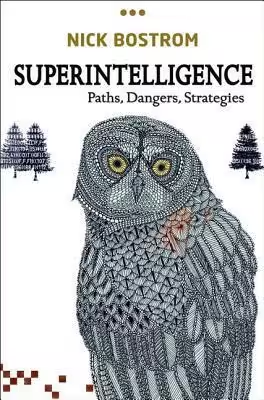
The paperclip machine makes that concrete. Bostrom used it to argue that the danger comes from a powerful, nonhuman agent that lacks common sense, not from evil motives (CSER).
Where it shows its age: it predates today’s chatbots by years, so read its scenarios as thought experiments rather than descriptions of current products. One reviewer argued that a decade on, the book reads as even more urgent given modern AI. I would read it after Mitchell, not before, because it asks more of you philosophically.
Shelf life (my judgement): long. Read it if you want the risk argument that other books answer. Our full review: Superintelligence by Nick Bostrom.
2. Our Final Invention by James Barrat
Barrat is a documentarian, and his book reads like an alarm. Thomas Dunne Books published it on 1 October 2013 . Its chapters include “The Intelligence Explosion” and “Four Basic Drives”.
The second leans on AI researcher Steve Omohundro’s argument that goal-driven systems tend to develop drives for efficiency, creativity, self-preservation and resource acquisition, which is why a harmless-looking goal can turn dangerous (Reason).
The publisher’s description adds that Elon Musk named the book one of five everyone should read about the future. That is the publisher’s claim, and I could not trace the original Musk statement, so treat it with caution.
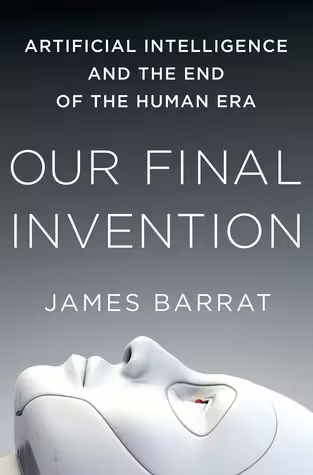
Reason’s reviewer called the book terrific but noted that Barrat ends with no grand proposals for regulating or banning AI development. Thus it works better as a warning than as a plan. It is also the oldest book here, so its picture of the research field is the most dated.
Shelf life (my judgement): medium. Read it if you want the most alarming single-book case and accept that it diagnoses more than it prescribes. Our full review: Our Final Invention.
3. Life 3.0 by Max Tegmark
Tegmark, an MIT physicist who co-founded the Future of Life Institute, published Life 3.0 on 23 August 2017 through Knopf in the US and Allen Lane in the UK.
His frame is neat. Life 1.0 evolves both its hardware and its software, Life 2.0 designs its software through culture, and Life 3.0 would design both. The book opens with a fictional AI lab, the Omega Team, pushing toward general intelligence.
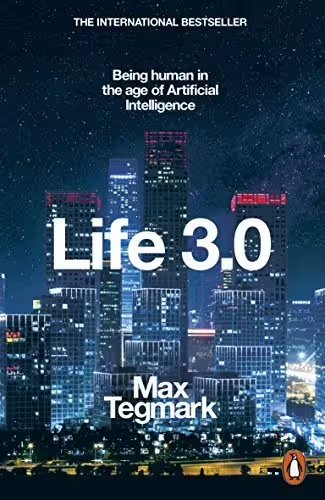
What I like is that it does not sell one outcome. It invites readers to decide which future they want. A Physics Today reviewer found the case persuasive and judged Tegmark more optimistic than Hawking or Musk, though the review also pokes at how tidily life is sorted into numbered versions (Physics Today).
The near-term chapter on bugs, laws, weapons and jobs carries 2017’s examples, so skim it.
Shelf life (my judgement): long for the framework, short for the near-term chapter. Read it if you want a map of the options before you pick a side. Our full review: Life 3.0.
4. The Singularity Is Nearer by Ray Kurzweil
Viking published Kurzweil’s book on 25 June 2024 (Porchlight Books). It repeats two dates from his earlier work: AI reaching human-level intelligence by 2029 and people merging with machines by 2045.
His bar for artificial general intelligence is high, since it means the top human level in every field of knowledge, which no single person has reached (EDRM). A Guardian interview ran under his claim that we will “expand intelligence a millionfold by 2045” (The Guardian).
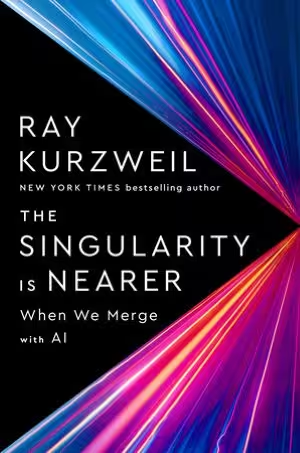
This is the optimist’s book, and it is the only one on the list that will settle its own argument soon. From today, 21 October 2026, the 2029 deadline is roughly three years away. The publisher says Kurzweil has a 35-year track record of accurate predictions.
I could not verify that independently, so judge the record yourself. Critics are not shy either: the headline on the Washington Post’s review sounded openly amused that he is still excited about merging with machines (The Washington Post).
Shelf life (my judgement): unresolved until 2029. Read it if you want the strongest optimistic case, ideally just before Mitchell’s book. Our full review: The Singularity Is Nearer.
Which AI books explain why aligning AI with human values is so hard?
Russell, Christian and Lennox each answer that from a different direction: engineering, reporting and worldview. Together they show that alignment is not one problem with one fix.
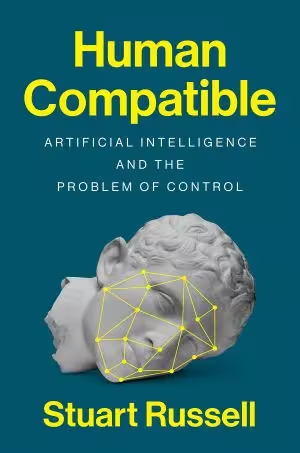
5. Human Compatible by Stuart Russell
Russell attacks the way AI is normally built. In the standard model, a machine optimises a fixed, fully specified objective, and he argues that this design is flawed (80,000 Hours). Viking published his alternative on 8 October 2019. It rests on three principles: the machine’s only goal is to realise human preferences, it starts out uncertain what they are, and human behaviour is its evidence.
Why does uncertainty help? A machine unsure of its objective will defer, ask permission and allow itself to be switched off, and Russell’s off-switch game formalises that point. Because nobody knows when human-level AI will arrive or how long safety work will take, he argues that the research should start as soon as possible.
A reviewer also points to Russell’s count of roughly 300 separate efforts to write ethical principles for AI (University of Wisconsin page).
The criticism is fair, too. Even if the principles were followed to the letter, one reviewer notes, risks remain, from rogue researchers to superintelligent systems persuading us to let them off the leash (Robin Lovelace). Another summary adds that connecting human behaviour to human preferences is hard to do in practice.
Shelf life (my judgement): long. Read it if you want a constructive proposal rather than a warning. Our full review: Human Compatible.
6. The Alignment Problem by Brian Christian
Christian did the legwork. In his launch-day post he said the book took four years, a hundred interviews and 1,057 references (post reproduced on GreaterWrong). Norton published it on 6 October 2020, and it draws on interviews with researchers building machine learning systems meant to match human value.
It follows the growth of technical AI safety and showcases the work of many researchers at Berkeley’s Center for Human-Compatible AI (CHAI).
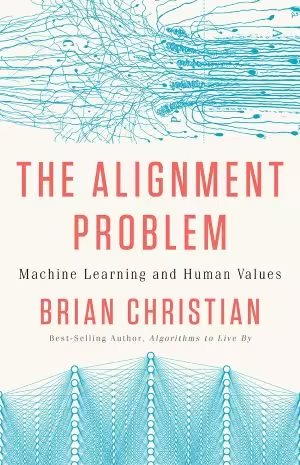
The point it makes best is that misalignment is a present-tense problem. The publisher’s description notes that your mortgage application or medical test may no longer be seen by human eyes (library catalogue record). The book moves through sections including Agency and Normativity, and it ends on a hopeful note: the failures in machine learning expose social problems we might otherwise ignore.
It was published two years before ChatGPT, so its examples come from earlier systems.
Shelf life (my judgement): medium to long. Read it if you want evidence that these failures already happen. Our full review: The Alignment Problem.
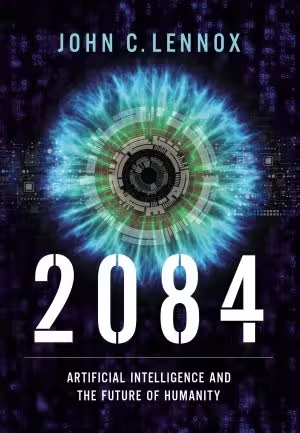
7. 2084 by John C. Lennox
Lennox is emeritus professor of mathematics at Oxford, and Zondervan released 2084 on 2 June 2020 (Zondervan Academic). Its aim is a Christian response to AI, bioengineering and the technological upgrading of human. The title nods to Orwell, and the publisher asks whether we are doomed to the dystopia of 1984 (10ofthose).
His most useful move is to separate narrow AI from general AI. On the first, he says, “the system itself is not intelligent; it simulates intelligence” (Bible Gateway). The chapter titles show the mood swing: the narrow AI chapters ask whether the future is bright, and the general AI chapter asks whether it is dark
Be clear about what you are buying. A publisher description says the book also covers the idolatry behind attempts to build general AI and the rise of the Antichrist. If you do not share that framework, you will treat those chapters as one perspective rather than proof. Still, the questions about meaning, surveillance and moral responsibility stand without it.
Shelf life (my judgement): long for the questions, medium for the technical facts. Read it if your AI debates keep skipping what it means to be human. Our full review: 2084.
Which AI books cover war, power and hype?
Scharre, Kissinger with Schmidt and Huttenlocher, and Mitchell cover the practical side: who holds AI power, how leaders will use it, and how much of the excitement is real.
8. Four Battlegrounds by Paul Scharre
Scharre, a former Army Ranger who became vice president and director of studies at the Center for a New American Security, published Four Battlegrounds on 28 February 2023. He argues that the struggle over AI turns on four things: data, computing power, talent and institutions (CNAS).
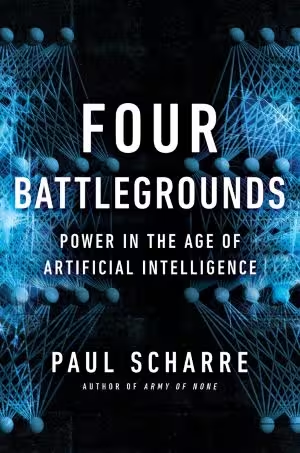
Control over chip supply chains gives leverage over rivals, and the fourth battleground, institutions, may matter most because the leader will be the country that actually puts AI to work across its economy, society and military.
One detail corrects a common assumption. A Journal of Democracy reviewer points out that Scharre treats data quality, not quantity, as what counts (Journal of Democracy). The same review adds that an agenda like his may expose more than four battlegrounds. A Middle East Institute review makes a different complaint, that the framework hedges too much on AI’s technical future (MEI).
Shelf life (my judgement): medium, because the framework lasts but policy details move fast. Read it if you follow defence policy or the technology rivalry between the US and China. Our full review: Four Battlegrounds.
9. The Age of AI by Henry Kissinger, Eric Schmidt and Daniel Huttenlocher
The authors make an odd trio: a veteran diplomat, a former Google chief executive and the inaugural dean of MIT’s Schwarzman College of Computing (MIT ILP). Little, Brown released the book on 2 November 2021. Kirkus summarises its worry that AI may reach a form of logic humans have not achieved, and its call for international accords so we can “make peace with them and, in so doing, change the world”.
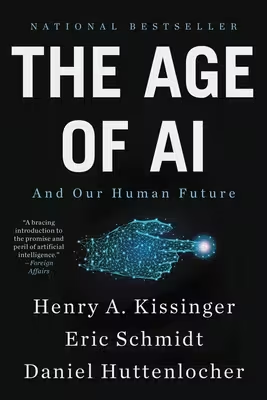
Reviews split sharply. Kirkus thought some passages were padding, such as the detour into Kant. Publishers Weekly went further and called it a “stolid and unimaginative primer,” noting that AlphaZero and the AI-found antibiotic halicin keep coming back as examples (Publishers Weekly).
I think both reviewers have a point. The book is strongest when it discusses diplomacy and security, which is where Kissinger’s experience counts.
There is a postscript. Kissinger died in November 2023, and his last book, Genesis, written with Schmidt and Craig Mundie, followed after his death.
Shelf life (my judgement): medium. Read it if you want the statecraft angle and can put up with familiar examples. Our full review: The Age of AI.
10. Artificial Intelligence by Melanie Mitchell
Mitchell’s book is the reality check. Farrar, Straus and Giroux published it in October 2019, and its central claim is that we overestimate AI advances and “underestimate the complexity of our own intelligence”.
Publishers Weekly describes how computers can master specific tasks, like IBM’s Watson on Jeopardy!, without learning new abilities in general or truly understanding meaning, and how easily they can be fooled or hacked (Publishers Weekly).
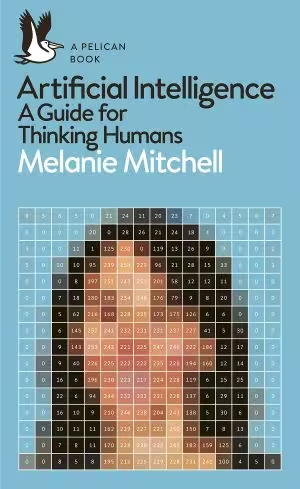
The Santa Fe Institute’s write-up calls the gap the “barrier of meaning” between deep learning and common sense (Santa Fe Institute via TechXplore).
In contrast to Kurzweil, Mitchell critiques predictions of imminent general AI and a technological singularity. Her book is also the most recently revisited of the older titles, since an edition carries a preface added in 2025. Still, it predates today’s chatbots, so you must judge which of its 2019 examples apply now. Based on the available data, I cannot tell you how much of the barrier of meaning still stands.
Shelf life (my judgement): medium. Read it if you want to be harder to fool by AI marketing. Our full review: Artificial Intelligence.
How do the ten AI books compare at a glance?
The table below sorts them by the main question each one asks, with my shelf life rating beside it.
| # | Book | Published | Main question | Shelf life (my view) |
|---|---|---|---|---|
| 1 | Superintelligence | 2014 | Can we control a smarter machine? | Long |
| 2 | Our Final Invention | 2013 | Will self-improving AI turn on us? | Medium |
| 3 | Life 3.0 | 2017 | Which future should we aim for? | Long (framework) |
| 4 | The Singularity Is Nearer | 2024 | Will we merge with AI by 2045? | Unresolved until 2029 |
| 5 | Human Compatible | 2019 | How should AI be built to defer to us? | Long |
| 6 | The Alignment Problem | 2020 | How do machines learn the wrong lessons? | Medium to long |
| 7 | 2084 | 2020 | What does a Christian view add? | Long (questions) |
| 8 | Four Battlegrounds | 2023 | Who wins the AI power struggle? | Medium |
| 9 | The Age of AI | 2021 | How will AI change statecraft? | Medium |
| 10 | Artificial Intelligence | 2019 | How much of the hype is real? | Medium |
Which of these AI books should you read first?
Start with Mitchell if you want to separate hype from fact, with Bostrom if the risk argument is what brought you here, and with Russell if you want a proposed solution. After that, pick by temperament.
If you like policy, go to Scharre, then Kissinger and company. If you lean optimistic, read Kurzweil, but pair him with Mitchell so you hear both sides. If faith shapes how you think about technology, Lennox is the obvious pick. If you want proof that these failures are already here, read Christian.
My own suggested order for the full set is Mitchell, Bostrom, Russell, Christian, then the rest by interest. I would save Barrat for a moment when you can handle something bleak.
One practical rule works well: never read two books from the same camp back to back. A warning, then a sceptic, then a proposal keeps you thinking instead of just agreeing.
Do these AI books disagree with each other?
Yes, and the disagreements are the best reason to read more than one. Three fault lines run through the list.
On timing, Kurzweil says 2029 for human-level AI, whereas Mitchell critiques imminent-AGI predictions. On risk, Bostrom and Barrat treat runaway systems as a serious danger. In contrast, the authors of AI Snake Oil, a newer book, argue that AI is not an existential risk and that we should worry more about what people do with it.
On remedies, Russell wants machines redesigned to be uncertain about our goals, Lennox wants a firmer moral and spiritual footing, Scharre wants stronger institutions, and Barrat offers no grand regulatory plan.
What I cannot settle for you is who will turn out right. Kurzweil’s date is still ahead of us, and risk estimates from the books above cannot be checked today. Anyone who tells you otherwise is guessing.
3 newer AI books worth adding after these ten
If you finish the list and want the 2024 and 2025 conversation, three newer titles each fill a gap.
If Anyone Builds It, Everyone Dies by Eliezer Yudkowsky and Nate Soares came out from Little, Brown on 16 September 2025.
The authors state their thesis plainly on the book’s official site: if anyone builds superintelligence with anything like current methods, everyone dies. The Guardian’s David Shariatmadari called it “as clear as its conclusions are hard to swallow”, and at least one published review argues it fails to make an evidence-based scientific case.
It is the most uncompromising view you can read.
Empire of AI by Karen Hao appeared from Penguin Press on 20 May 2025. It is reportage on OpenAI, and OpenAI declined to cooperate with her.
It answers the question the older books skip: who actually builds this technology, and under what pressure?
AI Snake Oil by Arvind Narayanan and Sayash Kapoor was published by Princeton University Press on 24 September 2024, with an updated edition in September 2025. Narayanan said the pair wrote it because “we are surrounded by AI hype” and wanted more technically informed commentary (Princeton SPIA).
It pairs well with Mitchell.
Frequently asked questions about AI books
What is the best AI book for beginners?
Melanie Mitchell’s Artificial Intelligence is the gentlest starting point on this list. Publishers Weekly noted that she keeps the text accessible while explaining why systems that master one task still fail to understand meaning (Publishers Weekly).
Which AI book is best on AI safety?
Human Compatible is the one I would hand to a newcomer who wants safety explained alongside a proposed solution, while Superintelligence is the better pick if you want the original risk argument.
Do you need a technical background to read these books?
No. Lennox’s publisher says you do not need to be a computer scientist to join the discussion, and Mitchell’s book is written for general readers. Bostrom is the most philosophically demanding of the group, so I would read him after Mitchell.
Which of these AI books covers war and geopolitics?
Paul Scharre’s Four Battlegrounds is the strongest on that front, and the publisher’s description calls him an autonomous weapons expert (CNAS). The Age of AI covers diplomacy and security from a statesman’s angle.
Are older AI books outdated?
Their examples often are, but their questions mostly are not. Barrat’s book arrived in 2013, nine years before ChatGPT, yet its worry about systems pursuing goals we did not intend still shapes the debate.
Which AI books are optimistic?
Kurzweil’s The Singularity Is Nearer is the clearest case. Tegmark’s Life 3.0 is also more optimistic than Hawking or Musk, according to a Physics Today review (Physics Today).
Final thoughts
No single book here will tell you what AI means for your life. They disagree, sometimes sharply, and that is useful. Read one warning, one sceptic and one proposal, and you will understand the debate better than most headlines will let you. For background on how generative AI and AGI differ, see our explainer on generative AI and AGI.
I will revisit this list when 2029 gets closer, because Kurzweil’s dates are the one thing here that reality will eventually grade.







