

You opened this article. Before you finish the first paragraph, your phone will probably buzz. A notification will surface — a message, a headline, a like — and some part of your brain will tilt toward it. You may resist. You may not. Either way, the tilt happened. That tilt is what this reading list is about.
The convergence of artificial intelligence, algorithmic media, and always-on devices has quietly restructured how human beings think, read, and pay attention.
Researchers, journalists, psychologists, and philosophers have spent the last two decades trying to name and understand what is happening — not just to culture, but to cognition itself. The books about AI and attention gathered here represent the best of that effort.
This list is split into two movements: the first half focuses on what technology and algorithmic systems are doing to our minds, our focus, and our emotional lives. The second half turns outward to examine AI itself — its alignment challenges, its economic logic, its philosophical stakes.
Together, they form something like a complete picture of the moment we are living through.
Whether you are a technologist, an educator, a parent, or simply someone who feels scattered in ways that weren’t true ten years ago, these are the books to read.
Table of Contents
Books About AI and Attention
Part One: What Technology Is Doing to the Mind
1. Stolen Focus by Johann Hari
If you read only one book on this list, make it this one. Hari spent three years interviewing scientists, psychologists, and technologists to answer a single question: where did our concentration go?
His answer is both structural and personal. The problem is not willpower. The problem is that dozens of industries — social media platforms, news organisations, food companies, pharmaceutical firms — are actively profiting from the erosion of human attention.
What makes Stolen Focus essential among books about technology and the mind is Hari’s refusal to let either the individual or the system off the hook.
He documents the science of attention in granular detail — the role of sleep, diet, childhood play, and reading — while never losing sight of the political economy driving the crisis. The result is a book that is galvanising rather than paralyzing.
Best for: Anyone who wants both the science and the systemic analysis of the attention crisis.
2. The Anxious Generation by Jonathan Haidt
Social psychologist Jonathan Haidt argues that the widespread adoption of smartphones among adolescents — roughly from 2012 onwards — triggered a mental health epidemic. The evidence he marshals is striking: rates of anxiety, depression, self-harm, and loneliness among teenagers, particularly girls, rose sharply and in near-perfect correlation with the rise of social media use.
The Anxious Generation is one of the most argued-about AI books about human cognition published in recent years, partly because Haidt’s causal claims are contested by some researchers.
But even critics who dispute the mechanisms tend to agree that something significant has changed in adolescent psychology, and that digital environments are implicated. The policy recommendations alone make this worth reading.
Best for: Parents, educators, and policymakers concerned about young people and screens.
3. The Shallows: What the Internet Is Doing to Our Brains by Nicholas Carr
Published in 2010 and still one of the most important books on tech and attention span, The Shallows was Carr’s attempt to understand why he found it increasingly difficult to read deeply after years of heavy internet use.
What began as personal anxiety became a sweeping investigation into neuroplasticity, the history of reading, and what happens to the brain when it migrates from linear text to hyperlinked, distraction-dense digital environments.
Carr draws on neuroscience to show that the internet is not simply a tool we use — it is an environment that reshapes the neural circuitry of anyone who inhabits it. The deep reading brain, built over centuries of literacy practice, does not survive the skim-and-click regime of online life without deliberate effort. A foundational text.
Best for: Readers interested in the neuroscience of reading and the cognitive costs of digital multitasking.
4. The Chaos Machine: The Inside Story of How Social Media Rewired Our Minds and Our World by Max Fisher
Fisher, a New York Times journalist, spent years interviewing engineers, researchers, and victims of algorithmic radicalisation to produce this investigation into recommendation systems and their consequences.
The “chaos machine” of the title is the engagement-optimisation engine at the heart of platforms like YouTube and Facebook — a system designed to maximise watch time and sharing, which in practice means systematically promoting outrage, fear, and tribal identity.
This is one of the most important books about technology and the mind because it shows the path from individual psychology to geopolitical consequence.
The same cognitive vulnerabilities that make you more likely to click — negativity bias, in-group solidarity, conspiratorial pattern-matching — are the vulnerabilities being industrially exploited at scale.
Best for: Readers trying to understand algorithmic radicalisation and the political effects of social media.
5. The Attention Merchants: The Epic Scramble to Get Inside Our Heads by Tim Wu
Wu, a Columbia law professor, traces the history of the attention economy from the first penny press newspapers of the 1830s through radio, television, and the internet. His central argument is that every major media technology has been funded by the same underlying logic: capture human attention, then sell it to advertisers.
What is new about the digital era is only the efficiency and intimacy of that capture.
The Attention Merchants provides essential historical grounding for the current crisis. Reading it, you understand that the attention economy is not an aberration but a culmination — the endpoint of a centuries-long project to monetise human consciousness.
Among books about AI and attention, it offers the longest view.
Best for: Anyone who wants the full historical arc of how human attention became a commercial resource.
6. Stand Out of Our Light: Freedom and Resistance in the Attention Economy by James Williams
Williams, a former Google strategist turned Oxford philosopher, wrote the most philosophically rigorous book on this list. His argument is deceptively simple: attention is not just a resource.
It is the medium through which we live. To have your attention systematically hijacked is not merely an inconvenience — it is an assault on your capacity for self-determination, for living the life you actually want to live.
Stand Out of Our Light is slim but dense. It distinguishes between three kinds of attention — spotlight (focus on the immediate), starlight (long-term goals), and daylight (meta-level self-understanding) — and shows how digital environments threaten all three. As a philosophical contribution to the literature on books on tech and attention span, it has no peer.
Best for: Readers who want a rigorous ethical and philosophical framework for understanding the attention crisis.
7. Digital Minimalism: Choosing a Focused Life in a Noisy World by Cal Newport
Where most books on this list diagnose the problem, Newport offers a prescription. Digital Minimalism proposes a philosophy of technology use built around one principle: be very intentional about the role digital tools play in your life, and ruthlessly eliminate those that do not serve your deepest values.
Newport is careful to distinguish his position from technophobia. He is not anti-technology. He is pro-agency. The digital minimalist uses technology deliberately, not compulsively — a distinction that sounds obvious but requires sustained effort to maintain in an environment engineered for compulsion.
A practical and genuinely useful addition to any collection of books about technology and the mind.
Best for: Readers looking for concrete, actionable strategies to reclaim their attention and time.
8. Deep Work: Rules for Focused Success in a Distracted World by Cal Newport
Newport’s earlier book makes a simpler but equally important argument: the ability to concentrate without distraction on cognitively demanding tasks is becoming both increasingly rare and increasingly valuable.
In an economy that rewards knowledge work, the capacity for deep work is a competitive advantage — and it is one that most people are systematically destroying through constant connectivity.
Deep Work has been influential in workplaces and universities since its publication, and its core insight holds up.
Among AI books about human cognition, it stands somewhat apart — it is less about what AI and algorithms are doing to us and more about what we can do to protect our capacity for serious thought. That practical orientation is precisely its value.
Best for: Professionals, students, and knowledge workers who want to produce their best work in a distracted world.
9. Attention Span: A Groundbreaking Way to Restore Balance, Happiness and Productivity — Gloria Mark
Mark is a UC Irvine professor who has spent over two decades studying how people actually use computers in real workplaces — not how they think they use them, but how they actually behave. Her findings are both reassuring and challenging.
Yes, average attention spans in digital environments have shortened dramatically since the early 2000s (from about two and a half minutes to around 47 seconds per screen). But human beings also have more attentional resources than they think, and those resources can be cultivated.
Attention Span is one of the most empirically grounded books on tech and attention span in existence. Mark is not a polemicist — she is a scientist, and her book reflects that orientation: careful, evidence-based, and ultimately hopeful.
Best for: Readers who want the science of attention without the ideology, and practical techniques backed by research.
10. Reader, Come Home: The Reading Brain in a Digital World by Maryanne Wolf
Wolf, a cognitive neuroscientist at UCLA, spent her career studying how the brain learns to read — a process that is, evolutionarily speaking, very recent and biologically demanding. In Reader, Come Home, she turns her attention to what happens when the reading brain migrates from deep literacy to digital skimming.
Her findings are personal as well as scientific: Wolf herself found that after years of digital reading, she struggled to read the novels she had once loved. The deep reading circuit — the one that supports empathy, critical analysis, and analogical reasoning — requires sustained practice to maintain.
Among books about AI and attention, this is the most intimate: a scientist’s account of what she almost lost, and what she recovered.
Best for: Educators, parents, and book lovers who want to understand the neuroscience of reading.
11. Dopamine Nation: Finding Balance in the Age of Indulgence — Anna Lembke
Lembke is a Stanford psychiatrist and one of the leading authorities on addiction in the United States. Dopamine Nation extends the addiction framework beyond substances to encompass the compulsive digital behaviours that have become normalised across the population.
Her argument: smartphones and social media apps are not like drugs. In their neurochemical effects on the reward system, they are drugs.
This is essential reading among AI books about human cognition because it explains the biological machinery beneath the attention crisis — the dopaminergic loops, the tolerance effects, the withdrawal dynamics — in language accessible to any reader. Understanding the mechanism is the first step toward changing the behaviour.
Best for: Anyone trying to understand the biological basis of compulsive technology use and how to break its grip.
12. The Age of Surveillance Capitalism: The Fight for a Human Future at the New Frontier of Power by Shoshana Zuboff
Zuboff’s monumental work is the most comprehensive political-economic analysis of what the major technology platforms have built.
Her concept of “surveillance capitalism” — a new economic logic in which human experience is raw material to be extracted, analysed, and sold as behavioural prediction products — has entered the vocabulary of policymakers, scholars, and activists worldwide.
The Age of Surveillance Capitalism is long and dense, but it rewards the investment. It is the definitive account of how companies like Google and Facebook transformed from tools we use into systems that use us.
As a contribution to books about technology and the mind, it operates at the highest level of analytical ambition.
Best for: Readers who want the full intellectual architecture of what surveillance capitalism is, how it works, and why it matters.
Part Two: Understanding AI — Cognition, Alignment, and the Future
13. The Alignment Problem: Machine Learning and Human Values by Brian Christian
As AI systems become more capable, a critical question emerges: how do we ensure they do what we actually want? The “alignment problem” — the difficulty of specifying human values precisely enough to encode them in a machine — is the subject of Christian’s brilliant and deeply reported investigation.
What distinguishes The Alignment Problem among books about AI and attention is its willingness to sit with complexity. Christian does not offer false reassurance or catastrophism.
He interviews the researchers working on these problems daily and emerges with a nuanced portrait of a field that knows what is at stake but does not yet know how to solve it.
Best for: Anyone who wants a rigorous, accessible account of what the AI alignment problem is and why it matters.
14. Artificial Intelligence: A Guide for Thinking Humans by Melanie Mitchell
Mitchell, a professor at the Santa Fe Institute, provides the most intellectually honest overview of the field available to non-specialists. Her central theme is the gap between what AI systems actually do — pattern matching in high-dimensional statistical spaces — and what we often claim or imagine they do when we use human-sounding words like “understanding,” “reasoning,” and “knowing.”
Among AI books about human cognition, Artificial Intelligence is particularly valuable because it clarifies the comparisons between machine and human cognition that are so often made carelessly. AI is impressive. It is also deeply different from human thought in ways that matter enormously for how we deploy it.
Best for: Readers who want a technically informed but accessible overview of AI’s real capabilities and genuine limitations.
15. Human Compatible: Artificial Intelligence and the Problem of Control by Stuart Russell
Russell is one of the most eminent AI researchers alive and the co-author of the field’s standard textbook. Human Compatible is his argument that the standard model of AI — building systems that optimise for fixed, human-specified objectives — is fundamentally broken as a path toward beneficial superintelligence.
His alternative: build AI systems that are uncertain about human preferences and therefore motivated to learn from and defer to humans.
This is among the most technically serious books about AI and attention on this list, though Russell writes with clarity and wit. His framing of the control problem is the most intellectually rigorous available outside of academic literature.
Best for: Technically minded readers who want the strongest available argument about AI safety from one of the field’s founders.
16. Co-Intelligence: Living and Working with AI by Ethan Mollick
Mollick, a Wharton professor who became one of the most widely read voices on practical AI adoption, offers something different from most books in this space: not a warning, but a manual. Co-Intelligence is about how to work with large language models intelligently — not naively, but not fearfully either.
His central argument is that the question is not whether AI will change knowledge work. It will. The question is whether people will engage with that change actively or passively.
Among books on tech and attention span, this one stands out for its focus on agency — how to use these tools in ways that augment rather than diminish human cognition.
Best for: Professionals and students who want a practical, clear-eyed guide to working effectively with AI tools.
17. Life 3.0: Being Human in the Age of Artificial Intelligence by Max Tegmark
Tegmark, an MIT cosmologist and co-founder of the Future of Life Institute, takes the longest view of any author on this list. Life 3.0 is a systematic exploration of what superintelligent AI might mean — not in ten years, but in fifty or a hundred — for human civilisation, consciousness, and meaning.
Tegmark is careful to distinguish speculation from analysis, and the book is structured to help readers think through scenarios rather than advocate for any particular one.
As a contribution to the literature on books about technology and the mind, it operates at the level of civilisational stakes rather than individual cognition — a necessary complement to the more personal books on this list.
Best for: Readers interested in the long-term trajectory of AI and the existential questions it raises.
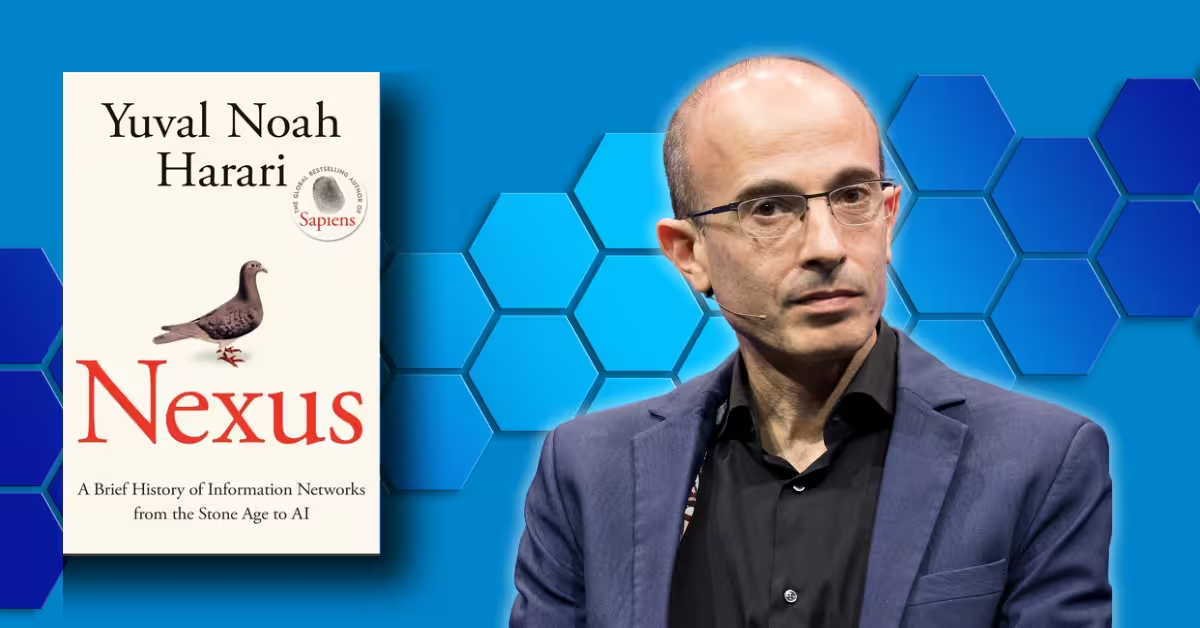
18. Nexus: A Brief History of Information Networks from the Stone Age to AI by Yuval Noah Harari
Harari’s most recent book applies his signature wide-angle lens to the history of information technology, arguing that every major civilisational transformation has been driven by a new information network — language, writing, print, and now AI.
His central argument: AI is categorically different from all previous information technologies because it can operate as an active agent in information networks, not merely a passive medium.
Nexus has attracted both admiration and criticism — Harari is better at provocation than precision — but among books about AI and attention, it offers the most sweeping historical context available in a single readable volume.
Best for: Readers who want a grand narrative framework for understanding where AI fits in the arc of human history.
19. God, Human, Animal, Machine: Technology, Metaphor, and the Search for Meaning by Meghan O’Gieblyn
O’Gieblyn is the most unusual voice on this list: a former evangelical Christian who became a technology writer and found herself unexpectedly at home in the theological dimensions of AI discourse.
God, Human, Animal, Machine is a philosophical and personal meditation on consciousness, identity, and meaning in an age when the boundaries between human and machine intelligence are dissolving.
Among AI books about human cognition, this is the most philosophically adventurous — and the most beautifully written. O’Gieblyn asks questions that the more technically oriented books on this list tend to avoid: What does it mean to have a mind? What do we lose — and gain — when we attribute minds to machines?
Best for: Readers drawn to the philosophical and existential dimensions of AI rather than its technical or policy aspects.
20. Weapons of Math Destruction: How Big Data Increases Inequality and Threatens Democracy by Cathy O’Neil
O’Neil, a mathematician turned activist, examines the algorithmic systems that increasingly govern consequential decisions in people’s lives — credit scores, hiring decisions, university admissions, criminal sentencing, and more. Her argument: these systems are not objective. They embed the biases of their designers and the historical data they are trained on, and they operate at a scale that makes human oversight nearly impossible.
Weapons of Math Destruction is essential among books about technology and the mind because it grounds abstract concerns about algorithmic power in concrete human harm. The systems she describes are not hypothetical. They are operational, they are affecting millions of people, and most of those people do not know it.
Best for: Readers concerned about algorithmic bias, data justice, and the real-world consequences of automated decision-making.
Honourable Mentions
Any serious reader of books about AI and attention should know these titles as well:
- Superintelligence (Nick Bostrom) — the philosophical grandfather of AI safety discourse; dense but foundational.
- The Coming Wave (Mustafa Suleyman) — a co-founder of DeepMind on why the AI wave cannot be stopped and why that matters.
- Atlas of AI (Kate Crawford) — the environmental and labour costs behind the AI systems we use daily.
- Amusing Ourselves to Death (Neil Postman) — written in 1985, it anticipated the attention economy with eerie precision.
- Alone Together (Sherry Turkle) — a pioneering MIT sociologist on how technology is changing the texture of human relationships.
- Reclaiming Conversation (Sherry Turkle) — Turkle’s follow-up, focused specifically on what we lose when we stop talking face to face.
- The Distracted Mind (Adam Gazzaley & Larry Rosen) — a neuroscientist and psychologist on the cognitive science of distraction.
- Irresistible (Adam Alter) — a social psychologist on the behavioural design techniques that make technology compulsive.
- How to Do Nothing (Jenny Odell) — an artist’s manifesto on resistance to the attention economy; part philosophy, part practical guide.
How to Read This List
Not all of these books belong on the same shelf, and not all of them agree with each other. Johann Hari and Jonathan Haidt would find much common ground; Shoshana Zuboff and Ethan Mollick would have productive arguments about whether the problem is systemic or solvable through better practice.
Stuart Russell and Yuval Noah Harari occupy different registers of the same anxiety about intelligent machines.
That intellectual friction is a feature, not a bug. The questions at the heart of this list — What is attention? What does it mean to think? Who should control intelligent systems?
What kind of future do we want to build? — are not questions with single correct answers. They are questions that repay ongoing engagement, and these twenty books are among the best tools we have for that engagement.
A practical suggestion: start with Stolen Focus or The Shallows if you are primarily concerned with your own cognitive life. Start with The Alignment Problem or Human Compatible if AI’s technical future is your primary interest. Start with The Age of Surveillance Capitalism if you want the political economy.
And start with God, Human, Animal, Machine if you want to be unsettled in the most productive possible way.
Whatever you read, read it carefully. Slowly. Without your phone nearby. The irony of reading a list of books about distraction while distracted is one that every author on this list would appreciate.
FAQs
What are the best books about AI and attention for beginners?
Start with Stolen Focus by Johann Hari for the attention crisis, The Shallows by Nicholas Carr for the neuroscience of digital reading, and Co-Intelligence by Ethan Mollick for a practical introduction to working with AI. These three together provide a strong foundation.
Are there books about technology and the mind that are scientifically rigorous?
Yes. Attention Span by Gloria Mark, Reader, Come Home by Maryanne Wolf, The Distracted Mind by Gazzaley and Rosen, and Dopamine Nation by Anna Lembke are all grounded in scientific research. Carr’s The Shallows also draws heavily on neuroscience.
What books should I read about AI and human cognition from an ethical perspective?
The Age of Surveillance Capitalism (Zuboff), Weapons of Math Destruction (O’Neil), Stand Out of Our Light (Williams), and The Alignment Problem (Christian) each approach AI’s ethical dimensions from different angles — political economy, mathematics, philosophy, and machine learning respectively.
Are there books on tech and attention span that also offer solutions?
Digital Minimalism and Deep Work by Cal Newport are the most solution-oriented on this list. Attention Span by Gloria Mark also offers evidence-based strategies. For a more philosophical take on reclaiming attention, try Stand Out of Our Light and How to Do Nothing.