
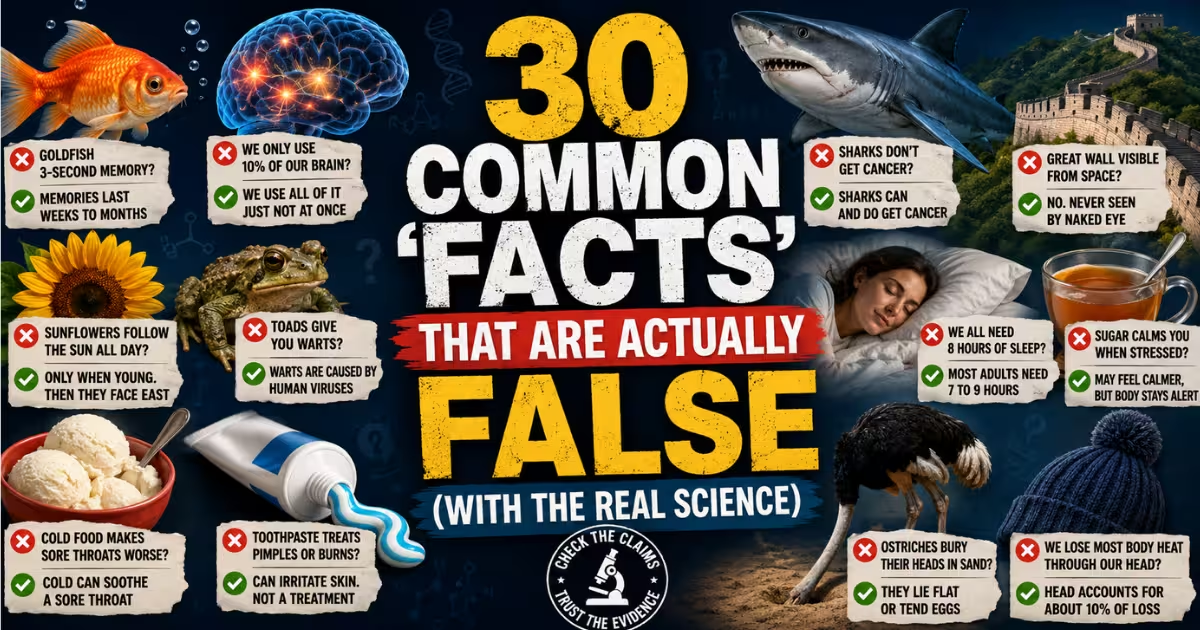
Did your teacher ever tell you that you only use ten percent of your brain, or that a goldfish forgets you exist within three seconds? I put that to the test and pulled together 30 common facts that are actually false, from the shark cancer myth to the ten percent brain claim, checked against actual research so you don’t have to just take some stranger’s word for it .
I believed both of those for most of my life, and I repeated them to other people with total confidence, which is honestly the most embarrassing part. Somewhere along the way I started actually checking these things instead of just passing them on, and what I found was a lot messier and more interesting than the tidy “fact” I’d been carrying around.
This piece is the result of that checking: thirty statements that most of us picked up in a classroom, a parent’s warning, or a chain email, laid next to what the actual research says, with sources so you don’t have to take my word for it.
Table of Contents
Overview
Most of these thirty “facts” trace back to one of three sources: a marketing campaign (shark cartilage pills), a badly designed old study that got oversimplified (the military heat-loss experiment), or a plausible-sounding guess that nobody ever bothered to test (toads and warts). A few turn out to be more complicated than a flat “true” or “false,” and I’ve said so where that’s the case rather than forcing a clean verdict.
Best for: People who like being the one at dinner who says “actually” and can back it up. Parents fielding an endless stream of kid questions. Writers, teachers, and trivia hosts who want their facts to survive a Google search.
Not for: Anyone hoping for a quick, mindless listicle to skim in thirty seconds. Some of these have real nuance, and I’ve tried not to flatten it just to make a punchier headline.
30 Common Facts That Are Actually False
1. Pure water conducts electricity

The lie: Water and electricity are always a dangerous combination because water itself carries current.
The truth: Chemically pure water is actually a poor conductor. What conducts electricity is the minerals and dissolved salts in it, not the H2O molecules themselves. Distilled water has had those minerals stripped out, so on its own it barely conducts anything.
The danger in real life comes from the fact that almost no water you’ll ever touch is chemically pure. Tap water, pool water, rain, and sweat are all full of dissolved ions, which is exactly why the “don’t touch outlets with wet hands” warning still holds.
2. Wrinkly fingers absorb water
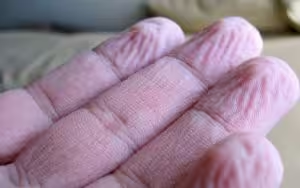
The lie: Your fingers get pruney in the bath because the skin soaks up water like a sponge.
The truth: Evolutionary neurobiologist Mark Changizi and his team proposed in 2011 that finger wrinkling is an active nervous-system response, not passive swelling, and later lab work backed that up.
Blood vessels under the skin constrict, pulling the surface into channels that work like tire treads, draining water away from the fingertip so you can grip wet objects better.
A follow-up study found people picked up wet marbles about 12 percent faster with wrinkled fingers than with smooth ones, and wrinkling made no difference at all with dry objects, which is exactly what you’d expect if this is a grip adaptation rather than a swelling accident.
3. Sharks don’t get cancer

The lie: Sharks are immune to cancer, which is why shark cartilage supposedly fights the disease in humans.
The truth: Sharks get cancer. Scientists have recorded tumors in sharks since 1908, and researchers have since documented malignancies in more than twenty shark species. The myth exploded after I.
William Lane’s 1992 bestseller “Sharks Don’t Get Cancer,” which built a supplement empire on a claim that was already known to be false when he published it. The U.S. Federal Trade Commission eventually fined Lane’s company a million dollars for the false advertising, but not before the shark cartilage boom had helped drive serious declines in shark populations, killed for pills that never worked.
4. Sunflowers follow the sun all day

The lie: Sunflowers track the sun across the sky from dawn to dusk, always facing it.
The truth: This is true, but only for young, unopened sunflowers. Researchers at UC Davis found that juvenile plants use an internal circadian clock to turn east to west during the day and reset overnight, and that this tracking measurably increases their leaf growth.
Once a sunflower matures and blooms, though, the movement stops completely, and the flower settles into facing east for good, which turns out to warm the flower faster in the morning and attract more pollinators.
5. Goldfish have a three-second memory

The lie: Goldfish forget everything within a few seconds, which is why they supposedly don’t get bored swimming in circles.
The truth: This has been known to be false since at least the 1960s. Fish cognition researcher Culum Brown of Macquarie University points out that goldfish memories can last weeks, months, or longer, and studies have trained goldfish to associate sounds with feeding times and recall that connection five months later.
Brown suspects the myth persists partly because fish don’t get the same emotional investment from people that cats and dogs do, so misinformation about them never gets challenged.
6. We only use ten percent of our brains

The lie: Humans access only a small fraction of their brainpower, with the rest sitting dormant and waiting to be “unlocked.”
The truth: Brain imaging shows that we use virtually all of our brain, just not all of it at the exact same moment for the exact same task. Neurologist Barry Gordon of Johns Hopkins calls the ten percent myth “so wrong it is almost laughable.”
The idea is often traced to a misreading of psychologist William James‘s 1907 essay The Energies of Men, where he argued people underuse their mental and physical resources, a claim about untapped potential that somehow mutated into a specific, made-up percentage.
Given that the brain burns about twenty percent of the body’s energy while making up only two percent of its weight, evolution would never have let ninety percent of it go idle.
7. Stress is the main cause of high blood pressure

The lie: Chronic stress is the primary driver behind hypertension.
The truth: Hypertension specialists say this one is mostly wrong. Samuel Mann of Weill Cornell Medicine has reviewed dozens of studies and found no meaningful link between everyday psychological stress and long-term high blood pressure.
The real drivers are genetics, smoking, excess salt, and diet, along with the unhealthy habits stress tends to trigger, like overeating or drinking more. Stress can spike your blood pressure temporarily during a stressful moment, but that’s different from causing the chronic condition.
8. Cats and dogs see only in black and white

The lie: Our pets experience the world in shades of gray, with no color at all.
The truth: Dogs and cats are dichromatic, meaning they have two types of color-sensing cones instead of our three. Dogs see mostly in blues and yellows, with reds and greens registering as a muddy brownish-gray.
Cats’ vision is a bit less settled scientifically, but researchers generally agree they see blues, yellows, and some greens.
So a bright red ball on green grass is genuinely hard for your dog to spot, not because it’s colorless to them, but because red and green both collapse into similar dull tones in their eyes.
9. Shaving makes hair grow back thicker

The lie: Shave an area and the hair that grows back will be coarser, darker, and thicker than before.
The truth: A 1928 study, later reaffirmed by more recent dermatology research, found no measurable change in hair diameter or growth rate from shaving.
The trick is that a razor cuts hair at a blunt angle rather than the natural tapered tip, so new growth feels stubbly and looks darker before it’s been lightened by sun exposure, creating the illusion of thicker, faster growth.
Dermatologist Amy McMichael notes that repeated skin irritation from things like scratching can occasionally thicken surrounding skin and hair, but that’s not what an ordinary shave does.
10. Mosquitoes only live for a day
The lie: A mosquito’s entire lifespan is a single day, so smacking one just speeds up the inevitable.
The truth: Male mosquitoes typically live one to two weeks. Females, which need blood meals to produce eggs, generally live two to four weeks and sometimes over a month under good conditions.
Some species can survive for several months. So the mosquito buzzing around your bedroom at 2 a.m. has probably been alive, and biting people, for longer than you’d like to think.
11. The Great Wall of China is visible from space

The lie: It’s the only man-made structure you can see with the naked eye from the Moon.
The truth: No astronaut has ever confirmed seeing it from the Moon, and multiple Apollo astronauts, including Neil Armstrong, have directly denied it’s possible.
The claim traces back further than space travel itself: English antiquarian William Stukeley wrote something similar about the wall in 1754, and the version most people know comes from a 1932 Ripley’s Believe It or Not cartoon.
When Chinese astronaut Yang Liwei returned from orbit in 2003 and said he hadn’t spotted the wall, China actually pulled the claim from its own school textbooks.
From low Earth orbit, with a long telephoto lens, it’s occasionally photographable, but that’s a very different thing from “visible to the naked eye,” and even then, plenty of other human structures show up more easily.
12. Sugar water calms you down when you’re stressed

The lie: A sugary drink is a reliable way to calm your nerves, while too much sugar just leaves you jittery and agitated.
The truth: This one is genuinely mixed, so I’m not going to pretend it’s a clean yes or no. Some research, including a 2016 study in Scientific Reports, found that sugar-sweetened tea produced a measurable calming effect during acute stress, likely tied to its caloric content rather than its sweetness.
But a more recent study out of the University of Konstanz found that while people who drank a glucose beverage before a massage reported feeling just as relaxed, their sympathetic nervous system, the “fight or flight” system, stayed more activated than in people who drank water. So sugar may make you feel calmer in the moment while your body stays more wound up underneath.
Neither “sugar calms you” nor “sugar agitates you” is the full story here.
13. Toothpaste clears up pimples and burns

The lie: Dab toothpaste on a blemish or a burn overnight and it dries the problem right out.
The truth: Dermatologists specifically warn against this. The American Academy of Dermatology notes that toothpaste contains ingredients like baking soda, hydrogen peroxide, and menthol that can irritate skin, cause chemical burns, and leave dark marks, none of which is a treatment for acne or a wound.
Some older toothpastes contained the antibacterial agent triclosan, which gave this home remedy a thin sliver of real justification decades ago, but the FDA has since restricted triclosan and modern toothpaste doesn’t rely on it anymore.
14. Swallowed gum stays in your stomach for seven years
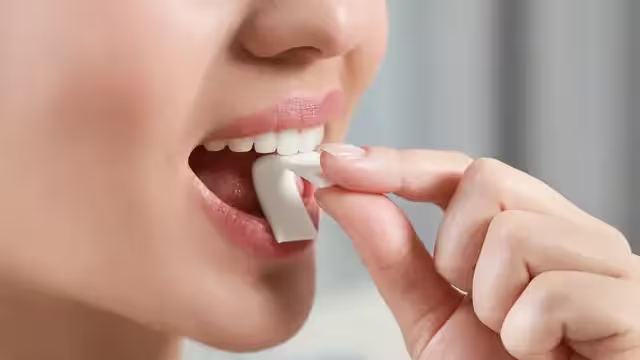
The lie: Accidentally swallow your gum and it sits undigested in your gut for the better part of a decade.
The truth: Your body can’t digest gum base, but that doesn’t mean it lingers. It gets pushed through your digestive system the same way corn kernels or other indigestible fiber do, and passes out in less than a week in nearly all cases.
Duke Health gastroenterologists say the only real risk is if someone swallows gum repeatedly, in large amounts, which can occasionally cause a blockage in young children. Nobody has ever traced the “seven years” figure to an actual source.
It appears to be pure folklore invented to stop kids from swallowing their gum.
15. Bats are blind

The lie: Bats can’t see at all, which is why they rely entirely on echolocation.
The truth: Every one of the roughly 1,400 bat species on Earth can see, and many see quite well. Megabats, or fruit bats, have large eyes tuned for low light and, in several species, better color vision than humans in the dark.
Even the smaller, echolocating microbats use vision to navigate over distances beyond echolocation’s range, which tops out at around fifty to sixty feet.
The idiom “blind as a bat” appears to come purely from the fact that they hunt by ear in total darkness, not from any actual deficiency in their eyesight.
16. Chocolate and sugar make kids hyperactive

The lie: Give a child sugar or chocolate and you’ll see the “sugar high” kick in within minutes.
The truth: Controlled studies going back decades have found no connection between sugar intake and hyperactive behavior in children. In one well-known experiment, parents who were told their kids had been given sugar (when they hadn’t) rated their children’s behavior as noticeably more hyperactive anyway.
The effect lives entirely in the observer’s expectation. If anything, some research on serotonin suggests sugar has a mild calming effect. The real downside of too much sugar is dental and metabolic, not behavioral.
17. The seasons happen because Earth gets closer to and farther from the sun

The lie: Summer is hot because Earth is nearer the sun, and winter is cold because it’s farther away.
The truth: Seasons are caused by Earth’s 23.5-degree axial tilt, not its distance from the sun. In fact, in the Northern Hemisphere, Earth is actually closest to the sun, at perihelion, in early January, right in the middle of winter, and farthest away, at aphelion, in early July, during peak summer.
The tilt determines how directly sunlight hits a given hemisphere and for how many hours a day, and that angle of light matters far more for temperature than the roughly three-million-mile difference in orbital distance.
18. Touching a frog or toad gives you warts

The lie: Handle an amphibian and you’ll wake up covered in warts.
The truth: Warts in humans are caused exclusively by the human papillomavirus, which frogs and toads don’t carry. Most viruses that cause warts in animals are species-specific, so a toad’s version couldn’t infect you even if it wanted to.
The bumpy glands on a toad’s skin, which secrete toxins as a defense mechanism, are what probably started this myth, since they look enough like human warts to make the connection seem obvious before anyone understood viruses. Handling toads does carry a real risk, just not this one: they can carry salmonella.
19. Redheads are going extinct

The lie: Red hair will disappear from the human population entirely, with some reports naming the year 2060.
The truth: This claim traces back to a 2005 press release from something called the Oxford Hair Foundation, which turned out to be a marketing arm of Procter & Gamble, the company that makes hair dye.
It was never a real scientific body. Geneticists point out that recessive genes like the MC1R mutation responsible for red hair don’t vanish over time; they can skip generations and resurface, which is exactly why two brunette parents can have a redheaded child if both happen to be carriers.
National Geographic’s own 2007 story on the topic, often blamed for spreading the rumor, never actually endorsed the 2060 extinction date.
20. A pony is a baby horse

The lie: Ponies are just young horses that haven’t grown up yet.
The truth: A pony is a distinct, fully mature type of equine that stays under 14.2 hands (about 58 inches) at the shoulder for its entire adult life, regardless of age or diet.
A baby horse or pony is called a foal, and any foal, pony or full-size breed, is under one year old. Ponies aren’t undersized horses; they have proportionally shorter legs, wider barrels, thicker coats, and often a different temperament, and the confusion likely comes from the word “pony” itself, which traces back to Old French “poulenet,” meaning a young or small horse.
21. Reading in dim light ruins your eyesight

The lie: Read in low light too often and you’ll permanently damage your vision.
The truth: Ophthalmologists across multiple institutions, including the University of Utah’s Moran Eye Center, describe this as a myth with no supporting evidence.
Reading in dim light does make your eyes work harder, dilating your pupils and forcing your focusing muscles to strain, and that can cause temporary discomfort, headaches, or blurriness.
But none of that translates into lasting structural damage. One ophthalmologist put it bluntly: saying dim light damages your eyes is like saying whispering will make you go deaf.
22. Elephants drink water through their trunks

The lie: An elephant’s trunk works like a built-in straw that sucks water directly into its mouth.
The truth: An elephant can’t actually drink through its trunk any more than you could drink through your nose, since a trunk is essentially an elongated nose fused with the upper lip.
What it does instead is suck water partway up into the trunk, using powerful muscles to expand its nostrils, and then curl the trunk around to spray that water into its mouth.
Georgia Tech engineers measured elephants sucking up as much as 3.7 liters of water in just 1.5 seconds this way, and found the trunk can dilate to hold up to 5.5 liters at once, functioning more like an expandable straw-and-hose combo than a simple tube.
23. Female praying mantises always eat the male after mating
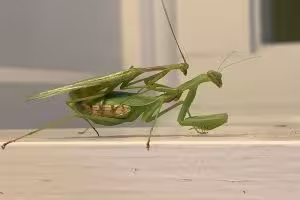
The lie: Every time a praying mantis mates, the female bites the male’s head off and devours him.
The truth: It happens, but nowhere near “always.” Studies of praying mantises in the wild put the rate of sexual cannibalism somewhere around 13 to 28 percent of encounters, and it varies a lot by species and by how hungry the female is; well-fed females in lab experiments cannibalized far fewer partners than starved ones.
Research published in Proceedings of the Royal Society B found that when it does happen, the male’s body genuinely nourishes the eggs, and cannibalized males’ offspring benefit nutritionally even after death, so there’s a real evolutionary trade-off buried in this gruesome-sounding behavior.
I couldn’t verify a specific figure like “1 in 69,” which shows up in some retellings of this myth; the actual peer-reviewed range is 13 to 28 percent, and I’d treat any more precise number with suspicion until it’s sourced.
24. Everyone needs exactly eight hours of sleep
The lie: Eight hours a night is the biologically correct amount of sleep for every adult.

The truth: Sleep researchers describe the rigid eight-hour rule as a rough population average, not an individual prescription.
The American Academy of Sleep Medicine puts the healthy range at seven to nine hours, and actual needs vary by genetics, age, and chronotype; some adults function well on seven hours, others need closer to nine and a half.
A cross-cultural study of nearly 5,000 adults in 20 countries found average sleep duration ranging from just over six hours in Japan to nearly eight hours in France, with eight hours never actually being the norm anywhere studied.
The number that matters more than any fixed target is how you actually feel and function during the day.
25. Vitamin C prevents the common cold

The lie: Load up on vitamin C at the first sign of a cold and you’ll stop it in its tracks, or avoid catching one altogether.
The truth: This traces back to two-time Nobel laureate Linus Pauling’s 1970 book “Vitamin C and the Common Cold,” which built its case largely on a single, non-representative trial of schoolchildren at a ski camp.
Since then, larger and better-controlled studies, including a Cochrane systematic review, have found that regular vitamin C supplementation does not prevent most people from catching a cold.
It may modestly shorten or ease symptoms in some circumstances, particularly for people under intense physical stress like marathon runners or soldiers, but as a general-population cold preventive, the evidence just isn’t there.
26. Cold food or ice cream makes a sore throat worse

The lie: Eating something cold when your throat hurts will aggravate the infection.
The truth: A sore throat is caused by inflammation from a virus or bacteria, not by temperature, and cold foods like ice cream can actually have a mild numbing, soothing effect on the pain rather than worsening it.
This is one reason ice pops and ice cream are commonly recommended after procedures like a tonsillectomy. The infection itself is unaffected either way by what temperature your food is.
27. Ostriches bury their heads in the sand when scared

The lie: When an ostrich senses danger, it sticks its head underground and pretends the threat isn’t there.
The truth: An ostrich that actually buried its head in sand would suffocate, so this has never made evolutionary sense, and it isn’t what happens.
The real behavior comes from two sources: ostriches dig shallow nests in the ground and dip their heads in repeatedly to rotate their eggs for even incubation, which from a distance can look like burying, and when genuinely threatened and unable to run, they’ll flatten their entire body and neck against the ground to blend into the terrain rather than hide their head specifically.
Given that ostriches can spot predators from over a mile away and are perfectly capable of killing a lion that gets too close to their eggs, “avoids conflict by hiding” is not really their style.
28. Hair and nails keep growing after you die

The lie: In the days after death, a corpse’s hair and nails visibly continue to grow.
The truth: Hair and nail growth requires active blood supply, hormones, and living cells, all of which stop the moment someone dies.
What actually happens is that the skin dehydrates after death and shrinks back from the nail beds and hair follicles, exposing more of the nail plate and hair shaft and creating a convincing illusion of growth.
Forensic anthropologist William Maples described the idea of postmortem growth as “pure moonshine” in a widely cited BMJ review of medical myths, even while acknowledging just how visually convincing the illusion is.
29. Microwave ovens cause cancer

The lie: The radiation from microwaving food damages your DNA the way X-rays would.
The truth: Microwave ovens use non-ionizing radiation, and the distinction matters enormously. Ionizing radiation, like X-rays and gamma rays, carries enough energy to knock electrons loose and break chemical bonds in DNA, which is how it can trigger cancer.
Microwaves don’t carry anywhere near that much energy; they just make water molecules in food vibrate and generate heat through friction, the same basic principle as a warm hand rubbing together.
Health organizations including the WHO have found no evidence linking properly functioning microwave ovens to cancer. The genuine risks of microwaving are burns from overheated food or liquid, not radiation exposure.
30. You lose most of your body heat through your head

The lie: Up to 40 to 45 percent of your body heat escapes through your uncovered head, so a hat is the single most important thing to wear in the cold.
The truth: This figure comes from a flawed mid-20th-century U.S. military experiment in which soldiers were bundled in full arctic survival gear with only their heads left exposed, then had their heat loss measured. Unsurprisingly, most of the heat they lost escaped through the only bare skin they had.
Vreeman and Carroll’s 2008 review in the BMJ, along with a 2008 study cited by wilderness medicine physician Richard Ingebretsen, found that the head accounts for roughly ten percent of the body’s surface area and loses heat in rough proportion to that, no more and no less than any other exposed patch of skin.
Skip your gloves in freezing weather and you’ll lose a comparable share of heat through your bare hands. A hat still matters in the cold, it’s just not magic.
What all thirty have in common
Looking back over this list, almost none of these myths were invented out of nowhere. Most started as a real observation, a real study, or a real marketing pitch that got flattened and exaggerated with each retelling: a military experiment that only measured one part of the body, a single ski-camp trial extrapolated to the whole population, a book deal built on a half-truth about shark tumors.
The distance between “here’s what one narrow study found” and “here’s an eternal fact about the universe” is usually where these things go wrong, and it’s worth remembering the next time a tidy, quotable claim shows up without a source attached to it.
References
- Britannica, “Can you see the Great Wall of China from space?”
- BBC Sky at Night Magazine, “Can you see the Great Wall of China from space?”
- Scientific American, “Mythbusting 101: Sharks will cure cancer”
- Wikipedia, “Sharks Don’t Get Cancer”
- Ripley’s Believe It or Not, “Are Redheads Going Extinct?”
- National Geographic, “Redheads aren’t going extinct. Here’s why.”
- Live Science, “Do goldfish really have a 3-second memory?”
- Scientific American, “Do People Only Use 10 Percent of Their Brains?”
- MIT McGovern Institute, “Do we only use 10 percent of our brain?”
- Axios, “Everything you know about stress and high blood pressure is wrong”
- Dartmouth Undergraduate Journal of Science / Scientific American, on finger wrinkling
- UC Davis News, “Sunflowers Move by the Clock”
- Snopes, “Why Sunflowers in These Videos Don’t Face the Sun”
- Cleveland Clinic, “Will Shaving Make Your Hair Grow Back Thicker?”
- Scientific American, “Fact or Fiction?: If You Shave… Your Hair Will Come Back Thicker”
- Duke Health, “Myth or Fact: It Takes Seven Years to Digest Chewing Gum”
- McGill Office for Science and Society, “Gum and the 7 Year Myth”
- Britannica, “Are Bats Really Blind?”
- McGill Office for Science and Society, “The Sweet and Sticky Science of Sugar”
- Medical Xpress, “Why sugar may undermine meditation and massage, even when you feel calm”
- Nature Scientific Reports, “Tea-induced calmness”
- NOAA NESDIS, “Why does Earth have Seasons?”
- Smithsonian Science Education Center, “It’s All About the Tilt”
- Forest Preserve District of Will County, “Myth buster: Frogs and toad don’t cause warts”
- Horse Racing Sense, “Is A Pony A Baby Horse?”
- University of Utah Health, “Top 10 Eye Health Myths Debunked”
- Georgia Tech, “How an Elephant’s Trunk Manipulates Air to Eat and Drink”
- Zoo Atlanta, “Busting elephant myths”
- Proceedings of the Royal Society B, via Gizmodo and IBTimes UK, on mantis sexual cannibalism
- PMC, “Low Mate Encounter Rate Increases Male Risk Taking in a Sexually Cannibalistic Praying Mantis”
- Rise Science / Today.com, on the 8-hour sleep myth
- Cochrane Library, “Vitamin C for preventing and treating the common cold”
- ScienceDaily, “Vitamin C won’t prevent most colds, but it may do one small thing”
- McGill Office for Science and Society, “Ostriches Do Not Really Stick Their Heads in the Sand”
- BirdFact, “Do Ostriches Bury Their Heads In the Sand?”
- BMJ medical myths review, via UAMS Health and Debunked.info, on postmortem hair and nail growth
- EUFIC, “Does heating food in the microwave cause cancer?”
- WebMD, “Do Microwaves Affect Your Health?”
- NPR, “Scientists Shed Light On Festive Medical Myths” (Vreeman and Carroll, BMJ)
- Cleveland Clinic / WebMD, “Do You Really Lose Most of Your Body’s Heat Through Your Head?”
- Toothpaste on skin: American Academy of Dermatology, via Curology and GoodRx







