
Last updated on October 19th, 2026 at 04:33 pm
The Farha 2021 film is a Jordanian drama written and directed by Darin J. Sallam that keeps you inside a locked pantry with a 14-year-old girl while her village is attacked in 1948. It premiered at the Toronto Film Festival on 14 September 2021, was Jordan’s submission to the 95th Academy Awards, and reached Netflix on 1 December 2022, where a political backlash made it one of the most argued-about streaming titles of that year.
I watched it, and my verdict is simple: it is not a flawless film, but it is one you will carry with you afterward. I give it 4 out of 5. Below you get the full spoiler plot, what is documented and what is invented in the story, the controversy in order, the awards, and a plain answer on who should press play.
Directed by the Jordanian filmmaker Darin J. Sallam, the 2021 film is set during the Nakba of 1948, the mass displacement of Palestinians during the war that followed the creation of Israel. Sallam has said it was inspired by the true story of a girl who survived that year and eventually reached Syria, a story passed down to Sallam through her own family.
Table of Contents
Who made Farha, and how did it get made?
Farha is the first feature film from Jordanian writer and director Darin J. Sallam, who had five award-winning shorts behind her, including The Dark Outside (2012) and The Parrot (2016). She holds an MFA from the Red Sea Institute for Cinematic Arts and co-founded the Amman production company TaleBox, which produced the film with Swedish co-producers Laika Film & Television and Chimney.
Deema Azar and Ayah Jardaneh are the credited producers, and Variety noted at the time that the production was mostly led by women.
The path was long. Sallam began the script in 2016 and had a rough outline of the major scenes by 2019, and the Red Sea International Film Festival gave post-production funding. The film was shot in the northern Jordanian towns of Ajlun and Al-Fuhais, which stand in for the Palestinian village. The credits list Rachelle Aoun as cinematographer, Pierre Laurent as editor and Nadim Mishlawi as composer.
Casting mattered more than usual because one performer carries almost the whole picture. Sallam has said she needed a girl she could stay with for 52 minutes inside a room, and she chose first-time actress Karam Taher despite a shaky audition. The subject is also personal for her: her family fled Palestine for Jordan in 1948, and her father was born in Ramle. She has said some crew members cried behind the monitor while shooting, thinking of their own families’ stories.
The Story
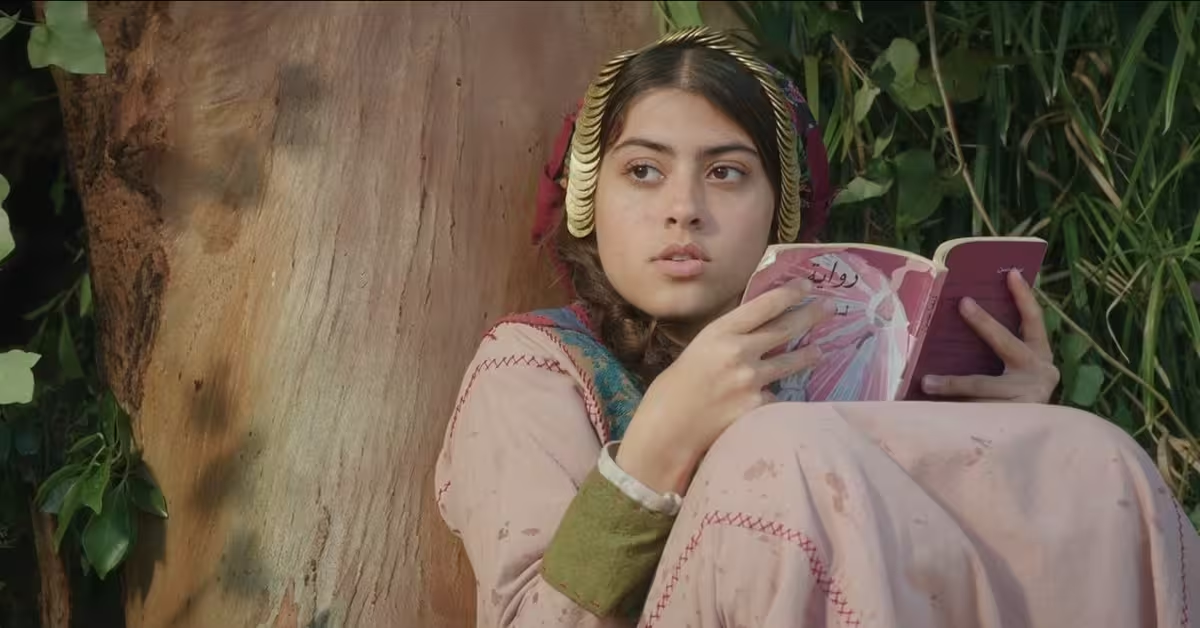
In a Palestinian village in 1948, Farha is not interested in the wedding plans that excite her friends. She wants to go to school in the city like her close friend Farida. Her father, the village leader, resists at first, but finally agrees. It is the happiest moment of her life.
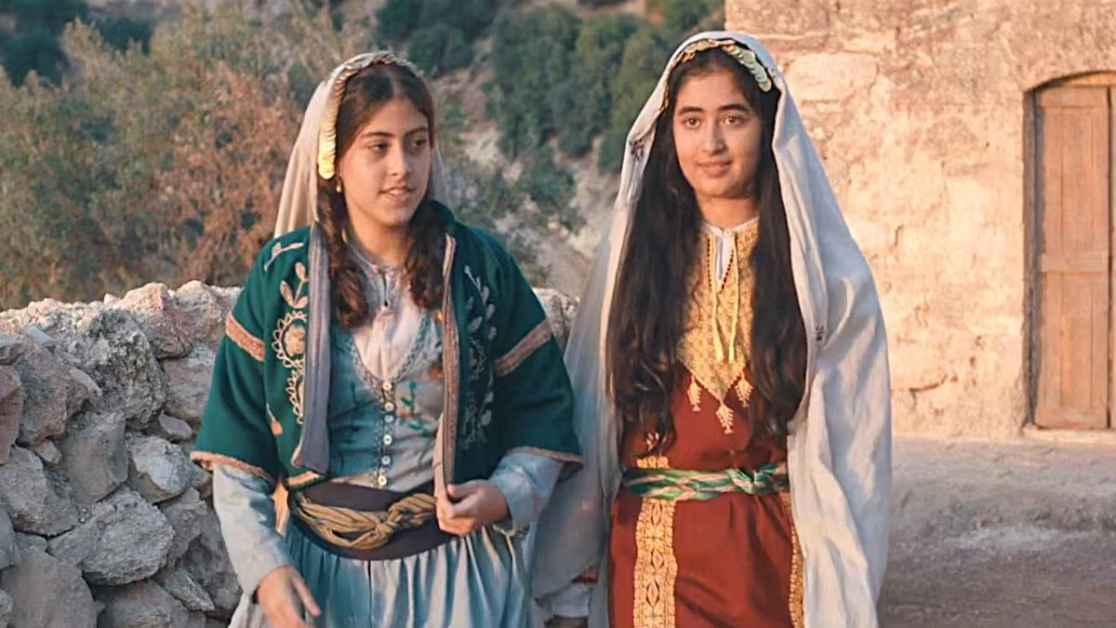
Then armed Zionist militias reach the village and order the inhabitants to leave. Farida’s family offers to take Farha with them, but she refuses to abandon her father. He takes her home and, to keep her safe, locks her in the storeroom, promising to come back for her.
He does not come. For days Farha is alone with little food and water, listening to gunfire and watching the courtyard through a hole in the wall. A Palestinian family, a father, a pregnant mother and two small children, take shelter there, and the mother gives birth. Soldiers arrive, led to the family by a Palestinian informer whom Farha recognises. The parents and children are shot.
A young soldier is ordered to kill the newborn without wasting a bullet, cannot bring himself to do it, and leaves the baby on the ground.
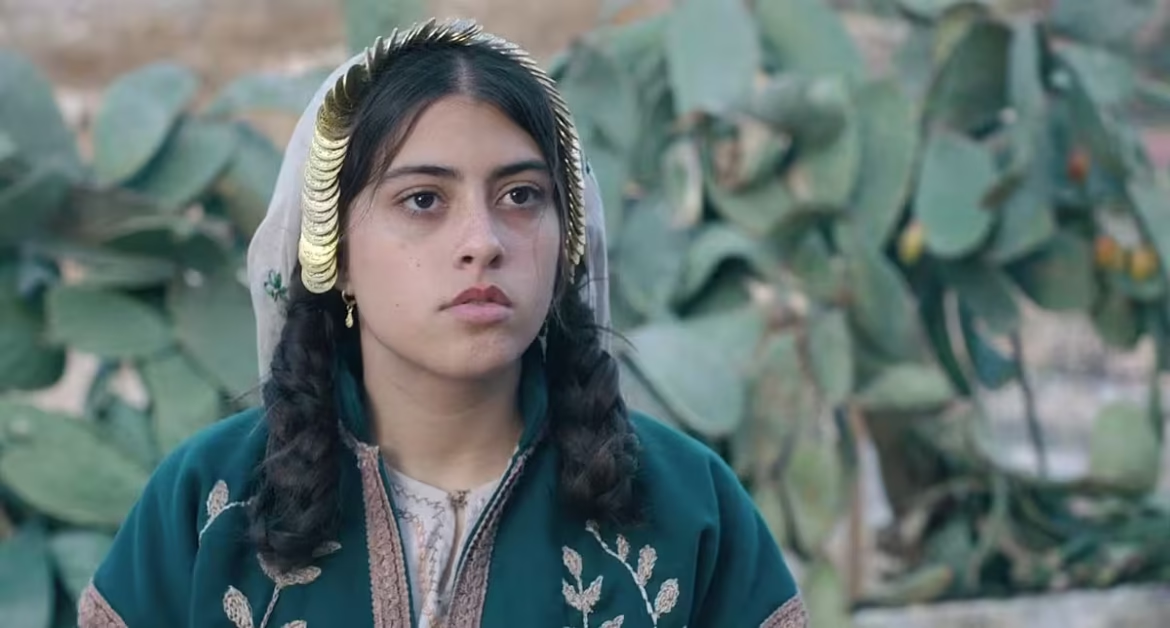
Farha hears the infant crying and cannot reach it. Eventually she finds a hidden pistol, shoots open the lock, and steps out into an empty, ruined village. Her father is nowhere to be found. The film ends with a note that the real girl made her way to Syria, and that her story survived because she told it.
Is Farha worth watching? My critical analysis
Yes, with one caveat: Farha is stronger as an experience than as a piece of screenwriting. Its great decision is where it puts the camera. After the father locks the door, the film stays with Farha, and a Boston reviewer notes that it offers claustrophobic close-ups and no other perspective characters after that turning point. You see the courtyard only as she does, through a hole and a few cracks, so what you cannot see does as much work as what you can.
Sound does the rest. Review excerpts collected on Rotten Tomatoes praise how the sound design makes the hiding place feel airless and how the film shows only snippets of violence while letting you hear it clearly. That restraint was deliberate: Sallam has said the key scene is blurry and out of focus because the film is about the girl’s journey. Runtime figures for the pantry vary.
Sallam talks about 52 minutes in a room, while Common Sense Media says more than 40 minutes are spent in near darkness. Either way, only about 40 to 52 minutes of a 92-minute film happen outside the pantry.
Critics who loved it were specific. The New York Times called it a brutal kind of coming-of-age story that speaks volumes from a tiny storage room, according to the film’s Wikipedia entry. CNN said it offers a perspective rarely heard on a global mainstream platform. The Hindu’s Pallavi Keswani praised its barebones narrative.
In contrast, the dissent deserves a hearing. Common Sense Media argues that using film as a message delivery system needs cinematic skills that are sometimes absent, and compares it unfavorably with The Endless Trench, which tells us more about the person in hiding.
Scholar Umayyah Cable, reviewing for the Institute for Palestine Studies, found the script often didactic, the editing at times rushed, and some of the biggest names occasionally awkward, and she still concluded that the film is “spectacular nonetheless”.
My own view sits between the two camps. Because so much of the runtime belongs to the pantry, the opening world of the village and Farida gets little time, and I wanted a few more minutes there so the loss would cost me more. Still, the informant is the idea I keep returning to.
A Brazilian reviewer singled out that the film does not leave out the uncomfortable role of Palestinian collaborators, and that choice gives the courtyard scene a moral weight that a simple victim and aggressor story would lack.
How good are the performances in Farha?
Karam Taher carries the film, and her performance is the main reason to watch it. This was her first on-screen appearance, and she spends most of the story alone with a hole in a wall. Film Threat says the first-time actor rises to a heavy challenge, Arab News credits her with an arc from hope to despair, suffering and joy, and a Boston Palestine Film Festival reviewer goes further, calling her work “nothing short of canonical”.
The Aswan International Women Film Festival gave the film Best Actress, though the listings I found do not name the winner, so I will not assume it was Taher.
The early scenes give her something to lose. Tala Gammoh plays Farida, and the swing scene in which the two friends plan school and futures, which Film Threat describes, is where the friendship is built. Without it the later isolation would hit less hard.
Ashraf Barhom plays the father, Abu Farha, and Ali Suliman plays her uncle Abu Walid, according to the cast list on Plex. Barhom is a veteran whose earlier work includes Paradise Now, The Syrian Bride and Lebanon. Opinions on the two big names split. Cable’s review in the Institute for Palestine Studies found some performances by the biggest names occasionally awkward, and I felt the father’s scenes worked best when he said least.
Supporting players carry the cruelest sequence. Sameera Asir and Majd Eid play the couple whose family is shot in the courtyard, Firas Taybeh plays Farida’s father, and Plex lists Sultan Alkhail as the Young Soldier and Samuel Kaczorowski as the Commander. The soldier who cannot finish the order is, for me, the most quietly affecting beat in the film, because it is a face and not a speech.
What is Farha really about?
Farha is about witness: what it costs to see a catastrophe you cannot stop, and what it means to tell it afterward. The Nakba is the setting, but the film’s real subject is one person’s attention, held on a hole in a wall.
Education as a girl’s right. The story starts with a school dream, and that is no decoration. The festival synopsis notes that girls her age were traditionally married off, and that schooling in her village was restricted to boys. When the attack comes, the film takes away the thing she had just won.
Memory passed hand to hand. The final text about Syria matters because the story survived only by being told. Sallam describes a chain of one girl telling another, who told her daughter, who happened to be her. The film is a link in that chain, which is why it feels less like an invented plot and more like testimony.
Complicity and conscience. The informant had been promised that women and children would not be hurt, and he watches that promise break. The young soldier who cannot carry out the order is the mirror image. Between them, the film shows moral injury on more than one side of the door, and that is what keeps it from being a simple picture.
Childhood ending. The festival description frames the ordeal as a journey that forces her to grow up and leave her childhood behind, and Sallam picked her lead partly for a face that looked like a child from one side and a young woman from the other.
Denial and recognition. For Sallam this is personal, not abstract: denying the Nakba is denying her existence. New Lines describes older Palestinians seeing their own stories of exile reflected, and MERIP observes that the film does not offer a happy false ending.
How does Farha compare with similar films?
Farha sits closest to confinement dramas such as The Endless Trench, and it differs by being told from a child’s point of view with no relief from the outside.
Common Sense Media draws that exact comparison with the 2020 Spanish film in which a man hides behind a false wall from 1939 authorities for 30 years, and argues that film gives us more depth about the hidden person. That is a fair hit, and it is where Farha falls short of its closest relative.
Another comparison is the Anne Frank story. Independent Catholic News sees many parallels, with the difference that Farha does get out alive. MERIP also discusses the 1960 film Exodus alongside Farha and notes that Farha’s strong lead performance is not used to produce a happy false ending.
As for place in the Nakba screen record, claims of firsts need care. A writer in the Forward calls it the first major narrative film to show the 1948 war from a Palestinian point of view, and Maktoob Media says it is the first time a major film has been made on the theme.
The Cyprus Mail is more modest and calls it one of a handful of films about the Nakba. I could not verify a clean “first”, so I use the cautious version.
Against Sallam’s own earlier work, I have no fair comparison. Her record before this was five award-winning shorts, and I have not watched them. What I can say is that this is a much larger canvas for a debut.
If you finish Farha and want more, three directions are supported by sources I found:
- For another Palestinian story on Netflix with a very different tone, the Forward points to the Palestinian American comedy series Mo.
- For the lead actor’s earlier work, Rotten Tomatoes lists Paradise Now and The Syrian Bride among Ashraf Barhom’s best-rated films.
- For the confinement angle, The Endless Trench is the film critics keep reaching for.
How was Farha received, and why did Israel object?
Critics mostly praised Farha, while Israeli ministers attacked it within a day of its Netflix release, and the two reactions have been tangled together ever since. On the review side, Wikipedia reports that all 13 counted Rotten Tomatoes reviews were positive, averaging 7.1 out of 10.
A magazine piece from December 2022 gave an IMDb rating of 8.5 out of 10, and I could not recheck the live score today, so treat that figure as a snapshot from that month.
What officials said. Finance minister Avigdor Lieberman said Netflix was streaming a film meant to stir hostility toward Israeli soldiers on false pretences, and culture minister Chili Tropper said it showed lies and libels and called the Jaffa screening a disgrace. Both were outgoing ministers at the time.
The target was a Jaffa venue, the Al Saraya Theater, which receives state subsidies. Accounts differ on the funding threat: Wikipedia says Lieberman ordered the treasury to revoke funding, while AFP says he suggested withdrawing it. I could not confirm what finally happened. The theater’s manager said the venue stood by the freedom of art and went ahead.
What critics of the film said. The activist group Iron Lion Zion called the film a blood libel, and Ynet reported that many Israelis cancelled Netflix subscriptions. The producers answered that the government was running a disinformation campaign against the film.
Voices in between. A writer in the Forward, who said the soldiers’ cruelty was uncomfortable to watch, still wrote that they did not believe the state of Israel so fragile that a film would destroy it. Another Forward opinion piece argued that the exact events may not have happened, but Palestinian civilians, including women and children, were killed in 1948, as excerpted on Wikipedia.
The ratings fight. The film was hit by a coordinated IMDb downvoting campaign, and The Hollywood Reporter judged that the effort appeared to have backfired as the score quickly recovered.
| Date | What happened | Source |
|---|---|---|
| 7 Dec 2022 | Sallam tells TIME she received hateful, racist messages | TIME |
| 1 Dec 2022 | Farha begins streaming on Netflix | Wikipedia |
| 30 Nov 2022 | Lieberman and Tropper condemn the film and the Jaffa screening | AFP via ARY News |
| 7 Nov 2022 | Screening at Palestine Cinema Days in Ramallah | Wikipedia |
| Dec 2021 | First screening at the Red Sea International Film Festival in Jeddah | Arab News |
| 14 Sep 2021 | World premiere at the Toronto Film Festival | Wikipedia |
What awards did Farha win?
Farha won a run of festival prizes and was Jordan’s official Oscar entry, but I found no Academy Award nomination. AFP reported in January 2023 that the film had won a dozen awards at other festivals. I could verify only the four below by name, so the table is shorter than that count and I have not padded it.
| Award or event | Result | Year | Source |
|---|---|---|---|
| Asia Pacific Screen Awards, Best Youth Feature Film | Winner | 2022 | Wikipedia, TIME |
| Aswan International Women Film Festival, Best Euro-Mediterranean Film dealing with Women Issues, Best Director, Best Actress | Winner | 2022 | Amman International Film Festival listing |
| Malmo Arab Film Festival, Jury Award | Winner | 2022 | Amman International Film Festival listing |
| Red Sea International Film Festival, Red Sea Competition | Special Mention | 2021 | Amman International Film Festival listing |
| 95th Academy Awards, Best International Feature Film | Jordan’s submission, no nomination found | 2023 ceremony | Wikipedia, Watershed |
The festival circuit helped as well. After Toronto, the film screened to critical acclaim in Rome, Busan, Gothenburg and Lyon, and that run led to the Netflix deal through the sales company Picture Tree International. One thing I could not confirm is whether Farha made the Academy’s shortlist, so I have not claimed it.
My Verdict
Farha is not an easy film to watch, and it is not meant to be. It is a small story about one girl that opens onto a huge history. Whatever your politics, I think it is worth ninety minutes of your attention, and a long silence afterward.







