
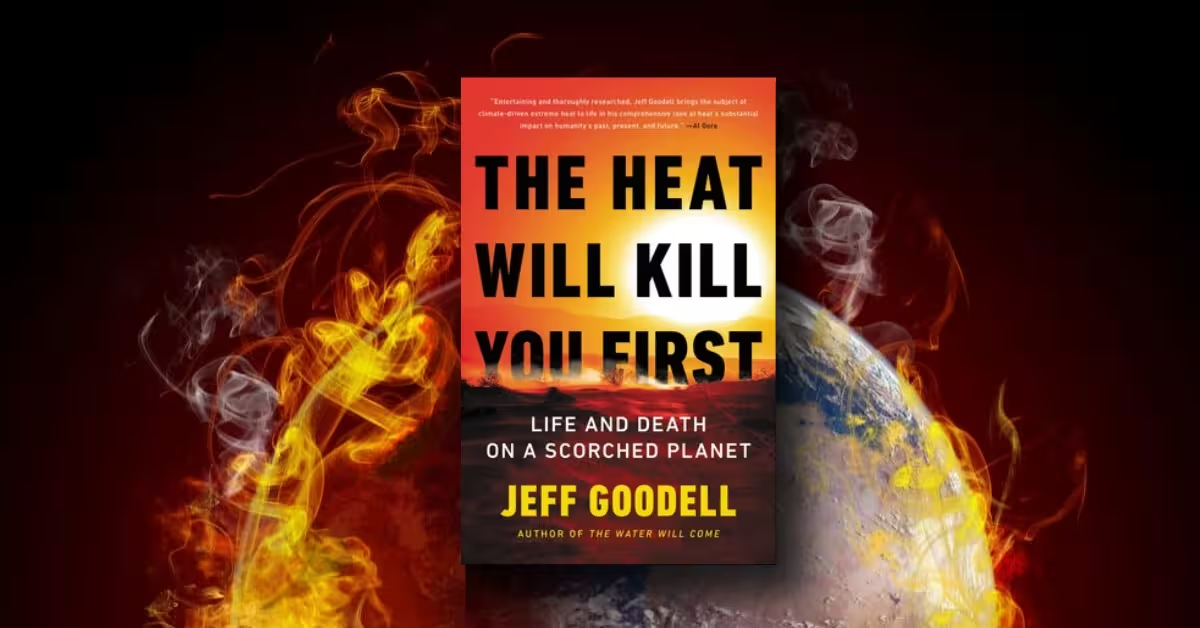
Extreme heat, heat waves, and wet-bulb temperature are not abstractions anymore; they’re the daily grammar of climate change, and Jeff Goodell’s The Heat Will Kill You First is the most vivid single-volume map to this scorching reality. In an era where global warming is shattering temperature records and heat deaths are spiking from Phoenix to Dhaka, Goodell shows—clinically and compassionately—why heat is the climate system’s first-order killer, how heat domes form, what wet-bulb temperatures mean for the human body, and which heat adaptation steps actually work.
Hot weather isn’t just uncomfortable; it’s a silent mass-casualty risk hiding in plain sight. Goodell solves the “invisibility” problem of extreme heat by making it tangible—how it kills, how it spreads, how it overwhelms cities, farms, hospitals, and our bodies long before anyone calls it an emergency. “When heat comes, it’s invisible… It just surrounds you and works on you in ways that you can’t anticipate or control.”
Heat is the engine of climate chaos: the primary, first-order effect of global warming that drives fire, drought, floods, crop failures, migration, disease, and mortality—and it’s accelerating as oceans absorb bomb-level energy every second.
Evidence snapshot
- 2024 was the warmest year on record globally, and the first calendar year with an annual average >1.5 °C above pre-industrial levels (Copernicus; WMO).
- Global heat mortality: ~489,000 heat-related deaths/year (2000–2019) worldwide; Asia ~45% of the toll (WHO; Lancet).
- Europe’s deadly summers: ~61,000 heat deaths (2022); >47,000 in 2023 (Nature Medicine/ISGlobal; Reuters).
- Wet-bulb 35 °C is near the theoretical limit of human thermoregulation; already briefly observed in nature (PNAS; Science Advances).
- Economic losses: Heat waves cost the world ~$16 trillion (1992–2013).
- Ocean heat: most excess energy (≈89%) goes into the ocean; researchers communicate its magnitude as several “Hiroshima bombs” per second—an indicator of relentless planetary heating (ESSD; multiple summaries).
Best for / Not for
Best for: readers who want a human-centered, science-literate guide to extreme heat, heat waves, wet-bulb temperature, heat adaptation, and the politics of climate change—from city planners and med students to journalists and parents.
Not for: readers seeking a narrow technical monograph or a purely optimistic playbook; Goodell’s book is narrative-driven, evidence-rich, and, at times, unsettling.
Table of Contents
1. Introduction
Title & author information
- The Heat Will Kill You First: Life and Death on a Scorched Planet (2023), by Jeff Goodell; Little, Brown and Company (U.S. publication July 11, 2023).
- Genre: reported non-fiction on extreme heat and climate change; Goodell is a longtime Rolling Stone contributing editor and multiple-book climate author (How to Cool the Planet; The Water Will Come).
Goodell’s thesis is direct: heat is the prime mover of the climate crisis—the silent first-order force driving the disasters we tend to label “secondary” (fire, drought, sea-level rise, crop failure, disease). As he writes, “The climate impacts you hear about most often… are all second-order effects of a hotter planet. The first-order effect is heat. It is the engine of planetary chaos.”
2. Background
Heat is not “just another” hazard. It reshapes physiology, infrastructure, and economies.
Goodell opens by reframing heat’s cultural and biological meanings, then connects the dots to fossil fuels: “this is a form of heat that has been unleashed upon us through the burning of fossil fuels.” And he underscores the scale with a visceral line: “the ocean absorbs the equivalent of the heat released from three nuclear bombs every second.”
External science aligns: ~89% of excess heat goes into oceans (ESSD, 2023), and the 2024 climate summary confirms humanity has entered a new temperature regime (Copernicus/WMO).
3. Summary
Goodell structures his argument like a detective story, moving from the intimate experience of heat death to the global systems it disrupts. What follows is a broad, extended summary that integrates the key themes and lessons from all chapters.
Part I: The Body Electric – How Heat Kills
The book opens with a harrowing, intimate tragedy: the 2021 deaths of the Gerrish-Chung family—Jonathan, Ellen, their one-year-old daughter Miju, and their dog Oski—on a hiking trail in California’s Sierra Nevada foothills. Goodell uses this cautionary tale (Chapter 1) as a gateway to explain the physiology of heatstroke. He masterfully dissects their final hours, their missteps, and the brutal physics that overwhelmed them.
The human body is a heat machine, fiercely maintaining an internal temperature of ~98.6°F. When ambient heat rises, the body pushes blood to the skin to cool it via sweat evaporation. But this system has brutal limits. Hyperthermia begins with dizziness and cramps and escalates to heatstroke, a cascading metabolic failure. As core temperature climbs past 105°F, cells begin to “denature” or melt. Proteins unravel, cell membranes dissolve, intestines leak toxins into the bloodstream, and organs hemorrhage. Goodell explains:
“At the most fundamental level, your body unravels… Your insides melt and disintegrate—you are hemorrhaging everywhere.”
He dispels the dangerous myth that hydration alone prevents heatstroke. While critical, water cannot cool the inner core once this feedback loop begins; only rapid, external cooling can. The Gerrish family story is the ultimate evidence of this: they had water, they were young and healthy, but the heat on that exposed, sun-baked trail was too much, too fast. Goodell’s own near-miss with heat exhaustion on a Nicaraguan volcano (Page 34-37) adds a personal, terrifying layer of validation to the science.
To understand our vulnerability, Goodell takes us back in time in Chapter 2: How Heat Shaped Us. He explores the evolutionary leap to warm-bloodedness (endothermy) that allowed mammals to dominate the planet. This advantage, however, came with a Faustian bargain: a narrow thermal operating window.
The key to human success was not just big brains or tools, but our unparalleled cooling system: eccrine sweat glands. While other animals pant or seek shade, we sweat profusely, allowing us to be persistence hunters who could literally run prey to death from heat exhaustion. But this system evolved for a specific world.
As Goodell notes, we are now “like actors in Hollywood’s silent era who suddenly find themselves cast in speaking roles. We know the script, but our skills are no longer well-matched for the world we live in.”
Part II: The Social Scorch – Heat and Injustice
Heat does not impact everyone equally. It is a predatory force that “culls out the most vulnerable people” (Prologue). Chapter 3: Heat Islands exposes the urban heat island effect, where concrete, asphalt, and AC exhaust can make cities like Phoenix 20°F hotter than surrounding areas.
Goodell profiles people like Leonor Juarez in South Phoenix, who lives in constant fear of her pre-paid electricity card running out, and Stephanie Pullman, a 72-year-old who died in her home after her power was shut off over an unpaid $51.84 bill during a 107°F heatwave.
This temperature apartheid is even starker globally. In Chennai, India, we meet Anjalai, a woman whose life is a daily negotiation with heat.
She wets her thatched roof to cool her home, worries about her husband with a heart condition working construction, and bikes across the sweltering city to her teaching job.
Meanwhile, Mercy Muthu and her family have been forcibly relocated from their slum to a concrete high-rise prison called Perumbakkam, a treeless “heat island unto itself” where the elevators trap residents during blackouts and children get heat rashes from simply playing outside.
Goodell’s reporting makes the statistic—that in a heat wave, “wealth can afford twenty-five degrees of coolness”—devastatingly real.
This inequity drives the great theme of Chapter 4: Life on the Run. Goodell argues that heat is driving a “great migration—of humans, of animals, of plants, of jobs, of wealth, of diseases.” He details how species are moving pole-ward at an average of 1 mile per year, with malaria-carrying mosquitoes moving even faster at 2.5 miles per year. But humans are also on the move, both toward and away from danger.
He meets climate refugees fleeing Hurricane Harvey’s watery aftermath, only to encounter the desert’s thermal wall.
This chapter contains one of the book’s most chilling passages: the weaponization of heat. On the “Devil’s Highway” along the US-Mexico border, Goodell joins John Orlowski of the humanitarian group No More Deaths.
He learns that the US Border Patrol strategically funnels migrants through the hottest, most lethal corridors, a tactic Orlowski confirms is a deliberate strategy. “So, basically, the US Border Patrol has figured out a way to weaponize heat,” Goodell states. Orlowski replies, “Yes, that’s one way to think about it.” It is a stark admission that heat has become a tool of policy and violence.
Part III: The Engine of Chaos – Heat’s Planetary Reach
The middle section of the book expands the lens to show how heat is the fundamental driver of other climate disasters.
Chapter 5: Anatomy of a Crime Scene introduces Dr. Friederike Otto, a pioneer of extreme event attribution science. Her work allows scientists to calculate how much more likely or intense a specific heatwave was due to climate change. For the 2021 Pacific Northwest “heat dome,” her team concluded it would have been “virtually impossible” without human influence. Goodell bikes with Otto through London during its own record-shattering 2022 heatwave, framing her as a detective at a crime scene, gathering evidence to hold the perpetrators—fossil fuel companies—liable. This science, Otto believes, is “the first science ever developed with the court in mind,” potentially opening the door to trillions in damages from climate lawsuits.
Chapter 6: Magic Valley explores heat’s impact on our food supply. Goodell travels to the agriculturally rich Rio Grande Valley, where the convergence of heat and drought is pushing farmers to the brink. He explains the brutal biology: plants sweat (transpire) too, and their water needs double with just a 18°F (10°C) rise in temperature. Heat disrupts pollination, increases pests, and makes crops less nutritious. He details the vulnerability of corn, a crop that evolved in a steady 80°F climate now pushed to its absolute limits.
The takeaway is terrifying: a recent study found that global agricultural productivity is already 21% lower than it would have been without climate change.
Chapter 7: The Blob shifts to the oceans. Goodell details the infamous 2013-2015 North Pacific marine heatwave, a Texas-sized patch of water 5°F hotter than normal.
Christened “The Blob,” it killed phytoplankton, collapsed food chains, and led to the death of a million seabirds, the starvation of sea lions, and the bankruptcy of fisheries. It also demonstrated the ocean’s role as a climate shock absorber—it has absorbed 90% of the excess heat from global warming—and the dire consequences when it overheats.
The Blob contributed to California’s drought and may have amplified wildfires by raising nighttime temperatures, preventing fires from calming down. Goodell’s dive in the now-devastated kelp forests of Monterey Bay, grazed to oblivion by urchins that thrived in the warmer water, is a poignant elegy for a lost ecosystem.
Part IV: The Future – Roast, Flee, or Act
The final chapters grapple with adaptation and survival. Goodell explores the limits of air conditioning (a solution that often exacerbates the urban heat island effect), the promise and perils of geoengineering, and the stark choices we face.
The title of Chapter 13: Roast, Flee, or Act says it all. He is skeptical of purely technological fixes, arguing that they often deepen inequality. True resilience, he suggests, will come from social cohesion, equity, and a radical reassessment of our relationship with the planet.
The book concludes by returning to its philosophical core: the Goldilocks Zone. All life exists within a specific, narrow temperature band. We have spent centuries exploiting the energy of ancient life to push ourselves and every other living thing out of that zone.
The heat is here, and it is killing us first because we are the architects of this new world, yet remain trapped in bodies and societies built for the old one.
Highlights
Highlighted takeaways (you can skim this and grasp the whole book):
- Extreme heat is a first-order climate hazard that directly harms health, agriculture, infrastructure, and ecosystems, and indirectly magnifies wildfire, drought, floods, migration, and economic losses.
- Heat waves now routinely exceed historical norms, turning “climate refuges” into risk zones, as seen in the 2021 Pacific Northwest heat dome.
- Heat kills quietly and fast, often without dramatic visual cues—making risk communication and heat adaptation (cooling centers, urban shade, work-shift changes) central to public health.
- Wet-bulb temperature (and WBGT) are better guides to danger than air temperature alone; 35 °C wet-bulb is near the survivability limit, with lethal risk at lower thresholds for sustained exposure or vulnerable people.
- Urban heat islands amplify inequality: neighborhoods with more concrete and less tree canopy can be 15–20°F hotter than nearby leafy zones—especially at night.
- Global heat mortality is serious and undercounted: ~489,000 heat deaths annually (2000–2019), with Asia and Europe bearing large shares, as per WHO report.
- Economy-wide costs are massive: heat waves have drained ~$16 trillion from the global economy (1992–2013).
- Oceans, absorbing most excess heat, are broadcasting a planetary fever—fueling marine heatwaves and coral bleaching, with energy analogies of multiple atomic bombs per second.
- Personal action + system change: Goodell illustrates interventions from tree shade and cool roofs to city heat officers, workplace standards, early warnings, and emissions cuts—because “cheap cold air” (AC) is not a silver bullet if grids fail or urban design traps heat.
How The Heat Will Kill You First builds its case
Prologue – “The Goldilocks Zone.” Goodell begins with the 2021 Pacific Northwest heat dome, warning residents that “this is life-threatening heat,” then showing how a supposed climate refuge became a mass-casualty zone. He explains why heat is invisible and treacherous—you feel fine until you don’t—and how it interacts with humidity, wind, shade, and exertion.
Early chapters trace heat’s evolutionary role and today’s urban realities (the urban heat island, AC dependence, work exposure). He defines WBGT and wet-bulb in clear, nontechnical language; the glossary clarifies how WBGT captures sun, wind, and radiation while WBT isolates evaporative cooling—critical when humidity spikes.
Case studies anchor the narrative:
- Cities: concrete + low canopy + waste heat = killer nights. Goodell’s 15–20°F urban-rural differential lines up with climate organizations’ summaries and public-health literature.
- Agriculture & labor: night shifts to beat heat fail when nights stay hot; WBGT exceeds safe work thresholds more often, raising kidney injury risk for outdoor workers. (Goodell details orchard workers starting at 1 a.m. during the PNW heat dome.)
- Disease & vectors: warming speeds mosquito range expansions (~2.5 miles/year poleward, per cited literature in the book’s notes).
- Oceans & ice: the same engine of heat is melting ice sheets, elevating seas, and reshaping currents—and, via marine heatwaves, it is triggering ecological cascades.
Numbers to keep in your head (from the book’s “Heat Index,” with peer-reviewed sources):
- 30 million people live today in mean annual temperature >85°F; 2 billion could by 2070.
- 21%: global ag production loss over 20 years due to heat and drought; 210 million more people facing acute food insecurity since 2019.
- 489,000 heat deaths/year (global, 2000–2019).
Goodell’s argument crescendos with a simple point: heat is not a future problem. It’s here; 2024 broke global records; and South Asia, including Bangladesh, is living this reality with weeks-long heatwaves, school closures, and economic strain.
4. Critical Analysis
Evaluation of content
Goodell excels at translating complex physiology and atmospheric science into human terms. He interleaves narrative scenes (orchard workers picking cherries at 1 a.m.) with WBGT and wet-bulb explanations, making clear why 95°F wet-bulb (~35 °C) is not a trivia fact but a survivability threshold. Peer-reviewed literature supports these thresholds and warns they’re being briefly reached already in parts of the world.
On evidence: he’s careful with sourcing—his Heat Index references PNAS, Nature Climate Change, Lancet Planetary Health, WFP, ISGlobal, and more, and his framing of oceans as heat sinks aligns with Earth energy imbalance research.
Does the book fulfill its purpose? Yes—by repositioning extreme heat at the center of climate risk and connecting personal risk (your sweat, heart rate, blurry vision) to planetary dynamics. If you’re in public health, planning, or education in a warming region (e.g., South Asia, Mediterranean, U.S. Sun Belt), it’s effectively a primer and story-driven briefing.
Style & accessibility
Goodell writes with reporterly clarity and novelistic detail. He avoids numbing jargon and explains terms like urban heat island in brisk, memorable prose (“temperatures 15 to 20 degrees hotter in cities”). His metaphors stick—for instance, the “three nuclear bombs every second” ocean-heat image is both intrinsically memorable and anchored in energy-balance math.
Themes & relevance
The central theme—heat as first-order hazard—is deeply relevant to 2023–2025 events: record-hot oceans, “warmest year on record” (2024), and cascading impacts (fires, crop failures, power demand spikes).
The book also grapples with inequality: heat’s heaviest burdens fall on outdoor workers, the elderly, low-income neighborhoods, and countries in the tropics (Asia contains ~51% of temperature-related mortality across cold + heat categories).
Author’s authority
Goodell isn’t a lab scientist; he’s a veteran climate journalist whose previous books (Big Coal, How to Cool the Planet, The Water Will Come) and Rolling Stone work have built credibility as a translator and synthesizer of climate risk.
He cross-checks claims with primary literature and interviews, then ties them to lived stories.
5. Strengths & Weaknesses
What worked for me (strengths):
- The physiology is unforgettable. After reading his description of heat stress—“Your heart races… Your vision blurs” —I started calibrating my day by WBGT, not just the forecast.
- It centers what kills. By insisting heat is the main act, not a side effect, Goodell changes how you read every heat story thereafter.
- The data spine is strong. The Heat Index section corrals scattered science into a compact dashboard (e.g., 489,000 annual heat deaths; 21% ag productivity loss).
- Actionable framing. From cooling centers to shade equity and workplace standards, Goodell connects high theory to low-tech interventions.
Where it may frustrate (weaknesses):
- Limited deep dive on policy levers. The book sketches adaptation options but—by design—stays narrative. If you want exhaustive policy or engineering blueprints, you’ll need to supplement with technical reports.
- AC paradox underexplored. He flags AC’s equity and grid problems (and “Cheap Cold Air” as a chapter idea), but readers might want more cost-benefit detail on passive cooling and district systems in tropical megacities.
6. Reception, criticism, and influence
- Mainstream reviews highlight urgency and clarity; The Washington Post wrote it “lives up to its alarming title.”
- Grist called it “a chilling book—and a warning.”
- The book has seeped into civic conversations, including public talks and policy forums focused on extreme heat.
- Why some readers critique it: a few reviews say it leans on familiar climate narrative arcs (story → science → responsibility) rather than novel policy architectures.
7. Quotations
- “When heat comes, it’s invisible… You sweat. Your heart races… The sun feels like the barrel of a gun pointed at you.”
- “In this book, my goal is to convince you to think about heat in a different way… [It] can bend railroad tracks and kill you before you even understand that your life is at risk.”
- “This is a form of heat that has been unleashed upon us through the burning of fossil fuels.”
- “The ocean absorbs the equivalent of the heat released from three nuclear bombs every second.”
- “The first-order effect is heat. It is the engine of planetary chaos.”
- “Urban heat island: …temperatures 15 to 20 degrees hotter in cities than in nearby rural areas…”
- “Wet-bulb temperature… focuses on humidity and how well someone can cool via the evaporation of sweat.”
- “This is life-threatening heat.”
8. Comparison with similar works
- David Wallace-Wells, The Uninhabitable Earth: macro-scale catalog of climate risks; Goodell zooms into heat as the proximate killer, with more physiology and city-level storytelling.
- Amitav Ghosh, The Great Derangement: cultural/philosophical framing of climate imagination; Goodell provides public-health pragmatism and reporting on heat waves and wet-bulb events.
- Kim Stanley Robinson, The Ministry for the Future: fiction that (famously) opens with a wet-bulb mass casualty; Goodell is the nonfiction counterpart, binding that scenario to real numbers and case studies.
- Reports (WMO, WHO, Copernicus, ISGlobal, Dartmouth): Goodell’s narrative is consistent with these institutions’ findings on record heat, heat deaths, and economic costs.
9. Conclusion & recommendation
Overall impression: This is the single best extreme heat explainer I’ve read that balances human stories, physiology, infrastructure, and science—without numbing the reader with acronyms. It convinced me to treat heat as the first line on any climate risk checklist, not an afterthought.
Who should read it?
- General readers who want a lucid, gripping tour of how heat waves endanger daily life.
- Students and policymakers in Bangladesh, India, the Middle East, the U.S. Sun Belt—anywhere wet-bulb risks and urban heat islands are rising.
- Journalists, city planners, public-health workers who need a narrative-plus-data foundation to communicate risk and design heat adaptation.
A note on “philosophy”: While The Heat Will Kill You First is not a philosophy book, it works as public philosophy about how we live together on a warming planet—what we owe workers, neighbors, and future generations.
For that reason, many consider it one of the most important climate and public-health books of the decade; it reframes our ethics of care under extreme heat (see BBC/Reuters/WMO/Copernicus coverage of the new heat regime).
Appendix: Evidence & current context you can cite tomorrow
- Warmest year on record (2024), annual mean >1.5 °C above pre-industrial (Copernicus/WMO). (copernicus.eu)
- Heat deaths: ~489,000/year (2000–2019); Europe 2022 ~61,000; Europe 2023 >47,000. (World Health Organization)
- Wet-bulb limit: 35 °C theoretical survivability edge; observed brief exceedances and many near-misses (Science Advances; PNAS). (Science)
- Economic loss: $16T due to heat waves, 1992–2013 (Dartmouth).
- Bangladesh: consecutive record heatwaves, school closures, record long heat spells in 2024–2025; strong local relevance for planning. (ReliefWeb)
Goodell does for extreme heat what Atul Gawande did for clinical checklists: he makes a technical, under-appreciated killer memorable, measurable, and manageable. After his pages, wet-bulb 30–35 °C is no longer a statistic; it’s a boundary in your mind about when you call your elderly neighbor, cancel the midday practice, or fight for tree canopy and cool roofs in your ward.
A few last, high-impact passages worth quoting exactly (and citing)
- “The amount of heat… is difficult to grasp: by one measure, the ocean absorbs the equivalent of… three nuclear bombs every second.”
- “The first-order effect is heat… the engine of planetary chaos.”
- “Urban heat island… temperatures 15 to 20 degrees hotter in cities than in nearby rural areas.”
- “Wet bulb temperature… focuses on humidity and how well someone can cool via the evaporation of sweat.”
- “This is life-threatening heat.”







