
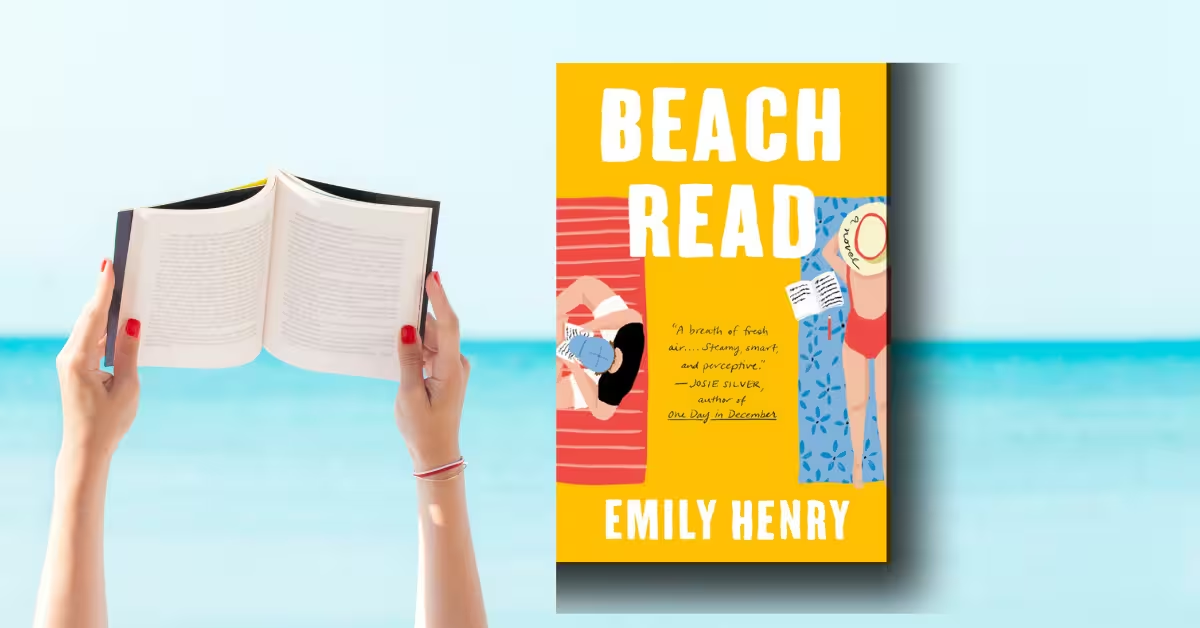
When love feels like a lie and art dries up, Beach Read solves the problem of how to write (and live) through grief, betrayal, and writer’s block—without surrendering hope.
It shows that a “happy ending” can coexist with complicated truths, and that healing often requires changing the story you tell yourself about your life.
Most of all, it proves romance can be emotionally rigorous literature, not just an escape.
Two blocked authors—romance writer January Andrews and literary novelist Augustus “Gus” Everett—swap genres for a summer, only to discover that honesty, vulnerability, and love are the hardest (and most necessary) things to write and to live.
The novel opens with January’s life imploding—“I HAVE A FATAL flaw”—and grounds its transformation in precise scenes, like her father’s cancer-era family memory (“You know what we need to get these bad feelings out? We need to dance!”).
Externally, Beach Read hit major bestseller lists and accelerated Emily Henry’s ascent; it was published by Berkley on May 19, 2020, and became a New York Times bestseller, later fueling multiple screen deals for Henry’s works.
Best for readers who want a romance novel with real emotional stakes, layered character arcs, and meta-literary playfulness (enemies-to-lovers, forced proximity, writer vs. writer).
Not for readers looking for pure fluff, zero grief, or a plot that avoids moral ambiguity around family, fidelity, and forgiveness.
Table of Contents
1. Introduction
Beach Read by Emily Henry (Berkley, May 19, 2020) is a contemporary romance set on Lake Michigan in a small lakeside town, told with crisp, witty first-person narration.
Henry—a breakout star whose novels have dominated bestseller lists—uses the genre’s warm architecture to explore grief, disillusionment, and creative recovery.
Beach Read is significant because it reframes the “happy ending” not as denial, but as an earned ethical wager: January chooses honest love and honest art after losing her old story. It’s a smart, emotionally literate romance that stands up to close reading and rewards rereading.
2. Background
Henry’s adult debut arrived in 2020 amid a pandemic-era surge in romance readership and BookTok attention, helping revive mainstream respect for the genre’s depth and craft.
Published by Berkley (Penguin Random House’s romance powerhouse), Beach Read quickly became a bestseller, later included in “best of” lists and award longlists; its success positioned Henry for multiple screen adaptations (including Beach Read in development at 20th Century Studios).
3. Summary of Beach Read
January Andrews arrives at her late father’s secret Lake Michigan house broke, heartbruised, and blocked—forced to confront the wreckage of an old family myth (“we will always be okay”) and the proof of his affair sealed in a key and a letter she’s too afraid to open.
On the first night, she meets neighbor Augustus “Gus” Everett—her taciturn college rival turned acclaimed “serious” novelist—when his party rattles her windows and their barbed banter restarts a competition that never really ended. The house’s bohemian decor and a framed bestseller list (with both their names once on it) twist the knife of recognition: they occupy parallel careers, opposite temperaments, and—for the summer—adjacent decks like a stage set for a duel.
January can’t write her promised romance; Gus, for all his reputation, is also stuck in a private winter, nursing old wounds behind a crooked mouth and a cultivated disdain for “happily ever after” that once punctured January in workshop: “Let me guess: Everyone lives happily ever after. Again.”.
They make a bet to break the stalemate: January will write “literary,” and Gus will write a true romance with a real HEA, each dragging the other on weekly “research dates” into their respective worlds—her rom-com field trips (fairs, dancing, book club) and his interviews tied to a local cult’s grim history.
The arrangement turns proximity into intimacy; porch-to-porch teasing softens into porch-to-porch confession, and the novel begins to braid two craft problems (how do you end a story honestly?) with two human problems (how do you love honestly?) until the boundaries blur and both manuscripts start to sound like letters written to the person next door.
January’s fatal flaw—“I HAVE A FATAL flaw”—was never naïveté but her impulse to narrate life as if candlelight and Fleetwood Mac could always punch holes in fear. Gus’s fatal flaw is the reflex to evacuate first—to live in the cold safety of disillusionment where no ending can disappoint him because he wrote it off in advance.
The house forces January to metabolize grief in geographical layers: the deck where she spars with Gus, the kitchen where her father’s memory hums in a framed bestseller clipping, and the bathroom where photographs confirm a second life she didn’t know existed.
Meanwhile, Pete’s Coffee & Books becomes their neutral ground, a small-town refuge where January’s career anxiety meets community; it’s also where she first truly sees Gus in daylight—less a “grump” than a man carrying more history than he admits, his magnetism tempered by caution.
Each research date exposes the hidden premise under their styles: January learns that writing darkness demands the same ethical precision romance demands about care and consent, while Gus learns that romance’s promise is not denial but an audacious thesis about repair. When storms roll off the lake, scene and psyche sync up; as the weather clears, so do the sentences—hers warmer, his gentler—and the summer tilts from friction to tenderness. They sleep together, and the bet stops being cute; it becomes a dare to live the endings they mock or fear, and both of them, still drafting, flinch.
Gus recedes when vulnerability feels like a deadline he can’t meet; January pushes forward because craft is the only tool she can still trust, even when hope feels like a costume. Finally, she opens her father’s letter, and its voice rearranges the furniture of her grief without excusing the affair: love can be true and still harm, a contradiction she must hold if she wants to keep any story at all.
In the town’s long shadow of a cult tragedy, January witnesses how testimony—survivors telling their stories to Gus—can be both mirror and solvent, making her own family narrative feel less singular and less shaming. Gus, whose marriage wrecked in the undertow of childhood trauma, admits the limits of pure skepticism: it protected him but stranded him on the cold side of the glass, watching connection like a scientist instead of risking it like a lover.
Their pages start to answer each other: January’s “literary” draft refuses to tidy the past and still reaches, embarrassingly, for light; Gus’s “romance” draft drops the ironic air quotes and names longing as a real research subject, not a specimen to pin.
But the bet—so playful at first—now hurts because its outcome is their lives; if one of them finishes and the other can’t, then the loser has to admit the thesis failed, and losing feels indistinguishable from being unlovable.
A rupture comes as it often does in love stories that don’t cheat: each misunderstands a retreat as rejection rather than terror.
January re-reads the house as archive rather than evidence against her father; forgiveness becomes less a verdict than a practice, and she chooses to finish a book that won’t lie to her or for her, even if it forfeits the easy sheen she once wore so well. Gus, cornered by the truth that he wants more than he’s trained himself to want, returns not with a grand speech but with a willingness to stay on the page—inside the scene, inside the risk, inside January’s life—without narrating himself out of it.
They reconcile not through a gimmick but through revisions: apology, clarity, and specific promises about how to fight better next time.
The lake is calm when they claim each other openly, and the decks that staged their duel now stage a future—still provisional, still human, but chosen.
The manuscripts land; the deadline that once felt like an execution shifts into a ceremony.
January’s book is honest about grief and still insists on joy, and Gus’s book stakes his name on a tenderness he used to mislabel as unserious—proof that “HEA” can be a rigorous artistic choice, not a concession.
In a coda that resists syrup, the town holds them like a chorus, Pete’s kindness still a lighthouse for both, and work doesn’t stop because love began: the point is not that romance solves life but that it changes how you work on it—together.
January’s final understanding of her parents is neither idol nor indictment: it’s an adult knowledge that two truths can sit side by side like their houses—love was real, harm was real—and integrity means carrying both without letting either erase the other.
When the summer closes, nothing about the world is simpler, yet everything about their days is more precise: coffee, writing, porch light, a laugh that wasn’t there before, and the small, repeated courage of choosing the same person tomorrow. The bet is now an heirloom—a private joke and a public ethic—because winning turned out to be the same as learning how to lose the old story and keep the heart.
So the book ends where honest romances do: not at the finish line but at a threshold, with two writers who no longer need to borrow each other’s forms to speak plainly, and with a happy ending that is not an escape hatch but a craft decision—an audacious, ethical yes that they keep revising, keep living, and keep earning.
Setting
A Lake Michigan town of bookshops, porches, decks facing decks, and water that “beats up on the dusky shore,” the setting functions as a pressure cooker and a mirror: the open lake evokes vastness—possibility, grief’s horizon—while the side-by-side decks stage the novel’s theater of misrecognition and desire.
Pete’s Coffee & Books (with its earnest, small-town warmth) counterbalances January’s pain, and the house itself—curated with “bohemian” tastes that aren’t her mother’s—becomes a contested archive of what January thought she knew versus what truly was.
4. Beach Read Analysis
4.1 Beach Read Characters
January is a romantic realist in recovery; her “fatal flaw” is not optimism but the habit of narrating life as a controllable story (“the one about your own life… golden light lancing through car windows”).
Gus is not a simple grump; he’s a researcher of sorrow, a man whose “seriousness” masks fear of disappointment and the ease of preemptive rejection—his early “Let me guess: Everyone lives happily ever after” posture from college haunts January’s work ethic and heart.
Together, they are genre in dialogue: each learns that the other’s form isn’t lesser but differently rigorous—romance demands ethical commitments (consent, care, trust), and “literary” fiction demands fearlessness about ambiguity; the novel’s craft argues for both.
4.3 Beach Read Themes and Symbolism
Truth vs. Story: The father’s letter and the house key function as physical symbols of narrative authority—who gets the last word, and what happens when reality contradicts your thesis about love.
Grief and Art: The genre-swap is a Trojan horse for grief work; research dates collapse the distance between writing and living, culminating in pages that are both confession and craft.
Community & Witness: Secondary spaces (book club, interviews, coffee shop counters) remind the protagonists that love stories are social texts, not private fantasies.
Water / Lake as Threshold: The shoreline, where “angry” waves knock against the land, stages every difficult choice as a crossing; storms externalize internal weather, then clear.
5. Evaluation
Strengths (pleasant, positive experiences)
The prose is propulsive and quotable without grandstanding—Henry can turn a scene with a line (“There would be candlelight and Fleetwood Mac playing softly in the background”), then undercut it with humor, then press on a bruise. Characters own complicated choices; the chemistry is earned; the meta-talk about genre lands as both critique and love letter.
Weaknesses (negative experiences)
Readers seeking a feather-light beach romp may find the cult-interview subplot heavier than expected; some may want more on Gus’s past marriage and less on January’s internal monologue, where pain can circle back on itself.
Impact
Beach Read hit me like a mirror I didn’t know I needed: the scene where January admits she’s “so tired” after performing composure felt alarmingly, tenderly true; the novel re-taught me that hope is a discipline, not a delusion.
Comparison with similar works
Position it beside David Nicholls’s One Day for time and tenderness, or Sally Rooney’s Normal People for intelligent intimacy, but note that Henry insists on a romance HEA as an ethical stance—akin to Jasmine Guillory’s warmth with the lit-fic texture of Ann Patchett’s interpersonal clarity.
Reception and criticism
Beach Read debuted to strong trade reviews (Kirkus called it “heartfelt”), hit the NYT list, and anchored Henry’s multi-million-selling momentum (now 7–10M+ copies across her catalog, depending on the report).
Adaptation
20th Century Studios is developing a feature film of Beach Read, with writer-director Yulin Kuang attached; Henry confirms Beach Read (and others) are in development, with timelines moving slowly as is typical.
6. Personal Insight
In classrooms that dismiss romance as “lesser,” Beach Read is a clean case study for genre literacy: ask students to map consent, conflict resolution, and repair as ethical plot beats, then contrast with the investigative arc of Gus’s interviews.
For data points: romance has boomed in the BookTok era, bringing complex emotional narratives to mainstream readers, a trend outlets have traced across Henry’s meteoric rise and the pandemic’s demand for hopeful art.
For film/media literacy, you can pair this novel with news about the 2026 Netflix release of Henry’s People We Meet on Vacation and discuss adaptation pipelines, IP economics, and why romance translates well to screen.
If you assign reflective writing, consider a prompt: “Rewrite one core memory with the least charitable interpretation (Gus-mode), then with the most hopeful (January-mode). Which version feels truer—why?”
7. Beach Read Quotes
“I HAVE A FATAL flaw.”
“You know what we need to get these bad feelings out? We need to dance!”
“The point is, I started telling myself a beautiful story about my life…”
“January Andrews stared out the car window at the angry lake beating up on the dusky shore.”
“Let me know if you need any sugar.”
8. Conclusion
Emily Henry’s Beach Read is a romance that refuses to lie, a love story that keeps the lights on while letting you see the room; it’s as funny as it is ferocious about grief, as generous as it is exacting about craft.
Recommended for readers who want an enemies-to-lovers romance with brains, for writers who need a permission slip to start again, and for teachers seeking a living, teachable text about narrative ethics.
Its significance endures because it argues, persuasively, that honest joy is not naïve—it’s an act of rigorous imagination.







