
Last updated on January 13th, 2026 at 05:34 am
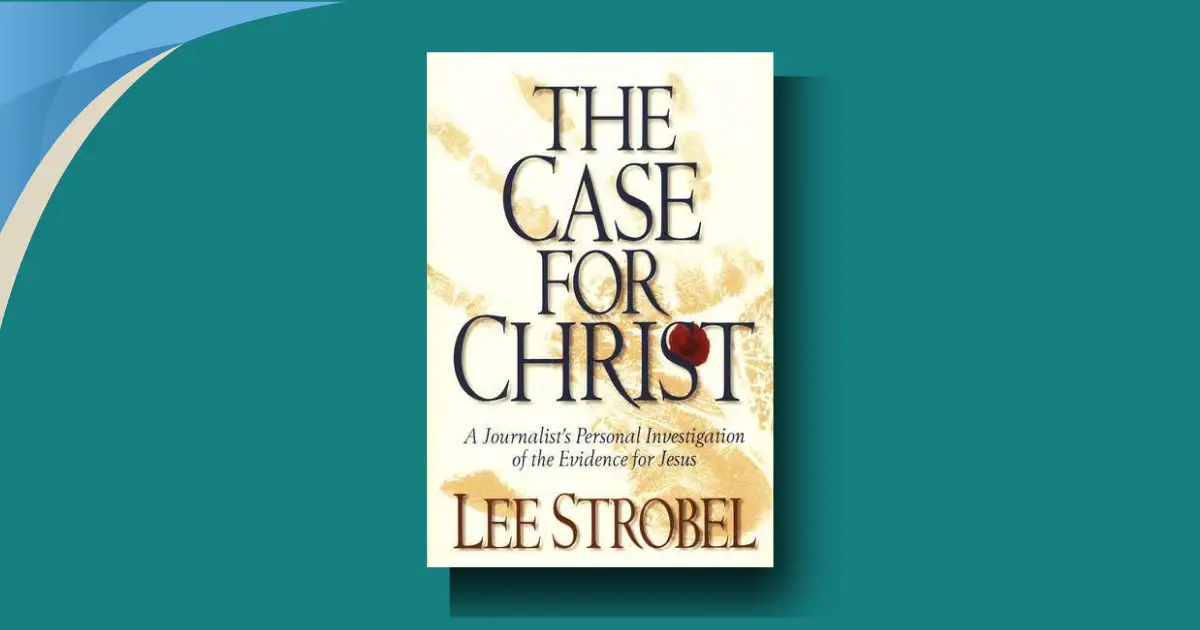
Ever wonder why your doubts don’t go away—even after you’ve “tried” faith—because your brain keeps asking for receipts? The Case for Christ is the rare Christian book that welcomes that itch and treats it like a serious question, not a sin.
Lee Strobel turns the Jesus question into a courtroom-style investigation—interview by interview—arguing that the cumulative evidence points to Jesus’ identity and resurrection as the best explanation of the historical data.
The Case for Christ is best for
- Curious skeptics who want a structured case rather than vibes.
- Christians who want a “why I believe” framework that’s easy to explain.
- Readers who like journalism, cross-examination, and clear claims.
Not for:
- Readers wanting a neutral academic survey of historical Jesus scholarship (it’s apologetics-driven).
- People allergic to evangelical framing or miracle-affirming assumptions.
- Anyone looking for a short, gentle devotional (this is built like an argument).
Table of Contents
1. Introduction
Book: The Case for Christ: A Journalist’s Personal Investigation of the Evidence for Jesus
Author: Lee Strobel
Publisher: Zondervan (HarperCollins Christian Publishing)
First published: commonly listed as 1998
Context (genre, subject, author credentials)
This is modern Christian apologetics written in a journalistic/legal style: Strobel frames Christianity’s central claim—Jesus’ identity and resurrection—as something you can interrogate using evidence, interviews, and reasoning.
Strobel’s public bio typically highlights that he trained as a journalist and worked at the Chicago Tribune (often described as its legal editor) and that he began as an atheist before converting to Christianity.
That background matters because the entire voice of the book is “reporter with a notebook,” not “pastor with a pulpit.”
Purpose of The Case for Christ
Strobel states the mission plainly: he aims to “investigate the evidence for Jesus and ultimately reach a verdict about whether he’s the Son of God.”
He also says the investigation is meant to help “spiritual seekers” examine “the outrageous claims of Jesus.”
2. Background
The emotional spark is personal: Strobel describes his wife Leslie’s conversion and his resistance—he says he “wasn’t about to allow God” into their marriage and that his “aim had been to crush her newfound faith.”
He even anchors the moment in time: Leslie becomes a Christian in the autumn of 1979, and he describes himself as an atheist then.
That home-pressure becomes the narrative engine: If Christianity is false, prove it. If it’s true, face it.
Strobel’s method is to build a case through expert interviews, organized into three big movements:
- Part 1: Examining the Record (gospels, manuscripts, external corroboration, archaeology, rebuttals)
- Part 2: Analyzing Jesus (identity, psychology, “profile” of God-attributes, messianic “fingerprint”)
- Part 3: Researching the Resurrection (death, empty tomb, appearances, circumstantial evidence)
3. The Case for Christ summary
What the book feels like as you read it
The tone is intentionally prosecutorial. Strobel repeatedly uses trial imagery: evidence tightening “a noose,” courtroom strategies, “dead-bang winner” cases, and verdict language. Even before he gets to Jesus, he opens with an attempted murder case to show how cumulative evidence can persuade.
Introduction :“Reopening the Investigation of a Lifetime”
Strobel begins like a legal thriller: a shooting, fingerprints, a gun, motive—classic “open and shut.”
Then he pivots: what if you approached Christianity with the same evidence habits? This is The Case for Christ’s framing device: treat the Jesus claim like a case file.
He admits something that actually made me trust the narrative more: he wasn’t a neutral explorer at first. He says he wasn’t “sincerely seeking truth” in the early stage—he was trying to win.
That confession matters because it sets up the internal arc: the evidence doesn’t merely inform him; it confronts his motives.
Part 1 : Examining the Record
Chapter 1 — The Eyewitness Evidence (with Craig Blomberg)
Strobel’s first big question is simple: Can the biographies of Jesus be trusted?
He interviews Craig Blomberg, and the chapter functions like a basic reliability primer: what the gospels are (ancient biographies), why they were written, and how historians weigh sources.
A key move in this section is Strobel’s attempt to knock down the gospels the way a defense attorney might: bias, legend, time gap, contradictions. The response (as presented in the book) is: yes, authors had perspectives, but perspective ≠ fabrication—and the earlier you can date traditions, the less room there is for mythology to grow.
Chapter 2 — Testing the Eyewitness Evidence (with Blomberg again)
This is the cross-exam sequel: Strobel returns with tougher objections—especially contradictions and whether gospel differences undermine reliability.
This chapter is less about new facts and more about stress-testing the previous chapter’s confidence.
My reader takeaway: this two-part structure is intentional persuasion: “state the case” then “attack the case” then “defend it.” It’s lawyerly.
Chapter 3 — The Documentary Evidence (with Bruce Metzger)
If the gospels are the “testimony,” this chapter is chain-of-custody: Were Jesus’ biographies reliably preserved?
Here come the famous manuscript numbers. The Case for Christ contrasts the New Testament with Homer’s Iliad: it states that more than five thousand Greek manuscripts had been cataloged, and that the next best ancient work (the Iliad) has fewer than 650.
Strobel uses that contrast to argue: even with copying variations, the textual base is unusually rich.
He also shares a striking analogy: the “Pinto papers” were authenticated with only “a handful of documents,” while the New Testament has far more manuscript support—so (as the book frames it) the confidence level can be high.
Important nuance (as a reader): manuscript abundance doesn’t automatically prove miracles; it strengthens claims about what the text originally said—not whether what it reports happened. The Case for Christ sometimes glides past that distinction, but it’s still a meaningful point about textual stability.
Chapter 4 — The Corroborating Evidence (with Edwin Yamauchi)
Now Strobel steps outside the Bible: Is there credible evidence for Jesus outside his biographies?
This chapter leans hard on “external sources” and summarizes the idea that non-Christian or non-biblical writers confirm pieces of the story (existence, crucifixion, early belief, worship).
The Case for Christ quotes Yamauchi saying: “We have better historical documentation for Jesus than for the founder of any other ancient religion.” It also claims that one expert documented “thirty-nine ancient sources” corroborating “more than one hundred facts” about Jesus’ life, teachings, crucifixion, and resurrection.
As a reader, I treat those as reported claims within the book—they’re presented as strong support, but the underlying list isn’t fully reproduced in the main narrative, so you either trust the cited scholarship or you go chase the footnotes.
Chapter 5 — The Scientific Evidence (with archaeologist John McRay)
In Chapter 5, Lee Strobel argues that the most relevant “scientific” tool for checking Jesus’ biographies isn’t forensics like blood tests—it’s archaeology, the study of “durable rubbish” (artifacts, ruins, coins, documents) that can confirm or challenge ancient claims.
He notes that hundreds of first-century findings have been unearthed and asks whether they undercut or support the Gospel accounts.
Strobel interviews archaeologist John McRay, chosen specifically because he admits archaeology’s limits. McRay says archaeology cannot prove the New Testament is God’s Word; at best it can verify whether its history and geography match reality. Still, McRay explains the core logic: when an ancient author repeatedly gets “incidental details” right, it increases confidence in harder-to-test claims.
The chapter then stacks examples. McRay argues Luke is widely regarded as historically careful and says archaeology has repeatedly confirmed Luke’s accuracy, such as inscriptions supporting Luke’s mention of Lysanias as tetrarch around A.D. 27.
He also cites evidence for Luke’s term “politarchs,” noting more than thirty-five inscriptions mentioning them. McRay adds that excavations have supported details in John (like the Pool of Bethesda’s five porticoes) and mentions a fragment of John dated about A.D. 125, countering claims it was written too late to be reliable.
Strobel finishes with “puzzle” challenges (like census documentation dated A.D. 104) and McRay’s broader conclusion that archaeology has produced no unequivocal contradiction to the Bible while often overturning skeptical “facts.”
Chapter 6 — The Rebuttal Evidence (with Gregory Boyd)
Strobel goes after a high-profile skeptical movement: the Jesus Seminar. Is the Jesus of history the same as the Jesus of faith?
In a later summary passage, The Case for Christ describes the Seminar as “radical-fringe” and argues it rules out miracles in advance and uses questionable criteria. This chapter’s goal is not just to defend Christianity but to discredit a particular skeptical methodology as biased from the start.
My reader note: this is where you feel the apologetic edge sharpen. Strobel is not merely asking “what happened?”—he’s also arguing about which scholars should be trusted.
Chapter 7 — The Identity Evidence (with Ben Witherington III)
This chapter asks: Was Jesus convinced he was the Son of God?
Strobel uses an FBI profiler analogy: behavior reflects personality; therefore examine Jesus’ actions/words to infer self-understanding. He sets up the dispute: some professors claim deity was a later myth, but Strobel goes to Witherington to argue the earliest material already points to Jesus’ exalted self-understanding.
In the book’s later wrap-up section, Witherington is quoted giving a blunt verdict that Jesus viewed himself as Son of God / Son of Man / Messiah.
Chapter 8 — The Psychological Evidence (with Gary Collins)
Now Strobel asks what many people whisper but don’t say out loud: Was Jesus crazy when he claimed to be the Son of God?
Collins’ “short answer” is “no,” and he explains why psychological assessment isn’t only about claims—it’s also about emotional appropriateness, reality contact, and coherence. He points to Jesus crying at Lazarus as emotionally appropriate and describes Jesus’ anger as morally grounded rather than irrational.
He argues Jesus shows no paranoia, misperceptions, or disordered thinking—again, as The Case for Christ presents the case.
There’s also a striking rhetorical moment: Collins argues that if someone claims to be president without evidence, it’s delusional—but if the real president says it, the “confirming evidence” is there. He claims Jesus likewise backed up claims through teaching, miracles, and (ultimately) resurrection.
My reader reaction: even if you’re skeptical about miracles, this chapter is persuasive on a narrower point: the gospel portrait doesn’t read like clinical psychosis. Whether that portrait is historically exact is the bigger debate.
Chapter 9 — The Profile Evidence (with D. A. Carson)
This chapter asks whether Jesus matches “the attributes of God.”
Carson surprises Strobel by focusing less on raw miracle-power and more on Jesus’ moral authority—especially forgiveness.
Carson’s key argument: if you wrong me, I can forgive you; but if someone else says “I forgive you” for wrongs not committed against them, it’s outrageous—unless they’re speaking with divine authority. He frames Jesus forgiving sins as a major indicator of divinity.
This is one of the book’s most philosophical chapters: it tries to show that Jesus behaves like God, not merely that he claims to.
Chapter 10 — The Fingerprint Evidence (with Louis Lapides)
In Chapter 10 of The Case for Christ, titled “The Fingerprint Evidence: Did Jesus—and Jesus Alone—Match the Identity of the Messiah?”, Lee Strobel interviews Louis Lapides, a Messianic Jewish believer, to examine whether Jesus uniquely fulfills Old Testament messianic prophecies.
The chapter’s central argument is that biblical prophecy functions like a “fingerprint”—a complex, multi-layered identity marker that only the true Messiah could match .
Lapides recounts his personal journey as a Jewish skeptic who initially believed Christians had distorted Hebrew Scriptures. Challenged by a pastor to read only the Old Testament and ask the God of Israel to reveal the truth, Lapides began discovering prophecies that startled him with their precision .
A pivotal moment comes with Isaiah 53, which vividly describes a suffering servant “pierced for our transgressions” and bearing the sins of many—written more than 700 years before Jesus lived. Lapides recognizes this portrait as unmistakably aligning with Jesus of Nazareth .
Strobel presses common objections. First, he asks whether Jews would have challenged false prophecy claims; Lapides responds that even hostile Jewish sources never accused Christians of fabricating fulfilled prophecies .
Second, Strobel raises the “intentional fulfillment” theory—that Jesus staged events to fit prophecy. Lapides concedes a few acts could be arranged but argues most could not, such as Jesus’ birthplace, ancestry, method of execution, soldiers gambling for his clothes, or the precise timing of his appearance predicted in Daniel 9 .
Finally, Lapides addresses claims of misinterpretation, insisting that when studied in original context and language, messianic prophecies consistently withstand scrutiny.
He challenges skeptics to research for themselves and sincerely seek God’s guidance . Strobel concludes that Jesus alone fits this prophetic fingerprint—an identity match unmatched in history .
Chapter 11 — The Medical Evidence (with Dr. Alexander Metherell)
In Chapter 11, Lee Strobel investigates whether Jesus truly died on the cross or merely appeared to die, a claim often called the “swoon theory.” To examine this, Strobel interviews Dr. Alexander Metherell, a physician with expertise in medical pathology.
Metherell explains the physiological effects of crucifixion in detail. According to him, Jesus likely suffered hypovolemic shock due to severe blood loss from scourging, which involved whipping that tore into muscle and exposed underlying tissue. This would have caused intense thirst, rapid heartbeat, and eventual organ failure.
The chapter also analyzes the spear wound described in the Gospel of John. Metherell explains that the “blood and water” reported would medically correspond to serous fluid and blood separating after death, indicating that Jesus was already dead when pierced.
Metherell concludes that survival would have been medically impossible. A man in Jesus’ condition could not have escaped the tomb, rolled away a heavy stone, overpowered guards, and convinced followers he had conquered death.
Strobel presents this medical analysis as strong evidence that Jesus genuinely died, making the resurrection claim a matter of explaining what happened after death, not whether death occurred at all.
Chapter 12 — Evidence of the Missing Body (with William Lane Craig)
This is the “empty tomb” chapter.
In Chapter 12 of The Case for Christ, Lee Strobel examines whether Jesus’ tomb was genuinely empty after the crucifixion, a claim central to the resurrection narrative. He interviews Dr. William Lane Craig, a philosopher and historian, to assess the historical credibility of the empty tomb.
Craig begins by addressing a common objection: that the resurrection cannot be evaluated historically because it involves a miracle. He argues that historians are still justified in examining the facts surrounding the claim, even if they debate the explanation. As Craig states, if the existence of God is even possible, then divine action in history cannot be ruled out in advance.
The chapter presents several arguments supporting the empty tomb. First, Strobel notes that the burial of Jesus is recorded as being conducted by Joseph of Arimathea, a known member of the Jewish council—an unlikely invention, since early Christians would not fabricate a sympathetic authority figure from a hostile group.
Second, the discovery of the empty tomb is attributed to women, whose testimony carried low legal status in first-century Jewish culture, making the story counterproductive if fabricated.
Craig also argues that if Jesus’ body were still in the tomb, opponents of Christianity could have easily ended resurrection preaching by producing it. The chapter concludes that the empty tomb is widely accepted by many scholars as a historical fact, leaving the resurrection as the most coherent explanation offered by early Christians.
Chapter 13 — Evidence of Appearances (with Gary Habermas)
In Chapter 13 of The Case for Christ, Lee Strobel examines the claim that Jesus appeared alive after his death, focusing on whether these appearances were real historical events or psychological phenomena such as hallucinations. Strobel interviews Dr. Gary Habermas, a scholar specializing in resurrection studies.
Habermas begins by clarifying an important limitation: there is no direct eyewitness account of the moment of resurrection itself. Instead, the historical case rests on what happened afterward—specifically, whether people genuinely believed they encountered the risen Jesus. He argues that historians can still evaluate resurrection claims by establishing two core facts: that Jesus died by crucifixion and that multiple individuals and groups later claimed to see him alive.
The chapter gives special attention to 1 Corinthians 15:3–8, which Habermas identifies as an early creed dated to within a few years of Jesus’ death. This passage lists named individuals and groups—Peter, the Twelve, James, more than five hundred people at once, and Paul himself—who claimed resurrection appearances.
Habermas argues this early, public, and multi-person testimony undermines the hallucination hypothesis, since hallucinations are individual, subjective experiences.
The chapter also highlights the dramatic transformation of skeptics such as James, Jesus’ brother, and Paul, a former persecutor of Christians. Habermas concludes that the resurrection appearances best explain the sudden courage, conviction, and expansion of the early Christian movement.
This chapter is crucial because it admits something many casual readers miss: there is no descriptive, eyewitness “video” account of the resurrection moment itself. Habermas says, “there’s no descriptive account,” and explains nobody sat inside the tomb watching the body rise.
So Habermas reframes the investigation as cause-and-effect: establish two things—
- did Jesus die?
- was he later seen alive?
“If you can establish those two things,” he argues, “you’ve made your case.”
He then leans heavily on Paul and early creed material, quoting 1 Corinthians 15’s list of appearances (“more than five hundred…,” then James, then apostles) and emphasizes its checkability at the time.
Habermas also gets personal: he connects resurrection belief to grief and hope, saying it was “good for 30 A.D.” and “good for 1995…1998,” in the context of loss.
That moment is less argument and more heartbeat—Strobel letting the reader see why this isn’t just an intellectual puzzle.
Chapter 14 — Circumstantial Evidence (with J. P. Moreland)
Strobel returns to courtroom thinking: circumstantial evidence can be as strong as direct testimony, even in massive crimes with no single eyewitness.
Moreland’s case (as summarized by Strobel) includes:
- disciples willing to die for what they believed they experienced,
- transformed skeptics like James and Saul,
- radical changes in Jewish social structures,
- the early emergence of Communion and baptism,
- and the rapid growth of the church.
Moreland insists the question isn’t whether these “facts” exist (as he frames them) but what explains them, arguing he’s “never seen a better explanation than the Resurrection.”
The Verdict of History (what Strobel ultimately claims)
Strobel says his investigation wasn’t quick: he describes “a process that took more than 600 days.”
He also marks his conversion time: he says he became a Christian “one November evening in 1981.”
The summary of his new stance is vivid: he says he came to believe it “takes more faith to maintain atheism” than to follow the evidence toward Christianity. And he offers his “faith formula” as not a blind leap but a reasoned step based on evidence—“faith is not a leap into the dark.”
There’s also a social ripple effect claim: after his conversion he says he gave a talk at his former church and within a year “more than 47 people became Christians” and the church grew “82 percent,” which he presents as one outcome of the message’s impact.
4. The Case for Christ analysis
Does Strobel support his argument effectively?
What works (even if you disagree):
- Clear structure. The three-part progression is logically satisfying: text reliability → identity claims → resurrection evidence.
- Method transparency. He shows the “attack” questions, not just friendly summaries; the cross-exam posture is consistent.
- A fair admission about evidence gaps. Habermas admitting no one witnessed the “moment” of resurrection is a credibility boost because it acknowledges an obvious objection.
Where it’s less airtight:
- The expert pool is not neutral. The scholars are presented as credentialed, but the selection leans heavily pro-Christian, and that matters because the “verdict” depends on which courtroom you’re in. (This is a common critique of the book’s design.)
- Some leaps are philosophical, not purely historical. For example, Craig’s argument explicitly hinges on whether God’s existence is possible and whether miracles can be admitted as explanations.
That’s not “just history”; it’s worldview-level reasoning. - Manuscript evidence can be overstated. The manuscript-count point is useful for textual stability, but it does not directly prove the truth of the events described. The Case for Christ’s rhetoric sometimes treats “well-preserved text” as closer to “therefore miracle,” which is a step readers should notice.
Does it contribute meaningfully?
If you judge it as popular-level apologetics, yes: it’s one of the most accessible “case-building” books for Christianity. Zondervan itself positions it as an evidence-focused investigation for readers wrestling with belief.
If you judge it as academic historical Jesus scholarship, it’s not trying to be that—so you’ll feel the missing counterweight.
To place it on the broader historical discussion: mainstream reference works note that Jesus’ existence is widely accepted by historians and that he was executed by crucifixion under Pontius Pilate, while debates center on interpretation and theology.
Strobel’s book is essentially an argument that interpretation should be “resurrection + divinity,” not merely “teacher + martyr.”
5. Strengths and weaknesses
Strengths (what genuinely pulled me in)
- It respects the skeptical mindset. The story begins with a man trying to disprove Christianity—“crush her newfound faith”—not a man looking for comfort.
- The book is extremely quotable without being fluffy. The purpose is direct: “reach a verdict.”
- It’s anchored in tangible claims: numbers, dates, comparisons, and public sources (e.g., manuscript counts; Paul’s letters; early creed; chain-of-custody reasoning).
- It includes emotional meaning, not only logic. Habermas’ grief-and-hope section reminds you this isn’t just a debate club exercise.
Weaknesses (what made me pause, even as I appreciated the ride)
- It’s an argument with a destination. Strobel admits early on he wasn’t seeking truth neutrally.
That honesty is refreshing, but it also reveals the emotional engine: the book isn’t “open-ended inquiry”—it’s a prosecution aiming for conviction. - It can feel like a one-sided courtroom. Critics argue Strobel interviews mainly conservative scholars and doesn’t fully represent the diversity of critical scholarship.
- Some sections rely on summary claims. Example: “thirty-nine sources…more than one hundred facts” is powerful, but the average reader isn’t shown that list in full in the main narrative.
- If you reject miracles a priori, the final step won’t land. Craig’s framing explicitly depends on the possibility of God acting in history.
If your worldview forbids that category, the best the book can do is challenge that worldview—but it can’t force agreement.
7. Comparison with similar works
- C. S. Lewis — Mere Christianity: Lewis builds a philosophical case from moral reasoning and the meaning of Jesus’ claims; Strobel builds a journalistic “case file.” (On my own site, I’ve written about Mere Christianity as another major Christian classic—worth reading alongside Strobel for a different style of persuasion.)
- Josh McDowell — More Than a Carpenter: often similar “evidence” energy, but Strobel’s interview format feels more like a documentary.
- N. T. Wright — resurrection work: more academic and detailed on ancient context; less “popular courtroom,” more scholarly argumentation.
If you want one book that feels like a true-crime investigation into Christianity, The Case for Christ is the one people keep recommending.
8. Conclusion
I’d recommend The Case for Christ by Lee Strobel to anyone who:
- wants a structured explanation of why Christians say the resurrection is historically credible,
- prefers interviews and argument over devotional tone,
- and can handle a book that’s clearly advocating a conclusion.
If you’re looking for a neutral academic survey, you’ll probably want to pair it with critical scholarship too (some critics argue Strobel’s selection of scholars skews the presentation).
But as a reader—and speaking as someone who values clarity—I get why The Case for Christ has endured: it doesn’t just say “believe.” It says, look at the evidence, then decide, and it’s confident enough to put its reasoning on the table.







