
Last updated on January 13th, 2026 at 05:14 am
Ever finish a book and realize you’ve been holding your breath for chapters—because the story keeps daring you to hope? The Last Letter does that. It takes love, grief, and the impossible math of motherhood…and makes it feel painfully real.
A soldier tries to honor a dead friend’s last wish—only to fall into a family’s orbit and discover that healing doesn’t come gently; it comes like weather.
The Last Letter is for * readers who want a military romance with high emotional stakes (letters, found-family energy, trauma + tenderness). Anyone who can handle themes involving childhood cancer, grief, and loss (this book does not tiptoe).
The Last Letter is not for readers who dislike heavy triggers or feel manipulated by intense tragedy. Anyone wanting a light romance where the conflict is mostly miscommunication.
Table of Contents
1. Introduction
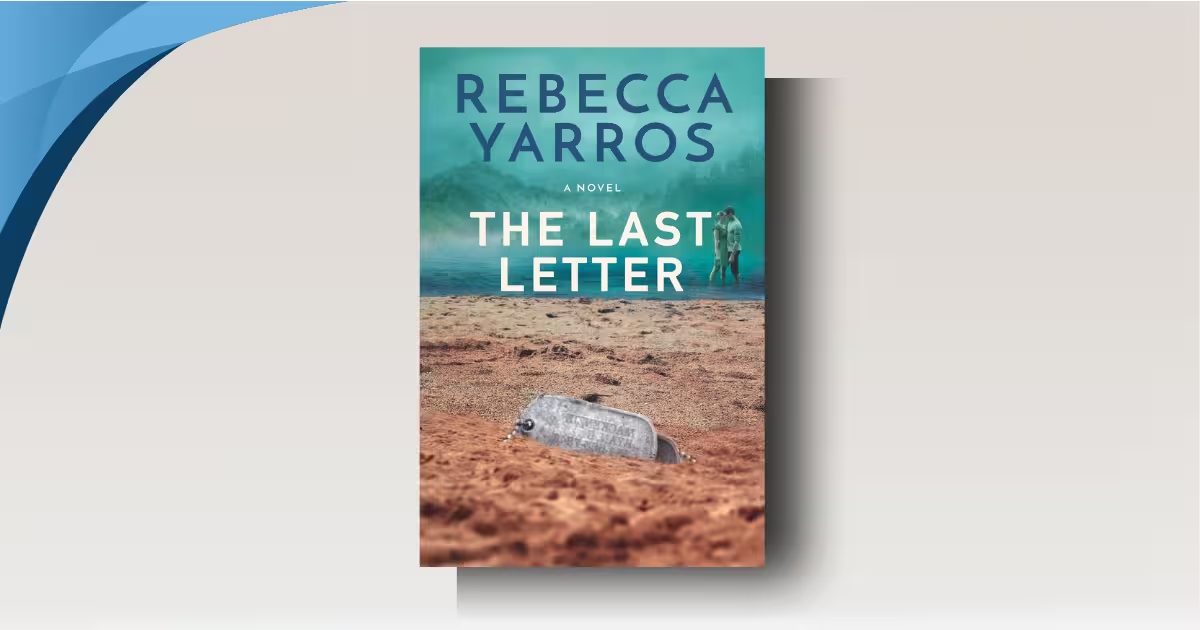
The Last Letter is a contemporary/military romance by Rebecca Yarros, first published as a First Edition (February 2019) under Entangled Publishing (Amara imprint), with ISBN 978-1-64063-533-3.
It’s written in alternating POVs and includes a letter structure that turns emotional honesty into the book’s engine.
A detail that matters: the book’s dedication explicitly centers children “who wage war with cancer,” and references “a 10 percent chance.” That dedication isn’t decorative—it’s a warning label for your heart.
2. Background
While The Last Letter is fiction , it draws power from two realities that shape modern life:
- Military absence and moral injury: the way deployments fracture time, identity, and relationships—especially when the people left behind don’t get neat closures.
- Childhood cancer as a long campaign: In real-world medicine, outcomes have improved over decades—NCI notes neuroblastoma survival rates have risen substantially over time. But “improved” doesn’t mean “easy,” and the book captures that exhausting cycle: scans, chemo, surgeries, timelines, fear.
This is why the setting works: it plants a love story inside a pressure cooker where promises carry real weight.
3. The Last Letter Summary
This section reveals major events and the ending.
The setup: letters that start as survival
Ella begins writing to a soldier her brother recommends—“Chaos”—because she needs somewhere to put the things she can’t say out loud. The first letter admits it’s “just as much for me as it is for you.” From the start, the book frames intimacy as practice: honesty on paper, where nobody can interrupt you.
Chaos (Beckett) replies with rough humor and guarded warmth, and Ella suggests a rule that becomes the emotional thesis: no erasing, only truth.
The turning point: illness becomes the family’s gravity
Then the story drops its first devastating anchor: Maisie has cancer. Ella repeats it like she’s trying to force reality to load.
She confesses the loneliness of decision-making—“God, the decisions I have to make”—and the terror of not being “enough.”
Beckett, meanwhile, is a man built out of distance. He thinks of “gravity” as both comfort and threat—something that could ground you or suffocate you. That idea matters because Ella, her kids, and the mountain town begin to act like gravity on him: pulling him toward a life he doesn’t believe he deserves.
Loss detonates the “before”
Off-page from the early letters but central to the novel’s architecture: Ella’s brother Ryan dies in action, and Beckett receives the “last letter”—a request that Beckett go to Ella, take care of her, and do what Ryan can’t.
Beckett arrives carrying guilt, a mission mindset, and secrets. Ella meets him with justified hostility: she hates that a stranger knows intimate details about her life, and she says it plainly—“that’s not fair.”
Beckett refuses to leave anyway. His reason isn’t romantic at first—it’s obligation, grief, and the belief that promises are the only clean thing left.
Becoming real to the kids (where the book quietly wins you)
What makes the story work isn’t just attraction—it’s Beckett’s slow integration into the children’s emotional world.
- Colt, sharp and too old for six, decides Beckett counts as family and delivers the verdict with kid logic: “that makes you family.”
- Beckett learns the medical language because he can’t stand being helpless—he read about neuroblastoma “a lot.”
- In the hospital, Maisie asks for something simple and enormous: she doesn’t want her mom to be alone, and she makes Beckett promise.
That promise becomes a spine running through the entire book: the promise to stay.
The romance: not a soft landing—an exposure
The love story develops in the negative space between trauma: moments of relief, tenderness, friction, and fear. Ella doesn’t trust permanence because life has trained her not to. Beckett doesn’t trust himself because he believes he ruins what he touches.
And still, he shows up. He even says it like a vow: “Because I show up. That’s what I do.”
At one point, their desperation collides with logistics—Maisie’s treatment costs force impossible choices, and the book doesn’t pretend love is enough without paperwork. (This is one of Yarros’s sharper moves: showing how romance can be shaped by healthcare systems, not just emotion.)
The late-stage arc: hope, remission, and the cruelest reversal
The story eventually gives the family the breath they’ve been begging for—Maisie’s treatment progresses; the future starts to resemble something that isn’t only fear.
Then the novel does what many readers call the true gut-punch: Colt dies suddenly in an accident. Ella’s grief turns furious and mathematical—she fought so hard for Maisie, and Colt is gone before she can even say goodbye.
She spirals into the mother’s unanswerable question: Did I trade one child’s life for the other?
Beckett tells her “No,” and tries to hold the line against the guilt that eats people alive.
This is where the book’s title resonates: “the last letter” isn’t only a letter from war; it’s also the final messages we never get to send, the words we didn’t say in time.
The ending
Despite that catastrophic loss, the ending doesn’t present healing as “getting over it.” It frames healing as continuing to love while carrying what’s missing.
In the epilogue space, the book confirms that Maisie is cancer-free, and the family is living in a future built with scars and devotion.
4. The Last Letter Analysis
4.1 Characters
Ella
Ella’s defining trait is not strength—it’s responsibility under pressure. When she says she’s “all she has” about Maisie , it’s not inspirational; it’s suffocating reality.
Her character arc moves from survival-mode control to allowing support without interpreting it as failure.
Beckett (Chaos)
Beckett is written as a man who understands crisis better than peace. His inner monologue about “gravity” shows his fear of attachment: to be tethered is to be vulnerable.
His transformation isn’t from “bad boy to good guy”—it’s from self-erasure to earned belonging, especially through the kids.
Colt
Colt functions as the story’s truth-teller: blunt, perceptive, and emotionally precise. His “you’re family” declaration shows what adults often can’t say without shame: love is also a decision.
Maisie
Maisie is not written as a symbol—she’s written as a child with fear and clarity. Her request—“I don’t want her to be alone” —is one of the most emotionally efficient lines in the book. It turns romance into duty, and duty into love.
5. The Last Letter Themes
“Gravity” as love, home, and fear
The gravity metaphor is the book’s quiet master key: Beckett wonders whether being grounded is comfort or suffocation.
Ella, meanwhile, is pure gravity—she cannot stop pulling her world into order, even when it costs her.
Promises as moral identity
This novel treats promises like identity documents. Beckett’s “I show up” isn’t romantic talk—it’s how he measures whether he’s redeemable.
The “last letter” as unfinished language
The war letter is literal, but the deeper symbolism is about all the unsaid words that grief weaponizes. Ella’s regret—did she say “I love you” enough?—is exactly how real grief behaves.
6. Evaluation
Strengths
- Emotional authenticity in the small moments: especially how kids talk, what they notice, what they demand.
- A romance that isn’t just chemistry: it’s logistics, caregiving, and hard choices.
- The letter device actually matters: the “never erase” rule makes intimacy feel earned.
Weaknesses
- Tragedy intensity: the late-stage death of Colt can feel like emotional overkill, depending on your tolerance.
- Pacing whiplash: the story sometimes swings from warm domestic scenes to sharp trauma beats.
Impact (why it sticks)
This book lingers because it doesn’t sell grief as a lesson—it shows grief as a place you live for a while, and love as the thing that keeps bringing you water.
7. Comparison with similar works
If you gravitate toward emotionally intense romances that deal with illness, caregiving, and big moral choices, you might also connect with books often recommended in that “cry-but-keep-turning-pages” lane (for example, contemporary tearjerkers and found-family romances). (This is a reading-taste comparison, not a claim of identical plots.)
Adaptation (book vs. screen)
As of Nov 2025, Amazon MGM acquired film rights to adapt The Last Letter, with Anna Klassen in talks to write the screenplay, and Imagine Entertainment linked to producing.
Current status is best described as in development with no confirmed cast, release date, or box-office results yet.
8. Personal insight with contemporary educational relevance
One reason The Last Letter hits so hard is that it quietly teaches something real: families in crisis don’t just fight the disease—they fight uncertainty.
In the novel, Ella lives inside scan results and treatment plans, and Beckett tries to reduce helplessness by learning the medical language—he read about neuroblastoma “a lot.” That’s not just characterization; it mirrors what caregivers often do in reality: research becomes a form of control when life feels uncontrollable.
The real-world context is complicated. Survival rates for neuroblastoma vary by risk group—American Cancer Society notes high-risk neuroblastoma has around a 60% five-year survival rate, while intermediate-risk is much higher.
The National Cancer Institute also documents large survival improvements over time. That’s hope—but it’s the kind of hope that still requires endurance, because treatment can be long, expensive, and psychologically brutal.
And here’s the modern layer: in 2025, Reuters reported a U.S. executive order aimed at using AI to boost childhood cancer research, alongside ongoing national initiatives to collect and share pediatric cancer data.
Whether AI delivers on the promise quickly or slowly, the direction is clear: more data, better trials, smarter treatments. The book’s emotional takeaway lands right here—progress matters, but so does support. People survive with medicine; they endure with community.
9. The Last Letter Quotes
- “Sometimes bad things happen. And there’s no blame to be placed. You can’t reason with the universe, no matter how sound your logic is … We are imperfect people made that way by an imperfect world, and we don’t always get a say in what shapes us.”
- “We can either breathe through the pain or we can let it shape us.”
- “I’d rather be great for a few people than be mediocre for a bunch.”
- “Love – when it was right – was enough to save you. Beckett taught me that every single day. And ours was more than enough. And so was I.”
- “Don’t let go,” she whispered. Her hands were still between us, but she wasn’t pushing me away, they were simply resting on my pecs. If anything, she leaned in. “I’d forgotten what this felt like.” “Being hugged?” My voice was sandpaper-rough. “Being held together.”
- “Hope is good. Feel it. Because we have no idea what’s coming around the corner. You have to take the good when it comes, because the bad isn’t going to give you a choice.”
- “Is this what it feels like?” he whispered so quietly that I leaned down. “What it feels like?” I asked. “Having a dad?” He tilted his head slightly.
- “I was here for as long as Ella would let me stay. Because somewhere between letter number one and letter number twenty-four, I’d fallen in love with her.”
- “This wasn’t heartbreak. Or sorrow. It was the utter desolation of my soul.”
- “It’s a good thing, though. Missing him. Grief means you had someone worth grieving.”
- “I would do anything for you.” His eyes locked onto mine in the dashboard lights, intense and a little hurt. “What is it going to take for you to believe me? To trust me? … I’m standing here offering my last name. What else can I give you?”
10. Conclusion
The Last Letter is a romance, yes—but it’s also a story about how people keep living after life proves it can be ruthless. It’s about vows that aren’t said at weddings, but in hospital hallways, kitchens, and grief-soaked mornings.
Recommendation:
- If you want a deeply emotional military romance with letters, found-family tenderness, and real loss, this is for you.
- If you’re in a fragile season—especially around grief or child illness—consider approaching gently or skipping.







