
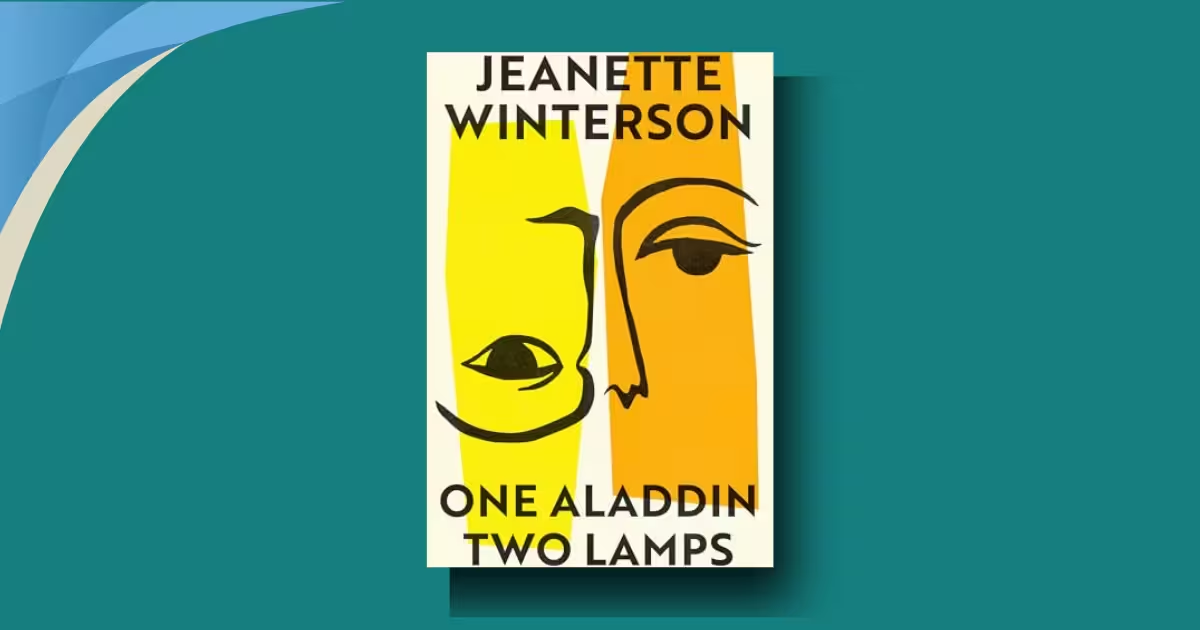
Have you ever felt like the world is speeding up—AI, politics, climate, loneliness—and you’re trying to keep your inner life from becoming collateral damage? One Aladdin Two Lamps is the rare book that doesn’t just describe that feeling; it teaches you how to out-story it.
Jeanette Winterson uses One Thousand and One Nights (and Aladdin) to show that your life isn’t “fixed”—it’s a narrative you can interrupt, rewrite, and live into, even when power, fear, and “modern utility” try to shrink you.
One Aladdin Two Lamps is best for readers who love literary memoir + big-idea essay + myth retelling; anyone craving a smart, emotional antidote to doomscrolling; fans of Winterson’s voice; readers who want a full thematic education on why stories still matter in 2025–2026.
Not for: readers who want a straightforward plot-driven novel; anyone allergic to digressions (science → Shakespeare → politics → fairy tale); people who dislike “genre-hybrid” books that move like thought itself.
Table of Contents
1. Introduction
Book: One Aladdin Two Lamps
Author: Jeanette Winterson
Imprint / Publisher: Jonathan Cape (Penguin Random House UK imprint)
Publication date (UK): 13 November 2025
Length: 272 pages
ISBN: 9781787336124
This is not a conventional novel. It’s a hybrid—memoir + cultural criticism + myth retelling + philosophical essay—held together by the frame of One Thousand and One Nights. A reviewer put it plainly: it moves like a “whirlwind,” leaping across time and genre.
Winterson’s credentials matter here because One Aladdin Two Lamps assumes she has earned the right to be both intimate and argumentative. Penguin’s author bio describes her as the author of Oranges Are Not the Only Fruit (published when she was 25), the memoir Why Be Happy When You Could Be Normal?, and as Professor of New Writing at the University of Manchester.
Winterson’s thesis is delivered with the clarity of a spell: “I can change the story because I am the story.”
Everything else—Aladdin, Shahrazad, the Fisherman, genies, time, “utility,” tech billionaires, women’s silencing—spirals around proving that line emotionally, intellectually, and politically.
2. Background
Winterson opens in lived memory: a childhood trip to a pantomime—Aladdin—paid for by her father’s factory. She describes the queue of children “wrapped around the theatre,” the smell of “toffee and Vimto,” the borrowed shiny shoes, the velvet seats. That’s not decorative nostalgia; it’s her origin story for how fiction becomes oxygen when real life feels tight.
Then she lands the first crucial reframing: Aladdin isn’t a “hard work wins” moral fable; it’s “a series of encounters” where outcomes aren’t fixed, and where setbacks aren’t just comic turns but “truth about human chances.”
This matters because Winterson is writing into a present where everything insists on fixity:
- algorithms deciding what you see,
- politics trying to lock gender and family into “old endings,”
- tech wealth imagining escape pods for the privileged,
- climate disaster as the background hum.
The Nights become her counter-technology: a device to interrupt the obvious story and keep a person alive.
3. One Aladdin Two Lamps Summary
I’m going to summarize this the way One Aladdin Two Lamps itself thinks: in braids. There’s (A) Shahrazad’s frame, (B) key Nights stories Winterson retells, (C) the Aladdin thread, and (D) Winterson’s memoir-and-ideas thread—where she connects ancient magic to modern systems.
A. The engine: Shahrazad vs time (and why this book keeps returning to morning)
Shahrazad’s predicament is simple and brutal: execution is scheduled for morning. Her solution isn’t force. It’s narrative engineering.
Winterson explains Shahrazad’s method like a philosophy of survival: every night she “gains another day,” disputing “the fixity of time,” battling “Time itself,” until one night “swells to a thousand more” and beyond.
Then Winterson makes the move that becomes the book’s heartbeat: chronological time is not the only time humans live in. Stories compress and expand time, let us “begin at the end,” enjoy “multiple beginnings,” and in a few hours “live many lifetimes.”
And this isn’t airy theory. It is a survival manual: Shahrazad refuses the “contrived drama of a powerful man” and instead “rolls out time like a flying carpet.”
One Aladdin Two Lamps’ structure, you feel this physically: stories break off because morning is coming. Winterson repeats that sensation as a moral alarm clock. In one retelling, she writes: “Shahrazad saw that morning was on the horizon.”
That repeated “morning” does two things:
- it reminds you the stakes are bodily (women’s bodies, especially), and
- it mirrors modern interruption—phones, feeds, constant urgency—except Winterson uses interruption to resist, not to numb.
B. The Nights inside the Nights: stories as moral laboratories
Winterson reminds us that One Thousand and One Nights is a long historical recombination—stories escaping, recombining, resisting neatness, moving across centuries and cultures. She describes it as an “overflowing bazaar” with magic treated as daily life and the visible world as only part of a larger invisible one.
Then she retells selected tales not as “cute classics” but as psychological and political instruments. Here are the major story-lines she uses and what she extracts from them:
1. The Merchant and the Ifrit: guilt, accident, and bargaining with the monstrous
One of the earliest frame tales in the Nights: a merchant kills something unintentionally (often told as a date-stone that kills an ifrit’s son), and an Ifrit arrives demanding blood. Winterson uses this as a primal scene: the terrifying idea that one small act can trigger consequences far beyond intention—an ancient version of how modern systems punish without context.
And then: storytelling becomes negotiation. Another man arrives and offers a story as exchange—“If it is more marvellous yet…”
Winterson is quietly teaching: when brute force rules, story becomes the only leverage left.
2. The Fisherman and the Genie: what we release, and what releases us
Winterson retells the Fisherman’s discovery: poor, “penniless,” he finds a sealed jar that contains the genie—power that is both gift and threat.
The tale becomes a metaphor for modern inventions (technology, finance, AI): once the jar opens, you cannot pretend it didn’t.
She ties this to that human feeling of the “nearby-ness of the unknown”—how huge changes can feel like they were waiting close by. “The nearby-ness of the unknown is always a surprise.”
That line hit me like a private confession: the scariest changes often aren’t far away; they’re beside your daily routine.
3. The Singing Fish / Prince of the Black Isles: enchantment, tolerance, and “no one remembers”
In this story chain, the Sultan pursues the secret of singing fish and finds a hidden palace where a prince is turned partly to stone by a “wicked wife.” Winterson pauses to ask whether this narrative is there to flatter misogyny (“some women are wicked indeed”) or to warn that enchantments create unforeseen webs.
But then comes a striking political-moral note: the “fishes” are religious groups—Muslims, Christians, Jews, and Magians—who had lived trading “in peace” before enchantment.
This becomes a parable about how violence is often a spell cast over ordinary coexistence.
And then Winterson drops the unsettling bit: “No one remembers? There would be no one to tell the story.”
This is one of her recurring anxieties: erased memory, erased women, erased suffering—what happens when the archive is controlled.
4. The City of Brass: apocalypse, wealth, automata—and the modern “tech jar”
The City of Brass is Winterson’s doomsday mirror. She retells it with a visual of luxury preserved inside ruin: gold leaf, mercury, brass soldiers guarding a tomb, greed punished instantly.
The inscription on the tomb—“Of the reality of our power nothing remains”—becomes Winterson’s warning to any empire (political, corporate, personal) that believes it has escaped time.
Then she pivots hard into the present: the City of Brass is “a story of climate disaster” and “We are living in the City of Brass.”
She skewers the fantasy that wealth can substitute for a livable world—“we won’t be eating gold or crypto.”
This is also where she explicitly connects the genie-in-a-bottle motif to modern tech elites: “All the genies caught in bottles are versions of Tech Bros uploading their consciousness onto some grandiose Eternity Server.”
Whether you agree or not, it’s a potent reframing: the old magical dream of escaping death has become a venture-backed project.
5. Automata: ancient “algorithms” and the fear of wind-up life
Winterson reminds us automata existed in the 8th century, built on cogs and levers, constructed to “delight the wealthy.” And she draws the modern analogy explicitly: “As with an algorithm, automata work through a series of pre-ordained steps.”
Then she turns the knife: the problem isn’t that machines look alive. The problem is that people live like machines—“going through the motions every day, till their clockwork finally runs down.”
That’s the summary of the Nights thread: Winterson uses myth to keep asking one question—what is real, and what is illusion?
C. Aladdin: not “poor boy makes good,” but an ethics of encounter
Winterson’s Aladdin begins in a British pantomime: “The Story of Aladdin and His Wonderful Lamp is Britain’s favourite pantomime,” she writes, noting how the Victorians shaped it into empire-friendly values.
But then she corrects the reading: the tale “looks like a Hero story, but that’s not the truth of it.”
Her version of Aladdin is One Aladdin Two Lamps’ title logic in miniature:
- There isn’t one lamp, one wish, one clean moral.
- There are multiple lamps: multiple interpretations, multiple lives, multiple endings.
And the heart of it is this: “Aladdin is a series of encounters. The outcomes are not fixed.”
That line alone is Winterson’s rebellion against determinism—whether genetic determinism, class determinism, algorithmic determinism, or the determinism of “this is just how things are.”
D. Winterson’s memoir + modern essays: the private life that makes the myth urgent
Winterson doesn’t float above the world as a neutral commentator. She keeps returning to her own body and history as the laboratory for these ideas.
1. Reading as escape (not escapism)
One of the book’s most helpful distinctions is between escapism and escape. Winterson admits why people slide into serial fantasy, games, endless online time: it’s a “desperate cry” for something beyond the mundane.
But she insists escapism is “brief relief,” while escape is “real.”
Then she does what she always does: she tells a story about a word (escape) and turns etymology into a moral instruction—leaving the “outer garment” behind.
If I had to name the emotional “self-help” core of One Aladdin Two Lamps, it’s this: reading is not running away; reading is practicing a bigger reality so you can return and change your life with more choices available.
2. Women, voice, and the politics of being heard
Winterson is furious—quietly, steadily—about how women’s lives become footnotes. She writes about “Mrs John Smith,” about voices not heard across time, about the rule “Speak up” answered by “According to the Qu’ran, women should not raise their voices.”
Then she explains Shahrazad’s genius as strategic ventriloquism: she lets women speak in stories so she “cannot be blamed” for what they say.
And Winterson generalizes the method: “Stories are smugglers.”
That’s one of One Aladdin Two Lamps’ most quotable insights because it’s true historically: stories cross borders when bodies can’t.
3. Modern tech as new magic (metaverse, avatars, the desire to be “more”)
Winterson’s section on shape-shifting is basically an essay about identity, mortality, and why the modern world is obsessed with avatars.
She writes: in games and VR, “Choose an avatar. Don’t like it? Choose another one.”
She imagines a metaverse that could become meaningful experimentation—or “an abusive fascist state,” like much social media, but insists it “doesn’t have to be that way.”
Then she lands the existential phrase that stayed with me: being caught in the body “doesn’t feel like the truth. It feels damn well wrong.”
This connects to her broader claim that the body is “a thing in process,” replacing cells, changing constantly.
Her argument isn’t “deny the body.” It’s: don’t mistake your current form (social role, fear, shame, class label, algorithmic profile) for your full reality.
4. Science, identity, and the fight against “fixed” narratives (genetics + epigenetics)
Winterson uses genetics to argue against the idea that destiny is written in stone. She cites the Human Genome Project milestone—announced as essentially complete on April 14, 2003.
Then she uses genomic similarity to argue for human sameness: NHGRI notes that “at the base-pair level” our genomes are about 99.9% the same.
Winterson’s move is philosophical: if we are so similar, why do we cling to stories of tribal difference? She suggests our fear, our hunger for hierarchy, and our need for control keep rewriting that tiny difference into a justification for cruelty. (This is her moral reading, not a lab conclusion—but she grounds it in the science’s scale.)
5. Politics and backlash: rights aren’t “old stories,” they’re current stakes
Winterson connects her own adoption context and stigma to modern rollback politics. She warns that if “retro-right-wingers… gain more power,” the future looks like: “No abortions, restricted contraception, and stigma… for single parents.”
She also links this to the reality of violence against women globally.
Human Rights Watch’s 2022 report on Turkey, for example, notes that “around four out of ten women” report physical and/or sexual violence by husbands or partners at some time in their lives (based on government studies from 2008 and 2014).
This is where One Aladdin Two Lamps stops being “literary” in the polite sense and becomes an argument: stories are not entertainment; stories are infrastructure. If you control the story of women’s bodies, you control the law, and then you control the morning.
6. AI, algorithms, and the new empire myth
Winterson doesn’t write an AI textbook, but she uses the Nights to interrogate the same question AI forces: what is alive, what is imitation, and what are we becoming?
Her automata-as-algorithm analogy is explicit.
And her City of Brass argument links tech wealth to apocalyptic denial—“we won’t be eating gold or crypto.”
If you want a real-world marker for the kind of “machine intelligence” shift Winterson is gesturing toward, consider AlphaGo: DeepMind documents that AlphaGo’s 4–1 victory over Lee Sedol in March 2016 was watched by “over 200 million people worldwide.” ([Google DeepMind][6])
Winterson’s point is not “AI bad.” It’s: without a human story of ethics and meaning, power will always justify itself as inevitability.
7. The hidden curriculum: how reading builds a private “root network”
One of the most beautiful sections is Winterson’s metaphor for reading as underground connection: a “private library” whose connections are like tree roots spreading unseen.
She contrasts that to superficial social networks and calls your internal pattern-making “riches.”
This is why One Aladdin Two Lamps feels personal even when it’s discussing Plato or climate catastrophe: she keeps steering you back to your inner archive and asking what you’re building there.
4. One Aladdin Two Lamps analysis
Does Winterson support her arguments effectively?
Winterson’s “evidence” is not the usual academic chain of citations; it’s constellation logic—myth + memoir + historical reference + contemporary example.
Where she is strongest:
- Narrative mechanics as truth: Her reading of Shahrazad is persuasive because it’s grounded in the actual structure of the Nights—breaks, mornings, layered stories—then mapped to modern interruption culture.
- Aladdin as non-fixed outcomes: She convincingly reframes Aladdin away from Victorian moralizing into chance/encounter ethics.
- Women’s voice as strategy: “Stories are smugglers” isn’t just poetic; it’s historically legible.
- Climate/wealth critique via City of Brass: She uses an ancient apocalypse narrative to make modern denial feel older than we admit.
Where she is more contestable:
- Sweeping tech-bro generalizations: Lines like “Tech Bros uploading their consciousness” are deliberately provocative. They work as satire, but a reader who wants careful nuance about technology’s diversity of actors may feel she compresses too much into one villain archetype.
- The book’s method is associative, not linear: That is also its beauty, but it means if you demand a single structured argument with subpoints and counterarguments, you may experience this as “too much,” too fast.
Does the book fulfill its purpose?
Yes—because its purpose isn’t to “teach the Nights” or to “explain Aladdin” as a scholar might. It’s to hand you a framework for living:
- time is not only chronological,
- your story is not fixed,
- meaning is created and defended through language,
- and when power is cruel, storytelling can be resistance.
Winterson says it outright: reading deeply is not “time wasted,” it’s time “set apart to get closer to ourselves.”
That is exactly what the book accomplishes—if you let it.
5. Strengths and Weaknesses
Strengths (what I genuinely loved)
- It makes you feel time differently. The repeated approach of “morning” and the insistence that inner time is elastic changed how I felt while reading.
- The Aladdin reframing is liberating. “The outcomes are not fixed” is a sentence I wanted to tape to my wall.
- Winterson’s voice is intimate without being self-pitying. Even when she describes cold shoes and being alone, the prose doesn’t beg for sympathy—it builds a lens.
- It’s an education in why language matters when meaning feels threatened. “Language itself defies meaninglessness,” she insists.
Weaknesses (what didn’t work for me)
- The digressions can feel like whiplash. If you’re not willing to be carried by association, you may feel unmoored (especially mid-book).
- Some provocations are intentionally blunt. The “Tech Bros” metaphors and the crypto critique are sharp-edged; readers wanting balanced tone may bristle even if they agree with her moral point.
- It can feel like four books in one. That’s a compliment for me, but a risk for anyone who needs one stable genre promise.
6. Comparison with similar works
- Winterson’s own Why Be Happy When You Could Be Normal? is the clearer straight-line memoir companion to the autobiographical elements she references here.
- Winterson’s Oranges Are Not the Only Fruit shares the same core concern: identity versus imposed narrative, but in a more traditional fictional form.
- Angela Carter’s mythic rewritings (if you like them) scratch a similar itch—old stories made newly political—but Winterson is more essayistic and directly contemporary in her references.
- On my own site, probinism.com, I’ve written about Aldous Huxley (a useful adjacent read if Winterson’s dystopia/modernity concerns grab you). Winterson explicitly nods to Huxley-world anxieties in her cultural web.
7. Conclusion
I’d recommend One Aladdin Two Lamps if you want a book that feels like a conversation with a fiercely intelligent friend who refuses to let you pretend that politics, technology, love, and private pain are separate topics.
This is suitable for general readers (not specialists), but only if you accept its method: it doesn’t walk; it leaps. If you come for a tidy plot summary, you’ll feel lost. If you come for a map of how stories help you survive the present without surrendering your inner life, this book delivers—with teeth and tenderness.
Winterson’s final gift is permission: you are not only a character. You are an author. And the book dares you to believe it: “I can change the story because I am the story.”








