
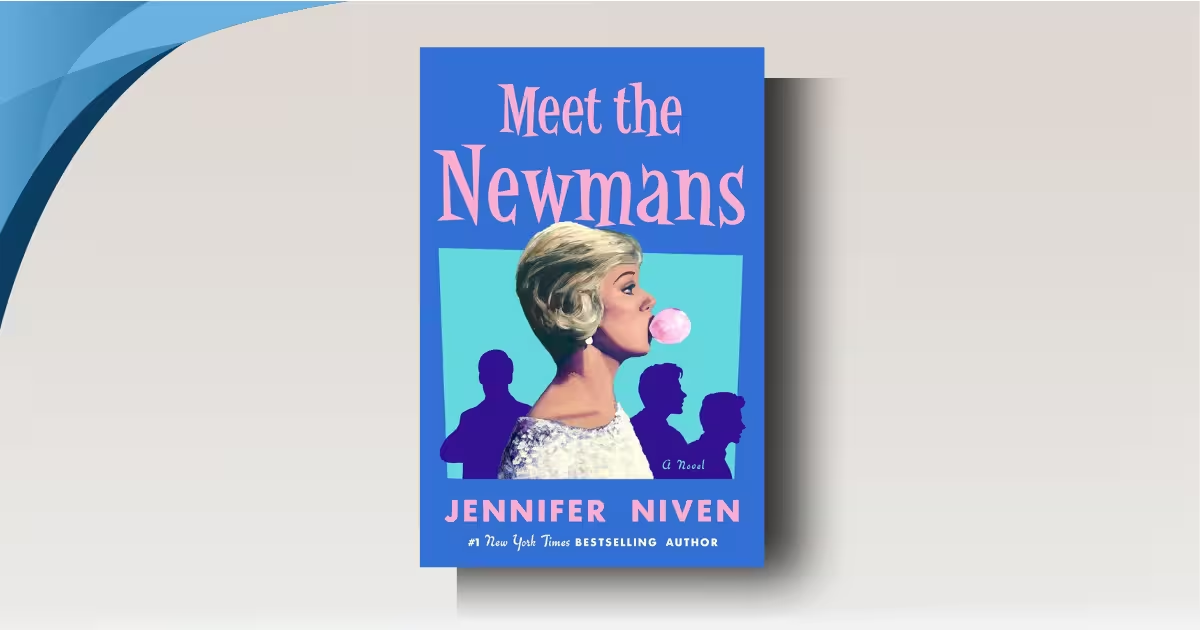
Do you ever wonder if the “perfect” families you see on screen are secretly falling apart the moment the director yells “Cut”? Jennifer Niven answers that question in Meet the Newmans, a behind-the-scenes look at the implosion of a 1950s-style sitcom family.
Struggling to adapt to the turbulent 1960s after their controlling patriarch falls into a coma, the “perfect housewife” and her sons are left to frantically rewrite their own narrative.
The novel juxtaposes the sanitized world of 1964 television against the gritty reality of the era—referencing real-life figures like Betty Friedan and James T. Aubrey—showing how the cultural shift of the 60s forced a reckoning for traditional family values.
Meet the Newmans is best for fans of Daisy Jones & The Six or The Seven Husbands of Evelyn Hugo who love backstage drama, feminist awakenings, and 1960s nostalgia.
Not for: Readers looking for a cozy, conflict-free nostalgia trip or those who dislike stories that deconstruct beloved tropes.
Table of Contents
1. Introduction
Title: Meet the Newmans Author: Jennifer Niven
Publication Details: Flatiron Books (2026)
Meet the Newmans is a dazzling, heart-wrenching dive into the dual lives of America’s “favorite family.” Jennifer Niven, known for her emotional depth in young adult fiction (All the Bright Places), turns her lens to 1960s Hollywood, crafting a story that feels both intimately personal and sweepingly historical.
The novel peels back the glossy veneer of a long-running sitcom to reveal the messy, complex, and beautiful humans hiding behind their black-and-white personas. It is a story about the cost of fame, the cages we build for ourselves, and the courage it takes to break out of them.
2. Background
The year is 1964. The United States is in a state of flux, suspended between the wholesome, conservative values of the 1950s and the radical cultural shifts on the horizon. The assassination of John F. Kennedy is a fresh wound on the national psyche, leaving a void that Americans are desperate to fill with comfort and familiarity.
Beatlemania is sweeping the nation, signaling the rise of youth culture, while the Civil Rights movement and second-wave feminism—sparked by works like The Feminine Mystique—are beginning to challenge the status quo.
In the world of television, the landscape is shifting.
Networks are moving from black-and-white to color, and audiences are growing tired of the “father knows best” tropes.
It is against this backdrop of upheaval that the Newman family—stars of the hit show Meet the Newmans—find themselves fighting for relevance. They are relics of a bygone era, trying to survive in a world that is rapidly outgrowing them.
3. Meet the Newmans summary
The Cracks in the Facade
The story opens in March 1964 with a prologue that immediately shatters the illusion of the “perfect housewife.” Dinah Newman, America’s beloved TV mom, stands in her kitchen staring at a pan of burnt pork chops. Despite being the spokeswoman for kitchen appliances and the face of domestic bliss, Dinah cannot cook.
She is forty-three years old, feeling “expendable” and increasingly numb, both emotionally and physically.
She watches her neighbor mow his lawn and fantasizes about a torrid affair, not because she doesn’t love her husband, Del, but because she is desperate to feel something.
The Newman family—Del, Dinah, and their sons Guy and Shep—have starred in Meet the Newmans for twelve years. Del Newman is the show’s creator, writer, producer, director, and star. He is a benevolent dictator who controls every aspect of their lives, both on and off the screen.
But the show’s ratings are in freefall, beaten by “a dolphin, a collie, and a man from outer space”.
The Ultimatum
Tensions come to a head during a meeting with James T. Aubrey, the ruthless president of CBS Television (known as the “Smiling Cobra”). Aubrey threatens to cancel the show unless they can turn the ratings around by the season finale, which will be broadcast live.
He demands they modernize the show by focusing on the younger generation—specifically Shep, a teen idol whose musical career rivals the Beatles—and by marrying off the older son, Guy, to his on-screen girlfriend, Eileen Weld, in a televised wedding.
Crucially, Aubrey insists this TV wedding be mirrored by a real-life marriage to squash rumors about Guy’s sexuality.
Guy, in reality, is gay and living with his “roommate,” actor Kelly Faber. Del, desperate to save the show and his financial standing (he has secretly squandered the family’s fortune on cars and collectibles), agrees to everything, effectively selling out his son’s happiness.
The Accident
The pressure mounts. Del is hiding the family’s financial ruin from Dinah. Guy is trapped in a PR engagement to a woman he doesn’t love. Shep is spiraling into drug use and promiscuity, trying to outrun the pressure of his fame and the news that his ex-girlfriend, Lorrie, is pregnant.
On the night of March 20, Del drives west toward Santa Monica, distracted and overwhelmed. He crashes his car into a palm tree. He is rushed to St. John’s Hospital, where he is placed in a medically induced coma to reduce brain swelling.
The Cover-Up
The family is thrown into chaos. Sydney Weiss, their executive producer, insists they keep the accident a secret to prevent the network from canceling the show immediately.
They concoct a story that Del has flown east to care for his ailing mother (who actually died years ago). This leaves the remaining Newmans to keep the show running without their leader.
Dinah, who has spent twenty years letting Del make every decision, suddenly finds herself at the helm. She realizes she has no idea how to write a script or manage the production. Determined to save the show, she approaches Juliet Dunne, a young, ambitious reporter for the Los Angeles Times who had interviewed her just hours before the accident.
Juliet had challenged Dinah’s “happy homemaker” persona, accusing her of holding women back. Dinah hires Juliet to help her write the season finale, seeing in the young reporter the modern voice the show desperately needs.
The Awakening
While Del lies in a coma, the family begins to fracture and then reform.
Guy takes over directing the show, discovering a talent and passion he’d suppressed to please his father. He and Kelly navigate the pain of his sham engagement to Eileen, who is also struggling with the idea of a loveless marriage.
Shep, feeling guilty for his role in stressing his father out, tries to step up but is haunted by his impending fatherhood.
Dinah and Juliet’s writing partnership is fraught with tension. Juliet pushes for a radical feminist script where Dinah leaves her husband and burns her apron. Dinah resists, knowing it will alienate their audience and the network. But as they work, they find a middle ground.
They begin to craft a script that mirrors their reality: Dinah Newman (the character) taking charge when her husband is incapacitated, discovering her own strength and agency.
The Revelation
As Dinah digs through Del’s office for financial records, she uncovers the truth about their money: it’s gone. She also finds a deed to a house in Santa Monica and checks written to an “M. Leslie”.
Fearing an affair, she drives to the address, only to discover the house belongs to Del’s estranged father, Matthew Leslie, whom Del had been secretly supporting and visiting before the crash.
This revelation humanizes Del for Dinah, showing her a man burdened by his past and trying to make amends.
The Return Just as the family finds their rhythm without him, Del wakes up. He returns home weak but determined to resume control. He is horrified to learn that Dinah and Juliet are writing the script and that Guy is directing.
He tries to assert his authority, but the family has changed. They have tasted freedom and competence. Guy stands up to him, asserting his role as director. Dinah refuses to step back into her box, telling Del that the script—their script—is the only way forward.
Del reads the script. It is titled “The Finale.” In it, the fictional Del has an accident, and the fictional Dinah must learn to live without him, discovering she can open bank accounts, run a business, and be a whole person on her own. It is a declaration of independence.
Del, moved by the quality of the writing and the truth of the story, agrees to let them film it.
The Final Act
The tension of the novel culminates in the filming of the series finale.
While Del is in his coma, Dinah and Juliet collaborate on a script that subverts the show’s decade-long formula of domestic submission. Instead of the “old tried and true” where Dinah bails out her husband, the new script features the fictional Dinah taking control of her own life.
During the live broadcast, the stakes are astronomical. The network and sponsors are watching to see if the Newmans are truly “obsolete”.
Shep performs a song that isn’t his usual teen-idol fare but a track reflecting the raw, changing times, effectively “playing them out” as the family they once were fades to black. The episode is a triumph of authenticity over artifice, proving that the public was hungry for the truth beneath the pearls.
The Ending
In the aftermath, the Newmans don’t just “go back to normal.” The show ends, and the family members finally pursue their own truths. Guy stops living a lie, embracing his relationship with Kelly.
Shep deals with the reality of fatherhood and finds a more grounded musical path. Dinah transforms from a TV housewife into a producer and activist.
The epilogue, set five years later, reveals that while Del never fully recovered from his injuries and passed away at age fifty, his legacy was redefined by his family’s growth.
Dinah remains a force in the industry and a champion for women’s rights, living a life that is finally, authentically her own.
4. Meet the Newmans Analysis
4.1 Meet the Newmans Characters
- Dinah Newman: Her arc is the heart of Meet the Newmans. She moves from a woman who feels “expendable” and numb to one who realizes, “I have to spend so much time with myself. I want to be good company”.
Del Newman: Initially a “shrewd, hardworking dictator,” his coma serves as a narrative catalyst that allows his family to grow without his shadow.
- Guy & Shep: Their relationship evolves from rivalry for their father’s approval to a genuine brotherhood. Guy finds his voice as a director, while Shep learns that “fame is fleeting and ephemeral”.
5. Meet the Newmans Themes
To truly understand Meet the Newmans, one must look past the 1960s hairspray and the laugh tracks. Jennifer Niven hasn’t just written a Hollywood period piece; she has crafted a devastatingly sharp autopsy of the “American Dream” as it was sold to the post-war generation. Because this is a deep-dive analysis, be warned: major spoilers for the entire plot follow.
The novel’s power lies in how it uses the transition from 1964 to 1969 to mirror the internal shattering of its characters. Here is a comprehensive analysis of the core themes and symbols that define the Newmans’ journey from “America’s Favorite Family” to a group of actual, breathing human beings.
1. The Perils of the “Scripted” Life
The most pervasive theme is the blurring of lines between the Newman family’s television show and their reality. For twelve years, Del Newman didn’t just write scripts for the screen; he wrote them for his family’s private lives.
The Performative Marriage:
Dinah and Del’s relationship is the ultimate “set.” Dinah realizes she has been playing a role—the happy, subservient wife—so long that she has lost her own voice. Niven illustrates this through the metaphor of the kitchen.
On TV, Dinah is a domestic goddess; in reality, she can barely boil water.
The Symbol of the Pearls:
Throughout the first half of Meet the Newmans, Dinah’s signature pearls represent her “costume.” They are the shackles of 1950s expectation. When she finally stops wearing them in the “Return” section of the book, it symbolizes her refusal to return to the character Del created for her.
2. Feminist Awakening and the “Feminine Mystique”
Niven positions Dinah Newman as a direct contemporary to the women Betty Friedan wrote about.
The theme of Female Agency is catalyzed by Del’s coma. Without the “Patriarch” to tell her what to do, Dinah faces the terrifying void of her own identity.
The Collaboration with Juliet:
Juliet Dunne represents the radical future. Their friction is the heart of the novel’s thematic debate: Can you change a system from the inside? By rewriting the finale to show a woman finding independence, Dinah isn’t just saving a TV show; she is performing a public act of rebellion.
The Kitchen as a Battlefield:
Early Meet the Newmans, the kitchen is a place of failure for Dinah. By the end, when she is running the production and managing the family finances, the “domestic sphere” is no longer a cage, but a platform she has transcended.
3. The High Cost of the “Closet” (Identity vs. Image)
Through Guy Newman, Niven explores the theme of Authenticity vs. Preservation. Guy is the “perfect” eldest son on screen, but his reality—as a gay man in an era that criminalized his existence—is a source of constant, simmering tension.
The Sham Engagement:
Del’s willingness to force Guy into a real-life marriage with Eileen for the sake of “The Brand” is the book’s moral low point. It highlights the theme that the “American Dream” of the 1960s was often built on the literal erasure of marginalized identities.
Directing as Truth: Guy’s shift from actor to director is symbolic. He stops being a puppet (actor) and starts being the one who defines the vision (director). His eventual decision to live openly with Kelly Faber is the ultimate rejection of the Newman “brand.”
4. The Erosion of the Patriarchal Myth
Del Newman is the “Father Who Knows Best,” but Meet the Newmans systematically deconstructs this myth.
Financial Decay:
The revelation that Del squandered the family fortune on collectibles and a secret house for his father proves that the “provider” was actually a drain.
The Coma as a Narrative Device:
The coma serves as a symbolic “death” of the old guard. It allows the rest of the family to breathe. When Del “returns,” he finds that he is no longer necessary in the way he once was. The theme here is that growth often requires the removal of the dominant authority.
5. Transition and Cultural Evolution
The novel is a microcosm of the 1960s. It captures the moment the “Polished 50s” met the “Gritty 60s.”
The Musical Shift:
Shep Newman’s transition from a manufactured teen idol singing “bubblegum” pop to a musician writing raw, authentic songs mirrors the shift from The McGuire Sisters to Bob Dylan and The Beatles.
The Live Finale:
The decision to film the final episode live is a metaphor for the unpredictability of the new era. You can’t edit life anymore; it’s happening in real-time, messy and unscripted.
The Ending and Symbolism
The “Five Years Later” epilogue is crucial. It shows that the Newmans didn’t find a “happily ever after” in the traditional sense. Instead, they found Truth. Del’s death at fifty is a final closing of the door on the 1950s era.
Dinah’s success as a producer signifies that while the “Newmans” as a brand died, the individuals survived.
In Jennifer Niven’s Meet the Newmans, the glitz of 1960s Hollywood serves as a backdrop for a sharp, empathetic exploration of identity and cultural revolution.
Below is a brief analysis of the book’s critical reception in terms of its strengths and weaknesses, followed by a comparison to similar literary works.
6. Evaluation
Strengths & Weaknesses
Strengths:
- Vivid Atmospheric Detail: Niven excels at world-building, capturing the specific tension of 1964 Los Angeles, from the “mosquito buzz” of suburban lawnmowers to the high-pressure environment of CBS Television City.
- Emotional Authenticity: The internal monologues, particularly Dinah’s “great, yawning void” and her secret “hysteria,” provide a raw, human counterpoint to the sanitized “old tried and true” sitcom tropes.
- Subversive Pacing: By placing the controlling patriarch in a coma early on, Niven effectively uses a “void” as a narrative engine, forcing the secondary characters to develop outside of Del’s rigid scripts.
Weaknesses:
- Predictable Archetypes: Some secondary characters, like the “Smiling Cobra” network executive or the rebellious younger son, occasionally lean into established 1960s tropes that may feel familiar to fans of the era.
- Internal vs. External Action: The middle section relies heavily on internal reflection and dialogue over external plot movement, which may feel slow for readers expecting a fast-paced Hollywood thriller.
7. Comparison with Similar Works
Meet the Newmans occupies a space between historical drama and feminist awakening, drawing natural comparisons to several high-profile contemporary works:
| Work | Point of Comparison |
| Daisy Jones & The Six | Like Taylor Jenkins Reid’s work, Meet the Newmans deconstructs a famous public entity to find the messy, drug-fueled, and heart-wrenching truth behind the “fame”. |
| Lessons in Chemistry | Both novels feature a woman in the 1960s who is publicly associated with domesticity (cooking/homemaking) but secretly harbors intellectual ambitions and a refusal to be “expendable”. |
| The Seven Husbands of Evelyn Hugo | Niven mirrors Reid’s exploration of the “closet” in Old Hollywood. Guy Newman’s struggle to maintain a “wholesome” image while loving Kelly Faber echoes the theme of sacrificing personal truth for a public brand888. |
| Mad Men | The novel shares the TV show’s obsession with the “shifting of the guard”—the specific cultural moment where the rigid 1950s (Del) meets the radical 1960s (Juliet and Shep). |
Final Insight: While many books tackle 1960s nostalgia, Niven’s work is unique in how it uses the literal rewriting of a television script as a metaphor for the characters rewriting their own lives.
8. Personal Insight
Reading Meet the Newmans felt like watching a black-and-white television set slowly bleed into vibrant, messy color. It’s a reminder that we are often the authors of our own “scripts.”
In a modern world obsessed with curated social media “perfection,” the Newmans’ struggle to break free from their public personas feels incredibly relevant.
Statistics show that the “loneliness epidemic” is often highest among those who feel they must maintain a perfect image, much like Dinah staring at her charred pork chops in 1964.
9. Quotable Lines
“I have to spend so much time with myself. I want to be good company.”
“The only limits are those we put on ourselves.”
“Fame is fleeting and ephemeral, and so is money. Show business should be considered a means to an end. Nothing more.”
10. Conclusion
Meet the Newmans is a stunning achievement that deconstructs the mid-century myth of the perfect family. It is a must-read for anyone who has ever felt like they were playing a role in their own life rather than living it.
Tags: Fiction, 1960s Hollywood, Feminism, Family Drama, Historical Fiction, Jennifer Niven, TV History, Coming of Age, Identity, Literary Fiction.
Keywords: Meet the Newmans summary, Jennifer Niven new book, 1960s sitcom drama, feminist historical fiction, Hollywood family secrets, Del and Dinah Newman, TV family breakdown, Answer Engine Optimization books, SEO optimized book reviews, deep dive book analysis.







