
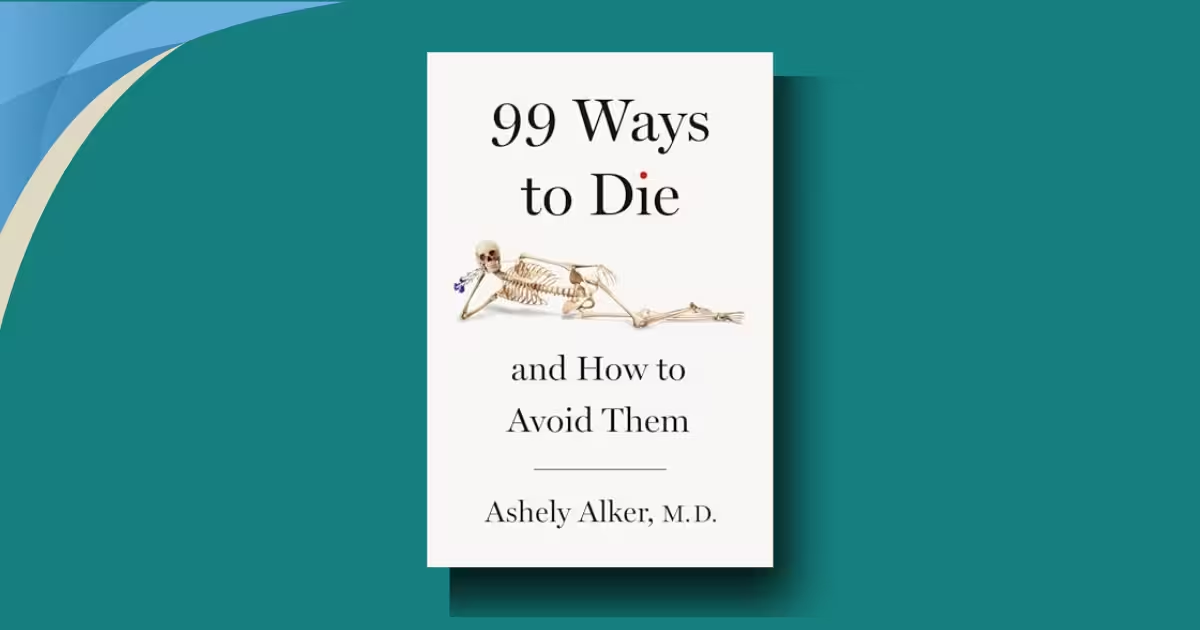
Have you ever Googled a symptom at 2 a.m., panicked yourself into cancer, and still not known what to do next? 99 Ways to Die felt like having a calm ER doctor translate chaos into clear, survivable steps—without draining the humor out of the fear.
Dr. Ashely Alker’s 99 Ways to Die and How to Avoid Them turns “how people die” into a prevention map—so ordinary people can recognize danger early, act fast, and avoid the dumb, common, and occasionally bizarre mistakes that land people in the ER.
99 Ways to Die and How to Avoid Them is best for:
- Readers who want practical, prevention-first medical literacy from an ER perspective—especially parents, travelers, outdoor people, anxious Googlers, and anyone who likes science with jokes.
- Fans of books that make you smarter and more cautious: public health, survival reality, emergency medicine storytelling.
- People who like learning through vivid case narratives (sometimes dark, often funny, always instructive).
Not for:
- Readers who want a gentle tone only; Alker deals in blood-and-bone reality.
- Anyone looking for personalized medical advice—Alker herself flags that the book is “not medical advice” even while being “more enlightening than a Google search.”
- Readers who prefer strictly academic epidemiology with heavy references on every page (this is pop-science + ER storytelling, not a textbook).
If you’re searching for an honest, readable 99 Ways to Die and How to Avoid Them review, here’s the most useful thing I can tell you: this isn’t a fear book—it’s a prevention book.
Dr. Ashely Alker frames modern risk the way an emergency physician has to: not as abstract “health,” but as patterns of injury, infection, poisoning, and human decision-making that repeatedly show up at the worst hour.
She calls herself a “board-certified death escapologist”—a phrase that sounds like a joke until you realize it’s basically the job description of emergency medicine.
Alker frames the thesis in her own words: 99 Ways to Die is “an exploration of and map to avoiding” ninety-nine terrifying, interesting, unfortunate ways to die—from “everyday household poisons” to “regrettable sex.”
And she plants a flag against panic-search medicine: “While this book is not medical advice, it will be more enlightening than a Google search…”
That line is the soul of 99 Ways to Die: not “trust me blindly,” but “stop outsourcing your judgment to the internet’s worst incentives.”
Table of Contents
1. Background
Alker begins with evolution—Darwin, finches, natural selection—and then twists it into modern life: humans have built a world where we survive things that would have killed our ancestors, and emergency medicine exists to keep that rebellion going.
Then she makes it personal.
She says she wrote 99 Ways to Die for the same reason she became a doctor: her mother, who was told she had six months to live after a lymphoma diagnosis, survived, and then lived with the long tail of medical consequences—open-heart surgeries, brain tumor, autoimmune hepatitis, pulmonary hypertension—all before 50.
That background matters because it explains the book’s voice: it’s not “look how smart I am,” it’s “I learned the hard way how confusing medicine feels from the outside—so here’s the translation.”
And culturally, the timing fits. We live in an era of:
- Information overload (symptom content everywhere, quality varies),
- rising climate-linked risk (heat illness, drowning patterns, vector disease),
- and public health whiplash where trust is fragile and prevention feels optional.
That’s why a prevention-forward, story-driven “how not to die” manual keeps finding an audience.
2. 99 Ways to Die summary
The structure: a prevention map built from ER patterns
The genius of the “99 ways” gimmick is not the number. It’s the mental model: risk is not random. It clusters.
Even in the excerpts available, you can see how Alker thinks in buckets:
- Infections (including rare nightmares and common killers),
- Poisons (plants, food toxins, water—yes, water),
- Trauma (cars, motorcycles, concussions),
- Environment (heat illness, drowning),
- Animals / envenomation (scorpions),
- Sexual health (STIs, emergencies, shame management),
- plus other categories she signals in the opening range (“household poisons,” “regrettable sex”).
What Alker repeatedly does is:
- Hook you with a story (sometimes hilarious, sometimes brutal).
- Explain what is happening physiologically (plain English, not med-school).
- List what matters: warning signs, what to do first, what not to do, and when the ER is the correct move.
- Add a prevention layer: the boring behavior that would’ve avoided the drama.
That pattern shows up everywhere, whether she’s talking about infections, trauma, or toxins.
Representative “ways to die”
1. Infections
What this chapter is really about
Alker treats infection like a shape-shifter: sometimes it looks ancient and biblical (leprosy), sometimes it looks like a “normal sore throat,” and sometimes it looks like a headline-level nightmare (Ebola).
The unifying theme is that microbes win when we underestimate how they spread, how fast they turn severe, and how much prevention matters—basic hygiene, early recognition, travel awareness, and not misusing antibiotics.
The big killers Alker focuses on
1) “Ordinary” bacterial infections that can turn fatal
Leprosy is framed as a “forgotten” disease that still exists in 120 countries with ~200,000 new cases a year, and she notes the U.S. still sees ~150 annual cases.
Strep throat is her “don’t shrug this off” example: the point isn’t the sore throat—it’s what untreated strep can trigger. She lists lethal pathways like rheumatic fever leading to myocarditis/rheumatic heart disease, and she cites an NEJM-based estimate of “more than a hundred thousand deaths in 2015 alone” from rheumatic heart disease in India.
Her practical warning is painfully simple: finish antibiotics when they’re truly indicated (strep is her cleanest example), because the preventable complications are the real danger.
2) Necrotizing fasciitis (“flesh-eating disease”)—the speed kills
This is written like an ER horror story with a public-health point: rate of spread is the red flag.
She notes mortality quotes ranging “20 to 80 percent,” and that many deaths occur in “less than fourteen days.”
Prevention isn’t mystical—she emphasizes wound care (especially after salt/brackish water), and urgent evaluation if redness/pain is rapidly expanding.
3) Tuberculosis—easy to catch, hard to cure, still huge globally
Alker’s framing here is: TB is culturally “old,” but epidemiologically still modern. She describes TB as airborne, capable of latency for decades, and requiring long, multi-drug therapy.
She cites the scale bluntly: WHO estimates roughly a quarter of the world will be infected over a lifetime, with about “two million annual TB deaths globally.”
She also notes new hope: as of March 2024, a new TB vaccine entered stage III trials, funded by “over $500 million” from Wellcome and the Gates Foundation.
4) Botulism—paralysis as the core mechanism
Her botulism section is less “rare trivia” and more “you can actually prevent this.”
- Infants + honey: she explains why spores can germinate in babies and cause floppiness and breathing difficulty.
- Foodborne botulism in adults: commonly tied to stored/home-canned foods; she adds a practical safety detail: boiling above 185°F (85°C) for >5 minutes kills the toxin.
- She gives a sharp fact that sticks: botulinum toxin as “the most poisonous substance known to man,” with a lethal dose she states as “1 nanogram/kilogram.”
5) Superbugs—how our behavior trains bacteria
Her tone turns almost scolding here (in a funny way): pushing antibiotics for viral illnesses and not finishing courses helps bacteria evolve.
She says resistant infections are rising, citing “at least two million a year in the US,” and points to a CDC “superbug watchlist” that even includes gonorrhea as a looming antibiotic-resistance problem.
6) Viral infections that kill by systems-collapse, not drama
Ebola: she states it “kills more than half” of infected people and stays contagious after death; she emphasizes it’s spread by bodily fluids (not airborne).
Coronaviruses (SARS/MERS/COVID-19): she contrasts SARS (~1 in 10 fatality in 2003) and MERS (~4 in 10 fatality), then shifts into lived experience from COVID-era system stress.
7) Parasitic infections—travel + climate + “you didn’t ask the right question”
Malaria: she writes like a detective: the diagnosis lives in the travel history. She cites that malaria kills “more than half a million people every year,” with “95 percent” of deaths in children under five.
She also notes climate-driven shifts: in 2023, five malaria cases were identified as being transmitted within the southern U.S.
River blindness: she anchors it with hard numbers—“20.9 million people infected,” and “99 percent… in 31 African countries.”
What Alker wants you to do (plain actions)
- Don’t treat infections as “gross but harmless.” Treat them as time-sensitive when symptoms escalate fast (spreading redness, high fever, confusion, breathing trouble).
- Use antibiotics correctly: don’t demand them for viral colds; finish prescribed courses; don’t use expired leftovers.
- Travel like a grown-up: learn regional risks (TB/malaria), and take prevention seriously.
2. Vaccine-Preventable Diseases
What this chapter of 99 Ways to Die is really about
This chapter is Alker at her most blunt: vaccines are one of the rare medical tools where the “avoid it” part is actually real—not motivational-poster real.
She frames vaccine-preventable diseases as things we used to accept as normal death until public health changed the rules.
The big killers Alker focuses on
1) Smallpox—proof eradication can happen
She reminds you smallpox killed at a staggering scale and then highlights the turning point: the WHO declared smallpox eradicated in 1980.
She connects it to the vaccine itself: the smallpox vaccine used a related virus (vaccinia) and became the model for how vaccination can “win.”
2) Polio—“almost gone” is not the same as gone
She notes polio can attack the nervous system and cause paralysis, and she flags the modern risk: wild poliovirus transmission in Pakistan and Afghanistan (2022).
Her point is basically: complacency is how eradication projects fail.
3) Measles (and the misinformation trap)
She calls out the Andrew Wakefield fraud directly and emphasizes the damage from the debunked autism claim.
Then she drops the stat that’s meant to end the argument: the MMR vaccine is estimated to have saved 93.7 million lives worldwide since 1974.
4) Meningitis—fast, lethal, and not “just a headache”
Her meningitis section reads like triage training. She describes classic danger signals like fever + neck stiffness + altered mental status, and she stresses urgency because outcomes can turn quickly.
5) Hepatitis A and B—preventable liver catastrophe
She notes hepatitis A can rarely progress to fulminant liver failure, citing a rate of about “1 percent of adult cases.” She also places the vaccine historically: Hepatitis A vaccine development began in the early 1990s.
What Alker wants you to do (plain actions)
- Treat vaccination like boring seatbelts: you don’t notice them because they work. (That’s the chapter’s entire emotional logic.)
- Don’t let the “autism” myth live rent-free in your brain—she points to the fraud history and the harm of skipping vaccines.
- Know that some diseases rebound when coverage drops; “nearly eradicated” is still “can come back.”
3. Heart Diseases
What this chapter is really about
Alker frames heart death as mostly predictable plumbing + electricity problems: blocked flow, torn vessels, chaotic rhythms, or inflammation.
Her clinical vibe is: you don’t get much warning time, so your best protection is recognizing the patterns early and not rationalizing symptoms away.
The big killers Alker focuses on
1) Heart attack (myocardial infarction)—the “classic,” but often not classic
She centers the danger on delayed care and highlights that the presentation can be messy and easy to dismiss.
(You can feel her ER frustration under the words: people wait too long.)
2) Aortic dissection—when the body’s main hose tears
This is one of the scariest parts of the heart chapter because of how sudden it is.
She describes the aorta’s inner layer tearing and blood tracking into the wall, and she notes the grim clock: untreated mortality increases 1–2% per hour.
She adds a core statistic: ~6,000–8,000 cases in the U.S. each year.
3) Hypertensive emergency—the “numbers” can become a brain/heart crisis
She explains that severe high blood pressure can injure organs and explicitly lists stroke-like symptoms as red flags (weakness, confusion, vision change, severe headache, chest pain, shortness of breath).
4) Arrhythmias—heart electricity going off-script
She talks about rhythm problems like Wolff-Parkinson-White (WPW) and genetic conditions like hypertrophic cardiomyopathy as causes of sudden death, especially in younger people.
5) Broken heart syndrome (Takotsubo)—stress as a trigger
Her point here is not “feelings kill you,” it’s that extreme stress hormones can temporarily weaken the heart in a very real way.
6) Inflamed hearts (myocarditis/pericarditis)—inflammation as the mechanism
She frames myocarditis as dangerous because inflamed heart muscle can fail or trigger bad rhythms.
What Alker wants you to do (plain actions)
- Don’t “wait it out” with chest pain, severe shortness of breath, fainting, or neurologic symptoms—she repeatedly points to how fast these timelines move.
- Respect vascular emergencies: the dissection clock is unforgiving.
- If you have known risk factors (family history, hypertension, stimulant use, connective tissue disorders), treat them like active threats, not trivia.
4. Brain Diseases
What this chapter is really about
This chapter of 99 Ways to Die reads like Alker saying: your brain is fragile hardware inside a hard case, and both pressure and infection can kill it fast.
Some of the conditions are rare (prions, brain-eating amoeba), but her theme is consistent: the brain has limited ways to scream for help—so you have to recognize the scream.
The big killers Alker focuses on
1) Prion disease (“Mad Cow Disease”)—the nightmare of misfolded proteins
She explains that prions are “improperly folded proteins” that cause a chain reaction of misfolding in the brain.
It’s fatal, progressive, and (emotionally) horrifying because it isn’t a “normal infection.”
2) Brain bleeds—pressure is the killer
She details catastrophic bleeds like intraparenchymal hemorrhage and gives the classic symptom cluster: sudden severe headache, vomiting, neurologic deficits.
She also includes epidural hematoma—the classic “hit the head, seem fine, then crash” pattern. And she names aneurysms as a “silent” risk: a weak blood-vessel spot that can rupture into a life-threatening bleed.
3) Guillain-Barré syndrome—paralysis that climbs
She describes the core terror: an immune attack on nerves that can escalate to breathing failure.
4) Brain-eating amoeba (Naegleria fowleri)—rare, but brutal
She frames it as a freshwater/warm-water exposure risk and explains the entry route (up the nose).
5) Meningitis/encephalitis—brain infection that can spiral fast
She emphasizes the diagnostic triad and urgency because the outcomes can deteriorate rapidly.
6) Dementia—longer timeline, huge life impact
She defines dementia as a progressive loss of cognitive function and clarifies it’s not a single disease but a syndrome.
What Alker wants you to do (plain actions)
- Treat sudden neurologic changes as emergencies—especially worst headache of life, weakness, confusion, fainting, persistent vomiting after head injury.
- Don’t ignore “rare” risks when the exposure is obvious (warm freshwater up the nose → don’t gaslight yourself about symptoms).
- In fast neurologic decline, time is everything—GBS and brain bleeds are not “sleep it off” problems.
5. Sex
What this chapter is really about
This chapter is surprisingly educational and not puritanical: Alker frames sex as a domain where people die through pregnancy complications, infections, and the weird places anatomy can fail when we treat it like it’s indestructible. She’s very “no shame, just facts,” but she’s also very clear that consequences are real.
The big killers Alker focuses on
1) Pregnancy complications—risk isn’t evenly distributed
She cites a hard number that sets the tone: in 2021, “1,205 women died of maternal causes in the United States,” and she adds the risk disparity: maternal mortality is “three times higher for Black women than white women.”
She also covers miscarriage, ectopic pregnancy, viability, and infection risks in pregnancy (and frames them clinically rather than politically).
2) Syphilis—old disease, modern comeback
She gives the headline-level trend: U.S. syphilis cases rose from ~6,000 (2001) to ~200,000 (2022). Her “so what” is that it can progress to neurosyphilis/organ damage if untreated, and it is preventable/treatable when caught.
3) Gonorrhea and chlamydia—quiet infections, serious outcomes
She uses these as the “you can have it and not know it” examples, emphasizing screening/early treatment rather than fear.
4) HIV—prevention and treatment have changed the stakes
She includes modern prevention explicitly: PrEP reduces sexual HIV transmission by about 99% (when used as prescribed). That’s one of the strongest “avoid it” tools in the entire 99 Ways to Die.
5) HPV—cancer risk, but preventable
She links HPV to cervical cancer risk and points toward prevention via vaccination/screening.
6) Herpes—and the reality of “common”
She frames HSV as widespread, often stigmatized, and clinically manageable—but not something to pretend is “nothing.”
7) “Butt stuff” and anatomy—injury and infection when people improvise badly
Yes, she goes there. She discusses injury/infection risk with blunt humor and very practical physiology.
What Alker wants you to do (plain actions)
- Treat sexual health like health, not a personality test: screening, condoms, honest conversations, and timely care.
- If pregnancy is possible, don’t romanticize it as “natural therefore safe”—she emphasizes real U.S. mortality and disparity.
- Use modern prevention where it exists (PrEP, HPV vaccine, routine testing) instead of relying on vibes.
6. Drugs
What this chapter of 99 Ways to Die is really about
Alker frames “drugs” less like a morality lecture and more like an ER reality check: most drug deaths happen through predictable physiology—breathing slows, blood pressure crashes, overheating/overhydration fries the brain, or a “normal” medicine becomes lethal at the wrong dose or in the wrong body.
The big killers Alker focuses on
1) Alcohol (including “not-even-really-alcohol” alcohol)
Alcohol is treated as a high-risk drug because it’s common, socially normalized, and deadly in multiple ways (poisoning, aspiration, accidents, withdrawal, violence, etc.). She cites the scale bluntly: about 130,000 deaths per year in the U.S.
She also calls out toxic alcohols (like methanol/ethylene glycol) as their own category of danger—because people can drink them accidentally (or intentionally) and crash into blindness, acidosis, and death.
2) Opioids (overdose + fentanyl risk)
The chapter treats the opioid epidemic as the modern “silent cliff”: you can look fine, then stop breathing. She cites ~600,000 overdose deaths since 1999, and notes opioids are the most common drug class involved.
Key mechanism: opioids shut down respiratory drive—so the danger isn’t drama; it’s quiet.
Her prevention move is practical, not preachy: she explicitly recommends Naloxone/Narcan access and training.
3) MDMA / “party drugs”
MDMA risk isn’t just “bad decisions.” She zooms into two ER classics:
Hyperthermia (overheating)
Hyponatremia (dangerously low sodium), often from overdrinking water + hormone effects
She makes the risk memorable with a line that hits like a warning label: “MDMA is a drug that kills you by causing you to drink water.”
4) “Date rape” drugs
She includes the pattern that makes these substances so dangerous: they’re designed (or used) to erase memory, reduce resistance, and impair breathing, often worsened by alcohol co-ingestion.
5) The hidden theme: drug risk is amplified by supply chains
She points out scale and reach: the illicit drug trade is estimated at ~$652B globally (UN estimate cited in the book). Her message: when the supply is huge, contamination/adulteration and “mystery doses” become normal—especially with fentanyl.
What Alker wants you to do (in plain actions)
- Treat alcohol like a drug with dosage, interactions, and overdose risk (not a beverage).
- For opioids: carry Narcan, know the signs, don’t assume you have time.
- For MDMA: understand that overheating + sodium imbalance can kill even “healthy” people.
7. Animals
What this chapter of 99 Ways to Die is really about
This isn’t a “sharks!” chapter—it’s a risk-ranking chapter. Alker repeatedly shows that the animals people fear aren’t always the animals that kill.
The big killers Alker highlights
1) Hippos, crocs, and snakes (the “boring” deadly animals)
Hippos: she states they kill ~500 people per year.
Crocodiles: she gives ~1,000 deaths per year, calling them “efficient predators.”
Snakes: she cites a wide but chilling range—81,000 to 138,000 deaths annually worldwide.
2) Sharks (famous, but statistically minor)
She contrasts fear vs reality by noting ~10 shark deaths per year.
3) Jellyfish and ocean stingers
She emphasizes that jellyfish are ancient and weirdly powerful: “Jellyfish have survived for 500 million years,” and their stings can be lethal depending on species and context. She also flags the Portuguese man-of-war, which is not technically a jellyfish, but can deliver serious envenomation.
4) Australia’s “cute but not safe” animals
Kangaroos: she notes they can reach ~90 km/h (56 mph) and describes why close-range contact can go wrong fast.
Koalas: she highlights injury patterns (claws/teeth), and the non-obvious infectious risk—koalas can carry pathogens like chlamydia, and bites can become medically serious.
5) Ticks (the tiny animal that kills by infection)
Tick-borne disease is presented as animal danger by proxy: it’s not the bite, it’s what the bite injects. She describes ticks as “a venomous syringe… loaded with bacteria and parasites.”
What Alker wants you to do
- Stop assuming “bigger teeth = biggest risk.” Look at encounter likelihood + medical consequences.
- Treat ticks as a real hazard, not an afterthought—check, remove properly, watch symptoms.
- Don’t approach wildlife—even “slow” animals can move fast and injure fast.
8. Poison
What this chapter is really about
“Poison” here is broad: not just assassins and toxins, but everyday exposures—plants, gases, medications, and “natural” things that aren’t safe.
The big poison themes and examples
1) Plants and “natural” poisons
She uses poison control data to make the point that plant poisoning is common and often underestimated: U.S. poison control gets ~2.4 million calls annually, and ~7% involve plants.
Kids are a major risk group, because the exposure mechanism is simple: curiosity.
2) Carbon monoxide (CO): the invisible poison
She’s blunt about the pattern: CO kills because you don’t notice it until your brain is already starving.
Her prevention emphasis is straightforward: CO detectors, and caution with combustion sources indoors.
3) Water as poison (yes, really)
She describes hyponatremia as the danger of “too much water,” especially when people overcorrect dehydration or combine exertion + water-chugging.
4) The “don’t gamble” poison: pufferfish toxin
Tetrodotoxin is her showpiece: she notes it can be ~1,200× more deadly than cyanide and that one fish can contain enough toxin to kill ~30 people.
She also notes the handling reality: in Japan, chefs require licensing because a tiny mistake is catastrophic.
What Alker wants you to do
- Treat “natural” as chemically active, not safe by default.
- Use detectors and ventilation where combustion happens.
- Don’t “out-hydrate” physiology—drink smart, not aggressively.
9. Food
What this chapter is really about
Food kills in two main ways: toxins (from organisms, algae, mushrooms, fish) and microbes (but Alker often keeps this chapter toxin-heavy to stay weird, memorable, and practical).
The major food risks she highlights
1) Red tide toxins + shellfish poisoning
She describes red tides as harmful algal blooms that can turn seafood into a toxin delivery system.
Paralytic shellfish poisoning: she gives a hard number—~30,000 cases worldwide per year, and describes the mechanism (blocking neuromuscular function → paralysis).
2) Ciguatera (the “I ate fish and now my nerves are haunted” illness)
She calls it the most common non-bacterial seafood poisoning and estimates ~16,000 cases annually in the U.S.
Her point: cooking doesn’t save you—the toxin is heat-stable (implied through the way it’s discussed as a toxin, not an infection).
3) Mushrooms (the “foraging roulette” section)
She names the danger clearly: amatoxin from death cap mushrooms can destroy the liver and kill.
The chapter’s vibe is basically: if you’re not an expert, don’t let hunger + confidence turn you into a case study.
4) Fugu / pufferfish (again, because it’s both food and poison)
She places it right where it belongs: food that becomes poison when preparation fails.
What Alker wants you to do
- Respect local seafood warnings and closures; they exist because the toxin mechanism is real.
- Don’t eat wild mushrooms unless you truly know what you’re doing.
- Don’t gamble on “exotic food bravery” when the toxin math is absurdly one-sided.
10. Locomotion
What this chapter is really about
This is the “movement kills” chapter of 99 Ways to Die: cars, bikes, falls, speed, and the physics of the human body losing a negotiation with momentum.
Key points she stresses
1) Motorcycles are the high-risk machine
She cites the core fact that dominates the chapter: in the U.S., motorcyclists were ~28× more likely to die in a crash than passenger-car occupants (2021).
Her message isn’t “don’t ride”—it’s: understand that the margin for error is tiny.
2) Restraints and airbags matter
She cites that in 2022, seat belts saved an estimated 14,955 lives in the U.S. Airbags are also framed as a major survival factor.
What Alker wants you to do
- Treat helmets and seat belts as “non-negotiable medicine,” not optional gear.
- Assume you’re not immune to physics—your skill doesn’t cancel out other people’s mistakes.
11. Crime
What this chapter is really about
This chapter is structured like a survival briefing: homicide, rape, domestic violence, gun violence, serial killers, and how to not become the easiest target.
What’s inside (as listed in 99 Ways to Die)
Her table of contents for “Crime” explicitly includes: Homicide, Rape, Domestic Violence, Gun Violence, Serial Killers.
Two big “crime reality” themes she pushes
1) Violence risk is often situational and familiar
Domestic violence is placed alongside the other categories for a reason: danger frequently comes from proximity and pattern, not strangers in alleys.
2) Serial killers are rare—but have recognizable patterns
She notes serial killers are a “rare phenomenon,” and gives a behavioral profile: they often target those who are “more vulnerable”—sex workers, children, unhoused people, and people with substance use disorders.
She also gives a stark scale estimate: ~30–50 active serial killers in the U.S. at any given time, and ~1% of murders attributed to serial killers.
What Alker wants you to do
- Reduce vulnerability signals (isolation, predictable routines, lack of check-ins).
- Take domestic violence seriously as a lethal risk category, not a “private issue.”
- Treat prevention as layered: awareness, boundaries, exit planning, and community systems.
12. The Elements
What this chapter is really about
Nature doesn’t “target” you; it just doesn’t care. This chapter is Alker translating storms, earthquakes, lightning, and volcanoes into survival behaviors.
The big hazards she highlights
1) Tornadoes
She cites that tornadoes kill about 80 people per year in the U.S.
Practical focus: where you shelter matters more than almost anything else.
2) Lightning
She cites that lightning kills ~20–30 people per year in the U.S.
The takeaway from this chapter of 99 Ways to Die is basically: if you can hear thunder, you’re in range (the chapter’s logic strongly leans toward early sheltering).
3) Earthquakes
She points to how fast a “rare” event becomes mass casualty: she references the 2023 Turkey/Syria earthquake with ~60,000 deaths.
4) Volcanoes
She reminds you the risk isn’t just lava; it’s the ecosystem of hazards. She cites volcano ash can cause lung disease, and that a volcano can produce its own “deadly weather.”
What Alker wants you to do
- Think “shelter behavior,” not “panic behavior.”
- Don’t wait until the danger feels dramatic; the safest decisions are usually early ones.
13. Warfare
What this chapter is really about
This is the most unsettling chapter because it insists on a counterintuitive truth: some war scenarios are survivable if you act fast and correctly, and some are lethal mainly because people do the wrong things under stress.
Two major warfare categories she covers
1) Chemical weapons
She grounds chemical weapons historically (used in WWI, then later via terror and state warfare) and stresses that modern chemical agents can be extremely lethal.
But she also emphasizes survivability: “The good news is, chemical weapons are survivable.”
Her practical guidance includes actions like decontamination (remove contaminated clothing, wash), and recognizing exposure patterns.
2) Nuclear weapons
She hits with a myth-buster immediately: “The idea that nuclear bombs are unsurvivable is just not true.”
She gives the historical anchor: Hiroshima and Nagasaki killed >200,000 people.
And then she pivots to what matters for a reader: where you are, what kind of structure you can get into, and what you do right away.
What Alker wants you to do
- For chemical exposure: prioritize rapid decontamination and minimizing secondary contamination.
- For nuclear: don’t freeze in fatalism—immediate shelter strategy changes outcomes.
What readers actually get, beyond “99”
If you stripped 99 Ways to Die down to its utility, it gives you three things:
- A mental triage system: what’s minor, what’s urgent, what’s ER-now.
- Pattern recognition: how serious problems often start as “not that bad.”
- Prevention scripts: what to do before risk happens (vaccines, helmets, supervision, food safety, travel prep).
That is why Publishers Weekly describes it as “witty yet indispensable” and notes Alker’s “medical translator” stance across common and rare threats.
3. Critical analysis
Overall, yes—for the kind of book this is.
She frequently anchors the narrative with:
- recognizable institutions (CDC, WHO, safety commissions),
- concrete numbers,
- and clinical reasoning that matches how ER triage works (stabilize first, diagnose next).
Example: in concussion care, she references the Pediatric Emergency Care Applied Research Network recommendation context and explains why the risk/benefit may favor observation in many cases.
That’s not armchair advice; it’s how real emergency medicine weighs harm.
Similarly, her infection content about necrotizing fasciitis aligns with CDC emphasis on rapid progression and the necessity of early surgical action.
Does 99 Ways to Die fulfill its purpose?
Yes—because it doesn’t pretend to be what it isn’t.
Alker explicitly warns it’s not medical advice, but she aims to be “more enlightening than a Google search.”
In practice,99 Ways to Die functions like a well-designed public health pamphlet that learned to tell jokes and keep your attention.
What it contributes meaningfully
The real contribution is behavioral: it fights two killers at once—
- misinformation,
- and delay.
And in a world where TB remains a top infectious killer (WHO reports 1.23 million TB deaths in 2024), prevention literacy isn’t an intellectual hobby; it’s life infrastructure.
Same with malaria (WHO estimates 597,000 deaths in 2023).
4. Comparison with similar works
If you like Atul Gawande (systems, safety, prevention thinking), this book has a cousin energy—but with more gallows humor and less surgical policy.
If you enjoy physician memoir voices like Adam Kay (This Is Going to Hurt) for dark humor, Alker is less about institutional satire and more about “how to survive what I see.”
And if you’ve read prevention-forward health books like Peter Attia’s Outlive, you’ll recognize the same philosophy: prevention beats heroics.
5. Conclusion: my recommendation
I’d recommend 99 Ways to Die and How to Avoid Them to anyone who wants to stop feeling powerless in the face of medical fear. It doesn’t make you a doctor. It makes you a better participant in your own survival—more alert, less gullible, more prepared.
Who benefits most?
- Parents (drowning, poisoning, concussion guidance alone earns the read).
- Travelers (road safety abroad, malaria framing, food toxin risks).
- Outdoor/adventure types (heat illness, envenomation).
- Anyone who “diagnoses” themselves via the internet and wants a saner path.
Is it for specialists?
Clinicians will find some sections basic, but may still enjoy the storytelling and the public-health messaging. For general audiences, it’s highly readable.
6. Q&A
What is 99 Ways to Die and How to Avoid Them about?
It’s a prevention-focused guide by ER doctor Dr. Ashely Alker, mapping ninety-nine lethal scenarios—common and rare—and showing how to avoid them.
Is it medical advice?
No. The author explicitly says it’s “not medical advice,” but aims to be more useful than panic-searching symptoms online.
Who should read it?
Parents, travelers, outdoor people, and anyone who wants practical emergency-prevention literacy.
What makes it different from other survival books?
It blends ER storytelling with public-health prevention, aiming to teach you warning signs and first actions—not wilderness fantasy.





I’m an evidence everyone to say the truth i never for once believe that i will receive my Dr festus medicine immediately like this and i was still scared after
making my payment because i have been scammed several times in different platform but after giving him a try today i can now see the reality of what he is
doing here and his work is true. You can contact him via email:[email protected] and also via WhatsApp +2347073677389.