
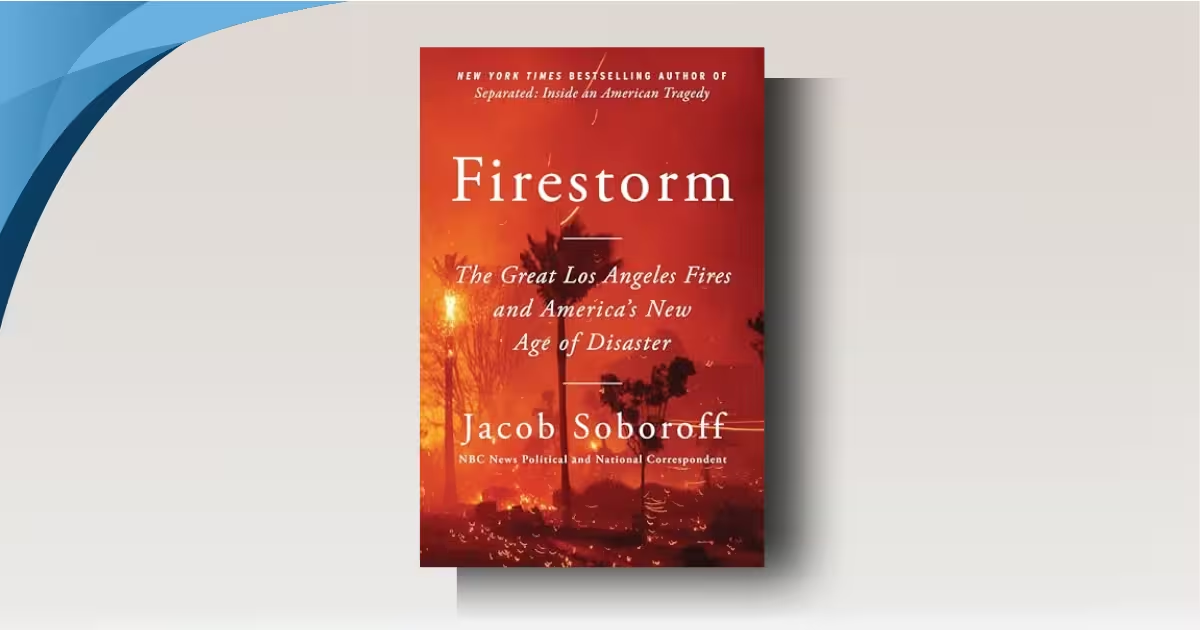
Do you ever lie awake at night wondering if the next climate disaster will hit your hometown, and whether anyone is truly prepared for it? Jacob Soboroff’s Firestorm isn’t just a book about a wildfire; it is a terrifyingly personal and meticulously reported warning about America’s fragile relationship with a new age of perpetual disaster.
Table of Contents
1. Introduction
Firestorm: The Great Los Angeles Fires and America’s New Age of Disaster is a 2025 work of narrative non-fiction and disaster journalism by Emmy Award-winning journalist Jacob Soboroff. Published by HarperCollins (ISBN 9780063467965), the book chronicles the catastrophic wildfires that engulfed Los Angeles in January 2025.
This book belongs to the genres of immersive journalism, climate reporting, and personal memoir. Soboroff, a seasoned MSNBC correspondent known for his deep-dive reporting on immigration and inequality, was thrust into covering the fires in his own childhood neighborhood.
This unique position—both objective reporter and devastated community member—forms the book’s powerful core.
His background, including covering the Trump administration’s family separation policy and the war in Ukraine, equips him to analyze disaster through political, humanitarian, and personal lenses.
he central thesis of Firestorm is that the 2025 Los Angeles fires were not a freak occurrence but a predictable and terrifying manifestation of America’s “New Age of Disaster.”
Soboroff argues that a dangerous confluence of climate change-induced drought, historical urban planning failures in the wildland-urban interface, underfunded emergency services, and a fractured political climate has created a society perpetually on the brink.
The book is a plea for recognition and preparation, asserting that what happened in LA is a blueprint for future catastrophes across the nation.
2. Background
To understand the magnitude of Soboroff’s account, one must recognize Los Angeles’s long, fraught history with fire. The city is built within a Mediterranean ecosystem designed to burn, a “design for disaster” as a 1962 LAFD film noted.
The Santa Ana winds, canyons packed with dry chaparral, and sprawling foothill communities have repeatedly combined into tragedy, from the 1961 Bel Air Fire to the 2018 Woolsey Fire.
Soboroff’s narrative is the latest, and most devastating, chapter in this ongoing story, set against a backdrop of a warming planet and a multi-year “megadrought” in the American West.
As noted in the prologue, the stage was set by “bone-dry conditions and ferocious hurricane-force Santa Ana winds,” a recipe repeated throughout California’s history but now intensified by climate change.
3. Firestorm Summary
Firestorm unfolds over thirteen harrowing days in January 2025, interweaving Soboroff’s personal journey with the stories of firefighters, meteorologists, politicians, and victims. The following is a detailed, spoiler-filled summary of the key events, themes, and lessons.
Prologue & The Ignition: A Predictable Catastrophe
The disaster begins with a smolder. The Lachman Fire, allegedly set maliciously on New Year’s Day 2025, is thought to be contained after burning nine acres. However, a single ember burrows into the roots beneath Pacific Palisades.
For six days, it burns underground, unseen—a “slow-motion ignition” (Page 12). This chilling detail underscores a central theme: our failures are often buried, waiting for the right conditions to explode.
Meanwhile, the warnings are blaring. David Gomberg, a lead forecaster at the National Weather Service, sees data across four monitors that compels an early “fire weather watch” on January 3.
By January 6, his colleague Dr. Ariel Cohen states flatly, “This is going to be horrific” (Page 18). They issue a “Particularly Dangerous Situation (PDS) Red Flag Warning,” predicting life-threatening winds over 80 mph and humidity in the single digits.
The system worked; the science was clear. Yet, as Soboroff notes, “what nobody could predict… was exactly when or how a fire might begin. There was no way for them to know that the Lachman Fire might still be burning below ground” (Page 20).
Day of Inferno: January 7, 2025 – The Palisades Fire
On January 7, the foretold Santa Ana winds arrive, unearthing the smoldering roots. At 10:30 AM, Captain Jeff Brown of Fire Station No. 69 (“Sixty-Nines”) looks toward the mountains and says, “I see smoke” (Page 13).
Veteran firefighter Eric Mendoza and his crew rush from their beach workout toward the hills. Brown’s radio call captures the immediate scale: “I need thirty, forty, fifty fire engines right now” (Page 13).
Simultaneously, Soboroff, reluctantly assigned to “coverage” duty, is at his NBC bureau. He watches the local news and sees the plume rising from his neighborhood. A text from his brother Miles confirms his dread: “Big Palisades fire. We are evacuating” (Page 36).
The fire, initially reported at 2 acres, balloons to 20, then 200, then over 700 acres in mere hours. Soboroff convinces his bureau chief to let him go, stating simply, “I grew up in the Palisades” (Page 43).
What follows is a minute-by-minute account of chaos. Soboroff and his producer, Bianca Seward, drive toward “Dead Man’s Curve” on Sunset Boulevard, passing abandoned cars and fleeing residents.
They witness the “gridlock of despair” as the only roads in and out of the Highlands become parking lots. Fire Chief Sam DiGiovanna appears on TV, delivering a line that chills Soboroff: “These people in the path of this fire right now, even if they have not been told to evacuate, they should be evacuating” (Page 39).
Soboroff’s reporting from the ground that evening is visceral. He stands at Sunset and Amalfi, the sky an apocalyptic orange, interviewing a resident named Nick who is refusing to leave his mother’s investment. “Just fucking hope?” Nick replies when asked why he stays (Page 59).
The fire, Soboroff tells MSNBC’s Chris Hayes, is “in the middle of an urban part of the City of Los Angeles” (Page 63)—this is not a wilderness fire; it is a city burning.
The Second Front: The Eaton Fire
As the Palisades burns, the other predicted “worst-case scenario” materializes. Around 6:10 PM on January 7, hurricane-force winds roar down the San Gabriel Mountains into Altadena.
A century-old, inactive power line, the Mesa-Sylmar, is thought to be energized by electromagnetic induction from active lines in the gale, sparking the Eaton Fire (Page 69).
Robert Garcia, Fire Chief of the Angeles National Forest, had warned of exactly this.
The “mountain-wave” event Cohen forecasted was now “one of those worst-case scenarios, for sure” (Page 71).
The fire explodes, consuming the dry canyons and racing toward communities like McNally Avenue, where residents like NASA engineer Cate Heneghan and retirees Herb and Loyda Wilson (away in Hawaii) have their lives.
The dual fires stretch resources to the breaking point. Kristin Crowley, the LAFD Chief, recalls all off-duty personnel.
Mutual aid requests fly between counties. Yet, the winds are so fierce that Dan Child, LAFD’s chief pilot, makes an unprecedented call: “All air assets are being grounded for the night” (Page 80). The firefighters are left alone on the ground, facing a literal firestorm.
Hellscape and Heroism: The Long Night
The heart of the book details the unimaginable bravery and desperation of January 7-8. Firefighter Eric Mendoza and Sixty-Nines abandon their massive ladder truck on Sunset Boulevard, resorting to fighting on their stomachs in the street as “melted metal puddles formed” from cars liquifying at over 1,000 degrees (Page 55).
They watch their own fire station threatened, shooting water curtains to save it, and are ordered at one point to “abandon the station” (Page 86).
In Altadena, crews like Twelves and Nineteens fight a street-by-street, house-by-house battle with dwindling water pressure. Captain Joshua Swaney and his crew subsist on military MREs. Tim Larson of Twenty-Threes in the Palisades, after 12 hours in a cul-de-sac, prays, “Lord, let us save just one more house” as his engine runs out of fuel (Page 90).
Soboroff himself drives through the devastated village at 3 AM on January 8. “Oh my God. Oh. My. God,” he narrates as he sees the Palisades Business Block—the “pink building” holding a century of community memory—burning, and entire blocks of the Alphabet Streets reduced to chimneys and ash (Page 94-95).
He FaceTimes his mother from the ruins of his own birth home on Frontera Drive, both of them in tears.
Politics in the Embers
Interwoven with the firefight is a parallel drama of political response and failure. Governor Gavin Newsom, having canceled a presidential event due to the winds, races to the fire lines, feeling his “eyeballs warming” from the heat (Page 46). He desperately tries to call President Joe Biden to secure a Major Disaster Declaration, scrambling for a cell signal amid the ruins (Page 114-115).
When they meet on January 8, Newsom hands Biden a hastily printed, two-page request. Biden’s response: “Pal… done” (Page 120).
Contrasting this is the response of President-elect Donald Trump, set to be sworn in thirteen days later. From Mar-a-Lago, he unleashes a stream of misinformation on social media, blaming the fires on Newsom protecting a “worthless fish called a smelt” and claiming, “NO WATER IN THE FIRE HYDRANTS, NO MONEY IN FEMA” (Pages 111, 120-121).
Soboroff experiences the surreal personal side of this political divide when Katie Miller, wife of Trump advisor Stephen Miller, calls him to check on her in-laws’ Palisades home. Soboroff drives to the address and texts her a photo of the ruins: “[Whole] neighborhood is gone I’m sorry” (Page 110).
Aftermath and The New Age of Disaster
The final chapters detail the grim accounting. The Palisades Fire ultimately burned 17,234 acres, destroyed over 1,000 structures, and displaced 150,000 people.
The Eaton Fire burned 10,600 acres, destroyed hundreds more homes, and killed at least five civilians. In total, the Great Los Angeles Fires of 2025 claimed 31 lives and destroyed over 16,000 structures.
But Soboroff’s conclusion looks beyond the statistics.
He reflects on the “remarkable time machine” quality of fire, erasing the past and scorching the future in one stroke (Page 11). He interviews experts and victims, like the Wilsons sifting through the ashes of their McNally Avenue home, finding only two UPS commendation pins. “This is all that’s left,” Herb says (Page 133).
The book ends not with a neat resolution, but with a haunting question and a symbol: as Soboroff surveys the ashen Palisades, he hears the shrill cry of wild nanday parakeets returning—resilient life amidst absolute loss, a fragile hope in America’s New Age of Disaster.
4. Firestorm analysis
Evaluation of Content and Argument:
Soboroff masterfully supports his thesis through a multi-layered narrative. His argument that this was a predictable disaster is anchored in the meticulous pre-fire chapters detailing the NWS warnings.
The evidence isn’t anecdotal; it’s the official PDS alert reproduced in the text (Page 19). The failure, then, becomes societal—not a failure to predict, but a failure to act on those predictions with sufficient infrastructure and public urgency.
He effectively ties the immediate catastrophe to broader systemic issues:
- Climate Change: The “bone-dry” fuel after years of drought is a constant character.
- Urban Planning: The “wildland-urban interface” is repeatedly named as the killer zone, a direct result of decades of building in fire-prone areas.
- Resource Strains: Firefighters like Captain Erik Scott are quoted saying, “Your Los Angeles City Fire Department needs more firefighters” in the middle of the crisis (Page 72).
- Political Dysfunction: The stark contrast between the on-the-ground coordination of Newsom/Biden and the corrosive misinformation from Trump is presented not as opinion, but as reported fact through direct quotes and social media posts.
The book’s greatest strength in argumentation is its human scale. Soboroff doesn’t just say “systems failed”; he shows Eric Mendoza dehydrated and blinded on El Medio Avenue, and Cate Heneghan packing her car with a disconnected door handle.
The logical reasoning is clear: if this could happen to the prepared, affluent Palisades with its celebrity residents and political connections, it can happen anywhere.
5. Strengths and Weaknesses
My Pleasant/Positive Experience (Strengths):
Unprecedented Access and Perspective: The fusion of memoir and journalism is breathtaking. Soboroff’s anguish is palpable, making the disaster feel immediate and real in a way traditional reporting cannot. His access to both the fire lines and the executive suites (Newsom, Biden’s team, even Trump’s orbit via Katie Miller) provides a 360-degree view.
Narrative Pace and Structure: The book reads like a thriller. The countdown from the NWS warnings to ignition, the parallel timelines of Palisades and Altadena, and the intercutting of personal, political, and frontline stories create unbearable, necessary tension.
Historical and Scientific Context: Weaving in the 1961 Bel Air Fire (“Design for Disaster”), the 1993 Kinneloa Fire, and the mechanics of mountain waves and power line induction elevates the book from a disaster log to a serious work of climate and urban history.
Devastatingly Effective Detail: The specific, haunting images linger: the melted aluminum like candle wax, the Marbelite streetlights standing sentinel over ashes, the UPS pins in the rubble. These are not embellishments; they are the core evidence of loss.
My Unpleasant/Negative Experience (Weaknesses):
Overwhelming Density: At times, the barrage of names, fire station numbers, street names, and minute-by-minute details can be disorienting for a reader not intimately familiar with LA’s geography. A few more maps or diagrams might have helped.
Limited Exploration of Socioeconomic Disparities: While the book nods to the workers who make the Palisades run, its primary lens is on a wealthy enclave. The experience of lower-income communities and undocumented residents in disaster zones—a critical part of America’s “New Age of Disaster”—is not deeply explored here, though Soboroff’s past work suggests he is keenly aware of it.
The “Personal” Can Occasionally Feel Privileged: The segment about trying to save Stephen Miller’s parents’ house, while fascinating politically, might strike some readers as an unusual allocation of reporter bandwidth in the midst of widespread tragedy. However, it effectively serves the book’s theme of disaster transcending politics.
6. Comparison with Similar Works
Firestorm stands firmly in the tradition of immersive disaster journalism like John Vaillant’s Fire Weather: A True Story from a Hotter World (which focuses on the Fort McMurray fire) and Elizabeth Kolbert’s The Sixth Extinction in its urgent climate messaging.
However, Soboroff’s deeply personal stake distinguishes it. It shares DNA with Rebecca Solnit’s A Paradise Built in Hell in its examination of community response, but is far more narrative and immediate.
Compared to Mike Davis’s Ecology of Fear—cited in the epigraph—Firestorm is less a theoretical critique and more a visceral, firsthand testament to Davis’s prophecies coming true.
7. Conclusion and Recommendation
Firestorm: The Great Los Angeles Fires and America’s New Age of Disaster is a monumental, heart-wrenching, and essential book. It is a masterpiece of narrative nonfiction that succeeds both as a page-turning account of catastrophe and a sobering analytical framework for understanding our perilous future.
Who should read this book?
- Every American living in the wildland-urban interface (which is millions of us).
- Policymakers, urban planners, and emergency managers.
- Journalists and students of journalism as a case study in ethical, embedded reporting.
- Readers of climate non-fiction who want story-driven evidence of our new reality.
- Anyone who believes in the power of long-form journalism to document history and spur change.
Who might it not be for?
- Readers seeking a light, hopeful read or purely solutions-oriented policy manual. This book is a searing diagnosis; the prescription is implied but not fully detailed.
- Those with personal trauma from wildfires may find it overwhelmingly triggering.
In the end, Jacob Soboroff has written more than a book; he has built a memorial in prose and issued a thunderous alarm. As he states while looking at his destroyed childhood home, “it’s hard to imagine what comes next.”
Firestorm forces us to imagine it, to remember what was lost, and to prepare—with clarity, courage, and unity—for what is inevitably coming next.







