
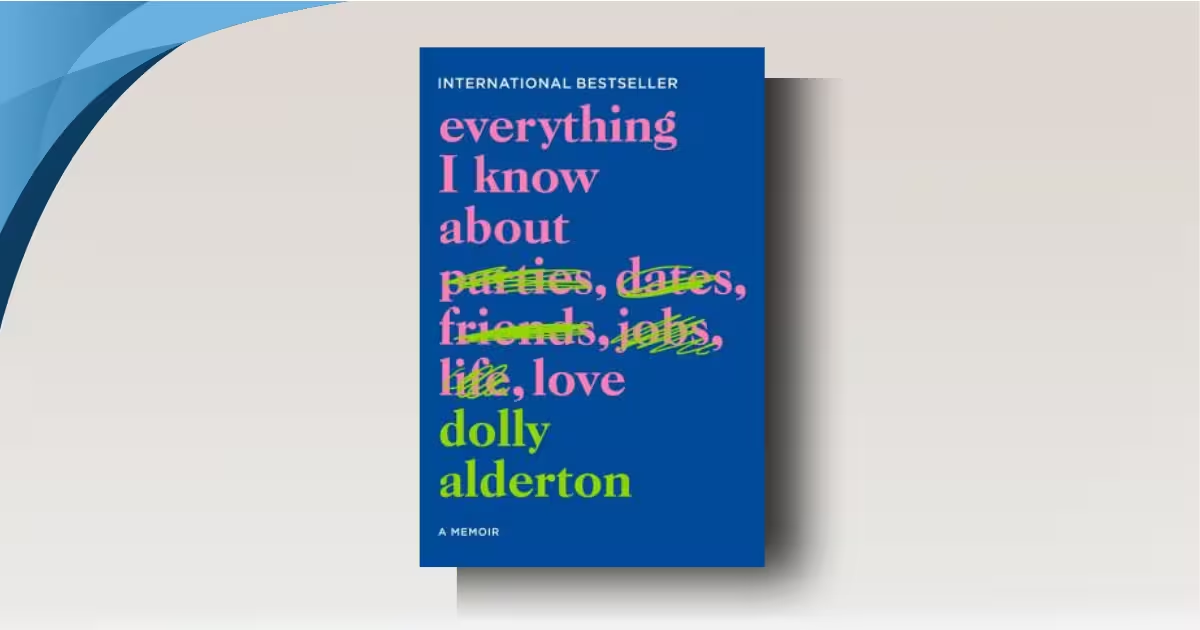
Alderton’s writing is packed with laugh-out-loud lines and profound truths. For the full collection of standout quotes, raw passages, and iconic moments, check out my dedicated roundup here: These Everything I Know About Love quotes are the words that stayed with me long after finishing.”
Everything I Know About Love quotes
Top Memorable Lines and Passages from “Everything I Know About Love” by Dolly Alderton
1. Naive Teen Beliefs on Love (From “Everything I Knew About Love as a Teenager,” Pages 5-6) This opening list is hilariously relatable, setting the tone for Alderton’s evolution from boy-obsessed teen to self-assured woman. It’s a spoiler for her early misconceptions that get shattered throughout the book. “Romantic love is the most important and exciting thing in the entire world. If you don’t have it when you’re a proper grown-up then you have failed, just like so many of my art teachers who I have noted are ‘Miss’ instead of ‘Mrs’ and have frizzy hair and ethnic jewellery. It is important to have a lot of sex with a lot of people but probably no more than ten. When I’m a single woman in London I will be extremely elegant and slim and wear black dresses and drink Martinis and will only meet men at book launches and at exhibition openings.
The mark of true love is when two boys get in a physical fight over you. The sweet spot is drawn blood but no one having to go to hospital. One day this will happen to me, if I’m lucky. It is important to lose your virginity after your seventeenth birthday, but before your eighteenth birthday. Literally, even if it’s just the day before, that’s fine, but if you go into your eighteenth year still a virgin you will never have sex. You can snog as many people as you like and that’s fine, it doesn’t mean anything, it’s just practice. The coolest boys are always tall and Jewish and have a car.
Older boys are the best kind because they’re more sophisticated and worldly and also they have slightly less stringent standards. When friends have boyfriends they become boring. A friend having a boyfriend is only ever fun if you have a boyfriend too. If you don’t ask your friend about their boyfriend at all they’ll eventually get the hint that you find it boring and they’ll stop going on about him. It’s a good idea to get married a bit later in life and after you’ve lived a bit.
Say, twenty-seven. Farly and I will never fancy the same boy because she likes them short and cheeky like Nigel Harman and I like them macho and mysterious like Charlie Simpson from Busted. This is why our friendship will last for ever. No moment in my life will ever be as romantic as when me and Lauren were playing that gig on Valentine’s Day at that weird pub in St Albans and I sang ‘Lover, You Should’ve Come Over’ and Joe Sawyer sat at the front and closed his eyes because earlier we’d talked about Jeff Buckley and basically he is the only boy I’ve ever met who fully understands me and where I’m coming from.
No moment in my life will ever be as embarrassing as when I tried to kiss Sam Leeman and he pulled away from me and I fell over. No moment in my life will ever be as heartbreaking as when Will Young came out as gay and I had to pretend I was fine about it but I cried while I burned the leather book I was given for my confirmation, in which I had written about our life together. Boys really like it when you say rude things to them and they find it babyish and uncool if you’re too nice. When I finally have a boyfriend, little else will matter.”
2. The Sound of Adolescence: AOL Dial-Up (From “Boys,” Page 7) A vivid, nostalgic passage spoiling her suburban isolation and digital escape into boys via MSN—foreshadowing her later realizations about real connections.
“For some, the sound that defined their adolescence was the joyful shrieks of their siblings playing in the garden. For others, it was the chain rattle of their much-loved bike, hobbling along hills and vales. Some will recall birdsong as they walked to school, or the sound of laughing and footballs being kicked in the playground. For me, it was the sound of AOL dial-up internet. I can still remember it now, note for note.
The tinny initial phone beeps, the reedy, half-finished squiggles of sound that signalled a half-connection, the high one note that told you some progress was being made, followed by two abrasive low thumps, some white fuzz. And then the silence indicated that you had broken through the worst of it. ‘Welcome to AOL,’ said a soothing voice, the upward inflection on ‘O’. Followed by, ‘You have email.’ I would dance around the room to the sound of the AOL dial-up, to help the agonizing time pass quicker. I choreographed a routine from things I learnt in ballet: a plié on the beeps; a pas de chat on the thumps. I did it every night when I came home from school. Because that was the soundtrack of my life. Because I spent my adolescence on the internet.”
3. MSN Messenger as an Escape (From “Boys,” Pages 9-10) This spoils her teen loneliness and the thrill of “Phantom Boys,” highlighting how digital flirtations shaped her early views on love, which evolve into appreciating real friendships.
“Morrissey once described his teenage life as ‘waiting for a bus that never came’; a feeling that’s only exacerbated when you come of age in a place that feels like an all-beige waiting room. I was bored and sad and lonely, restlessly wishing the hours of my childhood away. And then, like a gallant knight in shining armour, came AOL dial-up internet on my family’s large desktop computer.
And then came MSN Instant Messenger. When I downloaded MSN Messenger and started adding email address contacts – friends from school, friends of friends, friends in nearby schools who I’d never met – it was like knocking on the wall of a prison cell and hearing someone tap back. It was like finding blades of grass on Mars. It was like turning the knob of the radio on and finally hearing the crackle smooth into a human voice. It was an escape out of my suburban doldrums and into an abundance of human life. MSN was more than a way I kept in touch with my friends as a teenager; it was a place.
That’s how I remember it, as a room I physically sat in for hours and hours every evening and weekend until my eyes turned bloodshot from staring at the screen. Even when we’d leave the suburbs and my parents would generously take my brother and me for holidays in France, it was still the room I occupied every day. The first thing I would do when we arrived at a new B&B was find out if they had a computer with internet – usually an ancient desktop in a dark basement – and I would log on to MSN Messenger and unashamedly sit chatting on it for hours while a moody French teenager sat behind me in an armchair waiting for his go.
The Provençal sunshine beat down outside, where the rest of my family lay by the pool and read, but my parents knew there was no arguing with me when it came to MSN Messenger. It was the hub of all my friendships. It was my own private space. It was the only thing I could call my own. As I say, it was a place. My first email address was [email protected] which I set up aged twelve in my school IT room. I chose the number 14 as I assumed I would only be emailing for two years before it became babyish; I gave myself room to enjoy this new fad and its various eccentricities until the address would expire in relevance on my fourteenth birthday. I didn’t start using MSN Messenger until I was fourteen and in this space of time would also try out [email protected] to express my new passion for the 2002 winner of Pop Idol. I also tried [email protected] on for size, after giving a barnstorming performance as Mister Snow in the school’s production of Carousel. I reprised munchkin_1_4 when I downloaded MSN Instant Messenger and enjoyed the overflowing MSN Messenger contacts book of school friends I had accumulated since the address’s conception. But, crucially, there was also the introduction of boys. Now, I didn’t know any boys at this point. Other than my brother, little cousin, dad and one or two of my dad’s cricketing friends, truly, I hadn’t spent any time with a boy in my entire life. But MSN brought the email addresses and avatars of these new floating Phantom Boys; they were charitably donated by various girls at my school – the ones who would hang out with boys at the weekend and then magnanimously pass their email addresses around the student body.
These boys did the MSN circuit; every girl from my school would add them as a contact and we’d all have our fifteen minutes of fame talking to them. Where the boys were sourced from broadly fell into three categories. The first: a girl’s mother’s godson or some sort of family friend on the outskirts of her life who she had grown up with. He was normally a year or two older than us, very tall and lanky with a deep voice. Also lumped into this category was someone’s schoolboy neighbour. The next classification were the cousins or second cousins of someone. Finally, and most exotically, a boy who someone had met when they were on a family holiday.
This was the Holy Grail, really, as he could be from absolutely anywhere, as far-flung as Bromley or Maidenhead, and yet there you’d be, talking to him on MSN Messenger as if he were in the same room. What madness; what adventure. I quickly collated a Rolodex of these waifs and strays, giving them their own separate label in my contacts list, marked ‘BOYS’. Weeks would pass talking to them – about GCSE choices, about our favourite bands, about how much we smoked and drank and ‘how far’ we’d ‘been’ with the opposite sex (always a momentously laboured work of fiction).
Of course, we all had little to no idea of what anyone looked like; this was before we had camera phones or social media profiles, so the only thing you’d have to go on was their tiny MSN profile photo and their description of themselves.”
4. Body Image and Heartbreak (From “Being a Bit Fat, Being a Bit Thin,” Pages 47-50)
A raw spoiler for Alderton’s post-breakup weight loss and realization that thinness isn’t the key to happiness or love— a turning point in her self-acceptance arc.
“‘Do you love me any more?’ I asked. ‘No,’ he said. ‘No, I don’t think I do love you any more.’ ‘Do you at least fancy me?’ I asked. There was a silence. ‘I don’t think so.’ I hung up. (I’ve since advised people that it’s best to lie about this if they’re dumping someone. The ‘falling out of love’ stuff is pretty bad. The ‘I don’t fancy you’ stuff is killer.) I was just twenty-one, I was a month out of university. And my first proper boyfriend had just dumped me over the phone. Harry and I had been together for a little over a year despite being completely and utterly wrong for each other.
He was conservative, obsessed with sport, did a hundred press-ups before bed every night, was the social secretary of the Exeter University Lacrosse Club and owned a non-ironic T-shirt that said ‘Lash Gordon’ on the front. He hated excessive displays of emotion, tall women wearing heels or being too loud. So basically everything that made up my personality at the time. He thought I was a disaster, I thought he was a square. Our entire relationship was spent arguing, not least because we never had any time apart. He had practically lived at the flat I shared with Lacey, AJ and Farly in our final year at university and had moved into my parents’ house for the summer while he did an internship.
One of our lowest moments came at the end of that long, hot, agitated August with no space from each other, when we got a train to Oxford for Lacey’s twenty-first birthday party. I went rogue from my table after the main course and happened upon a swimming pool, which looked appealing. So I took all my clothes off and went for a dip, and, when a few friends came looking for me, encouraged everyone else to do the same. The night descended into a mass pool party and I became a sort of naked, poolside Master of Ceremonies. Harry went ballistic.
The next morning, Farly and AJ hid behind a tree with uncontrollable giggles as they watched him shout ‘YOU WILL NEVER SHOW ME UP LIKE THAT AGAIN!’ at me, my head-hanging shame made even more apparent by the fact the pool had been overchlorinated and my bleached hair had turned a vibrant bottle green. We had absolutely nothing in common. But he wanted to be my first proper boyfriend, and when I was nineteen that was a good enough reason to go out with someone.
I was living in an East London flat the night he called me, staying with a friend indefinitely while I began my journalism course to avoid the long commute from Stanmore. Farly turned up an hour later at one a.m., having driven from her mum’s house, and told me she was taking me home. I was inconsolable on the journey back, trying to recount our conversation to Farly, but barely remembering any of the detail. My phone rang – it was him. I told her I couldn’t speak to him. She pulled over, picked up and pressed it to her ear. ‘Harry, why have you done this?’ she barked.
I couldn’t make out what he was saying on the other end of the line. ‘Fine, but why do it to her over the phone? Why couldn’t you have come see her and do it in the flesh?’ she barked again. There was more indecipherable talking on his side. Farly listened. ‘YEAH? WELL YOU CAN GO FUCK YOURSELF,’ she shouted, hanging up and throwing the mobile on to the seat behind her. ‘What did he say?’ ‘Nothing, really,’ she said. Farly slept in my bed that night.
And the night after that. She ended up staying for a fortnight; I didn’t move back to the flat. It was the first time I had experienced heartbreak and I’d never thought the overwhelming feeling would be such acute confusion; as if I had no reason to trust anyone ever again. I didn’t have an exact idea of what had happened or why. All I knew was that I hadn’t been good enough. I also couldn’t eat.
I had heard about this upshot of a break-up before, but I had never imagined it would affect me. I was, and always had been, a very hungry girl. Perhaps the hungriest of all. I hadn’t managed a diet that had ever lasted longer than two days. My family all loved food, Farly and I had loved food. My mum, a natural cook who grew up with Italian grandparents, started teaching me to cook when I was five, standing me next to her on a chair so I could help knead dough or whisk eggs at the kitchen counter. I cooked for myself throughout my teens and I cooked for everyone at university.
My first ever diary entry, when I was six, was an enthusiastic record of what I had eaten that day. I recalled phases of my life by what was on a plate: the crispy baked potatoes on seaside holidays in Devon, the lurid, sticky jam tarts of my tenth birthday, the roast chicken of every Sunday night, bathing the dread of the school week in gravy.
No matter how terrible life became, no matter how blistering the pain, I was always sure I’d still have room for seconds. I never felt overweight, but my body type was often muddily described as ‘a big girl’. I come from a long, tall line of giants. My brother, God love him, was a six-foot-seven teenager who had to buy clothes in shops called things like ‘Magnus’ and ‘High and Mighty’. By the time I was fourteen, I was five foot ten. By the time I was sixteen, I was six foot. But I wasn’t one of those adorably tall, lanky teenage part-foal-part-human girls – I was broad, with big boobs and hips. I was the opposite of the girls photographed in the pages of Bliss and described in The Baby-Sitters Club book series. Just as I was never mentally built of the right stuff to be a teenager, neither was my physical being well-suited to it.
I found being so tall as a teenager difficult – I never knew how much I was supposed to weigh, because every girl was half my height and talked about their ‘fat weight’ as being a weight I hadn’t been since childhood, which engendered a great sense of shame.
That, partnered with boredom eating and puppy fat, meant I was shopping for size 16s when I was not yet sixteen. I was aware I was bigger than my friends and was sometimes called fat, but I always had faith that my shape would make more sense when I wasn’t a kid. The only truly mortifying moment came when, at a barbecue aged fifteen, my parents’ extremely drunk and spectacularly overweight friend Tilly grabbed my love handles like she was steering the wheel of a ship before announcing to the garden that ‘us chunky girls have got to stick together’ and telling me in no uncertain terms that ‘men like a bit of meat on a girl’, before I received a conspiratorial wink from her husband who was, incidentally, also the width of a Vauxhall Zafira.
Some weight slowly peeled off when I went to boarding school and by the time I got to university I was a comfortable size 14 – but I didn’t really mind that I wasn’t very slim. I still kissed the boys I wanted to kiss. I could wear Topshop. And I loved food and cooking. I understood that that was the trade-off. And yet, here I was. Finally unable to eat anything. From head to toe, I was flooded with a sickly yellow feeling and my appetite – my most resplendent asset – had vanished.
My intestines felt kinetic. There was a constant lump in my throat. Mum would give me bowls of soup in the evening, telling me it was easy to swallow, but I’d only manage a few spoonfuls and put the rest down the sink when she wasn’t there. After a fortnight, I got on the scales. I had lost a stone. I stood in front of the mirror naked and saw, for the first time in my life, the very beginnings of what I had been led to believe were the true qualifications of femininity. A smaller waist, hip bones, collarbones and shoulder blades. In this new landscape that I didn’t understand – where the boy I’d shared a home and life with for over a year was suddenly repulsed by me – I felt a flicker of something finally making sense. I had stopped eating, therefore my body was changing. It worked. Here, in the mess, I found a simple formula of which I was the master. Here was something I could control that would lead me somewhere new, where I could be someone different. The answer was in my reflection: don’t eat any more. I made a project of my new mission; I weighed myself every day, I counted my steps, I counted my calories, I did sit-ups in my bedroom every morning and night, I wrote down my measurements every week. I lived off Diet Coke and carrot sticks. If I wanted to eat something, I’d go to bed or have a hot bath. More weight dropped away.
I shed it day by day, pound by pound; it never seemed to plateau. This filled me with an energy that initially acted as a substitute for food; I felt like a high-speed train that was magically running on empty. Another month passed, another stone dropped. My period didn’t arrive, which simultaneously frightened and encouraged me. At least it meant something was changing inside and outside too; at least I was closer to being someone new. During this time, when I wasn’t at lectures, I was hunkered down at home. I still felt fragile from the break-up and I didn’t want to socialize.
The first person who noticed something was wrong was Alex, Harry’s sister, who I had become very close to during our relationship and who, thankfully, stuck by me through our break-up. She had just moved to New York and we talked every day. ‘You look really thin,’ she said to me on Skype one night. ‘Are you OK?’ I didn’t know how to tell her that I wasn’t, because I felt like I was. I was still functioning.
I was going to lectures. My health was plummeting, my stocks were up. And a woman can never really be thin enough, that’s the problem. It is not seen as too high a price to pay to be hungry all the time or to rest your head on your bed at night and feel the sharp new corners of your collarbones. Look like a Victoria’s Secret Angel even though you work in an office. It’s not enough to be an average-sized woman with a bit of hair and an all-right jumper. That doesn’t cut it. We’re all meant to be fucking She-Hulk meets Sheryl Sandberg.”
5. Friendships Change with Relationships (From “‘Nothing Will Change’,” Pages 92-93) Spoiling Alderton’s fear of losing Farly to a boyfriend, this passage captures the book’s theme of platonic love’s endurance amid change.
“‘No, no, I’m happy for you,’ I said. We did the rest of the walk in silence. ‘Do you want to bake chocolate chip cookies?’ Farly said when we got back to our house. ‘Yeah.’ ‘Great. Make a list of what we need and I’ll go get the ingredients. And why don’t we watch that Joni Mitchell documentary that’s been sitting on the shelf for ages?’ ‘Sure,’ I said. It reminded me of the time my mum took me to McDonald’s when I was eight after my goldfish died.
We sat on the sofa eating cookies, our legs intertwined, our tummies poking out from pyjamas. Graham Nash was talking about the soul-baring lyrics of Blue. ‘I know every single word of that album,’ I said. It was the only album we’d taken on a three-week summer road trip when Farly passed her driving test aged seventeen. ‘Me too. “Carey” is my favourite.’ ‘ “All I Want” is mine.’ I paused. ‘We’ll probably never do a road trip like that again.’ ‘Why?’ ‘Because you’re moving in with your boyfriend, you’ll do all your road trips with him now.’ ‘Don’t be stupid,’ she said. ‘Nothing will change.’ I would like to pause the story a moment to talk about ‘nothing will change’. I’ve heard it said to me repeatedly by women I love during my twenties when they move in with boyfriends, get engaged, move abroad, get married, get pregnant. ‘Nothing will change.’ It drives me bananas. Everything will change.
Everything will change. The love we have for each other stays the same, but the format, the tone, the regularity and the intimacy of our friendship will change for ever. You know when you were a teenager and you’d see your mum with her best friends and they’d seem close, but they weren’t like how you were with your friends? There’d be a strange formality between them – a slight awkwardness when they first met. Your mum would clean the house before they came and they would talk about their children’s coughs and plans for their hair. When we were kids, Farly once said to me: ‘Promise we’ll never get like that. Promise when we’re fifty we’ll be exactly the same with each other. I want us to sit on the sofa, stuffing our faces with crisps and talking about thrush. I don’t want to become women who meet up once every couple of months for a craft fair at the NEC.’ I promised. But little did I know how much work it takes to sustain that kind of intimacy with a friend as you get older – it doesn’t just stick around coincidentally.
I’ve watched it time and time again – a woman always slots into a man’s life better than he slots into hers. She will be the one who spends the most time at his flat, she will be the one who makes friends with all his friends and their girlfriends. She will be the one who sends his mother a bunch of flowers on her birthday. Women don’t like this rigmarole any more than men do, but they’re better at it – they just get on with it. This means that when a woman my age falls in love with a man, the list of priorities go from this: 1. Family 2. Friends To this: 1. Family 2. Boyfriend 3. Boyfriend’s family 4.
Boyfriend’s friends 5. Girlfriends of the boyfriend’s friends 6. Friends Which means, on average, you go from seeing your friend every weekend to once every six weekends. She becomes a baton and you’re the one at the very end of the track. You get your go for, say, your birthday or a brunch, then you have to pass her back round to the boyfriend to start the long, boring rotation again.
These gaps in each other’s lives slowly but surely form a gap in the middle of your friendship. The love is still there, but the familiarity is not. Before you know it, you’re not living life together any more. You’re living life separately with respective boyfriends then meeting up for dinner every six weekends to tell each other what living is like. I now understand why our mums cleaned the house before their best friend came round and asked them ‘What’s the news, then?’ in a jolly, stilted way. I get how that happens.”
6. Seeking Therapy (From “My Therapist Says,” Pages 152-155) Spoiling her anxiety breakdown and therapy start, this marks a pivotal self-reflection point leading to growth. “‘Why are you here?’ Why was I there? I never thought I would be there. In a small room, just behind Oxford Circus, with cream carpets and a burgundy sofa. Where it always smelt of molecule perfume and nothing else, no matter how hard I sniffed when I came in – no leftover lunch, no cooling coffee – no evidence of a life outside this room other than this woman’s perfume.
The smell that would for ever make my heart sink and think of one p.m. on a Friday afternoon whenever I got a whiff of it on a woman at a party. I was there for a price by the hour. In a vacuum of life where nothing existed but conversation between two people – a commentator’s box, the TV studio of post-match analysis. The less popular discussion show that runs alongside the big thing.
This was Strictly: It Takes Two. This was Dancing on Ice: Defrosted. This was the room I would always think of when I was on the verge of making a bad decision; in the loo of a pub, with a man in the back of a taxi. This room that promised that my life would change in it. I always promised myself I would never be in a room like this. But I didn’t know where to be but there. I had run clean out of other options. I was twenty-seven and I felt like I was toppling from a gale of anxiety. It was nine months since I went freelance and I had spent nearly every day alone with my thoughts.
I had pushed away the concerns of my friends and family; I was always on the verge of tears, but I was unable to talk to anyone. I woke up every morning with no idea of where I was or what was happening; I came round to my life every morning like the previous night’s sleep was a punch in the head that left me bloody. I was there because I had to be there. I was there because I had put off being there; because I always said I didn’t have any money or time; because it was indulgent and silly. I told a friend that I felt on the verge of an implosion and she gave me a woman’s number to call. I had run out of excuses. ‘I think I’m going to fall and die,’ I replied. She – Eleanor – peered over her glasses and then back to her page, furiously writing notes. She had a dark, semi-parted seventies-style flicky fringe, brown, feline eyes and a strong nose. She must have been in her early forties. She looked like a young Lauren Hutton.
I noted that her arms were muscular and tanned and elegant. I thought that she probably thought I was a silly crybaby. A big, fat loser. An over-privileged girl, needlessly spaffing all her hard-earned cash so she could blabber on about herself for an hour a week. She probably saw women like me coming a mile off. ‘I can’t open or close any windows in my flat, I have to ask someone else to do it,’ I continued, clipped and quiet to hold in tears that felt like they were pressing up behind the back wall of my eyeballs like water to a flood barrier. ‘Sometimes I can’t go into a room at all if a window is open because I’m so scared of falling out of it. And I have to stand with my back pressed against the wall when a train pulls into a tube station from the tunnel.
I see myself falling in front of it and dying. I see it happening every time I blink. Then I’ll spend all night replaying it over and over again in my head and I can’t sleep.’ ‘Right,’ she replied in an Australian accent. ‘And how long have you felt like this?’ ‘It’s all got really bad in the last six months,’ I said. ‘But on and off for the best part of ten years. The drinking gets bad when I’m very anxious. Same with the death obsession.
The flavour of the month fixation is falling.’ I guided her through The Greatest Hits of My Recurring Emotional Turmoil. I talked about my weight that had been as ever-changing as cloud formations – the fact that I could look at every photo taken of me since 2009 and tell her exactly to the pound how much I weighed in each one. I told her about my obsession with alcohol that hadn’t waned since I was a teenager, my unquenchable thirst when most people my age now knew when to stop, how I’d always been known for knocking it back at record speed, the vast black holes in my memory from these nights over the years; my increasing shame and distress over these lost hours and that unrecognizable madwoman running around town who I was meant to be responsible for, but who I had no recollection of being or knowing.
I told her about my inability to commit to a relationship; my obsession with male attention and my simultaneous fear of getting too close to someone. How difficult I had found watching all my friends, one by one, ease into long-term partnerships like they were lowering themselves into a cool swimming pool on a scorching day. How every boyfriend I’d had has asked why I can’t do the same; how I’d always feared that I was romantically wired wrong. We talked about how I had spread myself like the last teaspoon of Marmite across the width of as many lives as possible. I told her that I gave almost all of my energy away to other people when no one had asked it of me.
I described the control I thought this gave me over what other people thought of me, and yet it left me feeling more and more like a fraud. I told her how I fantasized about what people said about me behind my back; how I would probably agree with almost any insult thrown at me anyway. I told her the lengths I had gone to for approval: spending all my money on rounds of drinks for people I’d never met and not being able to pay my rent the next week; starting Saturday nights at four p.m. and ending them at four a.m. to attend six different birthday parties of people I barely knew. How tired and heavy and spineless and self-loathing this had made me feel.
The pathetic irony that I had the greatest circle of friends around me and yet I felt I couldn’t tell them any of this. How deep-rooted my fear of dependency was.
That I could cry in the bed of a stranger I met in New York, but I couldn’t ask my best friends for help. ‘But none of this is having a visible effect on my life,’ I said. ‘I feel silly for coming here because it all could be so much worse. I have great friends, a great family. My work is going well. No one would know that anything is wrong with me from the outside. I just feel shit. All the time.’ ‘If you feel shit all the time,’ she said, ‘it’s having a very, very big effect on your life.’ ‘I guess.’ ‘You feel like you’re going to fall because you’re broken into a hundred different floating pieces,’ she told me. ‘You’re all over the place. You’ve got no rooting. You don’t know how to be with yourself.’
The back wall of my eyeballs finally gave way and tears poured out from the deepest well in the pit of my stomach. ‘I feel like nothing is holding me together any more,’ I told her, my breathlessness punctuating my sentence like hiccups, the stream of my tears on my cheeks as hot and free-flowing as blood. ‘Of course you do,’ she said with a new softness. ‘You’ve got no sense of self.’
So that’s why I was there. The penny dropped. I thought I had a fear of falling, but really I just didn’t know who I was. And the stuff I used to fill up that empty space no longer worked; it just made me feel even more removed from myself. This overwhelming anxiety had been in the post for a while and it had finally arrived, fluttered through the letter box and landed at my feet. I was surprised by this diagnosis; there I was thinking my sense of self was rock solid. I am Generation Sense of Self, this is what we do. We have been filling in ‘About Me’ sections since 2006.
I thought I was the most sensiest of selfiest of anyone I knew. ‘You will never know what I truly think of you,’ she said, just as I was about to leave, letting me know she had already sensed how I work. ‘You might be able to guess from my demeanour if I like you, but you’ll never know exactly what I think of you on a personal level. You need to let go of that thought if we’re going to make any progress.’ At first I was filled with an uncomfortable paranoia; then an almost immediate sense of total relief. She was telling me to stop making crap jokes. She was telling me to stop saying sorry for ploughing through her Kleenex supply on the table next to me. She was telling me that this was a room where I didn’t have to labour over every word and gesture and anecdote to accommodate her in the hope that she would like me.
This woman with no sense of self, no self-regard, no self-esteem – a shapeshifting, people-pleasing presence; a tangled knot of anxiety – was being given permission to just be. She was telling me I was safe to let go in this room just behind Oxford Circus, with the cream carpet and the burgundy sofa. I left her office and walked the five and a half miles home. I was both liberated with the relief that I had finally found my way to that room and unbearably heavy with the weight of what was to come. I told myself that everything could be ironed out in three months. ‘She thinks I’ve got no sense of self,’ I told India as she made our dinner that night.”
7. It Takes a Village to Mend a Broken Heart (From “Heartbreak Hotel,” Page 173)
This line spoils Farly’s breakup aftermath, emphasizing communal support over romantic love.
“It was at this time that I was reminded of the chain of support that keeps a sufferer afloat – the person at the core of a crisis needs the support of their family and best friends, while those people need support from their friends, partners and family. Then even those people twice removed might need to talk to someone about it too. It takes a village to mend a broken heart.”
8. Falling for the Guru (From “I Got Gurued,” Pages 180-182) Spoiling Alderton’s brief, intense infatuation with David, this reveals her vulnerability to charismatic men before self-love. “Early in the summer of Farly’s heartbreak, I was asked to write a first piece for a magazine about the dangers of people-pleasing. The editor I was working for suggested that I speak to a man who had written a new book on the subject. His name was David, he was nearing fifty; he was an actor turned writer. I googled him before we spoke on the phone and noticed he was also very handsome: olive skin, salt-and-pepper hair, gentle brown eyes.
His publisher sent me a PDF of the book and it was a frustratingly brilliant read. His work focused on the human need for validation and how it cuts happiness short. Reading it felt like something – or someone – had grabbed my shoulders with a pair of strong, trusted hands and given me one big, sharp, much-needed shake.
We emailed back and forth for a while then organized a time to speak. His voice was deep and soft; far more pronounced and theatrical than I had imagined. His general vibe seemed to be that of an out-and-out hippie, but he spoke like an RSC ensemble member. I asked him questions about the book and the things that had really stuck with me; he told me that when we are children, we are constantly told to contain our behaviour.
He described how being told not to be bossy or not to show off or not to be a clever-clogs puts up barriers around certain recesses of who we are; and we’re scared to ever revisit them again as adults. Instead, we hide those parts of ourselves, the bits that are dark or loud or eccentric or twisted, for fear of not being liked. It was those parts of ourselves, he argued, that were the most beautiful. Because the piece was written from a personal angle, we had to talk about my own experiences. I told him I had started seeing a therapist this year. ‘The danger of a person like you doing therapy is that you seem clever,’ he said. ‘You will get the theory of it all very easily.
You’ll be able to be academic about yourself in conversation. But, you know, all the talky-talky stuff will only take you so far. You need to really feel it in your core, that change. It can’t just be stuff you discuss with a therapist. You need to feel it in your body –’ his voice slowed – ‘you need to feel it in the backs of your knees, in your womb, in your toes, in your fingertips.’ ‘Hmm,’ I said in agreement. We talked for about forty-five minutes, drifting from passages in the book to the research and work he’d done for years and to my own experiences. He spoke to me directly, with no formalities or politeness. I felt like he had somehow got straight to my inner equator, just through a phone call. ‘Pinch that little cheek of yours,’ he said as if he’d known me for years. ‘You don’t need someone else to tell you what to do or who to be. You’re your own mother now. You have to listen to what you want.’ ‘Hmm,’ I managed again. ‘And for every day for the rest of your life, I want you to take that job seriously.’ ‘But what about being appropriate? How does that work when you’re being yourself all the time?’ ‘Have you ever fallen in love with a man because he’s appropriate?’ ‘Well, no.’ ‘Oooh, that Greg,’ he said in a lustful voice. ‘He turns me on, he’s so fucking appropriate.’ ‘No, no,’ I said, laughing. ‘I’m not interested in appropriate. Darkness and edges and corners is where buried treasure lies. Fuck appropriate.’ I felt like he was flirting with me, but I couldn’t tell if he was talking to me so intimately simply for the sake of good quotes for the piece. By the end of our conversation we had drifted into a general chat that didn’t feel at all like an interview. I could tell he also wanted me to disclose if I was in a relationship, but I kept that information vague.
He told me he thought I could use a one-on-one session with him. ‘If you feel like you can show all of yourself to someone without fear of being judged,’ he said, ‘your intimacy will go through the roof.’ ‘Yeah, that’s always been a huge problem for me,’ I said. ‘Intimacy.’ ‘I know, I can feel that in you.’ There was a sudden silence between us. Maybe he was talking guru bullshit; maybe everything I had always pushed down was far more visible than I thought. ‘Hmm,’ I managed once more. ‘I hope you have someone in your life who really holds you, Dolly.’ ‘I have a therapist,’ I replied. ‘That’s not what I meant,’ he said. I came out of my flat and blinked into the light like I had just woken up. ‘I’ve just had the most extraordinary conversation,’ I said to India and Belle, who were sunbathing in our garden. ‘With who?’ India asked, taking her earphones out. ‘That guy for the article – that guru guy.’ ‘What did he say?’ ‘I don’t know, it was like he was speaking to something inside me that hadn’t been spoken to before; it was like something was yawning and waking up for the first time.’ ‘That’s what they do though, isn’t it, they make you think that’s the power they have,’ India said lugubriously, turning on to her front. ‘I’d never trust anyone who called themselves a guru.’ ‘To be fair, he doesn’t call himself a guru,’ I said. ‘Everyone else does.’ ‘OK, well that’s better,’ she replied. ‘It’s a bit like being a “maven”,’ I continued. ‘Or a “mogul”. You have to wait for someone else to say it, I think. You can’t say it about yourself.’
I took my top off and joined them on the towels they had thrown on the grass. ‘Did you get what you needed from him?’ Belle asked. ‘Yeah,’ I said. ‘He was a great interviewee.’ I closed my eyes and let the strong English sunshine give me a rare hug. ‘Jesus, I am not going to be able to stop thinking about him.’ ‘In, like, a sex way?’ India asked. ‘No, I don’t think so. In a I-want-to-eat-your-soul way. I just want to find out everything about him, I want to listen to everything he has to say.’ ‘Ask for his number,’ she said. ‘I already have his number. I just interviewed him on the phone.’ ‘Oh yeah,’ she said. ‘Well then, just text him.’ ‘I can’t “just text” someone I interviewed for a piece.’ ‘Why not?’ Belle asked. ‘Because it would be inappropriate,’ I said, catching the words in my mouth. ‘But whoever fell in love with appropriate?’”
9. Self-Love Breakthrough (From “Enough,” Pages 205-206) The emotional climax spoiling her solo trip realization: she’s enough without external validation. “would be there; I didn’t engineer chance encounters with people I fancied. I went out dancing with Lauren one night and when she was chatted up, instead of trying to find a bloke of my own, I stayed in the centre of the dance floor for an hour and danced by myself, sweating and swaying and spinning and spinning. ‘Are you waiting for someone?’ a bloke asked, pulling me towards him. ‘No, she’s right here,’ I said, and removed his hands from me. ‘I never thought I would use this word in relation to you, and I don’t want you to take offence at this,’ Farly said, three drinks down in the pub a few weeks later. ‘But I’ve found your company so calming these last few months.’ ‘When was the last time you saw me calm?’ I asked. ‘Well, I just haven’t,’ she replied, before draining the dregs of her vodka tonic and crunching on an ice cube. ‘Ever. In nearly twenty years.’ In the late spring, I took two flights to the Orkney Islands to write a piece for a travel magazine about holidaying on your own. I stayed above a pub that looked over the port of Stromness and at night, after I’d had a beer and a steaming bowl of mussels downstairs, I’d go for a long walk along the seafront and look up at the vast open skies – vaster than any sky I’d ever seen. One night, having spent a few days in peaceful solitude with my thoughts, I walked under the stars and along the cobbled streets and an idea crept all over me like arresting, vibrant blooms of wisteria. I don’t need a dazzlingly charismatic musician to write a line about me in a song.
I don’t need a guru to tell me things about myself I think I don’t know. I don’t need to cut all my hair off because a boy told me it would suit me. I don’t need to change my shape to make myself worthy of someone’s love. I don’t need any words or looks or comments from a man to believe I’m visible; to believe I’m here. I don’t need to run away from discomfort and into a male eyeline. That’s not where I come alive. Because I am enough. My heart is enough. The stories and the sentences twisting around my mind are enough. I am fizzing and frothing and buzzing and exploding. I’m bubbling over and burning up. My early-morning walks and my late-night baths are enough. My loud laugh at the pub is enough.
My piercing whistle, my singing in the shower, my double-jointed toes are enough. I am a just-pulled pint with a good, frothy head on it. I am my own universe; a galaxy; a solar system. I am the warm-up act, the main event and the backing singers. And if this is it, if this is all there is – just me and the trees and the sky and the seas – I know now that that’s enough. I am enough. I am enough. The words ricocheted through me, shaking every cell as they travelled. I felt them; I understood them; they fused into my bones. The thought galloped and jumped through my system like a race horse. I called it out to the dark sky. I watched my proclamation bounce from star to star, swinging like Tarzan from carbon to carbon. I am whole and complete. I will never run out. And I am more than enough. (I think they call it ‘a breakthrough’.)”
10. Life’s Duality (From “Twenty-eight Lessons Learnt in Twenty-eight Years,” Page 207) A key lesson spoiling her reflective wisdom at 28. “4. Life is a difficult, hard, sad, unreasonable, irrational thing. So little of it makes sense. So much of it is unfair. And a lot of it simply boils down to the unsatisfying formula of good and bad luck. 5. Life is a wonderful, mesmerizing, magical, fun, silly thing. And humans are astounding. We all know we’re going to die, and yet we still live. We shout and curse and care when the full bin bag breaks, yet with every minute that passes we edge closer to the end. We marvel at a nectarine sunset over the M25 or the smell of a baby’s head or the efficiency of flat-pack furniture, even though we know that everyone we love will cease to exist one day. I don’t know how we do it.”
11. Quiet Love in Everyday Moments (From “Homecoming,” Page 215) Spoiling the book’s redefinition of love as mundane yet profound, shifting from romance to friendships. “I know that love can be loud and jubilant. It can be dancing in the swampy mud and the pouring rain at a festival and shouting ‘YOU ARE FUCKING AMAZING’ over the band. It’s introducing them to your colleagues at a work event and basking in pride as they make people laugh and make you look lovable just by dint of being loved by them. It’s laughing until you wheeze. It’s waking up in a country neither of you have been in before. It’s skinny-dipping at dawn. It’s walking along the street together on a Saturday night and feeling an entire city is just yours. It’s a big, beautiful, ebullient force of nature.
And I also know that love is a pretty quiet thing. It’s lying on the sofa together drinking coffee, talking about where you’re going to go that morning to drink more coffee. It’s folding down pages of books you think they’d find interesting. It’s hanging up their laundry when they leave the house having moronically forgotten to take it out of the washing machine. It’s saying, ‘You’re safer here than in a car, you’re more likely to die in one of your Fitness First Body Pump classes than in the next hour,’ as they hyperventilate on an easyJet flight to Dublin.
It’s the texts: ‘Hope today goes well’, ‘How did today go?’, ‘Thinking of you today’ and ‘Picked up loo roll’. I know that love happens under the splendour of moon and stars and fireworks and sunsets but it also happens when you’re lying on blow-up air beds in a childhood bedroom, sitting in A&E or in the queue for a passport or in a traffic jam. Love is a quiet, reassuring, relaxing, pottering, pedantic, harmonious hum of a thing; something you can easily forget is there, even though its palms are outstretched beneath you in case you fall.”
12. Friendships as the True Love (From “Homecoming,” Page 212) The book’s thesis, spoiling her prioritization of platonic bonds. “Nearly everything I know about love, I’ve learnt in my long-term friendships with women. Particularly the ones I have lived with at one point or another. I know what it is to know every tiny detail about a person and revel in that knowledge as if it were an academic subject. When it comes to the girls I’ve built homes with, I’m like the woman who can predict what her husband will order at every restaurant. I know that India doesn’t drink tea, AJ’s favourite sandwich is cheese and celery, pastry gives Belle heartburn and Farly likes her toast cold so the butter spreads but doesn’t melt.
AJ needs eight hours sleep to function, Farly seven, Belle around six and India can power through the day on a Thatcherite four or five. Farly’s wake-up alarm is ‘So Far Away’ by Carole King and she loves watching narrative-driven programmes about obesity called things like Half-Ton Mom or My Son, The Killer Whale. AJ watches old Home and Away episodes on YouTube (astonishing) and buys books of sudoku to do in bed. Belle does exercise videos in her bedroom before work and listens to trance music while in the bath. India does jigsaw puzzles in her bedroom and watches Fawlty Towers every single weekend. (‘I just don’t know how she gets the mileage out of it,’ Belle once privately commented to me. ‘There are only twelve episodes.’) I know what it is to enthusiastically strap on an oxygen tank and dive deep into a person’s eccentricities and fallibilities and enjoy every fascinating moment of discovery. Like the fact that Farly has always slept in a skirt for as long as I’ve known her. Why does she do that? What’s the point of it?
Or that Belle rips her flesh-coloured tights off on a Friday night when she gets home from the office – is it a mark of her quiet rage against the corporate system or just a ritual she’s grown fond of? AJ wraps a scarf round her head when she’s tired – it’s certainly not cultural appropriation so what is it? Was she overly swaddled as an infant and it brings her a peaceful sense of infantilization? India has a comfort blanket, a frayed old navy jumper she calls Nigh Nigh that she likes to sleep with. Why does she call it ‘he’? And how old was she when she decided it was a boy? In fact, I would love nothing more than to conduct a sort of literary salon in which all my beloved friends bring their comfort blankets from childhood to the table and we discuss the gender identities of all of them. I would, believe it or not, find that completely compelling.”
13. Abundance of Non-Romantic Love (From “Everything I Know About Love at Twenty-eight,” Page 220) Spoiling the shift from seeking romance to recognizing existing love. (Note: This is a close match to popular quotes; the exact web phrasing may vary by edition, but the sentiment is here.) “More often than not, the love someone gives you will be a reflection of the love you give yourself. If you can’t treat yourself with kindness, care and patience, chances are someone else won’t either.”
14. Breakups Evolve with Age (From “Everything I Know About Love at Twenty-eight,” Page 220) A poignant spoiler for how loss deepens over time. “Break-ups get harder with every year you get older. When you’re young, you lose a boyfriend. As you get older, you lose a life together.”
15. Love in the Ordinary (From “Everything I Know About Love at Twenty-eight,” Pages 220-221) The final wisdom, spoiling her matured view. “I know that love happens under the splendour of moon and stars and fireworks and sunsets but it also happens when you’re lying on blow-up air beds in a childhood bedroom, sitting in A&E or in the queue for a passport or in a traffic jam. Love is a quiet, reassuring, relaxing, pottering, pedantic, harmonious hum of a thing; something you can easily forget is there, even though its palms are outstretched beneath you in case you fall.”
These passages encapsulate the book’s heart: from teen illusions to adult truths, with spoilers revealing Alderton’s journeys through bad dates, body struggles, therapy, guru crushes, and ultimate embrace of self and friends. If you want more from specific chapters or the full book, let me know! 😊







