
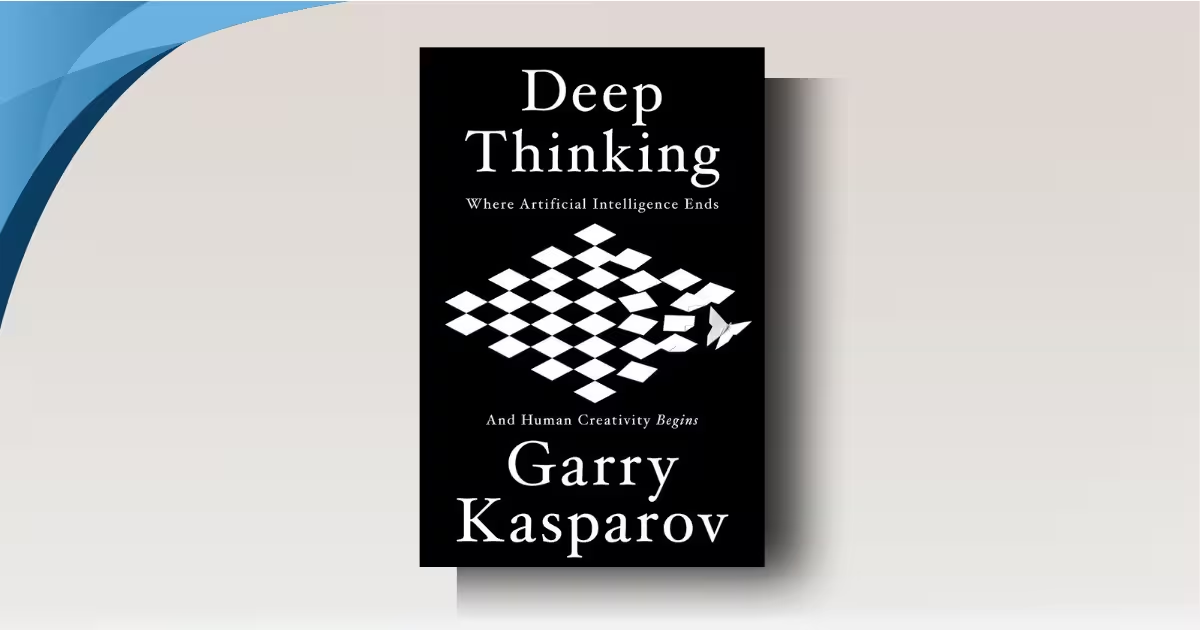
Do you ever wonder why your smartphone can beat you at chess but still cannot understand your frustration when it loses signal? Do you feel uneasy about artificial intelligence taking over jobs, yet excited about the new tools it gives you? If you’ve found yourself caught between fear and fascination with the rise of intelligent machines, then Garry Kasparov’s “Deep Thinking: Where Machine Intelligence Ends and Human Creativity Begins” is the book you’ve been waiting to read.
Deep Thinking is Best for:
- Tech enthusiasts curious about the real story behind AI milestones
- Chess players and historians interested in the human vs. machine saga
- Professionals in business, education, or innovation seeking strategies for human-machine collaboration
- Anyone concerned about the future of work in an automated world
Not for:
- Readers looking for a highly technical AI textbook
- Those who prefer purely theoretical philosophy without real-world examples
- Anyone expecting a quick, light read—this is a deep, reflective work
Table of Contents
1. Introduction
“Deep Thinking: Where Machine Intelligence Ends and Human Creativity Begins” was published in 2017 by John Murray. It is co-authored by Garry Kasparov, the former world chess champion, and Mig Greengard, his long-time collaborator and spokesman.
This book sits at the crossroads of memoir, technology history, and strategic philosophy. It is not just another chess book or a dry AI manifesto—it is a firsthand account of what it feels like to be the person facing the machine that might make human expertise obsolete.
Kasparov’s unique position as the world’s top chess player during the critical rise of chess computers (1985–2005) gives him an unparalleled perspective on human vs. machine intelligence.
The central thesis of Deep Thinking is that human creativity and machine intelligence are not in opposition, but in collaboration. Kasparov argues that the real potential of technology lies not in replacing humans, but in augmenting us—creating what he calls “centaurs,” hybrid teams of humans and machines that outperform either alone. He writes:
“My brainchild saw the light of day in a match in 1998 in León, Spain, and we called it Advanced Chess. Each player had a PC at hand running the chess software of his choice during the game. The idea was to create the highest level of chess ever played, a synthesis of the best of man and machine.” (Page 7)
Kasparov’s purpose is to move the conversation beyond fear of automation and toward a future where humans and machines work together to solve complex problems.
2. Background
To understand why this book matters, you need to grasp Kasparov’s unique journey. Born in 1963 in Baku, Azerbaijan, he became the youngest ever world chess champion in 1985 at age 22.
His career spanned the most dramatic period in chess history—the rise of the chess computer from a laughable novice to an unbeatable champion.
Kasparov wasn’t just an observer; he was the central human protagonist in this story. From his first simultaneous exhibition against 32 computers in 1985 (which he won 32–0) to his historic loss to IBM’s Deep Blue in 1997, he was the face of human intelligence in the global drama of man vs. machine.
But Kasparov is more than a chess legend. After retiring from professional chess in 2005, he became a global speaker on strategy, innovation, and human rights. He is a senior visiting fellow at the Oxford Martin School, focusing on human-machine decision-making. This blend of lived experience and academic reflection makes his insights deeply credible.
3. Deep Thinking summary
What follows is a comprehensive, spoiler-rich summary of “Deep Thinking.” I’ve structured it around the key events and arguments so that you can grasp the full narrative without needing to go back to the book.
Part 1: The Dawn of Digital Rivals (1985–1997)
Kasparov begins with his early encounters with chess machines. In 1985, he played 32 computers at once in Hamburg and won every game. Yet even then, he sensed a shift. He writes:
“From the human perspective, or at least from my perspective as the human in this equation, these were the good old days of human versus machine chess. But this golden age would be brutally short.” (Page 6)
By 1989, he faced a much stronger machine: Deep Thought, the predecessor to Deep Blue. He defeated it easily, but the writing was on the wall. Chess programs were improving at an exponential rate, driven not by human-like intuition but by brute-force calculation—evaluating up to 200 million moves per second.
The climax of this era was the 1997 rematch against Deep Blue. Kasparov lost 2.5–3.5 in a six-game match, a moment that made global headlines. For many, it symbolized the triumph of machine over human intellect. But Kasparov reveals the behind-the-scenes tensions: IBM’s secretive practices, his own psychological struggles, and the lingering questions about whether Deep Blue’s moves were always entirely autonomous.
“After the unbearable tension of the match, exacerbated by IBM’s unsportsmanlike behavior and my suspicious human mind, I was in no mood to be a gracious loser.” (Page 9)
Part 2: Beyond the Board
What Machines Really Do
Kasparov uses chess as a metaphor to explore broader questions about AI:
- Moravec’s Paradox: Machines find hard things easy (like complex calculations) and easy things hard (like walking across a room).
- The Turing Test in Chess: By the 1990s, computers could play games indistinguishable from human masters, but did they “understand” chess? Kasparov argues no—they simulated understanding through speed, not insight.
He introduces the concept of “Advanced Chess” (also called “centaur chess”), where humans and computers collaborate as partners. In 1998, he played a match in León, Spain, with each player using a PC. The result wasn’t just stronger chess—it was a new kind of chess, blending human creativity with machine precision.
Part 3: The Real Threat Isn’t Machines—It’s Us
Kasparov shifts from chess to the wider world. He discusses job automation, citing historical examples like elevator operators (17,000 union jobs in 1920) disappearing without societal collapse. He argues that fear of AI is often misplaced. The real challenge isn’t machines taking jobs, but humans failing to adapt.
“Machines that replace physical labor have allowed us to focus more on what makes us human: our minds. Intelligent machines will continue that process, taking over the more menial aspects of cognition and elevating our mental lives toward creativity, curiosity, beauty, and joy.” (Page 13)
He visits companies like Google, Facebook, and hedge funds to see AI in action. He learns that the most valuable applications aren’t about replacing humans, but about augmenting human decision-making with data-driven insights.
Part 4: How to Thrive in the Age of AI
Kasparov’s final chapters offer a roadmap for the future. He emphasizes:
- Embrace augmentation, not automation.
- Focus on what machines cannot do: creativity, empathy, strategic vision.
- Promote education and lifelong learning to stay ahead of technological change.
He concludes with a powerful call to action:
“If we feel like we are being surpassed by our own technology it’s because we aren’t pushing ourselves hard enough, aren’t being ambitious enough in our goals and dreams. Instead of worrying about what machines can do, we should worry more about what they still cannot do.” (Page 42)
4. Deep Thinking Lessons at a glance
1. Human vs. Machine is the Wrong Framework
- The real opportunity is Human + Machine collaboration, not competition. Kasparov calls these hybrid teams “centaurs,” which outperform either humans or machines alone.
2. Machines Excel at Calculation, Humans at Creativity
- This is Moravec’s Paradox: machines find difficult things easy (e.g., complex math) and easy things difficult (e.g., walking a room). Use machines for brute-force tasks, freeing humans for strategy, empathy, and innovation.
3. The Deep Blue Victory Was About Speed, Not Intelligence
- Deep Blue didn’t “think” like a human—it evaluated 200 million moves per second. Its win was a triumph of engineering, not cognition. True AI requires understanding, not just processing.
4. Embrace Augmentation, Not Automation
- Don’t fear machines taking jobs. Focus on how they can augment human abilities. History shows technology creates new roles (e.g., elevator operators gone, app developers born).
5. The Future Belongs to Those Who Ask Better Questions
- As Picasso noted, “Computers are useless. They can only give you answers.” Human creativity lies in asking the right questions—machines can’t do that yet.
6. Adapt or Stagnate: The “Gravity of Past Success”
- Success breeds complacency. Kasparov admits his 2000 world championship loss was due to refusing to adapt. In a fast-changing world, continuous learning and flexibility are essential.
7. Chess is a Mirror for Broader AI Lessons
- The evolution of chess computers—from weak to unbeatable—parallels AI’s path in other fields (medicine, finance, driving). The patterns of disruption, fear, and adaptation are universal.
8. Technology Amplifies Inequality of Opportunity
- Access to technology creates new divides. Kasparov notes how chess computers democratized elite training, allowing talent from non-traditional countries to rise. The same applies to AI tools in education and business.
9. Don’t Confuse Performance with Understanding
- A machine can beat a grandmaster yet have zero understanding of chess. Similarly, AI can diagnose diseases without knowing what illness means. Performance does not equal consciousness or comprehension.
10. Optimism is a Choice, Not a Naive Belief
- Progress brings disruption, but the net benefit of technology has always been positive. The key is to guide innovation ethically and ensure its benefits are widely shared.
5. Human vs. Machine Contrasts from Deep Thinking
| Aspect | Human (As described in the book) | Machine (As described in the book) |
|---|---|---|
| Cognitive Process | Relies on intuition, pattern recognition, and “chunking” of information. Thinks in terms of candidate moves and strategic plans, guided by experience and analogy. “The stronger the player, the more they demonstrate superior pattern recognition…” (p. 17). | Relies on brute-force calculation and exhaustive search. Evaluates millions of positions per second via algorithms like minimax and alpha-beta pruning. “Systematically evaluating up to 200 million possible moves on the chess board per second and winning with brute number-crunching force” (p. 9). |
| Psychology & Physiology | Subject to emotional state, fatigue, nerves, time pressure, and inspiration. Performance is impacted by the “stress response process” (p. 69-70). Can be demoralized or become overconfident. | No psychology. Immune to pressure, fatigue, fear, or ego. “A machine won’t get overconfident when it has a superior position or dejected when it is worse” (p. 71). Its performance is consistent and purely functional. |
| Learning & Adaptation | Learns from experience, principles, and mistakes. Can adapt style and strategy creatively. Talent is cultivated through study and practice, but innate “gifts” play a role (p. 72-74). | Learns from programmed rules, databases, and adjusted parameters. Cannot understand context or learn from experience like a human unless specifically programmed to do so. Early programs would “make the same mistake over and over” (p. 48). |
| Physical & Practical Aspects | Embodied and physically limited. In a simul, the challenge is mental stamina. In the modern era, the physical act of moving pieces is trivial. | Digital and remote. Its physical presence is often just a screen or a board operator. Its “body” is irrelevant; its “mind” can be housed thousands of miles away (as during the Deep Blue match). |
| Strategic Approach | Excels at long-term strategic planning, prophylaxis, and understanding abstract concepts like piece harmony, weakness, and long-term compensation. Weak at endless, precise calculation. | Excels at tactical calculation, seeing forced lines, and defending complex positions. Weak at formulating long-term strategic plans without concrete objectives. “They cannot play strategically, but they are too accurate tactically…” (p. 75-76). |
| Understanding & Purpose | Possesses true understanding, context, and purpose. Plays to win within the framework of a human competition with cultural and personal meaning. “Chess is a culture shared among colleagues who form a human community…” (p. 79). | Has no understanding, consciousness, or purpose. It follows an evaluation function. “They play a strong move simply because it was evaluated to be better than everything else, not by using the type of applied reasoning a human would understand” (p. 62). |
| Creativity & Error | Capable of brilliant, creative leaps and intuitive sacrifices (like Tal’s “Magician from Riga” style). Also prone to blunders due to oversight or psychological collapse. | Capable of “brilliancy” that is actually the result of deep search finding a non-human tactical shot. Prone to horizon effect blunders (missing a deep threat beyond its search depth) and strategic misunderstanding (p. 76). |
| Optimal Role | The creative director, strategist, and asker of questions. Provides intuition, ethical framework, and long-term vision. | The perfect tactical executor, data analyst, and number cruncher. Provides raw power, flawless calculation, and memory. |
| Symbolic Relationship | John Henry, the “steel-driving man” racing against the steam hammer. Represented by Kasparov as the last champion of the human era (p. 11). | The steam hammer. A tool that eventually surpasses human raw power in a specific domain, symbolizing technological progress and disruption. |
| The Future Model | Half of a “Centaur.” The human element in a Human+Machine collaborative team, as demonstrated in Advanced Chess (p. 7-8). | The other half of a “Centaur.” The machine augmenting human decision-making, creating a synergy stronger than either alone. |
Key Citation from the Book that Summarizes the Table:
“In what artificial intelligence and robotics experts call Moravec’s paradox, in chess, as in so many things, what machines are good at is where humans are weak, and vice versa.” (p. 7)
6. Deep Thinking analysis
Evaluation of Content
Kasparov effectively supports his arguments with a compelling blend of personal anecdote, historical data, and philosophical reflection. His accounts of matches against Deep Blue are not just sports reporting—they are case studies in human psychology under unprecedented pressure.
He is particularly strong when debunking AI hype. For example, he explains that Deep Blue’s victory was not a triumph of “thinking” but of brute-force calculation, a distinction that matters for how we approach AI today.
“Deep Blue was intelligent the way your programmable alarm clock is intelligent. Not that losing to a $10 million alarm clock made me feel any better.” (Page 9)
However, some may find the chess details overly technical in places. Kasparov assumes a basic familiarity with the game, which could alienate non-chess players. Yet, he usually translates chess concepts into broader lessons, keeping the narrative accessible.
Does the Book Fulfill Its Purpose?
Yes, emphatically. Kasparov set out to reframe the debate from “human vs. machine” to “human plus machine,” and he succeeds. By the end, you see AI not as a threat, but as a tool—one that can free us to focus on what makes us uniquely human.
7. Strengths and Weaknesses
Pleasant Experiences (Strengths)
- Firsthand Authority: Kasparov was there. His stories carry a weight that no third-party account could match.
- Historical Depth: The book is rich with dates, stats, and milestones. For example, he notes that the first human loss to a computer in an intellectual game occurred in 1956 at Los Alamos.
- Optimistic Vision: In an era of AI doom-mongering, Kasparov’s optimism is refreshing and evidence-based.
- Practical Insights: The “centaur” model is not just theory—it’s a proven strategy for enhancing performance in chess, business, and beyond.
Unpleasant Experiences (Weaknesses)
- Repetition: Some arguments are revisited multiple times, which can feel redundant.
- Personal Bias: Kasparov’s bitterness toward IBM occasionally seeps through, which, while understandable, can distract from the broader message.
- Dense Prose: At over 300 pages, the book demands sustained attention. It’s not a casual read.
8. Comparison with Similar Works
Deep Thinking stands apart from other AI books like Max Tegmark’s “Life 3.0” (which is more speculative) or Kai-Fu Lee’s “AI Superpowers” (which focuses on geopolitics). Kasparov’s blend of memoir and analysis is closer to Henry Kissinger’s “The Age of AI” in its philosophical depth, but with the gripping narrative of a sports memoir.
Unlike Ray Kurzweil’s “The Singularity Is Near,” Kasparov avoids far-out predictions. He grounds his vision in real-world experience, making it more immediately actionable.
9. Conclusion
I walked away from Deep Thinking with a transformed perspective on AI. Kasparov convinced me that the future belongs not to machines, nor to humans alone, but to collaborators—those who can harness machine intelligence to amplify their own creativity.
You should read this book if:
- You work in tech, education, or any field undergoing digital transformation.
- You feel anxious about automation and want a balanced, hopeful view.
- You enjoy deep dives into history, strategy, or human psychology.
- You’re a chess fan wanting the definitive account of the Kasparov–Deep Blue saga.
Skip it if:
- You seek a light introduction to AI (try “Hello World” by Hannah Fry instead).
- You have no patience for chess terminology.
- You prefer purely technical or purely philosophical treatments of AI.
In the end, Deep Thinking is more than a book about chess or computers. It is a manifesto for human potential in the digital age. As Kasparov writes:
“The only way to win is to learn how to work with the machines, not against them.”
That lesson is perhaps the most important one we can take into the 21st century.







