
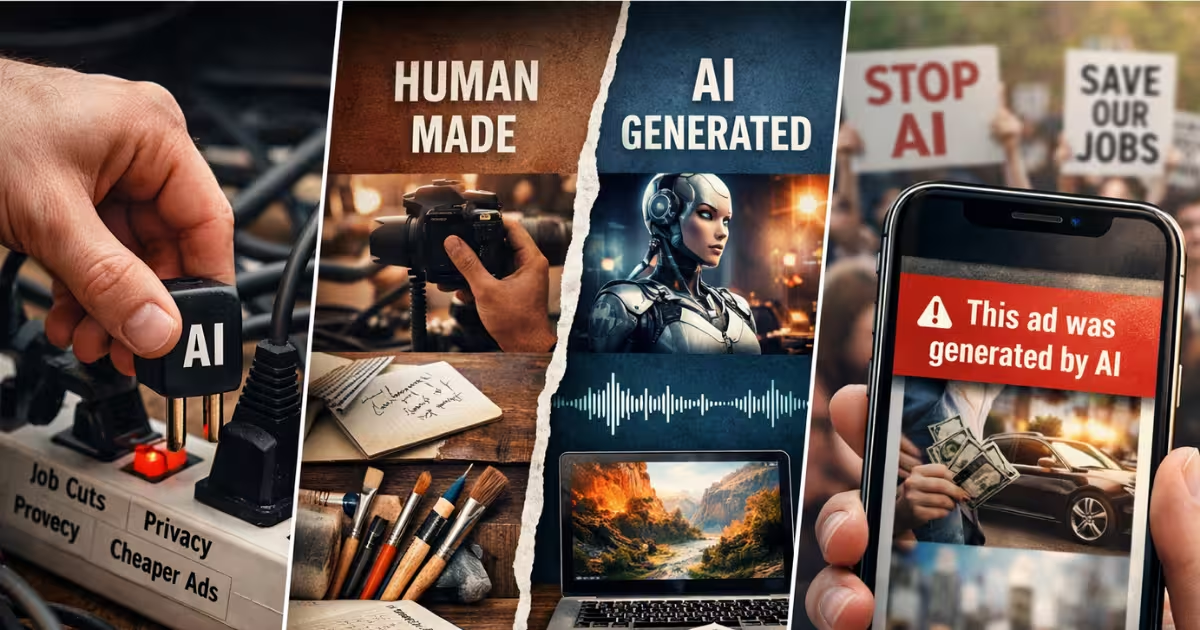
A couple years ago, “AI” felt like a superpower you could try for fun. Today it’s showing up everywhere: in school assignments, customer support, hiring screens, ads, and creative tools.
And a lot of people are… tired.
Not because they hate technology, but because they feel something is happening to them—not for them.
That feeling has a name now: AI backlash.
Table of Contents
1. What “AI backlash” actually means
AI backlash is the growing pushback against how AI is being deployed—especially when it feels forced, low-quality, unfair, or extractive. Wired recently described the backlash as broadening beyond niche tech critics into mainstream consumer and worker frustration, including anger over job displacement and content quality.
Brookings makes a related point from a policy angle: when harms and abuses (think privacy risks, bias, security failures, hallucinations) stack up and are highly visible, public trust drops and calls for regulation rise.
So if you’re writing about AI backlash, the best framing is:
This isn’t “Luddites vs innovation.” It’s people demanding rules, proof, and respect.
2. The 4 drivers of backlash
1, Consent & creative rights: “Did you train on my work?”
The loudest, most organized backlash is coming from creatives who believe their work has been used to train AI without permission or payment.
In January 2026, major actors, authors, and musicians backed the “Stealing Isn’t Innovation” campaign, accusing AI companies of using copyrighted work without consent and pushing for licensing-based approaches. (The Guardian)
Why this matters for your post:
This is a clean, human story with a simple moral question: What’s fair compensation when machines learn from people’s work?
A strong paragraph angle you can use:
The future of AI in art won’t be decided by prompts. It’ll be decided by contracts: licensing, opt-outs, and the right to say “no” to training.
2. “Workslop”: when AI creates busywork instead of value
A lot of companies rolled out AI fast. But people are noticing that some AI output looks polished while being empty—creating more work downstream.
Harvard Business Review popularized the term “workslop” for AI-generated work that “masquerades” as useful but lacks substance.
BetterUp Labs (with Stanford Social Media Lab) published survey-based stats on this effect, reporting that 40% of U.S. desk workers received workslop in the last month, and it takes about 2 hours on average to resolve each incident.
Why this matters for your post:
Backlash isn’t only moral or legal. Sometimes it’s simply: “This makes my day worse.”
Punchy line:
AI that saves 10 minutes for one person but costs 2 hours for three coworkers isn’t productivity. It’s outsourced thinking.
3. Education panic: cheating + “students are losing the muscle”
Education is becoming a frontline.
A national survey of 1,057 U.S. college faculty by AAC&U + Elon University’s Imagining the Digital Future Center found:
- 95% said GenAI increases student overreliance
- 90% said it diminishes critical thinking
- 78% said cheating has increased since GenAI became widely available (57% said “a lot”)
At the same time, the same report shows faculty aren’t uniformly anti‑AI: many teach AI literacy topics and many have created explicit classroom policies for AI use.
Why this matters for your post:
It’s a balanced, credible story: fear + adaptation.
Useful framing:
The backlash in education isn’t “ban AI.” It’s “stop pretending learning happens when a model completes the thinking.”
4. Trust in information: people use AI more, but remain skeptical—especially for news
Even as adoption rises, skepticism remains—especially around news.
A Reuters Institute / University of Oxford report based on YouGov surveys in six countries said weekly use of generative AI nearly doubled (18% → 34%) year-on-year, while use of AI to get news doubled from a low base (3% → 6%). It also found a “comfort gap” where people prefer human-led journalism workflows and expect AI-heavy news to be cheaper/faster but less transparent and less trustworthy.
Why this matters for your post:
This is the heart of backlash: people will use AI, but they don’t automatically trust AI.
Clean takeaway line:
Adoption is not approval.
3. AI Backlash is turning into policy
This is where your article gets Discover-worthy: connect emotions → real-world action.
South Korea: labeling and anti-deception moves
Associated Press reported South Korea will require AI-generated advertisements to be clearly labeled starting in early 2026, responding to deceptive deepfake-style ads.
South Korea’s Ministry of Science and ICT also has an English-language press release noting its AI Basic Act was slated to take effect in January 2026 (following earlier passage), alongside related governance measures.
Europe: the EU AI Act and implementation pressure
The European Commission announced the EU AI Act entered into force on 1 August 2024. The Commission also published guidelines on prohibited AI practices (Feb 2025), tied to AI Act definitions and enforcement clarity.
AP also covered the EU’s voluntary code of practice for general-purpose AI to help companies comply, while noting continuing industry criticism and phased rollout timelines.
Why this matters:
Once regulation starts moving, backlash stops being “online noise.” It becomes compliance, labels, fines, contracts, and lawsuits.
4. Conclusion
The AI backlash is not a single movement—it’s a signal. When people see AI taking value without permission, shipping low-quality output, and forcing “automation” where it doesn’t belong, they push back.
The fastest way to cool the backlash isn’t better marketing. It’s better rules: consent, transparency, and real quality standards—so AI feels like a tool again, not a takeover.







