
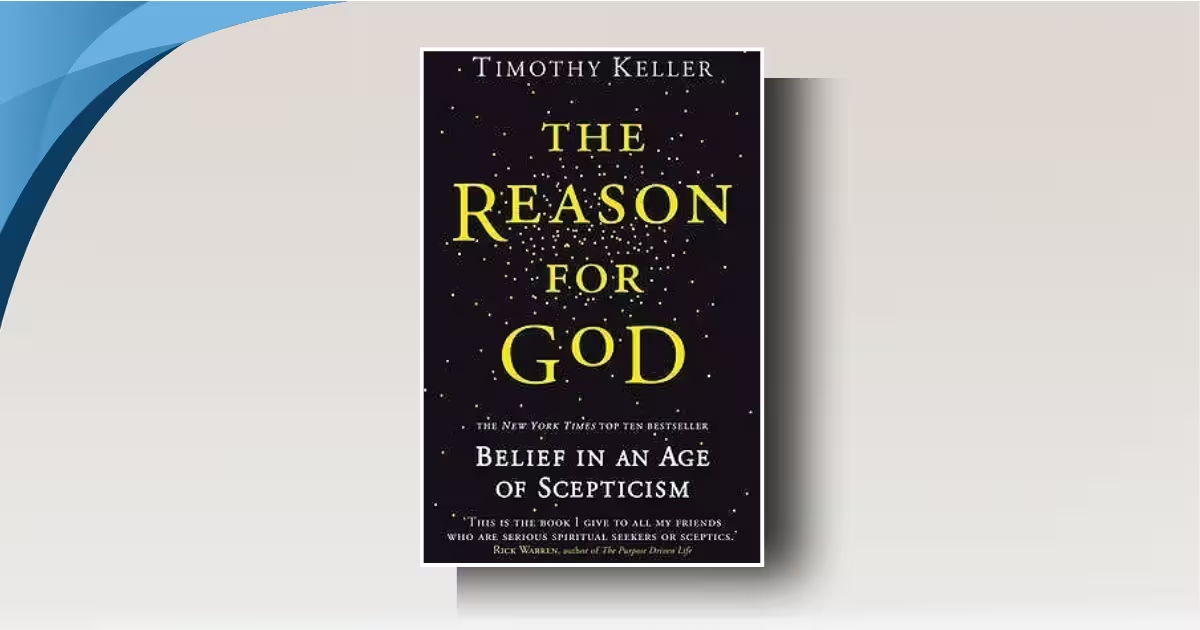
What if your loudest doubts about God are actually pointing to something you can’t quite name—yet can’t quite shake? Does The Reason for God by Timothy J. Keller (2008) give skeptics and believers an intellectually honest way to talk about God without turning the conversation into a shouting match?
The Reason for God is best for skeptics who don’t want soft, sentimental answers, especially on suffering, exclusivity, science, and the Bible; believers who want to pressure-test their faith without pretending doubts are shameful; and readers who like “objection → response → deeper question → practical implications.”
Although The Reason for God is not for you if you want a purely academic philosophy-of-religion textbook, this isn’t that (it’s pastoral + apologetic, written for real people with real objections); if you’re looking for a quick “five proofs” pamphlet, you may find his approach too narrative, too cultural, or too morally demanding. And if you’re allergic to Christianity’s exclusive truth claims, you may “bounce” early—though he directly addresses that objection in Chapter 1.
Table of Contents
1. Introduction
Written by Timothy J. Keller, The Reason for God is Christian apologetics for modern skeptics—written in a style that expects readers to say, “Okay, but what about this?” Keller doesn’t open with a victory lap. He opens by naming the vibe of a skeptical age: pluralism, moral suspicion, science-confidence, and the sense that “religion” is either oppressive or childish.
He also frames his context personally: his ministry setting is Manhattan, and he describes founding Redeemer Presbyterian Church in 1989 and seeing it grow over time. That matters, because the book’s tone feels like it was forged in conversations with smart friends who aren’t impressed by Christian clichés.
Keller presents himself as a pastor who has spent decades in urban skepticism—not sheltered subculture Christianity. He’s writing as someone who has sat with both belief and disbelief in the same room (and often inside the same person).
Keller is explicit that he isn’t trying to deliver a lab-style proof of God. He says:
“I have not tried to prove God’s existence, but… show you already know God is there…”
And in the epilogue, he makes The Reason for God’s most sticky point: faith is only as good as its object. He uses the image of trusting a tree branch:
“It is not thut the object of your faith that actually saves you.”
That single idea is the spine of the whole book: don’t just ask “Do I have faith?”—ask “What is my faith resting on?”
2. Background
Inside The Reason for God, he even points to a cultural moment where belief looks “implausible” in the West, citing a line attributed to The Economist (dated 2006) about Christianity “collapsing” in most places (with London as an exception).
Fast-forward: the landscape is still contested. Pew Research has tracked large “religiously unaffiliated” populations in the U.S. in recent years. Whether or not Keller’s question remains live: If belief is fading socially, does that mean it’s false—or just unfashionable?
3. The Reason for God summary
Keller structuresThe Reason for God in two big movements:
- Part 1: The Leap of Doubt — common objections to Christianity (Chs. 1–7)
- Part 2: The Reasons for Faith — why Christianity might actually be true (Chs. 8–14)
Then an Epilogue about what to do next.
I’m going chapter-by-chapter, but I’ll also keep surfacing the “why this matters” in plain language.
Part 1: The Leap of Doubt (Objections)
Chapter 1: “There Can’t Be Just One True Religion”
This is the modern default setting: pluralism = humility, exclusivity = arrogance. Keller pushes back by saying pluralism can become its own kind of dogma, especially when it assumes all religions must be equally true (or equally false).
He tackles the modern assumption that exclusivity = arrogance. Keller says many people treat “all religions are equally valid” as the only humble position, but he argues that claim is itself a kind of exclusivism (it rules out views that say truth matters).
Pluralism can become its own dogma. He suggests that insisting “no one can claim truth” is still a truth-claim—so the real issue isn’t whether you have an exclusive belief, but whether your exclusivity is honest and consistent.
Christianity’s exclusivity is meant to humble, not inflate. Keller argues the gospel undermines moral superiority because it says acceptance with God comes by grace, not by being “better” than others—so a truly gospel-shaped Christian shouldn’t be smug.
He challenges the idea that “all sincere beliefs are equally valid,” because sincerity doesn’t automatically make a belief true.
He also argues that Christianity’s exclusivity is not meant to be tribal superiority; it’s meant to be a truth-claim that humbles the believer, because it’s grounded in grace rather than moral performance.
One-sentence takeaway: Keller argues that rejecting “one true religion” often creates a new, hidden exclusivity—and that Christianity’s truth claim, when grounded in grace, is designed to produce humility rather than superiority.
Chapter 2: “How Could a Good God Allow Suffering?”
This is where The Reason for God gets emotionally serious. Keller doesn’t treat suffering as a cleveedges it as the objection that carries real blood, real funerals, real unanswered prayers.
He references large-scale tragedy—like the 2004 Indian Ocean tsunami—as an example of the kind of suffering that makes “God” feel morally impossible.
But he pushes two main ideas:
- If you say evil is truly evil, you’re smuggling in a moral standard that’s hard to ground in a purely material universe. (He develops this more later in the “clues” chapter.)
- Christianity doesn’t say “suffering is fine.” It says God enters suffering, and therefore suffering can be faced without pretending it’s meaningless.
What I felt reading this: a sort of “everything happens for a reason” as a throwaway line. He’s more like: “If you want a God who can stop evil, you also have to wrestle with whether you want a God who can judge evil—and whether you want yourself judged.”
Chapter 3: “Christianity Is a Straitjacket”
This objection says Christianity restricts freedom, desire, and identity. Keller’s answer: Every worldview has constraints; the real question is which constraints fit reality and lead to deeper joy rather than shallow autonomy.
He shows how “freedom” can become its own prison if it turns into endless self-invention with no stable meaning.
My takeaway: This chapter stung, because it pokes the modern dream: “If nothing defines me, I’m free.” Keller replies: “Or you’re just unmoored.”
Chapter 4: “The Church Is Responsible for So Much Injustice”
He agrees that the objection is emotionally and historically serious. Keller doesn’t pretend the church’s record is clean—he treats the charge as one of the strongest reasons people reject Christianity.
He separates Jesus from Christians’ failures. Keller argues that the worst injustices committed “in Christianity’s name” often reflect people ignoring or contradicting Jesus rather than faithfully following him.
He claims Christianity contains internal resources for self-critique. Because the faith centers on repentance, humility, and confronting sin, Keller says Christianity has a built-in mechanism for condemning hypocrisy and reforming the church from within.
He argues Christianity has also fueled major justice movements. While acknowledging real harm, he contends that key ideas like human dignity and care for the marginalized have often been strengthened by Christian belief and practice (even if inconsistently applied).
One-sentence takeaway: Keller admits the church has committed real injustice, but argues that those failures are best understood as betrayals of Christianity—and that Christianity’s core message both exposes hypocrisy and can energize reform.
Chapter 5: “How Can a Loving God Send People to Hell?”
He treats “hell” as a moral objection, not just a doctrine. Keller acknowledges that for many modern readers, hell sounds incompatible with a God of love—so the question is whether Christianity’s concept of judgment is cruel or coherent.
Hell as the trajectory of chosen separation. Keller argues hell is not God taking pleasure in punishment, but God allowing a person’s settled refusal of him—separation as the end-point of a life oriented away from God.
Judgment is tied to love and justice. He suggests that if God truly loves, God must oppose evil; a universe with no final accountability can make moral outrage meaningless. In this framing, judgment isn’t the opposite of love—indifference is.
One-sentence takeaway: Keller argues that a loving God can judge because love isn’t moral indifference—and “hell” is best understood as God honoring a person’s chosen separation rather than arbitrary cruelty.
My honest reaction: Even if you accept the logic, the emotional weight doesn’t vanish. Keller’s strength here is that he treats the question as moral, not merely doctrinal. But readers who’ve experienced spiritual abuse may still find this chapter hard.
Chapter 6: “Science Has Disproved Christianity”
Keller argues the conflict is often exaggerated: science addresses mechanisms, not unity historically fueled scientific inquiry rather than shutting it down.
He disputes the claim that “science” automatically rules out God, pointing to how scientific discoveries can raise new “why” questions rather than eliminating them.
My reader translation: Keller is saying, “Science is brilliant at answering ‘how.’ But it’s not equipped to answer ‘why there is something rather than nothing,’ or ‘why moral obligation feels real,’ or ‘why beauty wrecks us.’”
Chapter 7: “You Can’t Take the Bible Literally”
He challenges the “literal vs. not literal” framing. Keller argues the Bible isn’t a single-genre book, so “take it literally” can be a category mistake—because poetry, narrative, prophecy, wisdom, and letters are meant to be read differently.
He pushes for serious interpretation, not knee-jerk dismissal. Rather than saying “everything is literal” or “nothing is trustworthy,” he emphasizes reading the Bible with attention to what the authors intended and what the text genre signals.
He argues skeptics and believers can both misread it. Keller suggests skeptics often attack a simplistic “literalism,” while believers can also flatten the Bible by ignoring metaphor, context, and literary form—both approaches missing what the Bible is actually doing.
One-sentence takeaway: Keller’s point is that the Bible should be read carefully and genre-aware—not as a simplistic “literal rulebook,” but as a complex text making real claims that deserve serious interpretation.
Part 2: The Reasons for Faith (Why belief might be true)
Chapter 8: “The Clues of God”
This is where Keller turns from defense to offense. He’s not just batting away objections; he’s asking: Why do humans experience certain realities as if they point beyond nature?
He states his aim is to prove God’s existence… show you already know God is there…”
Then he develops “clues” like:
- Meaning: we crave meaning like hunger craves food; maybe meaning corresponds to something real.
- Moral obligation: we experience moral “oughtness” as more than preference.
- Beauty: beauty hits us like a message, not just a chemical event.
What I felt here: This chapter reads like Keller saying, “Your own interior life is a witness stand.” Not proving the soul.
Chapter 9: “The Knowledge of God”
Keller argues belief is not just logic; it’s also the posture of the whole person. He uses a well-known style of reasoning: there are beliefs we consider rational not because we can prove them like geometry, but because they best explain experience and evidence.
He argues that Christianity is not a blind leap into darkness but can be a step toward light when it fits the world more fully than its alternatives.
My reader translation: “You don’t get certainty about anything big—love, meaning, morality—without stepping beyond what can be proven in a lab. The question is whether Christianity makes more sense of the world you already live in.”
Chapter 10: “The Problem of Sin”
This chapter is where Keller stops flattering the reader. He reframes sin not as “breaking religious rules” but as **mis—building identity on something finite, then letting it enslave you.
He describes how humans turn good things (career, romance, reputation, even morality) into god-things—ultimate things—and that distortion collapses both self and society.
My emotional response: This is the part where The Reason for God stops being “about atheists” and starts being about me. Even if you don’t believe in God, you can recognize the mechanism: how identity-worship (success, approval, control) quietly destroys peace.
Chapter 11: “Religion and the Gospel”
This chapter is Keller’s pivot point—where he argues that a lot of what people hate about “Christianity” is actually religion-as-performance, not the gospel-as-grace.
1. Keller’s setup: why “fanatical Christians” can be the wrong diagnosis
He says people often imagine Christians on a spectrum: nominal (barely practices) to fanatic (over-practices). But that assumes Christianity is basically moral improvement—so the “fanatic” is just an intense moralist. Keller argues that’s precisely the problem: when Christianity becomes a self-improvement project, it produces superiority, exclusion, and oppression.
Then he flips the diagnosis: the harsh, overbearing “fanatic” may be that way not because they’re too committed to the gospel, but because they’re not committed to it enough.
2. The Bible itself critiques “religion” (and Jesus targets the religious)
Keller stresses that the Bible isn’t blind to religious hypocrisy—it attacks it first. He points out Jesus’ sharpest critiques aren’t aimed at irreligious outsiders but at religious insiders who use spiritual performance for acclaim and power.
He describes how this performance-driven approach makes people judgmental and condemning, and he highlights Jesus’ repeated shock-line that “tax collectors and prostitutes” enter ahead of the respectable religious.
3. Keller’s core distinction: Religion vs Gospel (the “operating principle”)
This is the chapter’s most quotable (and most practical) idea:
- Religion: “I obey—therefore I am accepted.”
- Gospel: “I am accepted…therefore I obey.”
Keller says two people can look identical in church—both praying, giving, serving—but be driven by radically different inner engines.
4. What changes when grace is the engine? motivation + identity
Keller names two big internal differences:
A) Motivation
- In “religion,” obedience is fueled by fear—fear of losing blessing, fear of rejection.
- In the gospel, obedience grows from gratitude—a response to blessing already received through Christ.
B) Identity/self-regard
In a religious framework, your self-esteem becomes unstable:
- If you’re meeting your standards → you drift into superiority and disdain.
- If you’re failing → you spiral into self-loathing and intensified guilt.
Keller even uses himself as an example: when his grasp of grace was weak, his self-view swung between pride (when “performing”) and shame (when not).
5. The “paradox” identity the gospel creates: humble and confident
Keller says the gospel creates a unique self-understanding: you can admit flaws without being destroyed by them because acceptance isn’t earned by performance.
He summarizes the effect: the gospel produces deep humility and deep confidence at the same time, and it dismantles both swagger and self-pity.
6. Grace can feel threatening (Victor Hugo’s illustration)
To show how disruptive grace is, Keller uses Les Misérables:
- Valjean is transformed by radical mercy.
- Javert, whose whole world is built on reward/punishment, can’t absorb grace without losing his entire worldview—so he refuses it.
Keller’s point: grace is liberating, but it also forces you to surrender control and the illusion of self-salvation.
7. Why this matters for readers who hate “churchy Christianity”
Keller directly acknowledges that performance-based, self-righteous church cultures drive people away—sometimes for life. He describes how moralistic religion breeds insecurity, pride, and hostility toward other groups.
He also notes how these churches can become outwardly judgmental and inwardly conflict-ridden, and how that experience can “inoculate” people against Christianity by making them assume Christianity = “religion.”
My takeaway: If you’ve ever met a Christian who felt smug, Keller is basically saying: “That smugness is evidence they don’t understand their own gospel.”
Chapter 12: “The (True) Story of the Cross”
Keller frames the cross as the center of Christianity: not merely an inspiring martyrdom, but a claim about substitution, justice, and love.
He argues the cross shows:
- the seriousness
- the depth of love (God bears the cost)
This chapter is where the emotional and moral logic of Christianity converges: a God who judges evil and absorbs judgment.
Chapter 13: “The Reality of the Resurrection”
Here Keller treats the resurrection as Christianity’s make-or-break claim. He argues that if Jesus rose, Christianity is not just “helpful”—it’s true in a way that changes everything. If Jesus didn’t rise, then Christianity collapses.
He’s blunt about the stakes:
“If you do not believe that he rose from the dead… then you should not ident
He then engages common alternative explanations (legend, hallucination, stolen body) and argues that the early Christian movement is hard to explain without a real resurrection event.
My reader reaction: Even if you disagree, you can’t accuse him of bait-and-switch. He puts the whole faith on one historical claim and invites you to interrogate it.
Chapter 14 — “The Dance of God”
God is relational, not solitary. Keller argues that the Christian doctrine of the Trinity (Father, Son, Spirit) means ultimate reality is personal love-in-relationship, not an impersonal force or a lonely deity.
Why the “dance” metaphor matters. He uses “dance” to describe the Trinity as mutual self-giving, joy, and unity without erasing distinction—a picture of love as dynamic, not static.
Love isn’t an add-on; it’s God’s nature. Keller’s point is that if God has always existed as triune, then love existed before creation—meaning love isn’t something God learns or starts doing later.
Human longing makes sense in this frame. Our deep desire for community, intimacy, belonging, and “home” isn’t random; Keller frames it as an echo of being made for relationship with a relational God.
Invitation, not just information. The chapter closes as an appeal: Christianity isn’t only a set of arguments; it’s an invitation to be drawn into God’s life—into that “dance”—through Christ.
One-sentence takeaway: Keller says the Trinity means love is the deepest reality, and Christianity ultimately invites you into that life of self-giving joy—“the dance of God.”
Epilogue — Where do we go from here?
Keller returns to doubt and belief in a way that feels pastoral rather than combative. The branch metaphor is the best summary of his apologetic posture:
“It is not the strength of your faith but the object of your faith that actually saves you.”
Meaning: don’t obsess over “am I confident enough?” Ask “is what I’m tru”
4. The Reason for God analysis
Does Keller actually support his arguments? Yes, and what makes it compelling is that Keller doesn’t lean only on “Bible says so.” He argues philosophically (about pluralism), existentially (about meaning and beauty), historically (about resurrection claims), and psychologically (about sin as mis-placed identity).
His best move—strategically—is this: he doesn’t just argue against atheism; he argues against all “alternative faiths” (career-as-salvation, romance-as-salvation, politics-as-salvation). That keeps The Reason for God from feeling like a cheap “believers vs unbelievers” fight.
When Keller says belief is not about the strength of faith but the object of faith, he is quietly aiming at everyone. Because everyone trusts something.
Does The Reason for God fulfill its purpose?
Yes—if its purpose is to create a space where:
- skeptics feel respected enough to keep reading,
- believers feel challenged enough not to stay smug,
- Both sides get pushed toward deeper intellectual honesty.
Keller’s explicit goal is not mathematical proof, but reawakening the sense that God is a live possibility you already suspect. The book succeeds on that level.
Where I think Keller is strongest
- Suffering: he refuses simplistic comfort and instead reframes what kind of God could address trivial.
- Religion vs gospel: he exposes “religion” as a self-justification project and positions grace as the destabilizer of moral superiority.
- Resurrection stakes: he makes Christianity falsifiable—if resurrection is false, walk away.
Where I think Keller is weaker
- Hell: even with his response, emotionally and morally difficult, and some will feel his answer doesn’t fully resolve the horror.
- Church injustice: he acknowledges harm, but depending on a reader’s feel like it moves too quickly from confession to defense.
- Science chapter: it’s helpful as a “myth-buster “; readers will want more direct engagement with specific claims and contemporary debates. –
5. Strengths and weaknesses
Strengths (what genuinely worked on me)
- The tone is civil, not sneering. That alone makes it readable in 2026.
- He respects the skeptic’s intelligence. He doesnple who just want to sin.”
- He interrogates “secular faiths.” Chapter 10’s reframing of sin as identity-misplacement is uncomfortably insightful. kes Christianity about Jesus, not “religion.” The cross and resurrection chapters center the claim, not the tribe.
lly land for me) - Some sections feel like compressed debates. If you want deep philosophy, you’ll occasionally feel he’s summarizing arguments rather than fully inhabiting them.
- Personal pain can outrun intellectual framing. If your skepticism is rooted in trauma, you might find the logic respectful but still insufficient.
- A few cultural references feel time-stamped. Even though the objections are amples sometimes they feel early-2000s.
6. Comparison with similar work
The Reason for God vs C.S. Lewis (Mere Christianity)
Lewis’s Mere Christianity (often listed as 1952) is more “classic rational faith,” less directly aimed at modern urban skepticism. Keller feels like Lewis translated into postmodern pluralism and Manhattan conversation.
The Reason for God Keller vs Dawkins (The God Delusion)
Dawkins’s The God Delusion is often listed as 2006. Where Dawkins can feel combative (religion as harm), Keller is dialogical (religion as both harm and hope—depending on whether it’s “religion” or “gospel”).
The Reason for God vs Strobel (The Case for Christ)
Strobel’s approach is journalistic/legal-evidence style. Keller overlaps on the resurrection question but spends more time on the existential plausibility of belief (meaning, morality, beauty) before he goes full historical case.
7. Conclusion
If you’re the kind of reader who has ever thought:
- “I want to believe, but I can’t pretend my questions aren’t real,” or
- “I’m satisfied with shallow cynicism either.”
…then The Reason for God is worth your time.
Keller’s best gift is that he treats faith like something that can survive scrutiny. And his final push is quietly devastating in its simplicity: don’t just measure your confidence—measure what you’re trusting.







