
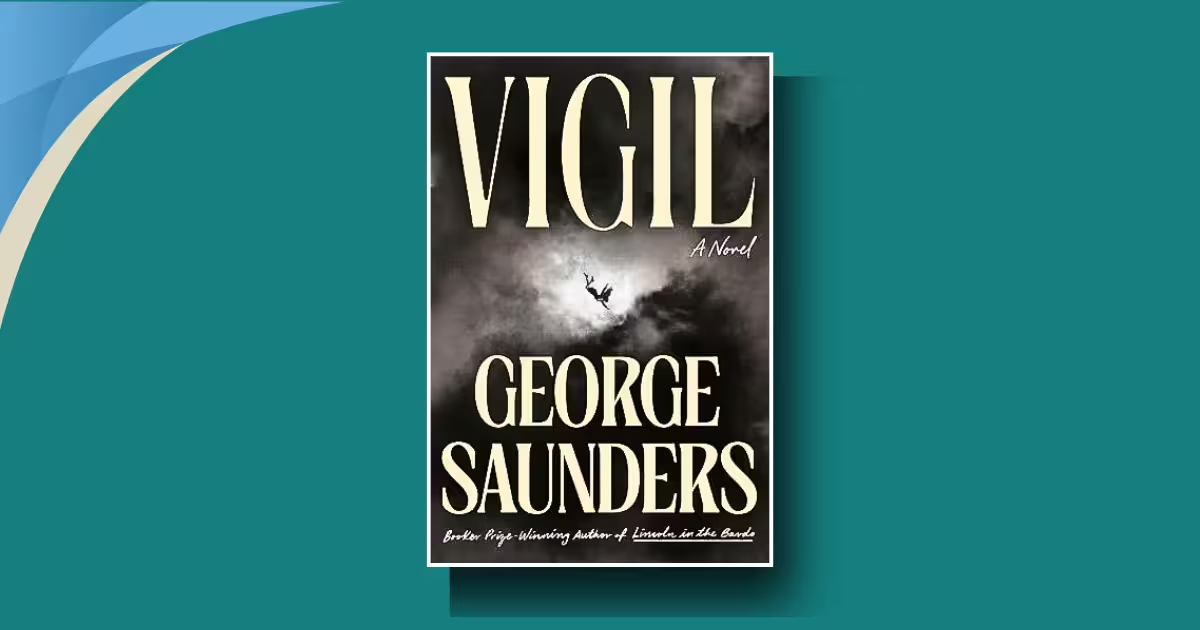
Did you ever wonder why some people can look straight at a burning world and still feel innocent—almost proud? George Saunders’s Vigil is the sharpest, funniest, most unsettling little “last-night-on-earth” book I’ve read in years, and it made me rethink what comfort even means.
Vigil is a wild, bedside afterlife comedy about an oil titan who refuses regret—and a spirit-guide who discovers that real consolation isn’t “you’re fine,” but “look carefully, feel fully, and tell the truth before it’s too late.”
Vigil is best for fans of dark satire, magical realism, and moral philosophy who aren’t afraid of a little ectoplasmic chaos. Not for: Readers looking for a traditional plot or those who prefer their fiction entirely free of political allegory.
Table of Contents
1. Introduction
George Saunders, the Booker Prize-winning author of Lincoln in the Bardo, returns to the realm of the dead in his blistering new work, Vigil.
Published in 2026, this book feels like a direct spiritual sequel to his previous masterpiece, but with the stakes raised from the soul of a single president’s son to the fate of the entire biosphere.
It is a story about the stories we tell ourselves to live with what we’ve done—and whether mercy is a weakness when dealing with monsters.
2. Background
On the surface, Vigil is “a playful, wise, electric novel taking place at the bedside of an oil company CEO.”
But the deeper context is our present: an age where people can live comfortably inside curated stories—even as the physical world keeps producing receipts.
In the book, the dying man (K. J. Boone) has spent a lifetime in the oil world, and he’s now accused—explicitly—of “something involving the weather.” That line lands because it echoes a real public pattern: decades of debate over corporate responsibility, climate science communication, and the political economy of delay.
Research and reporting have documented organized campaigns that spread doubt about climate science and slowed policy action.
Saunders doesn’t write a policy paper, though. He writes a haunted room—one where metaphysics, memory, comedy, and dread all crowd in, and where “comfort” becomes an ethical question, not a soothing service.Saunders has long been a master of American absurdity, often using surrealism to crack open the darkest parts of our capitalist culture.
In Vigil, he tackles the existential threat of climate change, not through dystopian sci-fi, but through a lens of metaphysical bureaucracy.
The narrative operates in a space similar to the Bardo—a liminal zone where the dead mingle with the living—but the tone here is sharper, more desperate.
It asks a question that haunts the modern age: When a person has profited from destruction on a planetary scale, is “comfort” what they deserve at the end?
3. Vigil summary
The story begins with a voice that is both cosmic and bluntly personal: a spirit named Jill “Doll” Blaine—a “vigil” whose job is to accompany dying people—falls back to earth in a body that is assembling as she plummets.
The sensation is physical and weirdly specific: she notes her clothing, her “black pumps,” and the cold of winter as she arrives.
But Jill quickly signals something is off—not only with her “charge,” but with herself. She isn’t purely “elevated” (the serene, god-adjacent mode). She’s hybridized: part cosmic instrument, part leftover human self. She calls it being “dual… a hybrid… Part elevated, part Jill ‘Doll’ Blaine.”
That split matters, because Vigil is essentially a battle between two kinds of mercy:
- mercy that insists on seeing harm without flinching.
- mercy that floats above consequence (“you’re inevitable, so nothing is your fault”), and
Her latest charge is K.J. Boone, a titan of the oil industry who is dying of cancer in his opulent mansion.
Jill arrives at Boone’s estate, observing the “golden dog” fountain and the sheer wealth that insulates him. Her job is to help him pass peacefully, to scan his mind for doubts or regrets and soothe them.
However, Boone is unlike any charge she has ever tended. He is “as sure of himself as ever a charge of mine had been,” filled with satisfaction rather than regret. He views his life as a triumph, a rags-to-riches story of a Wyoming boy who rose to become a “king,” advising presidents and shaping the world.
The vigil is interrupted by “The Frenchman,” a fellow ghost who appears to be the remorseful inventor of the internal combustion engine. The Frenchman is tormented by the environmental catastrophe his invention unleashed and believes that if he can get Boone—a key architect of climate denial—to repent, it might bring some cosmic balance.
The Frenchman is weak and desperate, burdened by a towering stack of papers that represent his guilt.
Throughout the night, the Frenchman tries to force Boone to see the damage he has caused. He summons visions of extinct birds—Hooded Warblers, Necklace-throated Dayhawks—which appear in the room only to wither and die.
He brings in Mr. Bhuti, a ghost from a drought-stricken village in India who died of thirst and heat, to testify to the suffering Boone’s industry has caused.
Boone, however, remains stubbornly unrepentant. He dismisses the Frenchman as a “frog” and the birds as pests. He retreats into his memories to defend himself: he remembers his hardscrabble childhood, the “burn pile” in the backyard, and his belief that he saved people from the drudgery of the past. He argues that he provided the fuel the world begged for, and that his enemies are merely jealous hypocrites.
Jill finds herself caught in the middle. Her duty is to comfort, but she finds herself increasingly repulsed by Boone.
She is distracted by a wedding taking place next door, a celebration of life that contrasts sharply with the “death room”. She drifts between the two, remembering her own life as “Jill ‘Doll’ Blaine” in 1970s Indiana—her love for her husband Lloyd, her “Chevelle,” and the tragedy of being blown up by a bomb meant for someone else.
The conflict escalates when two other ghosts appear: “The Mels.” These are former scientists/lobbyists who worked with Boone to sow doubt about climate change.
They appear as grotesque figures, constantly shifting between lab coats and business suits, and they encourage Boone to “admit no wrongdoing” and “leave with thy victory intact”. They are the sycophants of the afterlife, assuring Boone he is a hero.
Jill’s internal struggle reaches a breaking point. She realizes that her “elevation”—her detachment—is slipping. She feels a human urge to judge and punish. She investigates her own death and learns that her killer, Paul Bowman, lived a long life and forgave himself, while she was forgotten. This injustice fuels a new, fierce power in her.
In the climax, as Boone nears death, his daughter Julia arrives. She tries to comfort him but ends up inadvertently confirming his worst fears: that the world sees him as a “monster” and a “trickier bastard” than she ever knew. Crushed by his daughter’s doubt, Boone finally breaks, but not into repentance. He tries to bargain, offering to “fix” the world if he is allowed to lead the effort from the other side.
When he dies, the Mels immediately bind his spirit with a rope to drag him away, presumably to a hell of their own making where they will forever reinforce their shared delusions. Jill, acting on a surge of “unelevated” rage and pity, intervenes. She uses her powers to “lacerate” the Mels and fill them with concrete, freeing Boone.
However, the freedom is wasted. Boone, released but incapable of change, simply runs away.
He sprints into the forest, running “faster, by far, than he had ever run in life,” fleeing judgment, fleeing truth, destined to run on his bare, pain-racked feet for centuries. The Frenchman follows him, hoping to continue his work.
Jill, left alone, decides to abandon her human attachment to “Jill” and recommit to her sacred duty of comfort, realizing that judgment is a trap.
4. Vigil analysis
4.1. Vigil Characters
Jill “Doll” Blaine: Jill is a fascinating subversion of the “angel in the house.” She begins as a passive vessel of “elevation,” defined by her desire to serve and “comfort”.
Her backstory as a woman from 1970s Indiana gives her a specific, tragic grounding; she was a person who loved simple things like her Chevelle and her husband Lloyd. Her journey is one of de-elevation; as she spends time with the monstrous Boone, she regains her human capacity for anger and judgment.
She realizes that “to be in touch even briefly with elevation is to know the bliss of being one with God,” but to be human is to care about justice. Her final decision to “comfort” Paul Bowman, her own killer, signifies a return to radical, almost terrifying empathy.
K.J. Boone: Boone is the embodiment of the “Great Man” myth. He is not a cartoon villain but a man deeply convinced of his own righteousness.
He views himself as a “bantam rooster” who fought his way up from poverty. His denial is his armor; he believes he is the “grown-up in every room” who made the hard choices the world needed.
His tragedy is that he is “inevitable”—a product of his time and desires, trapped in a “lavish jailing” of his own ego.
The Frenchman: He represents the conscience of progress. As the inventor of the engine, he feels personally responsible for every “tiny lake” that boils and every bird that dies.
He is frantic, tragic, and ultimately ineffectual because he believes facts and guilt can change a man like Boone. He fails to see that Boone’s worldview is immune to shame.
The Mels: These characters serve as a satirical critique of the machinery of doubt. They are “doers” who “bend the world to our will”. Their grotesque shifting between lab coats (science) and business suits (profit) visually represents the corruption of truth for money.
4.2. Vigil Themes and Symbolism
The Inevitability of Character (Determinism): A central theme is whether people can truly choose to be different. Jill muses that Boone (and even her killer Bowman) were “inevitable occurrences”.
She asks, “At what precise moment could Paul Bowman have become other-than Paul-Bowman?”.
This determinist view challenges the reader’s desire for punishment. If Boone is just a “cog” in a machine he didn’t build but only greased, is hate the right response?
Comfort vs. Justice: The book wrestles with the purpose of the afterlife (and perhaps literature itself). Is it to judge and punish the wicked, as the Frenchman wants?
Or is it to offer “comfort” because “all else is futility,” as Jill concludes?. The ending suggests that while justice is satisfying (Jill attacking the Mels), it changes nothing. The damage is done. Comfort is the only infinite resource left.
The Golden Dog: The statue in Boone’s driveway—a gold dog holding a gold duck with a gunshot wound—symbolizes the perverse stewardship of nature. It is nature frozen, gilded, and killed, “loved” only as a trophy.
The Wedding: The wedding next door serves as a counterpoint to the death room. It represents the chaotic, lustful, unthinking vitality of life. It highlights what Boone is losing and what Jill misses, grounding the lofty moral debates in the sweaty, messy reality of being alive.
5. Evaluation
Vigil strikes me as one of the most important and poignant books of our time, a worthy successor to Lincoln in the Bardo that manages to be even more urgent. It is a heartbreaking, hilarious, and ultimately terrifying examination of the human capacity for justification.
If I had to sum up my feelings in one sentence: It is a literary exorcism for the anxiety of living in a dying world, forcing us to laugh at the very things that are killing us.
Strengths
The Voice: Saunders’ signature style—that mix of high-concept supernatural bureaucracy and gritty, low-rent American reality—is at its peak here. The way Jill transitions from a transcendent spiritual being to a 1970s teenager worried about her “Chevelle” and “cool dad” is masterful. It grounds the lofty themes in palpable human emotion.
The “Mels”: The depiction of the two lobbyists, Mel G. and Mel R., is a stroke of genius. Their dialogue, often completing each other’s sentences while shifting forms, captures the slippery, corporate doublespeak that has paralyzed climate action for decades.
They are terrifying because they are so recognizable.
The “Inevitability” Argument: The book challenges the reader with the uncomfortable idea that perhaps villains like Boone are “inevitable occurrences” . It forces us to ask: If we were born with his “predisposed mind” and lived his life, would we have done any differently? .
Weaknesses
The Ambiguity of Justice: Some readers might find the ending frustrating. Boone doesn’t have a Scrooge-like epiphany; he runs away, essentially escaping the worst of the “Mels'” punishment. While thematically consistent—proving that some people never change—it lacks the catharsis of a traditional moral victory.
Pacing: The middle section, where various ghosts (like the “pronghorns” and “mountain lion”) appear, can feel a bit crowded, slowing down the central conflict between Jill, the Frenchman, and Boone.
Impact
This book resonated with me on a visceral level. It captures the specific, maddening grief of watching powerful people deny reality while the “world’s critical supply” of everything we love vanishes.
It made me angry, then sad, then strangely comforted by the idea that even if we can’t save the world, the act of witnessing—of keeping vigil—has value.
Comparison with Similar Works
A Christmas Carol by Charles Dickens: Vigil is essentially an inverted Christmas Carol. Instead of three spirits successfully redeeming a miser, we have a chaotic host of spirits failing to redeem a tycoon. Boone is a Scrooge who looks at the Ghost of Christmas Yet to Come and says, “Hooey” .
The Great Divorce by C.S. Lewis: Like Lewis’s work, this is a tour of the afterlife where souls are given a choice to let go of their earthly baggage, but most refuse because they prefer their own misery to the truth.
Lincoln in the Bardo: The DNA is shared—the chorus of voices, the historical grounding—but Vigil feels more contemporary and biting.
6. Personal Insight & Contemporary Relevance
What Vigil taught me—painfully—is how denial can be a luxury product. Boone can argue that droughts have always existed, that the wedding next door looks normal, and that heartbreaking footage is staged—because his life has been designed to protect him from consequence.
The most profound angle of Vigil is its dissection of denial as a survival mechanism. Boone isn’t just lying; he has constructed a reality where he is the hero. He asks, “Was he, as CEO, supposed to know every single detail about every minor bit of research?” .
This mirrors the real-world defenses of fossil fuel executives who claim they were “stewards” rather than destroyers .
The book suggests that this denial is impenetrable because to admit the truth would be to admit that one’s entire life was a “big bleck” .
In our current climate crisis, understanding this psychology is crucial—we aren’t fighting ignorance; we are fighting the terrifying strength of the human ego.
7. Vigil book quotes
- On the futility of judgment:
“Comfort, for all else is futility.” - On the nature of bad actors:
“An inevitable occurrence, upon which, therefore, it would be impossible, even ludicrous, to pass judgment. Who else could he have been but who he was?” - On the absurdity of wealth:
“At the center of the fountain: a gold-plated statue. Of a dog. (Someone must have really loved that dog.) In the mouth of the golden dog: a golden duck.” - On corporate stalling tactics:
“Deny, delay, obfuscate. You were all in on it. But you—you led it. You were the leader of the liars.” - On the persistence of the ego:
“When I win, I dance. When I lose? Also dance. I dance the dance called: next time, fuckers.”
8. Conclusion
Vigil by George Saunders is a masterpiece of empathy and rage. It takes the reader into the claustrophobic, delusion-filled room of a dying man who broke the world and asks us to sit with him.
Through the eyes of Jill, we see that the line between a monster and a “sweet little old thing” is often just a matter of perspective. It is a book that refuses to give us easy answers, instead offering a complex, messy, and deeply human portrait of the end.
This is a must-read for fans of literary fiction, magical realism, and satire. Readers who loved Lincoln in the Bardo or Tenth of December will feel right at home. It is also highly recommended for anyone grappling with eco-anxiety or the ethics of late-stage capitalism.
Ultimately, Vigil suggests that saving the world might be impossible, but saving our own humanity—by refusing to let hate consume us, by choosing to “comfort” even the worst among us—is the only victory available. It is a dark truth, but a necessary one







