
Do you ever catch yourself staring out a window, paralyzed by a profound nostalgia for a moment that never actually happened, wondering why the life you dream of feels more real than the one you live?
The Book of Disquiet argues that true existence lies not in action, which is always a misunderstanding, but in the private, unshared empire of our dreams, where we can be everything by being nothing.
The Book of Disquiet is best for the introverted soul who feels “a physical nausea” at the thought of social obligations; definitely not for those seeking a coherent plot, a cheerful resolution, or practical life advice.
Table of Contents
1. Introduction
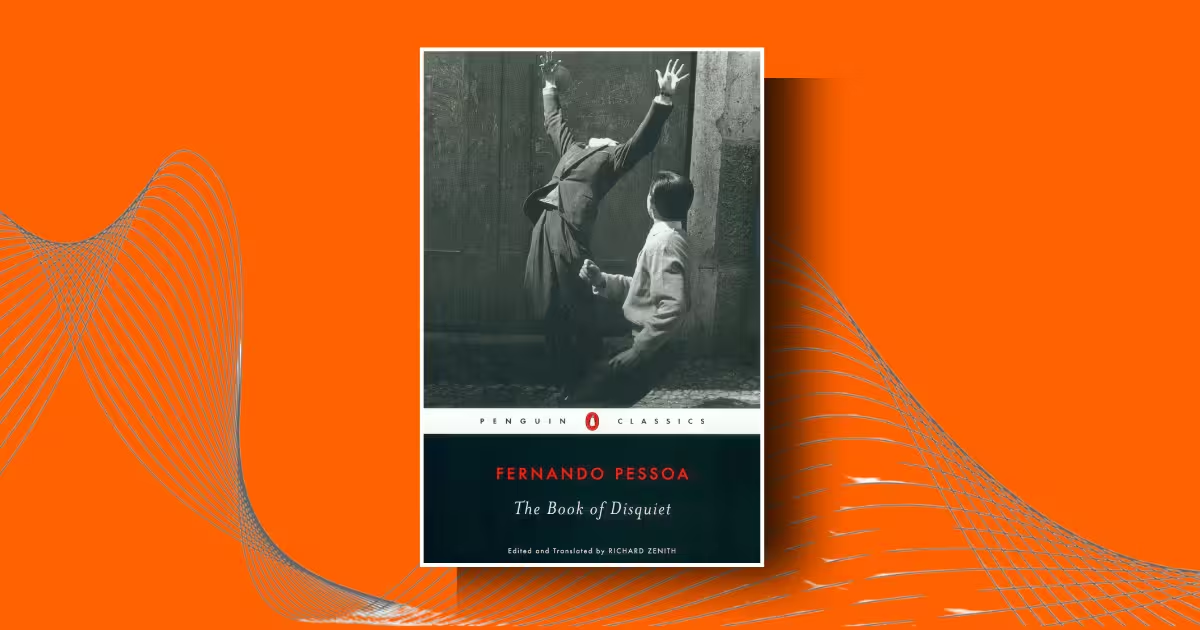
Title: The Book of Disquiet (Livro do Desassossego)
Author: Fernando Pessoa (specifically, his semi-heteronym Bernardo Soares)
Publication Details: A posthumous masterpiece, first published in Portuguese in 1982 (decades after Pessoa’s death in 1935). My reading is based on the authoritative edition edited and translated by Richard Zenith.
This isn’t a book you read; it’s a book you inhabit. It is a “factless autobiography” found in a trunk of disordered papers, a collection of fragments that mirror the fragmented soul of its author. It is a confession that confesses nothing but the sheer impossibility of existing.
2. Background
To understand this book, you must understand that it was never meant to be a “book” in the traditional sense.
It is the life’s work of Fernando Pessoa, a quiet man who worked as a commercial correspondent in Lisbon, much like his fictional counterpart Bernardo Soares.
Written between 1913 and 1935, it captures the spirit of Modernism—the shattering of the unified self. Lisbon is not just a setting here; it is a character, a mood of “Douradores” (gilders) and grey skies that reflects the internal weather of the narrator.
The book emerged from a time of political instability in Portugal, yet it resolutely ignores politics to focus on the “tumult” of the soul.
3. The Book of Disquiet Summary
Here is a comprehensive, full-spoiler analysis and summary of The Book of Disquiet by Fernando Pessoa, based on the text provided.
Introduction: The Plot of a Soul
To provide a plot summary of The Book of Disquiet requires an immediate redefinition of what constitutes a “plot.”
This work is not a novel in the traditional sense; it lacks a linear narrative, a rising action, a climax, or a resolution. As the text itself declares, it is a “factless autobiography”.
It is an “anti-literature,” a “primitive, verbal CAT scan of one man’s anguished soul”.
The “plot” of The Book of Disquiet is the static, internal evolution of its narrator, Bernardo Soares, an assistant bookkeeper in downtown Lisbon. The narrative arc is not one of events, but of consciousness.
It is the chronicle of a man systematically detaching himself from reality, replacing life with dreams, and cultivating a profound, existential tedium until he becomes “the empty stage where various actors act out various plays”.
The Protagonist: Bernardo Soares and the Rua dos Douradores
The Book of Disquiet is presented as the writings of Bernardo Soares, a “semi-heteronym” of Fernando Pessoa.
Soares is described as a man who “looks like a nondescript Jesuit” with a “gaunt and inexpressive face”. He lives a life of extreme routine and isolation in a fourth-floor rented room on the Rua dos Douradores in Lisbon.
His external life is intentionally banal.
He works in the office of a fabric warehouse, surrounded by figures who become the anchor points of his limited reality. The most significant of these is his boss, Senhor Vasques.
Vasques is described not just as an employer, but as a symbol of “Life – monotonous and necessary, imperious and inscrutable Life”. Soares feels a strange, hypnotic connection to Vasques, viewing him as a man of action who “plays with lives like the chess player with chess pieces”.
While Soares intellectually dissects the world, Vasques embodies the ability to act without feeling, a trait Soares simultaneously despises and envies.
Soares’s world is confined to the office, his room, and the streets of Lisbon between them.
He views his job as a “bulwark against life,” noting that “at this table in my absurd room, I, a pathetic and anonymous office clerk, write words as if they were the soul’s salvation”.
The “plot” begins with his acceptance of this confinement.
He does not seek to escape the Rua dos Douradores; rather, he seeks to expand it into an infinite, metaphysical universe through the power of his imagination.
He declares, “My destiny is to remain forever a bookkeeper, with poetry or literature as a butterfly that alights on my head, making me look ridiculous to the extent it looks beautiful”.
The Central Conflict: Life vs. Dreaming
The central tension of The Book of Disquiet is the conflict between the “Real World” (which Soares views as sordid, empty, and essentially dead) and the “Dream World” (which he cultivates as the only true reality).
Soares operates on a philosophy of “Abdication.” He believes that “To act is to rest” and that “Action is a disease of thought”.
Throughout The Book of Disquiet, Soares develops a rigorous “Aesthetics of Abdication” and an “Aesthetics of Indifference.”
He argues that to act is to destroy the perfection of the dream. “To possess is to lose. To feel without possessing is to preserve and keep, for it is to extract from things their essence”.
He creates a method for living that involves “The Art of Effective Dreaming.” This is not mere daydreaming, but a disciplined exercise in replacing reality. He describes three stages of this art:
- The First Stage: One must “respect nothing, believe nothing, [and] love nothing,” while retaining the desire to do so. This lays the foundation for a life lived entirely within the mind.
- The Second Stage: One must learn to avoid pain not by Stoic insensitivity, but by seeking “pleasure in pain.” This involves creating an “inner sadism” or an “extraneous I” to bear the suffering, turning pain into a “decadent gratification”.
- The Third Stage: This is the supreme refinement, where the dreamer passes sensations through “pure intelligence,” shaping them into literary form. This allows the dreamer to “make the unreal real” and become “crowned Emperor” within himself.
Soares confesses that he has reached a point where he can “write in countlessly different ways,” creating complete and autonomous plays within himself, living multiple lives simultaneously.
The Antagonist: Tedium (Ennui)
If there is a villain in this plotless story, it is Tedium.
However, Soares distinguishes his tedium from mere boredom. Boredom is the lack of things to do; Tedium is the “physical sensation of chaos,” a “boredom with other worlds, whether real or imaginary”.
Soares is haunted by this existential weight.
It is described as a “strangling of the life inside me,” a “longing to be another in all of my pores”. This Tedium is so profound that it becomes a character in itself, “the incarnate fiction of my own company”. It strips the world of meaning, turning the sky, the earth, and the world into “nothing at all but me”.
This Tedium leads Soares to a state of “living death.” He frequently refers to himself as a corpse, a shadow, or a “vacant interlude”. He writes, “I’m the suburbs of a non-existent town, the long-winded commentary on a book never written”.
The Climax of Isolation: The Visual Lover and The Rejection of Love
The narrative explores Soares’s relationships, or lack thereof, revealing deliberate emotional suicide.
He rejects all human intimacy because it threatens his inner world. He writes, “To love is to tire of being alone; it is therefore a cowardice, a betrayal of ourselves”.
He describes his interactions with women not as romances, but as exercises in distance. He speaks of a “Visual Lover,” stating, “I love with my gaze, and not even with fantasy… I want only to see it”. He views humanity as a “vast decorative motif,” preferring to view people as figures in a painting rather than real souls, because acknowledging their souls would require an exhausting empathy.
In a section titled “Advice to Unhappily Married Women,” Soares (ironically or not) advises women to cheat on their husbands only in their imagination, aiming for a “perfect sensuality” achieved through “The greatest inward unruliness combined with the greatest outward discipline”.
He recounts a specific “non-event” where he realized he was loved by someone. Instead of joy, he felt “tedium, of humiliation, and of weariness.” He felt humiliated because he was being given a prize meant for someone else (a “normal” human), and wearied by the duty to reciprocate. He concludes that “My destiny lacks the strength to be lethal in general, but it has the weakness of being lethal in whatever specifically concerns me”.
Key Vignettes and “Events”
While the book eschews traditional plot points, there are specific vignettes that serve as anchors in the fluid narrative, marking the passage of time and the deepening of Soares’s isolation:
1. The Office Boy’s Departure:
In a rare moment of narrative specificity, Soares describes the departure of an office boy from the firm.
This minor event triggers a “vague tragedy.” Soares realizes that the boy, simply by being a visible part of his daily routine, had become part of his life. “Today I was diminished. I’m not quite the same. The office boy left today.”
This event emphasizes Soares’s terrifying vulnerability to the slightest changes in his environment.
2. The Death of the Barber:
Soares visits his regular barbershop and asks about an older colleague. The young barber bluntly replies, “He passed away yesterday.” This news shatters Soares’s “irrational good mood.”
He realizes that the barber, like the office boy, was a symbol of his own mortality and the fleeting nature of the “familiar.” He laments, “Everything I’ve done, everything I’ve felt and everything I’ve lived will amount merely to one less passer-by on the everyday streets of some city or other”.
3. The Thunderstorm:
Soares describes a thunderstorm that terrorizes the office. The “light of a cold hell” sweeps through the room. Senhor Vasques and the employees are frozen in fear. When the storm passes, there is a collective “business benediction” as Vasques dismisses them.
This scene highlights the fragility of the “commercial reality” Soares clings to; even the stoic Vasques is rattled by the raw power of nature.
4. The Restaurant Acquaintance:
Soares meets a man in a restaurant who casually remarks, “To feel is a pain in the neck.” This phrase sticks with Soares, glowing in his memory because of its “earthiness” and profound accuracy regarding his own condition.
The Metaphysical Landscape: Lisbon as a State of Soul
The setting of Lisbon serves as a mirror for Soares’s internal state. The book is filled with descriptions of the weather, the light on the Tagus River, and the geometry of the streets.
- Rain: The rain is a constant companion, described as “my failed life weeping in nature”. It creates a “Rainy Landscape” in his soul, emphasizing his “anguished cold.”
- Sunsets: Sunsets are moments of “painful intensity,” representing the “eternal sunset of what we are”. They are beautiful but tragic because they signify the end.
- Night: The night brings a “sinister peace,” a time when Soares feels like a “widowed house, cloistered in itself”.
Soares often engages in what he calls a “Journey in the Mind.” He travels without moving, visiting “New Europes” and “other Constantinoples” from his desk.
He claims, “I’ve crossed more seas than anyone… If I were to travel, I’d find a poor copy of what I’ve already seen without taking one step”.
The Climax of Self-Dissolution: “I am Nothing”
As the book progresses (conceptually, if not chronologically), Soares’s deconstruction of his own ego becomes absolute. He reaches a state where he doubts his own existence. “I’m the suburbs of a non-existent town… I’m no one, no one at all”.
He begins to view himself as a fictional character. “I’ve made myself into the character of a book, a life one reads”. He is no longer a human being but a vessel for sensations and words. He writes, “I don’t write in Portuguese. I write my own self”.
In a profound moment of alienation, he looks at a fly on his inkstand and feels a “carnal, direct” horror, realizing he feels like a fly in the eyes of whatever supreme forces govern the universe. He feels he has a “flyish soul” and sleeps “flyishly”.
The “Ending”: A Funeral March for the Self
There is no final page that resolves the narrative, but the text moves toward a “Funeral March.” Soares envisions himself as the “Sovereign King of Detachment and Renunciation,” an “Emperor of Death and Shipwreck”.
He ultimately rejects all forms of hope—religious, social, or personal. He views revolutionaries and reformers as “stupid,” because “To fight for change is to be incapable of changing oneself”.
He rejects the Christian God and the concept of humanity, preferring to be a “creator of indifferences”.
The “resolution” of the book is the acceptance of the book itself as the only reality. Soares realizes that his life has been nothing but the writing of these fragments. “This book is my cowardice,” he confesses. He writes to “lower the fever of feeling,” using prose as a way to turn the chaos of his soul into a “decorative object”.
The final state of Bernardo Soares is one of “Grand Sleep.” He desires to be “reincarnated in a stone or a speck of dust”. He yearns for a state of “conscious unconsciousness,” where he can exist without the pain of awareness. He creates a “Funeral March for Ludwig II, King of Bavaria,” identifying with the mad king who lived in dreams.
Death comes to him not as a frightening end, but as a “maternal wife,” offering the “supreme nectar which doesn’t jade or taste bitter”.
Summary of Key Philosophies and Aphorisms
To fully “spoil” the book is to reveal the aphoristic conclusions Soares reaches regarding the human condition. These serve as the intellectual plot points of the work:
On Life: “Life is whatever we conceive it to be. For the farmer who considers his field to be everything, the field is an empire. For a Caesar whose empire is still
not enough, the empire is a field. The poor man possesses an empire, the
great man a field. All that we truly possess are our own sensations; it is in
them, rather than in what they sense, that we must base our life’s reality.
This has nothing to do with anything.”.
On Art: “Art consists in making others feel what we feel, in freeing them from themselves by offering them our own personality. The true substance of whatever I feel is absolutely incommunicable, and the more profoundly I feel it, the more incommunicable it is.
In order to convey to someone else what I feel, I must translate my feelings into his language – saying things, that is, as if they were what I feel, so that he, reading them, will feel exactly what I felt. And since this someone is presumed by art to be not this or that person but everyone (i.e., that person common to all persons), what I must finally do is convert my feelings into a typical human feeling, even if it means perverting the true nature of what I felt. “.
“To write is to forget. Literature is the most agreeable way of ignoring life. Music soothes, the visual arts exhilarate, and the performing arts (such as acting and dance) entertain. Literature, however, retreats from life by turning it into a slumber. The other arts make no such retreat – some because they use visible and hence vital formulas, others because they live from human life itself.”.
On Freedom: “Freedom is the possibility of isolation. You are free if you can withdraw from people”.
On Love: “We never love anyone. What we love is the idea we have of someone. It’s our own concept – our own selves – that we love. This is true in the whole gamut of love. In sexual love we seek our own pleasure via another body. In non-sexual love, we seek our own pleasure via our own idea.
The masturbator may be abject, but in point of fact he’s the perfect logical expression of the lover. He’s the only one who doesn’t feign and doesn’t fool himself.
The relations between one soul and another, expressed through such uncertain and variable things as shared words and proffered gestures, are deceptively complex. The very act of meeting each other is a non-meeting.
Two people say ‘I love you’ or mutually think it and feel it, and each has in mind a different idea, a different life, perhaps even a different colour or fragrance, in the abstract sum of impressions that constitute the soul’s activity.”
On Understanding: “To understand, I destroyed myself. To understand is to forget about loving”.
On Success: “To want is to be unable to achieve. The man who wanted something he achieved didn’t want it until it was already in his power to achieve. The man who wants will never achieve, because he loses himself in wanting. “
Conclusion: The Unfinished Cathedral
The Book of Disquiet ends with the realization that it can never be finished. It is a “ruin” by design. Soares compares his work to a “broken gateway to an Impossible Temple.”
He is a man who has “failed in everything,” who didn’t even “dare think of being something”.
However, in this failure, he finds a perverse victory. By recording his “factless autobiography,” he has created a universe more vivid and enduring than the “real” Lisbon he inhabits. He becomes the “Emperor of his own void.” The book concludes not with a death, but with a dissolution into the “confused series of intervals between non-existent things”.
Bernardo Soares remains eternally sitting at his high desk in the Rua dos Douradores, staring at a “tiny white cloud left behind by the universe”, waiting for a night that never completely falls.
4. The Book of Disquiet analysis
4.1. The Book of Disquiet Characters
Bernardo Soares: He is the narrator, but he is barely a “character.” He describes himself as a “mutilation” of Pessoa’s personality. He is an assistant bookkeeper who has “bowed out of life before it began”.
He lives in a rented room and works in a fabric warehouse. He is a man who has replaced life with dreaming, arguing that “to act is to react against oneself”.
He is tragic because he is lucid; he knows his dreams are fake, yet he prefers them to the “squalor” of reality.
Senhor Vasques: The boss. To Soares, Vasques is more than a man; he is the embodiment of “Life”—”monotonous and necessary, imperious and inscrutable”. Vasques is the man of action who succeeds because he does not feel.
Soares observes him with a mix of horror and inexplicable affection, noting that one day Vasques, too, will be nothing but a “dummy of his business suit”.
Moreira: The head bookkeeper. He represents “monotonous constancy”. He is the safe, unthinking routine that keeps Soares anchored to the material world.
The Office Boy: A minor figure whose departure triggers a disproportionate existential crisis in Soares, symbolizing the tragedy of all change and the loss of the familiar.
4.2. The Book of Disquiet Themes and Symbolism
The Cult of Tedium (Ennui): This is not simple boredom. It is a “physical sensation of chaos,” a feeling that the soul is a “broken bucket”. It is the paralyzing realization that neither acting nor not acting offers any relief.
Dream vs. Reality: This is the central conflict. Soares argues that “dreams are the only reality” because they are the only thing we truly possess. Reality is just “the trash of the gods.” He constructs elaborate lives, empires, and histories in his head, only to be crushed by the “sordidness” of having to buy bananas or answer a phone call.
The Office as Life: The fabric warehouse on the Rua dos Douradores symbolizes the “trivial things that make up life”. It is a cage, but a safe one. It represents the “normality” that Soares despises yet clings to for sanity.
Weather as Emotion: The weather in Lisbon—the “luminous, limpid day” or the “rain that keeps raining”—is never just weather. It is the externalization of Soares’s inner state. Rain is his “constant companion,” a symbol of the tears he cannot cry.
5. Evaluation
Strengths/Positive Experiences:
The sheer beauty of the prose is intoxicating. Pessoa (via Soares) captures fleeting feelings that everyone has but no one articulates.
When he talks about the “nausea” of interacting with people or the “weariness of having to feel,” it hits you in the gut. The book validates the introvert’s secret life. The imagery—”my heart is a poured-out bucket”—is unforgettable.
Weaknesses/Negative Experiences:
It is relentless.
There is no plot, no progression, no redemption. It is “fragments, fragments, fragments”. If you try to read it straight through, you might drown in its pessimism.
It can feel repetitive, like a spiral that goes nowhere. It is strictly not for those who need closure.
Impact:
The Book of Disquiet didn’t just make me think; it made me feel “seen” in my darkest, most passive moments. It validated the idea that feeling is a valid form of doing. It resonated intellectually as a supreme act of rebellion: the rebellion of doing absolutely nothing.
Comparison with Similar Works:
It stands alongside Dostoyevsky’s Notes from Underground (for its isolation) and Sartre’s Nausea (for its existential dread).
However, unlike those, it lacks a narrative arc. It is also reminiscent of Amiel’s Journal, which Pessoa himself references, though Pessoa is far more imaginative and poetic.
Adaptation:
There is a film adaptation titled Filme do Desassossego (The Film of Disquiet), directed by João Botelho (2010). Unlike a typical adaptation, it is an experimental visual poem that tries to capture the atmosphere of Lisbon and the text rather than a story.
It didn’t shatter box office records, as it is highly arthouse, but it was Portugal’s entry for the Oscars, showing its cultural weight.
6. Personal Insight with Contemporary Educational Relevance:
In our modern “hustle culture,” Soares’s philosophy of abdication is shockingly relevant. He practices what we might now call “quiet quitting” but elevates it to a spiritual art form.
He preaches an “aesthetics of indifference”, teaching us to detach from the rat race not out of laziness, but out of a desire to preserve our inner selves.
This book serves as a radical educational tool against burnout, reminding us that “success” is often just a “misunderstanding” and that the true richness of life might just be sitting in a chair, dreaming.
For deeper dives into such existential themes, sites exploring philosophical pessimism would find this text a cornerstone.
7. The Book of Disquiet quotes
- “I’ve never done anything but dream. This, and this alone, has been the meaning of my life.”
- “My heart drains out… like a broken bucket.”
- “To understand, I destroyed myself. To understand is to forget about loving.”
- “I am nothing. I’ve never been anything. I’ve never wanted to be anything.” (Wait, the actual quote is “I’m no one. Absolutely no one.”).
- “To act is to rest.” (This is irony; he means action is mindless).
- “I have a headache and the universe.”
8. Conclusion
Summary: The Book of Disquiet is a cathedral of unfinished thoughts, a monument to the unlived life. It is a masterpiece of introspection that turns the mundane into the metaphysical.
Recommendation: I recommend this strictly to writers, thinkers, and melancholics. If you loved The Stranger by Camus or the poetry of T.S. Eliot, you will find a home here. If you need a plot, run away.
Final Reflection: This book is significant because it is the ultimate proof that a life lived entirely inside one’s head is as valid, vast, and tragic as a life lived on the battlefield. It is the bible of the solitary soul.







