
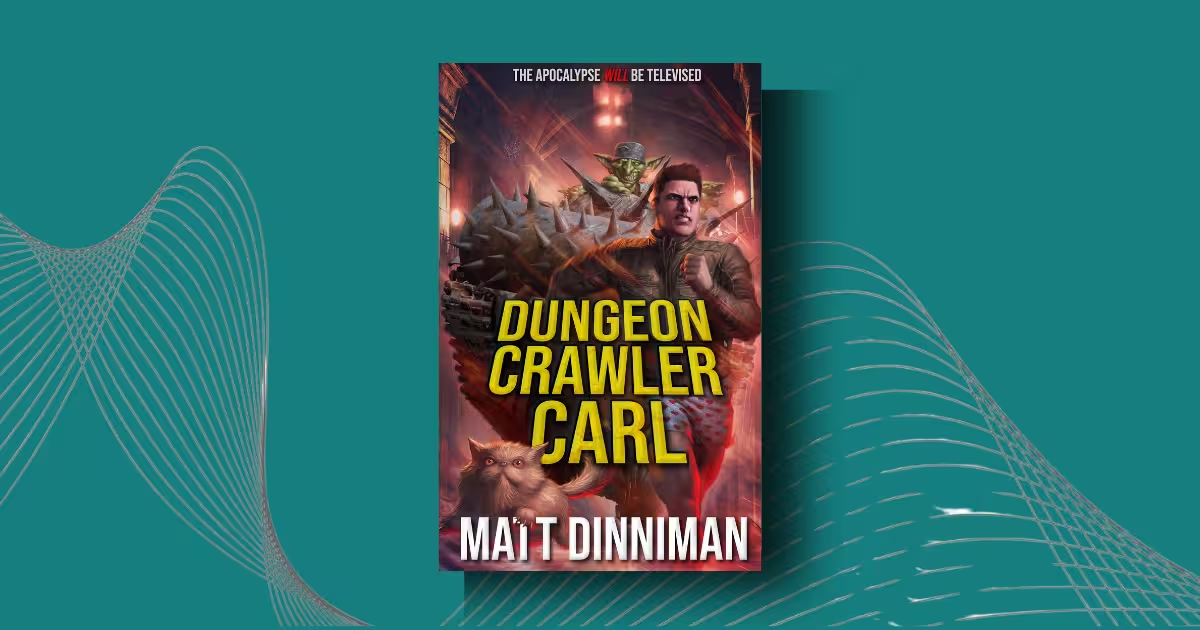
Did you ever wonder what would happen if the apocalypse arrived not with a whimper, but with a galaxy-wide broadcast of a man running for his life in his ex-girlfriend’s pink crocs and heart-patterned boxers? Dungeon Crawler Carl is a masterclass in blending the absurdity of internet culture with the visceral horror of survival, proving that even in a universe designed to break you, the most powerful weapon is a refusal to play by the rules.
Evidence snapshot: With over 6 million copies sold and a TV adaptation in the works by Seth MacFarlane’s Fuzzy Door and Universal International Studios, this series has transcended its niche LitRPG roots to become a global phenomenon.
Dungeon Crawler Caris is best for Fans of dark humor, The Hitchhiker’s Guide to the Galaxy, video game mechanics, and anyone who loves a protagonist who fights authority with explosives and spite. Not for readers who dislike video game stats (LitRPG elements), graphic violence, or those seeking a traditional high-fantasy slog without modern snark.
1. Introduction
- Title: Dungeon Crawler Carl
- Author: Matt Dinniman
- Publication: First published in 2020 (Self-published), later acquired by Ace Books in 2024.
- Format: Novel (LitRPG/GameLit), Audiobook (narrated by Jeff Hays).
In the crowded landscape of LitRPG (Literature Role Playing Game), few books manage to grab you by the throat and the funny bone simultaneously quite like Matt Dinniman’s Dungeon Crawler Carl.
It is a story that feels incredibly modern, tapping into our collective obsessions with reality TV, social media validation, and the crushing weight of corporate bureaucracy—all wrapped up in a blood-soaked dungeon crawl.
It is the story of Carl, a Coast Guard vet, and Princess Donut, a prize-winning Persian cat, as they navigate the end of the world one level at a time.
Table of Contents
2. Background
To understand Dungeon Crawler Carl, you have to understand the genre it deconstructs. LitRPG often falls into the trap of being a “numbers go up” power fantasy. Dinniman, however, uses the mechanics of the genre—stats, loot boxes, achievements—as a vehicle for satire. The book emerged during the COVID-19 pandemic, a time when the world felt increasingly absurd and trapped, mirroring the claustrophobic, televised nature of the dungeon itself.
The premise relies on the “System Apocalypse” trope, where Earth is integrated into a galactic gaming system. However, Dinniman twists this by focusing not just on survival, but on the spectacle.
The survivors aren’t just fighting monsters; they are performing for a galactic audience of trillions, begging for “likes” and “favorites” to receive loot boxes from wealthy patrons. It is The Hunger Games meets Running Man on an intergalactic scale.
3. Dungeon Crawler Carl Summary
The Collapse and The World Dungeon (Floor 1)
The story begins in Seattle on a freezing January night. Carl, a 27-year-old Coast Guard veteran and current marine technician, is smoking on his balcony to avoid angering his ex-girlfriend, Beatrice. When Beatrice’s prize-winning Persian cat, Princess Donut, escapes out the window, Carl chases her outside wearing nothing but a leather jacket, boxers, and Beatrice’s pink Crocs.
At exactly 2:23 AM, every building with a roof instantly collapses into the earth, flattening everything and everyone inside. A robotic voice announces to the survivors that Earth has been seized by the Borant Corporation due to a failure to file mineral rights appeals.
The remaining biomass and materials have been repurposed into an 18-level World Dungeon. Survivors are given a choice: die on the surface or enter the dungeon to “reclaim” their planet.
Carl, holding Donut, runs into the dungeon entrance just as the timer expires. He descends a massive iron staircase and enters the first floor.
He is designated Crawler #4,122. Because he entered with a cat, he receives the “Crazy Cat Lady” achievement and a Legendary Pet Box. The dungeon AI, which manifests as a snarky, often foot-fetishizing announcer, mocks Carl for entering without pants or weapons.
They encounter their first mob, a “Goblin Murder Dozer,” and Carl flees into a tutorial guild. There, he meets Mordecai, a shapeshifting alien (currently a rat-man) and Guildmaster. Mordecai explains the reality: they are on a galactic TV show. Carl learns about stats (Strength, Intelligence, etc.) and the importance of viewer ratings (Views, Followers, Favorites). He learns that patrons can send “loot boxes” to popular crawlers.
When opening his loot boxes, Carl receives a “Goblin Pass” tattoo that prevents lower-level goblins from attacking him. He also gives Donut an “Enhanced Pet Biscuit” from the Legendary box.
This biscuit grants Donut sentience, high intelligence, and the ability to speak. She reveals herself to be somewhat vain, obsessed with her show-cat heritage, but fiercely loyal. Donut accidentally equips a “Crown of the Sepsis Whore,” which designates her as royalty for a future floor (the 9th), putting a target on her back.
Carl and Donut leave the guild and begin exploring. They fight various mobs, including “Bad Llamas” and “Scatterer” cockroaches. Carl discovers his primary combat method is unarmed melee, specifically stomping and punching, earning him achievements like “Podophilia” (for killing with bare feet).
They encounter the neighborhood boss, “The Hoarder,” a tragic figure made from a human woman turned into a giant trash monster. Carl kills her by choking her with a chain and punching her, realizing that the “monsters” are often transformed humans begging for death. This victory grants them their first “Neighborhood Map.”
The Second Floor and The Media Circus
After finding a stairwell (which turns out to be a ramp for wheelchairs), Carl and Donut descend to the second floor. However, instead of the dungeon, they are transported to a “Green Room” on a boat.
They are interviewed by Odette, a galactic talk show host (who appears as a woman’s torso on a giant crab body).
The interview reveals the massive scale of their popularity; Donut charms the audience while Carl plays the “straight man,” inadvertently creating a catchphrase: “Goddamnit, Donut”.
Returning to the dungeon, they find themselves in a new environment. Floor 2 is a maze of neighborhoods filled with different mobs. They encounter a group of elderly survivors from the “Meadow Lark” care home, led by a nurse named Brandon and his brother Chris. The elderly are largely helpless, being pushed in wheelchairs. Carl decides to help them reach the next stairwell, despite the risk.
They face “Danger Dingoes” (who ride other dogs) and “Kobolds.” Carl uses his Goblin Pass to interact with a group of goblin mechanics, trading gunpowder for a “Copper Chopper” (a steam-powered motorcycle). He later uses this bike to bomb a “Ball of Swine” boss—a massive rolling ball of pig-men—by building a ramp and launching explosives at it.
A major conflict arises with two other crawlers, Frank and Maggie, who are “Player Killers.” They previously murdered a woman named Rebecca W to steal her gear.
They attempt to ambush Carl and Donut in a Safe Room (a designated non-combat zone). The dungeon AI freezes them for violating the rules. Later, Carl and Donut are forced onto another talk show hosted by “The Maestro,” an arrogant Orc prince. The Maestro tries to humiliate them by bringing Frank and Maggie on stage.
Carl turns the tables by exposing that Maggie murdered her own daughter to survive, ruining the Maestro’s segment and winning the audience’s favor.
The Rage Elemental and The Ending
Back in the dungeon, a “Rage Elemental” (Level 93) is summoned to hunt down a crawler named Jack who urinated in a corridor (violating a dungeon rule).
The elemental tears through the Meadow Lark group, killing the nurse Yolanda. Carl manages to save some of the elderly residents by using a “Protective Shell” spell and reversing gravity to escape into a safe room.
Realizing they cannot fight the Elemental, Carl devises a trap. He and Donut lure the monster to the stairwell leading to the third floor. Using a spell to teleport at the last second, they trick the Elemental into charging into the stairwell. The dungeon rules state that non-sapient mobs disintegrate if they enter a stairwell. The plan works, killing the unbeatable monster, though the system denies them the experience points for the kill.
Dungeon Crawler Carl ends with Carl and Donut ensuring the surviving Meadow Lark residents make it down the stairs.
They then spend the remaining time grinding levels and training Donut’s new pet, a dinosaur named Mongo (a Mongoliensis) found in a reward box.
As the timer for the floor expires, they descend to the third floor, preparing to choose their race and class, fully aware that the galaxy is watching, and the game is rigged against them.
4. Dungeon Crawler Carl Analysis
4.1. Dungeon Crawler Carl Characters
The beating heart of this story isn’t the loot or the leveling; it is the symbiotic, often hilarious, and surprisingly touching relationship between a man and his ex-girlfriend’s cat.
Carl (The Straight Man): Carl is the ultimate pragmatist. Thrust into a scenario designed to kill him, he survives not because he is the “chosen one,” but because he is stubborn.
He represents the “Tank” archetype—high constitution, high strength—but his real superpower is his refusal to lose his humanity. When he chooses to help the elderly residents of the Meadow Lark home instead of speed-running to safety, it defines his character arc.
He is the dad who didn’t want the dog but now loves it more than anything. His mantra, “You will not break me,” becomes the thematic anchor of the series.
Princess Donut (The Diva): Donut is a revelation. Initially presented as a pampered show cat, the “Enhanced Pet Biscuit” reveals she is intelligent, vain, and obsessed with gossip.
However, beneath the sass and demands for “green rooms,” she is fiercely loyal. Her arc is about finding agency; she goes from being a pet to a “Grand Champion” crawler. She provides the necessary levity to balance Carl’s grim determination.
Her obsession with “mongoliensis” dinosaur pets and internet fame makes her the perfect avatar for the modern, attention-deficit world.
Mordecai (The Mentor): The tragic figure of the story. As a Guildmaster, he is essentially an indentured servant, forced to guide new species to their slaughter cycle after cycle. His bitterness provides necessary exposition about the Syndicate’s corrupt nature. His backstory—having a brother who died in the crawl—adds stakes to his advice.
The Villains (Systemic & Personal): The Borant Corporation is the faceless evil, treating genocide as a line item on a spreadsheet. However, the personal villains, Frank and Maggie, serve as a dark mirror to Carl and Donut. They show what happens when survival instinct overrides morality.
Maggie’s murder of her own daughter to gain XP is the book’s darkest moment, proving that the monsters aren’t just the ones spawned by the dungeon.
4.2. Dungeon Crawler Carl Themes and Symbolism
The Gamification of Suffering: The central theme is the reduction of human life to entertainment. The “crawl” is broadcast to the galaxy, turning death into a spectator sport.
The “loot boxes” are a direct critique of predatory monetization in video games—literally gambling with your life for a better pair of boots. The AI announcer, with its creepy foot fetish and enthusiastic descriptions of gore, symbolizes the voyeuristic nature of the audience.
The Absurdity of Bureaucracy: The apocalypse happens because Earth failed to file a mineral rights appeal. This Douglas Adams-esque bureaucracy highlights how little individual lives matter to the cosmic machine. The aliens aren’t invading out of malice; they’re just following corporate procedure.
Viral Fame as Survival: In this dungeon, being skilled isn’t enough; you must be entertaining. Carl and Donut survive because they play the game of public relations.
Donut’s natural ability to charm the audience (and even the alien producers like Zev) saves them more often than Carl’s fists. It’s a biting commentary on the influencer economy—if you don’t have followers, you don’t exist (or in this case, you die).
5. Evaluation
“Dungeon Crawler Carl is an anarchic, adrenaline-fueled masterpiece that grabs the concept of the ‘hero’s journey’ by the throat and chokes it until it coughs up a loot box.“
Strengths
The chemistry between Carl and Donut is unmatched in the genre. Dinniman balances laugh-out-loud humor (like an achievement for killing with bare feet called “Podophilia”) with gut-wrenching horror (the “Ball of Swine” boss made of living people). The pacing is relentless, mimicking the ticking clock of the dungeon levels.
Weaknesses
The LitRPG mechanics (stat screens, inventory management) can be dense for readers new to the genre. At times, the sheer volume of “achievements” interrupts the narrative flow, though this is a feature of the genre rather than a bug.
Impact
Dungeon Crawler Carl resonated with me because it validates rage. It validates the feeling of being small in a system designed to crush you. It suggests that when the world ends, you don’t have to be a noble hero; sometimes, just being a guy in his underwear protecting his cat is heroic enough.
Comparison with Similar Works:
It shares the satiric DNA of The Hitchhiker’s Guide to the Galaxy but applies it to the violent framework of The Hunger Games or Battle Royale. Unlike Ready Player One, which celebrates nostalgia, Dungeon Crawler Carl weaponizes it
6. Personal Insight with Contemporary Educational Relevance
The “Contentification” of Tragedy
The most chillingly relevant angle of Dungeon Crawler Carl is how quickly the crawlers adapt to performing for the cameras. In our current digital landscape, we see real-world conflicts and tragedies livestreamed on TikTok and Twitch, often accompanied by donation buttons and emojis.
The book serves as a dark mirror to our “content brain.”
When Carl realizes he needs to create a “catchphrase” or perform a “stylish kill” to get a better loot box from a sponsor, he is engaging in the same economy that drives influencers to film themselves giving money to the homeless rather than doing it anonymously.
The lesson here is about the observer effect in the digital age: Does the presence of an audience change the nature of our morality? In the dungeon, the answer is a resounding yes—morality becomes a performance, and survival becomes a metric.
7. Dungeon Crawler Carl Quotes
- “You will not break me. Fuck you all. You will not break me.” — Carl’s internal mantra.
- “Goddamnit, Donut.” — Carl’s involuntary catchphrase.
- “I am a grand champion, Carl. I’m supposed to act a certain way. But sitting in your lap, watching you get fragged over and over in Call of Duty? I like that, too.” — Princess Donut.
- “It’s not a pyramid! It’s a reverse funnel system!” (Paraphrased from the Clurichaun MLM pamphlet satire).
- “New achievement! You Monster! You have killed an infant! An infant! Reward: You’re totally going to hell.” — The Dungeon AI.
8. Conclusion
Dungeon Crawler Carl is more than just a book about a guy fighting goblins; it is a scream of defiance against a universe that treats life as a commodity. It is violent, vulgar, and profoundly human.
Recommendation: I highly recommend this to anyone who has ever felt frustrated by “the system,” gamers who love a good min-maxing strategy, and cat owners who secretly suspect their pets are smarter than them.
If you enjoyed the dark humor of Deadpool or the survival mechanics of Squid Game, this is your next obsession.
Final Reflection: The significance of this book lies in its refusal to be cynical about connection. In a world where everything is fake, the bond between Carl and Donut is the only real thing left. And that is worth fighting for.







