
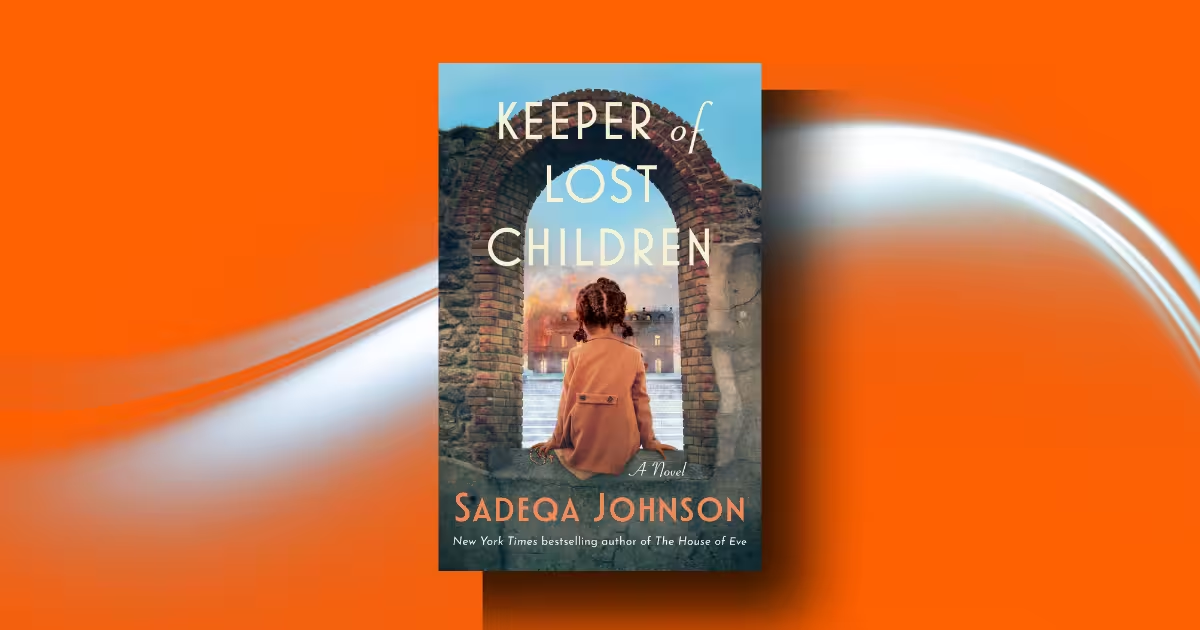
Did you ever wonder why some people feel “unmoored” even in a loving home—like something essential is missing from the story they were told? Keeper of Lost Children is a rare historical novel that turns that ache into a page-turning education about identity, adoption, and the cost of erased records.
Sadeqa Johnson uses a trio of interlocked lives to show how love can rescue—and also wound—when the truth about origins is hidden, mishandled, or denied.
Keeper of Lost Children isbest for readers who like historically grounded, emotionally intense, multi-POV fiction about race, family, secrecy, and belonging—especially anyone interested in transnational adoption and “hidden histories.”
Not for: readers who dislike messy moral trade-offs (good intentions with real harm), or who prefer “clean” endings without betrayal, grief, and systemic injustice.
Table of Contents
1. Introduction
Title: Keeper of Lost Children: A Novel
Author: Sadeqa Johnson
Publisher/Imprint: 37 Ink (Simon & Schuster)
Publication date: February 10, 2026
Johnson frames the novel as a searchlight on overlooked history—especially the labor, vision, and moral complexity of women whose stories were “marginalized, forgotten, or insufficiently documented.”
2. Background
Johnson’s springboard is a real historical phenomenon: thousands of biracial children born in post-WWII Germany to Black American servicemen and German women, many abandoned to orphanages under social stigma and institutional pressure.
In the novel, Ethel Gathers encounters a German children’s home where mixed-race children have effectively been “left behind,” while even marriage permissions could be denied by military authority—building a credible backdrop of power, policy, and prejudice shaping private lives.
Johnson also credits the documentary Brown Babies: The Mischlingskinder Story (by Regina Griffin) as a research catalyst.
On the publisher’s site, Johnson connects that research to the story of Mabel Grammer and the controversial, imperfect effort to place “more than five hundred” children into U.S. homes—an inspirational mission shadowed by bureaucracy, bias, and human error.
3. Keeper of Lost Children Summary
Part I: The Threads of Three Lives
The novel weaves together three distinct narratives across different timelines, centering on the legacy of African American soldiers in Germany following World War II and the mixed-race children they left behind.
Sophia Clark (1965 – Maryland)
In 1965, sixteen-year-old Sophia Clark lives a hardscrabble life on a farm in Prince Frederick, Maryland. She lives with her harsh, unyielding mother, “Ma Deary,” a distant father she calls “The Old Man,” her beloved older brother Walter, and younger twin brothers, Karl and Lu.
Sophia feels out of place; she is treated more like a farmhand than a daughter, often subjected to Ma Deary’s cruelty and deprived of food or affection. She is plagued by a recurring nightmare of being trapped in a fire, a trauma she cannot explain.
Sophia’s life changes when she is accepted into West Oak Forest Academy, an elite, predominantly white boarding school, as part of an integration initiative. Despite Ma Deary’s resistance, Sophia attends.
There, she befriends her roommate, Willa Pride, a wealthy Black girl from a loving family, and Max McBay, a handsome Black student who reveals he was adopted from Germany. Max shows Sophia a burn scar on his arm from a fire in a German orphanage—a revelation that triggers a deep, inexplicable recognition in Sophia.
She realizes she has no baby pictures and no knowledge of her early childhood. She begins to suspect she, too, was adopted.
Ozzie Philips (1948 – Philadelphia & Germany)
In 1948, Ozzie Philips, a young man from South Philadelphia, enlists in the army to escape poverty and prove his worth. He leaves behind his sweetheart, Rita, who breaks up with him before he deploys because she doesn’t believe long-distance relationships work.
Stationed in Mannheim, Germany, Ozzie experiences a strange duality: he is an occupier in a defeated land, yet as a Black man, he experiences more freedom in Germany than in the Jim Crow South, despite the lingering racism of white American officers.
Ozzie falls in love with a local German woman named Jelka. Their relationship deepens, and Jelka becomes pregnant. Ozzie is determined to marry her and support their child. However, just as he plans to cement their future, his racist commanding officer, First Sergeant Petty, transfers him to a new post in Auerbach with only thirty minutes’ notice.
Ozzie is physically prevented from saying goodbye or telling Jelka where he is going.
Ethel Gathers (1950 – Mannheim, Germany)
Ethel Gathers is the wife of a high-ranking Army officer stationed in Mannheim. She is a journalist for the Afro-American newspaper and deeply religious. Suffering from infertility and depression after a hysterectomy, Ethel seeks purpose. She discovers St. Hildegard’s, a local orphanage overflowing with “Brown Babies”—the mixed-race children of Black soldiers and German women.
These children are rejected by German society, considered outcasts, and often abandoned by mothers who cannot afford to feed them or fear social ostracization.
Ethel bonds with the children, specifically a young girl named Anke and a boy named Franz. Realizing these children have no future in Germany and are often barred from entering the US due to bureaucratic racism, she launches the “Brown Baby Plan.”
She uses her column in the newspaper to find Black families in America willing to adopt these children by proxy, fighting tireless legal battles to secure their passports and safe passage. Ethel herself adopts four children, including Anke and Franz.
Part II: The Intersection of Fate
Ozzie’s Heartbreak
After months of silence due to his transfer, Ozzie finally tracks Jelka down. He discovers a devastating truth: Jelka was married before they met to a German soldier, Gottfried, who was a prisoner of war in the Soviet Union.
Everyone assumed Gottfried was dead, but he returned. Because Jelka is legally married, Ozzie has no rights to his daughter, whom Jelka named Katja.
Ozzie visits them and meets baby Katja. He learns that Gottfried is abusive and hates the child because she is Black. Jelka begs Ozzie to take them away, but he cannot go AWOL without ruining his life.
He continues to visit secretly, taking Polaroid photos of Katja to keep close to his heart. However, the situation becomes untenable. Gottfried threatens to drown the child. Ozzie is eventually discharged and returns to Philadelphia, brokenhearted and believing he has failed to protect his daughter.
He reconnects with Rita, marries her, and they have a son, Maceo, but Ozzie struggles with secret alcoholism to numb the pain of losing Katja.
The Sacrifice
Back in Germany, Jelka realizes she cannot protect Katja from Gottfried. In a desperate act of love, she seeks out Ethel Gathers. Jelka surrenders Katja to Ethel’s adoption program to save the girl’s life, knowing it means she will never see her daughter again. Ethel secures an adoption for Katja with a family in Maryland—the Clarks.
Sophia’s Discovery
In 1966, Sophia (Katja) is now a teenager at West Oak Forest. She faces severe bullying, including a traumatic assault in the locker room by white students who want to see if she has a “tail.”
Despite this, she finds solace in her relationship with Max and her quest for the truth. During a library visit with Willa, Sophia finds old articles about the Brown Baby Plan written by Ethel Gathers. She recognizes the details.
Sophia calls Ethel Gathers, who is now living in Washington, D.C. Ethel invites Sophia to her home. There, Ethel shows Sophia the adoption files. Sophia sees a photo of her toddler self—a girl with red hair named Katja Durchdenwald.
The realization shatters Sophia’s world; Ma Deary and the Old Man are not her birth parents, and they have lied to her for her entire life.
Part III: The Search for Home
Confronting the Truth
Sophia returns to the farm and confronts Ma Deary. Ma Deary admits the truth: she couldn’t have children after a childhood illness, so she adopted Sophia through the newspaper advertisements to fill a void, though she grew hardened and bitter over the years. She didn’t tell Sophia because she wanted her to focus on survival, not a past she couldn’t change.
Determined to find her birth parents, Sophia enlists the help of her brother Walter and Mrs. Gathers.
Through the files, they learn that Jelka eventually emigrated to the United States. Mrs. Gathers agrees to drive Sophia to Williamsburg, Virginia, where Jelka was last known to be living.
A Tragic Reunion
Sophia arrives at the address in Williamsburg, her heart pounding with the hope of a reunion. However, when she knocks on the door, she is greeted not by Jelka, but by Jutta, Jelka’s younger sister (Sophia’s aunt).
Jutta reveals the devastating news: Jelka is dead.
Jelka had divorced Gottfried and married an American soldier, moving to the US to start a new life. However, she was consumed by the guilt of giving up Katja. She suffered from severe depression and, unable to forgive herself or cope with the loss, committed suicide in 1964.
Jutta explains that Jelka loved Katja more than anything and only gave her up to save her from being killed by Gottfried.
Jutta gives Sophia a small tin cottage box that Jelka had kept for her. Inside, Sophia finds letters from her father, Ozzie, that Jelka never opened because she felt too ashamed to contact him after giving the baby away. She also finds a locket and photos. Sophia learns that her father, Ozzie Philips, is alive and living in Philadelphia.
Finding Ozzie
Ethel Gathers drives Sophia and Jutta to Philadelphia. They track Ozzie down to the home he shares with Rita.
Ozzie has been sober for years, thanks to Rita’s ultimatum and the birth of their son, Maceo. He has become a professor and a stable family man, though the ghost of Katja has always haunted him. When he opens the door and sees Sophia—with his nose and Jelka’s smile—he is overcome with emotion.
The reunion is poignant and healing. Ozzie explains that he didn’t abandon her; he was forced away by the army and bureaucracy. He tells her about the letters he sent and the money he tried to provide.
Rita, who Ozzie eventually told about Katja, welcomes Sophia with open arms, as does her half-brother Maceo.
For the first time, Sophia feels a sense of true belonging and biological connection. She realizes she is not a mistake or a burden, but a child who was deeply loved by two parents who were separated by the forces of history and racism.
Part IV: Resolution and The End
Graduation and a New Beginning
The story jumps forward to Sophia’s graduation from West Oak Forest Academy in 1968. She has reconciled her two worlds. Ma Deary and the Old Man attend the graduation, behaving themselves, and Ma Deary even shows a flicker of pride.
Ozzie, Rita, and Maceo are also there, along with Jutta and Mrs. Gathers. It is a convergence of all the people who make up Sophia’s complex history.
Sophia plans to attend the University of Pennsylvania (Penn) on a scholarship, where she will study journalism, inspired by Ethel Gathers. She wants to give a voice to the voiceless. She is dating Max, her high school sweetheart and fellow German adoptee, who understands her journey better than anyone.
They visit the bench where they first connected, acknowledging that they are survivors.
Ethel’s Legacy (The Epilogue)
The epilogue shifts to Ethel Gathers in 1968. She is in Arlington, Virginia, being interviewed by Good Housekeeping. She and her husband, Bert, are receiving the Papal Humanitarian Award from Pope Paul VI for their work.
We see the fruits of Ethel’s labor: her own diverse, chaotic, and loving family surrounds her.
Her adopted children are grown; her eldest daughters are in the army, and her sons are successful. The reporter calls her the “Keeper of Lost Children.”
The novel ends with Ethel reflecting on her journey. She remembers the voice she heard at the shrine of Lourdes years ago telling her she had “much to offer.” She realizes that while she couldn’t birth children of her own, she was destined to be a mother to hundreds.
She looks at her family and thinks of Sophia and all the other “Brown Babies” who found homes because she refused to take “no” for an answer. She affirms that the children demanded a change in their circumstances through their love, and she simply did what was necessary.
Summary of the Ending Meaning:
The ending emphasizes resilience and the redefining of family. Sophia finds peace not by erasing her painful past on the farm, but by integrating it with her newfound biological history.
She forgives the circumstances that separated her from her birth parents, understanding that her mother’s choice was a tragic act of protection, not abandonment. Ozzie finds redemption and sobriety through the return of his daughter. Ethel finds her ultimate purpose and legacy, proving that motherhood is defined by action and love, not just biology.
The “lost children” are no longer lost; they have found themselves and each other.
4. Keeper of Lost Children Analysis
4.1. Keeper of Lost Children Characters
Sophia Clark / “Katja” — the novel’s emotional engine
Sophia arrives at an elite, white boarding school as an outsider twice over: racially isolated and internally fractured by paperwork that doesn’t match her body, memories, or instincts. Her relationship to identity is not abstract—she is literally fighting for documentation, truth, and the right to name herself.
Spoiler turn: Sophia learns her “real name is Katja,” and her brother Walter confirms he remembers the adoption journey and their German childhood—plus the forced silencing that followed (“if she heard us speaking German, she would slap our faces”).
That detail matters: it’s assimilation as violence, not gentle adjustment.
End-state clarity: By the end, Sophia makes a definitive claim—“Going forward, I’ll only be known as Katja. It’s my birthright… I’m taking it back.”
This is not a cosmetic choice; it’s her final refusal to be edited down to someone else’s convenience.
Willa Pride — friendship, class, and the cruelty of “nice”
Willa introduces herself as a pioneering Black student who knows how to survive white institutions by being polished, strategic, and socially fluent. She even jokes that she feels like “Rosa Parks,” then immediately frames the burden: “the first must open the doors for the next.”
However, Willa’s power is also her vulnerability: she’s invested in respectability and control—so betrayal hits her as total humiliation. The novel uses Willa to ask an uncomfortable question: What happens when the person who taught you how to belong decides you don’t deserve belonging anymore?
Max — desire entangled with history
Max functions as romance, yes, but more importantly as a mirror: he reflects Sophia’s hunger to be understood without translation. Their intimacy is built on recognition—shared strangeness, shared risk, shared “against the odds” gravity.
Yet Keeper of Lost Children refuses to romanticize the consequences. Max is never “just” a love interest; he’s also a hinge that exposes fault lines between Sophia and Willa, and a reminder that private longing can detonate public fallout.
Ozzie Phillips — the cost of leaving, the guilt of return
Ozzie embodies a specific postwar tragedy: Black Americans asked to serve a country that denies them full dignity, while their choices abroad create children who become political problems rather than protected lives.
In the novel’s world, Ozzie’s “longing to right his past wrongs” is not a heroic glow-up—it’s a debt collection.
Ethel Gathers — saintliness under interrogation
Ethel is the title’s “keeper,” but Johnson writes her as morally complicated: she’s fueled by faith, yearning, and an almost dangerous belief that doing good is the same as doing no harm. She experiences a “calling” at Lourdes—“You have much to offer others”—and interprets it as instruction to act.
Spoiler turn: Ethel confesses that “some things did go wrong,” then reconstructs the moment at Idlewild Airport: rain, seven small children, folders of identity documents—conditions ripe for irreversible mistakes.
The epilogue sharpens the irony: she’s honored for placing “over five hundred” children, praised for refusing “bureaucratic red tape,” and asked if she wants to add to being called a “Keeper of Lost Children.”
Her answer—anchored in faith and resolve (“So I did it.”)—lands as both admirable and haunting, because we already know what her system couldn’t prevent.
Jelka and Jutta — motherhood, loss, and the aftershock
Sophia’s search culminates in a devastating revelation: Jelka is dead, the death tied to medicated “sadness,” and—most gutting—Sophia’s birthday is not what she believed (“Your birthday is September fifth.”). Keeper of Lost Children turns a date into a moral indictment: if your birthday can be stolen, what else can be?
Jutta becomes the messenger of truth and the bridge to legacy: proof that family can be real even when time and borders tried to erase it.
4.2. Themes and Symbolism
1. Identity as documentation—and as theft
Johnson repeatedly shows identity being assigned by folders, certificates, school forms, and military policies. Ethel’s airport folders contain the child’s name, parents, birth details, and adoptive family—paper meant to protect truth.
However, those same papers become instruments of distortion: one mishap can rewrite a person’s life.
Symbol: the folder is practically a villain—an object that turns a child into a “case,” and a self into an entry that can be swapped.
2. Assimilation as enforced silence
Walter’s memory of being punished for speaking German shows assimilation not as “fitting in,” but as coercive un-selfing.
The novel suggests that the first loss in adoption isn’t the mother—it’s the language that would have let the child explain the loss.
3. Faith versus control
Ethel’s Lourdes experience (“You have much to offer others”) operates as both inspiration and warning: when faith becomes certainty, it can justify overreach.
Her “Do more” ethos is heroic, but Johnson makes “more” feel like a blade: the more you do, the more damage you might accidentally scale.
4. Friendship as survival—and as collateral
Sophia and Willa’s bond forms as mutual protection inside a hostile institution; however, it also becomes a stage where class, desirability, and betrayal replay the world’s hierarchies. Willa’s “first Negro girls” reality means she cannot afford scandal; Sophia’s truth becomes explosive not only personally, but socially.
5. The title as a moral question
When Ethel is labeled a “Keeper of Lost Children,” the phrase doubles: keeper as protector, but also keeper as gatekeeper—someone who decides where the “lost” belong, and who gets counted as found.
5. Evaluation
Keeper of Lost Children is a bruising, necessary novel—tender in its empathy, unsparing in its judgment of systems, and quietly devastating in the way it makes “good intentions” feel morally insufficient.
1. Strengths / pleasant experiences
A lived-in historical atmosphere: the orphanage scenes, military context, and institutional textures feel researched and emotionally specific.
Complex characterization: Ethel, especially, is neither saint nor villain; she is written as a human engine of conviction with blind spots.
A powerful identity arc: Sophia’s final reclamation of her name is earned—not motivational poster energy, but hard-won sovereignty.
2. Weaknesses / negative experiences
Emotional intensity can feel relentless: Keeper of Lost Children stacks betrayals and revelations in a way that may overwhelm readers who prefer more quiet space between blows.
Some readers may want more institutional accountability on-page: the narrative gives us the conditions for error; however, if you crave courtroom-style reckoning, this story is more intimate than procedural.
3. Impact
It left me with a specific kind of grief: not only for what Sophia lost, but for how ordinary the mechanisms of loss are—rain, paperwork, silence, adults “handling” children’s lives.
4. Comparison with similar works
If you were moved by the cross-generational adoption echoes of Christina Baker Kline’s Orphan Train, this novel hits a similar nerve—belonging as both gift and wound.
Similarly, if you like historical fiction that excavates buried racial history through intimate lives (in the broad lane of Johnson’s own The House of Eve and Yellow Wife), this is that project sharpened into a story about documents, borders, and naming.
6. Personal insight with contemporary educational relevance
What Keeper of Lost Children teaches—without preaching—is that identity is often treated like an administrative convenience, while the person living inside that identity experiences it as oxygen.
Sophia’s crisis isn’t only emotional; it’s bureaucratic: who you are depends on what a file says, what a state seals, what an institution recognizes.
That tension is not “back then.” Today, adult adoptees’ access to original birth records is still uneven in the United States.
The Adoptee Rights Law Center tracks states where adult adoptees can obtain their own original birth certificates without discriminatory restrictions—and notes that access is unrestricted in sixteen states (with other states falling into compromised or restricted categories).
That patchwork matters because sealed or altered records prolong exactly the kind of identity drift Johnson dramatizes: years lost to dead ends, shame, and missing context.
Meanwhile, modern tools are changing what’s possible. Direct-to-consumer DNA testing has become a major pathway adoptees use in searching for birth relatives, and recent academic work explores how these tests shape adoptees’ search narratives and sense of self.
The book’s obsession with papers and names gains a modern parallel: when institutions fail, people increasingly turn to biology-as-database to recover truth.
Finally, the novel’s postwar adoption pipeline echoes current global anxieties about adoption practices and documentation integrity, highlighted in investigative reporting on international adoption systems and their historical failures.
In short, Johnson’s story is a historical mirror: it reflects how easily the vulnerable are “processed,” and how lifelong the consequences become when truth is treated as optional.
7. Keeper of Lost Children Quotes
- “Going forward, I’ll only be known as Katja. It’s my birthright…”
- “I never meant for this to happen… what have I done?”
- “We are the first Negro girls to ever attend Forest.”
- “You have much to offer others.”
- “Your birthday is September fifth.”
- “Transparency was always my aim. I wanted the children to know who they were.”
- “Some have referred to you as a Keeper of Lost Children.”
8. Conclusion
My overall impression is that Keeper of Lost Children belongs to that small shelf of historical fiction that doesn’t just entertain—it educates your emotions. It makes you feel how policy becomes personal, how paperwork becomes fate, and how reclaiming a name can be a revolutionary act.
Recommended for: book clubs, readers of Black historical fiction, fans of multi-timeline literary drama, and anyone drawn to stories about adoption, archives, and the search for origin.
Approach with caution if you want lightness, low-stakes romance, or a story that keeps its moral messiness off-page.







