
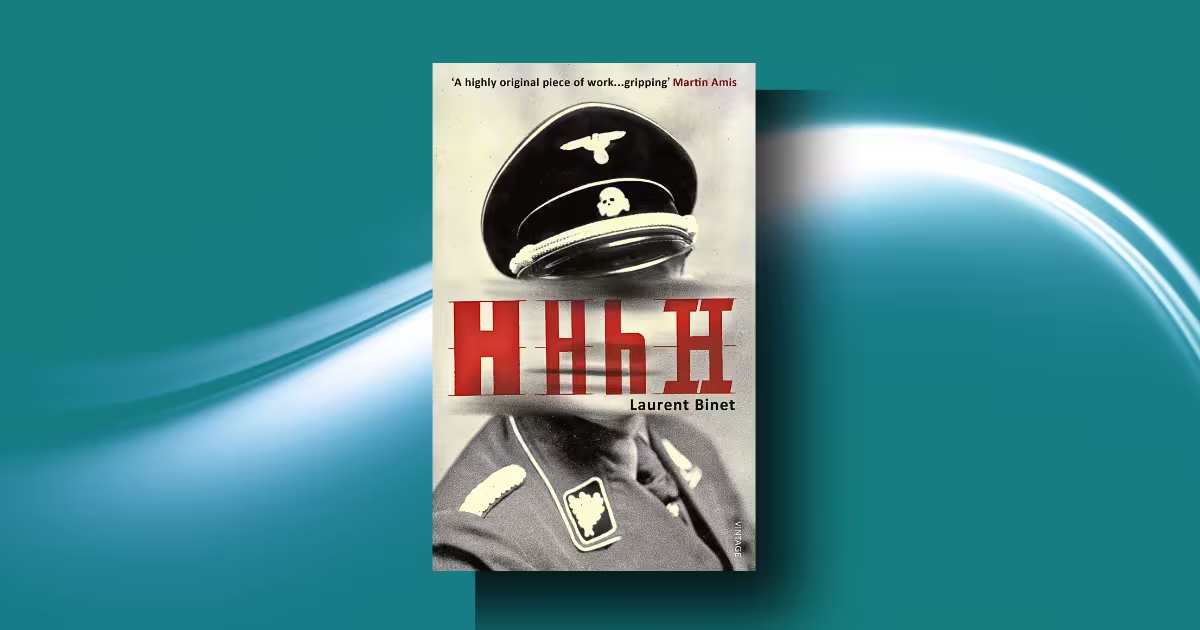
Did you ever pick up a book expecting a straight historical thriller only to find it dismantling its own storytelling right in front of you—and somehow end up more moved by the truth than any invented drama? That’s exactly what happened when I first cracked open Laurent Binet’s HHhH.
I was scrolling through the opening pages on a humid afternoon, and by the time Gabčík’s name appeared on page 11, I knew this wasn’t going to be a typical WWII read.
It felt personal, almost like Binet was sitting across from me, wrestling with the same questions I’ve had about how we remember heroes and monsters.
HHhH is the electrifying true story of the 1942 assassination of Reinhard Heydrich—the “Butcher of Prague” and Himmler’s right-hand man—told through the daring mission of two Czechoslovak parachutists, but layered with Binet’s own obsessive, self-doubting reflections on the ethics of turning real history into readable prose.
HHhH is best for you if you love smart, meta historical fiction that feels like a conversation with the author (think Kundera meets a spy thriller), or if you’re obsessed with WWII resistance stories, Operation Anthropoid, or the blurry line between fact and fiction, this book will hook you hard.
It’s perfect for history buffs, literature students, or anyone who’s ever wondered why some true tales hit harder than novels. Skip it if you want pure adrenaline with zero author interruptions—Binet’s voice is the secret ingredient, but it can feel like a chatty friend derailing the plot just when the tension peaks.
Table of Contents
1. Introduction
HHhH (the title is the German acronym for “Himmlers Hirn heißt Heydrich”—“Himmler’s brain is called Heydrich”) is Laurent Binet’s debut novel, published in French in 2010 by Grasset & Fasquelle and translated into English by Sam Taylor in 2012.
It won the Prix Goncourt du Premier Roman and became an international bestseller, praised for its genre-bending style.
HHhH clocks in at 257 short, numbered chapters that jump between 1940s Prague and Binet’s own research odyssey decades later. All characters and events are real—no invented names, no fabricated heroes.
Yet Binet constantly reminds us he’s fighting the novelist’s urge to “stain the tree of History with his thoughts,” quoting Osip Mandelstam right at the start of Part One.
2. Background
The historical core is Operation Anthropoid, the British-backed mission to assassinate Reinhard Heydrich in occupied Czechoslovakia in May 1942.
Heydrich, the “Hangman of Prague,” was not just a high-ranking SS officer and Gestapo chief—he was the architect of the Final Solution, chairing the Wannsee Conference and overseeing the deportation and murder of hundreds of thousands.
Slovakia had collaborated while Bohemia and Moravia were a protectorate under brutal Nazi rule. Binet weaves in his childhood memories (his father casually mentioning the story), his time teaching in Slovakia, romantic trips to Prague with partners like Aurélia and Natacha, and visits to the bullet-scarred crypt where the assassins made their last stand.
HHhH captures this perfectly in the early chapters: Binet describing the tram creaking outside Gabčík’s apartment, the church on Resslova Street, and even buying chocolates for the kind old lady at the Army Museum who slipped him a forbidden guidebook.
3. HHhH by Laurent Binet Summary
Part 1: The Framework – A Novel About Writing History
The Author’s Obsession and Method
“HHhH” is not a conventional historical novel. The title stands for “Himmlers Hirn heisst Heydrich” – a German phrase meaning “Himmler’s brain is called Heydrich.”
This cryptic title reflects the book’s central paradox: it is ostensibly about the assassination of Reinhard Heydrich, the Nazi “Protector of Bohemia and Moravia,” yet the author, Laurent Binet, constantly interrupts his own narrative to discuss the impossibility of writing historical fiction.
HHhH opens with Binet confessing his long-standing fascination with the story of Jozef Gabčík and Jan Kubiš, the two Czechoslovak parachutists who assassinated Heydrich in 1942. He first heard the story from his father as a teenager, reading Jacques Delarue’s “History of the Gestapo.”
The tale took root in his imagination, and for years he carried mental images of Gabčík lying on an iron bed in Prague, listening to trams outside.
Binet is obsessed with authenticity.
He despises invented dialogue and fictionalized interior monologues, yet he recognizes that pure historical documentation makes for dry reading. HHhH becomes a battleground between his desire for factual precision and the demands of narrative storytelling.
He repeatedly agonizes over choices: Should he describe Himmler’s face turning red with panic when Heydrich is shot down over Russia? He deletes the sentence, then restores it, then deletes it again. He quotes Oscar Wilde: “I was working on the proof of one of my poems all the morning, and took out a comma. In the afternoon I put it back again.”
Binet visits Prague multiple times. He discovers the crypt of Saints Cyril and Methodius Church on Resslova Street, where the parachutists made their final stand.
He bribes a museum guide who secretly gives him an exhibition guidebook. He drinks beer at the “Parachutists” bar. He tracks down a former French Resistance fighter who tells him that the Sten submachine gun was “shit” – a detail that becomes crucial.
The author also reveals his personal life interwoven with the research.
He had a passionate five-year relationship with a Slovak woman named Aurelia, which deepened his connection to the region. Later, he dates Natacha, whose father was a communist and whose family history touches the Resistance.
Natacha reads his drafts and criticizes his purple prose. Their relationship deteriorates as he becomes consumed by the book.
Binet’s meta-narrative constantly questions the ethics of historical fiction. He writes: “What could be more vulgar than an invented character?”
Yet he cannot avoid invention entirely. He decides that any dialogue he creates will be written like a play script – stylistically distinct from the historical narrative – to signal its fictional nature.
Reinhard Heydrich – The Making of a Monster
The historical narrative proper begins with Heydrich’s childhood in Halle, Germany, born in 1904. His father, Bruno Heydrich, was a musician and opera composer.
The family faced rumors of Jewish ancestry – Bruno’s mother had remarried a man named Süss, and schoolchildren taunted young Reinhard as “Süss the Jew.” This rumor would haunt Heydrich throughout his life and fuel his virulent anti-Semitism.
Heydrich was a gifted violinist and fencer.
He had a high-pitched, falsetto voice that made him an object of mockery – schoolmates called him “the Goat.” But he was also fiercely competitive and determined. When Germany lost World War I, the young Heydrich joined the Freikorps, paramilitary militias fighting against communists. He briefly considered becoming a chemist, then a musician, but economic depression led him to the navy in 1922.
In the navy, Heydrich served under Wilhelm Canaris, a future head of German military intelligence. He became an accomplished fencer but was known as a womanizer.
His naval career ended in disgrace in 1931 when he got a young woman pregnant and refused to marry her – her father was Admiral Raeder, commander-in-chief of the navy.
Heydrich was court-martialed and dismissed.
Unemployed and desperate, Heydrich’s fiancée Lina von Osten – a fervent Nazi – pushed him toward the rising SS. He secured an interview with Heinrich Himmler, who wanted to create an intelligence service.
Heydrich knew nothing about espionage but bluffed brilliantly, sketching diagrams and using military jargon. Himmler was impressed and hired him. The Sicherheitsdienst (SD) – the SS security service – was born.
Heydrich’s rise was meteoric.
He compiled files in shoeboxes, then built an enormous bureaucracy. He was instrumental in the Night of the Long Knives (June 30, 1934), when Hitler purged the SA leadership. Binet dramatizes this as a series of telephone calls where Heydrich coldly orders executions.
When Gregor Strasser, an old Nazi who had investigated Heydrich’s Jewish ancestry, lies bleeding from a gunshot, Heydrich arrives and says: “He’s not dead yet? Let him bleed like a pig.”
Heydrich became head of the Gestapo, then the RSHA (Reich Security Main Office), combining all police and security services under his control. He organized the Einsatzgruppen – death squads that followed the army into Poland and the Soviet Union. He forged documents to frame Soviet Marshal Tukhachevsky, contributing to Stalin’s purges.
He created a high-class brothel called “Kitty’s Salon” to spy on diplomats.
By 1941, Heydrich was the “most dangerous man in the Third Reich.” He flew combat missions as a Luftwaffe reserve pilot until being shot down over Russia (he survived). And on January 20, 1942, he chaired the Wannsee Conference, where the “Final Solution to the Jewish Question” was coordinated. The meeting lasted only two hours.
Afterward, Heydrich sipped brandy, listened to Schubert, and smoked a cigar.
Part 2: The Road to Anthropoid
The Parachutists – Gabčík and Kubiš
The narrative shifts to Czechoslovakia. After the Munich Agreement of 1938, which betrayed Czechoslovakia to Hitler, and the German occupation of March 1939, many Czech and Slovak soldiers fled abroad.
Jozef Gabčík, a Slovak from Košice, worked in a chemical factory before escaping through Poland to France. Jan Kubiš, a Moravian, followed a similar path. Both joined the Czechoslovak army-in-exile, fought in the fall of France, and escaped to England.
In London, President Edvard Beneš’s government-in-exile faced a problem: the domestic Czech Resistance was crumbling under Heydrich’s terror. Britain and the Soviet Union doubted Czechoslovakia’s fighting spirit. Beneš needed a spectacular act to demonstrate that his nation still resisted.
Colonel František Moravec, head of Czech intelligence, conceived Operation Anthropoid – the assassination of Reinhard Heydrich. The target was chosen for maximum impact: killing the “Hangman of Prague” would send shockwaves through the Reich and restore Czech honor.
Gabčík was selected as the Slovak representative. His original partner, Anton Svoboda, was injured in a parachute training accident, so Jan Kubiš replaced him. Binet reproduces their British Army personnel files: Gabčík is described as “smart and well-disciplined” but “slow at acquiring knowledge”; Kubiš as “quiet” and “reliable.”
Both were excellent soldiers.
Binet struggles to portray his heroes without inventing. He imagines Gabčík leaving Slovakia, then corrects himself when he discovers factual errors. He refuses to write their first meeting because he cannot verify it. He quotes from Alan Burgess’s novel “Seven Men at Daybreak” and David Chacko’s “Like a Man” to show how other writers have handled the story – sometimes approvingly, sometimes critically.
On December 28, 1941, Gabčík and Kubiš parachuted into Czechoslovakia from a Halifax bomber. The drop went wrong: they landed far from their intended target near Pilsen, and Gabčík broke his toe. A gamekeeper found them but, instead of betraying them, helped them reach Prague.
Waiting in Prague
The parachutists spent months in hiding, preparing for the assassination.
They used false identities – Gabčík became “Zdeněk Vyskocil,” Kubiš “Ota Navrátil.” Resistance families sheltered them: the Moravecs (no relation to Colonel Moravec), the Fafeks, the Novaks, the Svatošes. Each family risked death.
Binet emphasizes the ordinary heroism of these people. Aunt Moravec baked cakes for the parachutists. The Novaks’ young daughter retrieved Kubiš’s bicycle from near the attack site. The concierge hid Valčík. Most would be executed.
A third parachutist, Josef Valčík from Operation Silver A (whose mission was to re-establish radio contact with London), joined Anthropoid as a lookout. A fourth, Karel Čurda from Operation Out Distance, would later betray them all.
The parachutists scouted Heydrich’s movements. A carpenter at Prague Castle provided daily reports on when Heydrich arrived and left, and whether he had an escort. They chose a hairpin curve in Holešovice Street (now part of a highway ramp) as the attack site. The curve forced cars to slow down, and a hill allowed Valčík to signal when the Mercedes approached.
The plan: Gabčík would stop the car with a Sten submachine gun; Kubiš would throw a modified antitank bomb if necessary. They would then escape on bicycles.
Heydrich, meanwhile, was confident. He drove in an open-top Mercedes without bodyguards, despite warnings. He told Albert Speer: “Why should my Czechs shoot at me?” He was preparing to leave Prague for a new assignment – possibly France.
Part 3: The Assassination
May 27, 1942 – The Attack
The morning of May 27, 1942, dawned clear. Heydrich was late – he had played with his children and walked with Lina in their garden. Gabčík and Kubiš waited at the curve, growing increasingly exposed. A tram passed; more trams would come.
At 10:30 AM, Valčík flashed a signal from the hill. The Mercedes appeared.
Gabčík stepped into the road, pushed aside his raincoat, aimed his Sten at Heydrich’s chest – and pulled the trigger.
Nothing happened. The Sten jammed.
This is HHhH‘s central dramatic moment, and Binet handles it with excruciating detail. He cites the theory that grass from a rabbit-feeding bag clogged the mechanism. The Sten, as the French Resistance fighter had told him, was “shit.”
The car stopped.
Heydrich stood up and drew his pistol. Klein, the chauffeur, froze. Kubiš, hidden behind Gabčík, threw his bomb. It missed the front seat and exploded against the right rear wheel.
The blast tore through the Mercedes. Shrapnel hit Kubiš in the face. Horsehair stuffing from the seats flew everywhere. Heydrich was wounded in the back – fragments lodged near his spleen.
In the chaos, Gabčík fled uphill. Kubiš grabbed his bicycle and rode downhill, firing into the air to clear a path through stunned tram passengers. Klein chased Gabčík but was shot in the leg. Heydrich, bleeding, stood in the road waving his pistol until he collapsed.
A young German woman stopped a Tatra delivery van. The driver protested about boxes of shoe polish, but she ordered him to transport the Protector. Heydrich was laid face-down among the boxes, still clutching his briefcase. He was taken to Bulovka Hospital.
The attack had succeeded, though not as planned. Heydrich was alive but seriously wounded.
Aftermath – The Hunt Begins
Hitler was enraged. He initially ordered 10,000 Czechs shot, then agreed to more “moderate” reprisals. A state of emergency was declared. The Gestapo offered a 10 million crown reward. Red posters plastered Prague: anyone sheltering the assassins would be shot with their entire family.
That night, 4,500 SS, Gestapo, and Wehrmacht personnel, plus 20,000 Czech police, searched 36,000 apartments. They arrested 541 people and released 430. They found nothing.
Gabčík, Kubiš, and Valčík went into hiding. Gabčík bought a Tyrolean hat to look more German; an SS guard asked him for a light. Kubiš washed his wounds at the Novaks’ apartment; the daughter retrieved his bicycle. Valčík limped to a Resistance safe house, claiming he’d twisted his ankle.
Meanwhile, Heydrich seemed to recover. His spleen was removed. He was conscious and talking. Lina brought him soup. Himmler visited. The prognosis was good.
Then, suddenly, his condition deteriorated.
Septicemia set in. The doctors needed penicillin, which was only available in Britain. Heydrich lay in a fever, quoting his father’s opera: “The world is just a barrel organ, which the Lord God turns Himself. We all have to dance to the tune that is already on the drum.”
On June 4, 1942, Reinhard Heydrich died. He was 38 years old.
Part 4: Reprisals and Betrayal
Lidice – A Village Wiped Away
The Nazis needed to avenge Heydrich. A false lead – a letter from a factory worker named “Milan” to his mistress Anna Maruscakova, mentioning “the fatal day” – led them to the village of Lidice. There was no connection to the assassination. But the Gestapo was desperate.
On June 10, 1942, German forces surrounded Lidice. All 173 men were shot.
The women were sent to Ravensbrück concentration camp. The children were separated – most were gassed at Chełmno; a few deemed “Germanizable” were adopted by German families. The village was burned, bulldozed, and salted so nothing would grow again.
Hitler intended Lidice as a warning.
Instead, it backfired spectacularly. World opinion turned against Germany. “Lidice shall live!” became an Allied slogan. Towns in Mexico, Cuba, Brazil, and the United States renamed themselves Lidice. The Nazis had revealed their true nature to the world.
In the crypt of Saints Cyril and Methodius Church, Gabčík and Kubiš were devastated. They wanted to turn themselves in to stop the killing. Their comrades – Lieutenant Opalka, Valčík, and others – talked them down. But the guilt never left them.
The Traitor – Karel Čurda
Karel Čurda had parachuted into Czechoslovakia with Operation Out Distance. Unlike Gabčík and Kubiš, he had volunteered for “adventure” rather than patriotism. He was a heavy drinker who had expressed admiration for Hitler while training in England.
After the assassination, Čurda hid with his mother in Kolín. On June 16, 1942, he walked into Peček Palace – Gestapo headquarters in Prague – and offered his services. He was beaten, then interrogated.
He told them everything: the Moravec apartment, the Svatoš family, the bicycles, the briefcase. He named Gabčík, Kubiš, Valčík, and Opalka. He received 10 million crowns (later doubled by President Hácha to 20 million).
The Gestapo raided the Moravec apartment. Mrs. Moravec asked to use the bathroom, swallowed a cyanide pill, and died with a smile. Her husband and son Ata were arrested and tortured.
Ata was shown his mother’s head in a jar. He did not betray the parachutists’ hiding place, but Čurda had already done so.
Part 5: The Final Stand
The Siege of the Crypt
On June 18, 1942, the Gestapo surrounded the church on Resslova Street. Seven parachutists were inside: Gabčík, Kubiš, Valčík, Opalka, Bublik, Hruby, and Svarc. They had been hiding in the crypt for days.
The Germans attacked at dawn.
Three men – Kubiš, Opalka, and Bublik – held the gallery overlooking the nave, firing down on the attackers. They held out for three hours. Opalka was killed. Bublik was wounded and died in the ambulance. Kubiš was wounded and died twenty minutes later.
The Germans did not know that four more men were in the crypt below.
The trapdoor was hidden under a carpet. When they finally found it, they faced a narrow staircase that only admitted one man at a time. Gabčík, Valčík, Hruby, and Svarc shot down every SS soldier who tried to enter.
The Germans tried tear gas – the grenades fell in the water. They tried a searchlight – a bullet destroyed it. They tried to flood the crypt through a ventilation shaft – the parachutists used a ladder to push the hose away.
They tried dynamite to break through the altar. They brought Čurda and Ata Moravec to shout through the vent: “Give yourselves up!” The parachutists answered with gunfire.
For eight hours, 800 SS men fought seven men.
Finally, the Germans broke through from multiple directions. The parachutists had one clip of ammunition left. Rather than surrender, they used it on themselves.
At noon, four dull explosions silenced the gunfire. The Germans entered the crypt to find four bodies floating in the rising water. Gabčík, Valčík, Hruby, and Svarc had bitten cyanide pills and shot themselves.
The battle of the church was over.
Part 6: The Ending: What Happened After
Fates and Consequences
Binet does not end with the crypt. He follows the threads of history to their bitter conclusions.
The Reprisals Continue: The betrayal led to more massacres. The village of Ležáky, which had sheltered radiotelegrapher Potůček, was razed like Lidice.
Hundreds of Resistance members and their families were executed. The Moravecs, the Novaks, the Svatošes, the Zelenkas, the Fafeks – nearly everyone who helped the parachutists died in concentration camps. Gabčík’s fiancée Libena Fafek, nineteen and possibly pregnant, was gassed. Kubiš’s fiancée Anna Malinova was executed.
Only a handful survived, like the concierge who hid Valčík.
Karel Čurda: The traitor received his money, changed his name, married a German woman, and became a double agent. After the war, he was arrested by the Resistance near Pilsen. Tried and sentenced to death, he was hanged in 1947. As he climbed the scaffold, he told the hangman an obscene joke.
A54 (Paul Thümmel): The German spy who had warned Czechoslovakia of invasions was arrested. He survived in Terezín until April 1945, when the Nazis evacuated.
As he was led to be shot, he sent a message to Colonel Moravec: “It was a real pleasure to work with the Czechoslovak information services. I am sorry it has to end like this.”
The Heydrich Family: Lina Heydrich wrote her memoirs, “Living with a War Criminal.” In October 1943, a Czech worker driving a van accidentally hit and killed Klaus Heydrich, Reinhard and Lina’s eldest son. The driver was sent to a concentration camp.
Aktion Reinhard: In July 1942, the program to exterminate all Polish Jews began at Belzec, Sobibor, and Treblinka. Between July 1942 and October 1943, more than two million Jews and 50,000 Romani died. The operation was code-named “Aktion Reinhard” – in honor of Reinhard Heydrich.
The Ravensbrück Experiments: German doctors, unable to save Heydrich from gas gangrene, conducted experiments on 74 young female prisoners at Ravensbrück to prove that sulfonamides would not have helped. They deliberately infected the women with viruses; many died.
The Author’s Final Reflection
Binet returns to his own voice. He has finished his story, but he discovers he can never be finished with it. His father calls to read him a museum placard about the Ravensbrück experiments. He learns new details constantly.
He admits his failures: he could not properly honor all the forgotten heroes – the Novaks, the Svatošes, the thousands who died anonymous. He could not truly inhabit Gabčík and Kubiš.
He could not resist cheap literary effects or overcome the inherent falseness of turning real people into characters.
Yet HHhH ends with a quiet, imagined scene. Gabčík is on a boat crossing the Baltic to France, leaving Poland behind. He leans on the railing, watching the waves. A voice says: “Got a light, comrade?” He recognizes the Moravian accent. A lighter flame illuminates a face – a dimpled chin, lips made for smoking, and in the eyes, “a little bit of the world’s goodness.”
“My name’s Jan,” the man says.
Gabčík smiles silently. They will have time to get to know each other during the journey.
Binet places himself in the scene too: “I am also there, perhaps.”
It is a gesture of humility and hope – the author acknowledging that he cannot truly capture these men, but that he can stand beside them in imagination, bearing witness. The story will never end, but it can be passed on.
4. HHhH Analysis
4.1. HHhH Characters
Heydrich is the chilling centerpiece—blond, athletic, a gifted violinist and fencer, yet rumored to have Jewish ancestry that haunted him. Binet portrays him as the perfect Nazi prototype: efficient, cruel, and utterly obedient.
We see his rise from naval officer to Himmler’s “brain,” his marriage to Lina (who pushed his ambition), and his role in the Holocaust.
The real heroes are Jozef Gabčík (the Slovak) and Jan Kubiš (the Czech)—two ordinary men trained in England, parachuted into danger, hiding with brave Czech families.
Their attack on 27 May 1942 is pure tension: Gabčík’s Sten gun jams (Binet later learns from a French Resistance fighter that the Sten was notoriously unreliable—“The Sten was shit”), Kubiš throws the grenade, and Heydrich is mortally wounded by shrapnel and infection, dying on 4 June.
The manhunt ends in the Church of Saints Cyril and Methodius crypt: seven hundred SS troops flood the streets, the assassins and their helpers fight to the last grenade and bullet.
Betrayal by Karel Čurda seals their fate. Reprisals are horrific—Lidice is razed, its men shot, women and children sent to camps.
Binet refuses to romanticize; these are real people with sprained ankles, jammed guns, and cyanide pills they ultimately don’t use.
4.2. Themes and Symbolism
The dominant theme is the impossibility—and necessity—of telling true stories without fiction’s “veneer.”
Binet rails against invented dialogue (“If my dialogues can’t be based on precise, faithful, word-perfect sources, they will be invented… written like scenes from a play”) and mocks other historical novels like Jonathan Littell’s The Kindly Ones.
Memory itself is symbolic: the crypt’s bullet marks, the dancing house near the church, the black Mercedes with its blown tire.
The Sten gun jamming becomes a metaphor for imperfect tools in the fight against evil.
Broader themes include heroism in everyday people (the families who hid the parachutists), the banality of bureaucratic evil (Heydrich’s love of files), and the cost of resistance—Lidice’s destruction shows how one bold act ripples into mass suffering.
Binet’s interruptions symbolize the modern reader’s dilemma: we crave neat narratives, but history is messy, incomplete, and demands honesty.
5. Evaluation
HHhH is a groundbreaking, marvelous hybrid that left me stunned—part thriller, part memoir, part philosophical meditation. Like The Sense of an Ending by Julian Barnes, it’s poignant and intellectually thrilling, forcing you to confront how we construct the past.
Strengths/pleasant experiences: The short chapters create relentless momentum, and Binet’s voice is disarmingly honest and funny. I loved the Prague visits—the crypt scene in Chapter 6 still gives me chills: “There were seven hundred SS guards outside.” The research feels lived-in; you sense Binet’s genuine obsession.
Weaknesses/negative experiences: Some interruptions can pull you out of the action, and a few reviewers (including me at times) wished for less meta-commentary when the stakes were highest.
Impact: Intellectually, it reshaped how I read history—I now spot fictional flourishes everywhere. Emotionally, the assassins’ final stand and Lidice’s fate hit like a gut punch; I closed the PDF feeling both inspired by ordinary courage and haunted by its price.
Comparison with similar works: It outshines straight WWII fiction like The Kindly Ones (which Binet himself critiques) by refusing to invent psychology. It’s closer to Vladimir Pozner’s The Bloody Baron in blending research with narrative.
Adaptation – Comparisons between book & TV adaptation – Box-office information: The 2017 film The Man with the Iron Heart (directed by Cédric Jimenez, starring Jason Clarke as Heydrich and Rosamund Pike as his wife) drops most of Binet’s meta-layer for a more conventional biopic/thriller.
It’s visually slick but loses HHhH’s intellectual punch—focusing on Heydrich’s personal life while the assassins feel secondary. (A separate 2016 film, Anthropoid, with Cillian Murphy and Jamie Dornan, sticks closer to the operation itself.)
Box office was modest; it earned around $4–5 million worldwide, far from blockbuster status, partly because audiences expected pure action, not the book’s cerebral style.
6. Personal insight with contemporary educational relevance
The most powerful angle for me is Binet’s insistence on truth-telling amid the temptation to fictionalize.
In our era of deepfakes, revised textbooks, and politicized history (think ongoing debates over WWII memory in Eastern Europe or disinformation campaigns), this book feels urgently relevant.
It reminds us that resistance isn’t just bullets—it’s preserving accurate memory. Statistically, Holocaust denial and distortion persist: according to recent ADL reports, antisemitic incidents rose sharply post-2023, and surveys show younger generations in some countries have fading knowledge of the Shoah. HHhH counters this by making history visceral yet honest—no heroic inventions, just real courage and real cost.
Reading it in Bangladesh, where we grapple with our own liberation war narratives, hit differently; it taught me that every nation’s “official story” deserves the same rigorous scrutiny Binet applies.
For educators or book clubs, pair it with visits to resistance sites or discussions on ethical storytelling.
It’s a masterclass in why facts matter more than flair. (External link for further reading: the official Operation Anthropoid memorial site or the Prague crypt’s virtual tour.)
7.HHhH Quotes
From Chapter 1: “Gabčík—that’s his name—really did exist… I just hope that, however bright and blinding the veneer of fiction that covers this fabulous story, you will still be able to see through it to the historical reality that lies behind.”
On the crypt (Chapter 6): “There were still fresh traces of the drama… There were seven hundred SS guards outside.”
On invented dialogue (Chapter 15): “If my dialogues can’t be based on precise, faithful, word-perfect sources, they will be invented… they will function not as a hypotyposis but as a parable.”
The Sten gun moment (from the French Resistance fighter’s story in Chapter 9): “The Sten was shit, there’s no other way of saying it.” (Crucial to the attack’s near-failure.)
Closing reflection on memory: “Memory is of no use to the remembered, only to those who remember. We build ourselves with memory and console ourselves with memory.”
8. Conclusion
Overall, HHhH is a rare gem—tense, funny, heartbreaking, and intellectually honest. It doesn’t just recount heroism; it honors it by refusing easy fiction.
I recommend HHhH wholeheartedly to fans of literary nonfiction, WWII history, or anyone who appreciates a book that challenges you to think while it thrills you. In a world drowning in recycled narratives, Binet’s debut is a reminder that the best stories are the true ones—warts, jammed guns, and all.
If you care about how history shapes us, read this.
You’ll never look at a “based on a true story” the same way again.







