
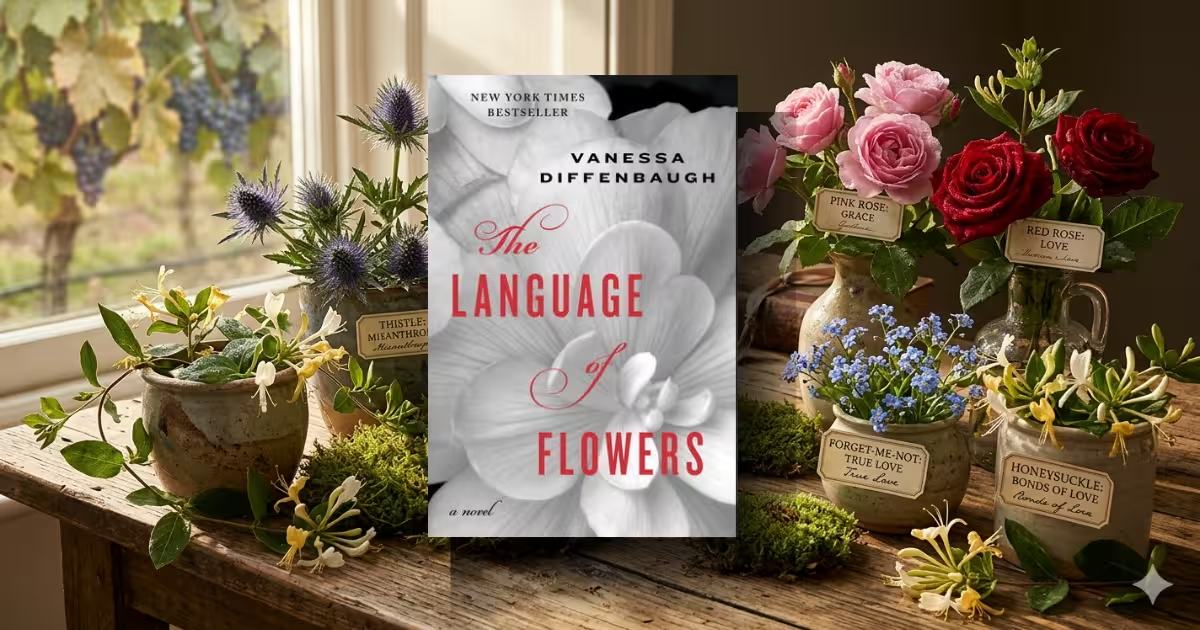
Ever wondered why you feel a sudden, inexplicable ache when you see a wilted rose, or why a simple bouquet of lavender can make you feel more guarded than a locked door? The Language of Flowers by Vanessa Diffenbaugh is a dual-timeline novel that explores themes of trauma, forgiveness, and the search for family through the lens of a young woman named Victoria Jones.
A traumatized young woman, newly emancipated from the foster care system, discovers that the secret Victorian language of flowers is her only hope for communicating her capacity for love, motherhood, and eventual self-forgiveness.
The Language of Flowers is best for readers who appreciate “grit-lit” mixed with beauty, fans of character-driven redemptive arcs, and anyone who loved Where the Crawdads Sing.
Not for readers looking for a light, breezy romance or those who are sensitive to depictions of child neglect and postpartum depression.
Table of Contents
1. Introduction
Title: The Language of Flowers
Author: Vanessa Diffenbaugh
Publication Date: August 23, 2011 (Ballantine Books)
Vanessa Diffenbaugh’s debut novel is a masterclass in emotional architecture. It bridges the gap between the historical elegance of Victorian floriography and the modern, often brutal reality of the California foster care system.
It’s a story about the “thorns” we grow to protect ourselves and the “moss” we eventually find to cushion our fall.
2. Background
The novel draws heavily from the Victorian Era tradition where specific blooms were assigned meanings—a “language” used to convey feelings that social decorum forbade.
Diffenbaugh doesn’t just use this as a gimmick; she integrates it as a psychological survival mechanism for her protagonist, Victoria. Historically, this system was popularized by books like Charlotte de la Tour’s Le Langage des Fleurs (1819), and it serves here as a silent dialogue between characters who are too broken for words.
3. Language of Flowers Summary
The Scars of the Past
The story is told through two alternating timelines: Victoria at age eighteen, just “aging out” of the system, and Victoria at age nine, during her most significant placement.
At eighteen, Victoria Jones is a “misanthropist”—a word she embraces with the same fervor she uses to plant common thistle (misanthropy). Having survived thirty-two foster homes, she has learned that “emancipation” is just a polite word for being thrown away.
She spends her first nights of freedom sleeping in Duboce Park in San Francisco, hiding her presence from the world while cultivating a secret garden. Her only comfort is a worn flower dictionary.
The Vineyard and Elizabeth
In the “past” timeline, we see why Victoria is so guarded. She was placed with Elizabeth, a woman who owned a vineyard and seemed to understand Victoria’s wildness. Elizabeth didn’t try to “fix” her; she taught her the language of flowers.
Victoria learned that honeysuckle means devotion and lavender means mistrust. Elizabeth intended to adopt Victoria, marking August 2nd on the calendar in pink. However, Victoria’s fear of being rejected led her to reject Elizabeth first. In a moment of panic and jealousy over Elizabeth’s estranged sister, Catherine, Victoria set a fire.
The blaze didn’t just burn the field; it scorched her relationship with the only mother figure she ever knew. She was sent back to the system, convinced she was “unlovable”.
The Arrival of Grant
Back in the present, Victoria finds a job at Bloom, a floral shop owned by the patient Renata. Victoria’s “prescriptions”—giving a woman white poplar (time) to help with a grieving mother—make her a local legend. At the flower market, she meets Grant, a vendor who, shockingly, speaks the language of flowers fluently. He is the first person to truly communicate with her in her own tongue.
The plot thickens when Victoria realizes Grant is actually the son of Catherine—Elizabeth’s sister. This connection is both a bridge and a barrier. As they fall in love, Victoria becomes pregnant. This triggers a visceral terror in her. “I am not a mother,” she thinks, haunted by the fact that she was abandoned at birth and failed by every “mother” since.
The Breaking Point: Hazel and Abandonment
Victoria gives birth to a daughter, Hazel, in Renata’s home. The sections describing Victoria’s struggle with motherhood are some of the most haunting in contemporary fiction. She is paralyzed by the fear that she will neglect the baby, just as she was neglected.
She interprets every cry as an indictment. Eventually, the weight of her trauma crushes her. In a desperate, heartbreaking act, she leaves baby Hazel in a crate at the flower market for Grant to find and disappears.
She spends months in a nearby town, working in a plant nursery, living a ghost-like existence. She believes that by leaving, she is protecting Hazel from herself. It is during this period of isolation that she has a revelation about moss. Moss is the emblem of maternal love because it grows without roots; it clings to the hard stone and softens it.
She realizes that she doesn’t need a perfect lineage or “roots” to be a mother.
The Ending Explained
The climax occurs when Victoria finally gathers the courage to return. She travels to Elizabeth’s vineyard and finds Elizabeth, Catherine, and Grant all together, caring for Hazel. The decades-long rift between the sisters has been healed through their shared love for the baby. Victoria is forced to confront her past—her role in the fire and her abandonment of Hazel.
The novel ends on a note of cautious, beautiful hope.
Victoria is reunited with Grant and Hazel. She hasn’t been magically “fixed,” but she has found a way to exist within a family.
The final scene involves the planting of a garden where the flowers aren’t just messages of mistrust, but of clematis (mental beauty) and moss (maternal love). She chooses to stay, finally realizing that she is worthy of the “devotion” symbolized by the honeysuckle.
In The Language of Flowers, Victoria Jones uses a specific Victorian floral dictionary to communicate. Here are the primary flowers mentioned in the book and their “at-a-glance” meanings:
The Core Symbols
- Moss: Maternal Love (The most significant symbol in the book’s conclusion)
- Thistle: Misanthropy (Victoria’s initial self-chosen flower)
- Lavender: Mistrust (Also used for devotion in different contexts)
- Honeysuckle: Devotion; Bonds of Love
- Rhododendron: Danger; Beware
- Marigold: Grief; Cruelty
Roses and Their Specifics
- Red Rose: Love
- White Rose: A heart unacquainted with love; Purity
- Yellow Rose: Infidelity; Jealousy
- Pink Rose: Grace; Gentility
- Burgundy Rose: Unconscious beauty
Emotions and Interactions
- Basil: Hatred
- Begonia: Beware
- Black-eyed Susan: Justice
- Chamomile: Energy in adversity
- Forget-me-not: True love; Remembrance
- Heliotrope: Devotion; Eagerness
- Hydrangea: Dispassion; Heartlessness
- Ivy: Fidelity; Friendship
- Lichen: Dejection; Solitude
- Orange Blossom: Your purity equals your loveliness; Marriage
- Peony: Anger; Indignation
- Ranunculus: You are radiant with charms
- Sweet Pea: Delicate pleasures; Goodbye
- Yellow Tulip: Hopeless love
- Zinnia: I mourn your absence
Functional and Practical Meanings
- Cabbage: Profit
- Clematis: Mental beauty; Poverty
- Hollyhock: Ambition
- Snapdragon: Presumption; Deception
These meanings are used throughout the story as a silent dialogue between characters, especially between Victoria and Grant, to express feelings they are unable to put into words.
4. Language of Flowers Analysis
4.1. Language of Flowers Characters
Victoria Jones: A “prickly protagonist” who earns her place. She is flawed, often selfish, and defensively aggressive, but her journey toward self-forgiveness is profoundly human.
Elizabeth: She represents the “mother” Victoria could have had. Her own trauma—her rift with her sister—mirrors Victoria’s internal conflict.
Grant: More than a love interest, Grant is a translator. He translates Victoria’s silence into a life she can actually live.
4.2. Language of Flowers Themes and Symbolism
The Flower Dictionary: This is the most significant symbol. It represents Victoria’s attempt to order a chaotic world. When she eventually creates her own dictionary at the end of the book, it signifies her taking agency over her own life story.
Moss vs. Roots: The recurring theme that “roots” (biological family) aren’t the only way to thrive. Moss (chosen family/maternal instinct) is just as vital.
5. Evaluation
The Language of Flowers is a groundbreaking work that manages to make the reader feel the sharp sting of a thorn and the soft velvet of a petal in the same sentence.
Strengths: The dual-timeline structure is expertly handled, building a “mystery” about Victoria’s childhood that pays off emotionally. The botanical research is impeccable.
Weaknesses: The coincidence of Grant being related to Elizabeth stretches the “small world” trope slightly, but in the context of a story about fate and roots, it’s forgivable.
Impact: This book is a poignant reminder that people who seem “difficult” are often just people who have been historically “refused” love.
*
Comparison: If you enjoyed the solitary, nature-bound atmosphere of Where the Crawdads Sing or the prickly, socially-stunted protagonist of Eleanor Oliphant Is Completely Fine, this is your next read.
Adaptation: A film adaptation has been in development for years. In 2019, it was announced with Michael Mayer directing and starring Kiersey Clemons as Victoria and Nick Robinson as Grant. While its release status remains “TBA,” the casting of Marisa Tomei as Elizabeth suggests a project with significant emotional weight.
6. Personal Insight with Contemporary Educational Relevance
As I read Victoria’s struggle with “aging out,” I couldn’t help but look at the cold reality of our social systems. In the United States, roughly 20,000 youth age out of foster care annually. Statistics from the National Foster Youth Institute show that 1 in 4 will be homeless within two years, and only 3% will earn a college degree.
Victoria’s garden in the park isn’t just a literary metaphor; it’s a survival tactic for the thousands of “emancipated” children who are left with a garbage bag of clothes and no “roots.”
For more on how books like this shape our view of social reform, check out reviews of similar deep-dives like Sally Rooney’s Intermezzo or the explorations of adversity, which often highlights the “shamelessness of love” and the power of literature to transform the mind.
7. Language of Flowers Quotes
- “Moss is selected to be the emblem of maternal love, because, like that love, it glads the heart when the winter of adversity overtakes us.”
- “Everything I know… I learned here.” — Victoria to Elizabeth
- “Misanthropy: Hatred or mistrust of humankind.”
- “My hopes for the future were simple: I wanted to be alone and to be surrounded by flowers.”
8. Conclusion
Vanessa Diffenbaugh’s The Language of Flowers is a vital piece of contemporary fiction. It’s a recommendation for anyone who has ever felt like a “weed” in a world of manicured roses. It teaches us that while we cannot change our “roots,” we can always choose what we plant next.







