
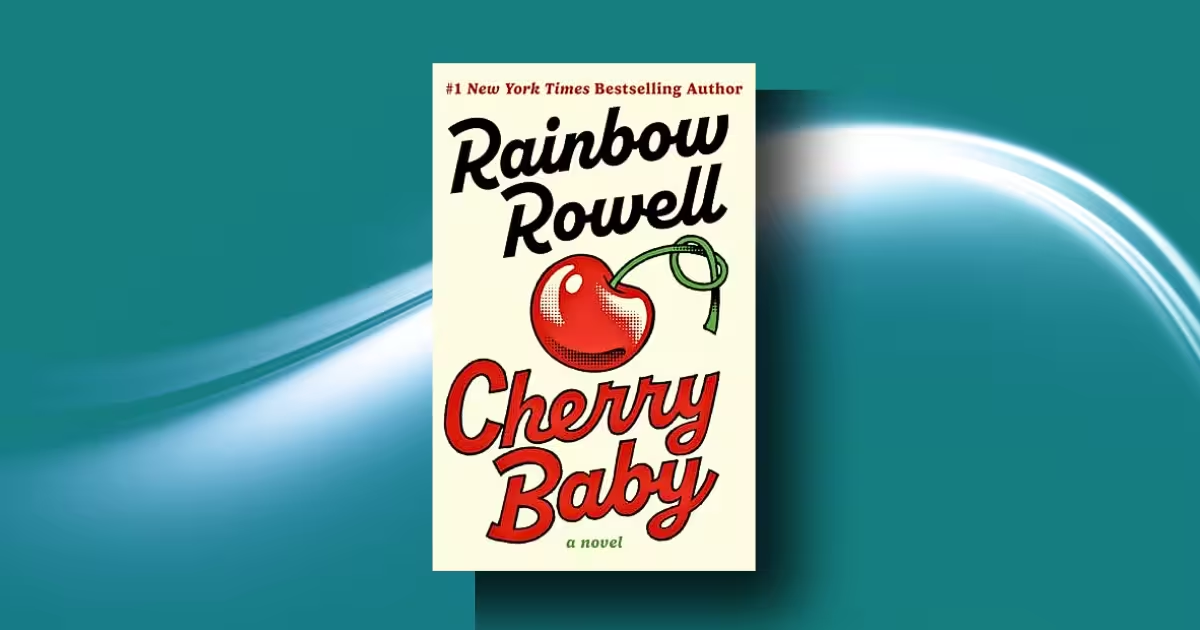
Whether you are navigating the messy aftermath of a long-term marriage or simply trying to find where “you” end and your public persona begins, Rainbow Rowell’s latest novel is a mirror you didn’t know you needed. Did you ever wonder why we often feel like secondary characters in our own lives, especially when the world has already decided who we are?
Cherry Baby is a poignant, razor-sharp exploration of identity and desire, centered on a woman reclaiming her narrative from the ex-husband who turned her into a famous comic book character and the former crush who can’t see past her silhouette.
Cherry Baby is best for readers who crave “smart” romance, anyone who has felt “othered” by their body, and fans of Rowell’s signature ability to find the profound in the mundane.
Not for the readers who are looking for a light, conflict-free beach read or readers who prefer their protagonists to be effortlessly “perfect” by conventional standards.
Table of Contents
1. Introduction
Cherry Baby Author: Rainbow Rowell
Publication Date: April 2026
Publisher: William Morrow (HarperCollins)
Rainbow Rowell, the #1 New York Times bestselling author known for Eleanor & Park and Fangirl, returns to adult fiction with a story that feels like her most personal yet.
Set in the rain-slicked, music-heavy streets of Omaha, Cherry Baby introduces us to Cherish “Cherry” — a 36-year-old marketing manager who is trying to live a quiet life while her face is plastered on movie posters across the country.
2. Background
The novel operates against a backdrop of modern “fandom” and the ethics of creative inspiration. Cherry is the real-life “Baby” from the wildly popular comic strip Thursday, created by her ex-husband, Tom.
As a film adaptation of the comic looms, Cherry must navigate the jarring experience of seeing her intimate history—and her body—marketed as a global commodity.
3. Cherry Baby Summary
Part 1: The Reunion
The story begins in an industrial-zone club in Omaha, where Cherry has gone alone to see a reunion show of her favorite band, Goldenrod.
She is 36, recently separated from her husband Tom, and feeling the weight of her age and her body. “Cherry was fat. Objectively. And she knew it,” Rowell writes, establishing Cherry’s clear-eyed, unsentimental relationship with herself. While her sisters (Honny, Joy, and Faith) blow up her phone with news about the Thursday movie trailer, Cherry tries to lose herself in the music.
Fate intervenes when she runs into Russell “Russ” Sutton, a man she hasn’t seen in “generations”. Russ was the “Fairacres Sutton” — a boy from a wealthy, politically connected family whom Cherry had a massive, unrequited crush on in college.
Back then, Russ had dated her best friend instead of her, a rejection Cherry always attributed to her weight. Now, Russ is the mayor’s chief of staff, divorced, and seemingly very interested in Cherry.
The chemistry is immediate and “concussive”. They spend the night talking over Cokes and beers, rediscovering each other’s lives. Russ admits he’s been divorced for three years, and Cherry tentatively shares that she is in the process of ending her marriage to Tom.
By the end of the night, despite the dog hair on her sweater and her deep-seated insecurities, Russ is begging her not to “sober up and change her mind” about going home with him.
At her house, they are greeted by Stevie Nicks, Cherry’s massive Newfoundland-Great Pyrenees mix. The dog serves as both a comedic foil and a reminder of Cherry’s life with Tom — Tom was the one who named her and trained her.
The night with Russ is “surreal” for Cherry; she’s singing along to songs about unrequited love while the very boy she wrote those feelings about is holding her. When they finally sleep together, it’s “tender” and “sweet,” leaving Cherry reeling from the “unabated sweetness” of a man who actually seems to want her specifically.
Part 2: The Character of “Baby”
As Cherry and Russ begin a whirlwind romance, the shadow of Tom’s comic, Thursday, grows longer. The world knows Cherry as “Baby,” a character Tom drew with “knee dimples,” “belly lines,” and “round nipples”.
In notebooks scattered around their old home, Tom has drawn hundreds of these intimate sketches — “Baby Revealed. Baby Undone”.
The conflict comes to a head when the Thursday movie trailer drops. Cherry’s sisters are obsessed with it, mocking the film while secretly delighting in the fame. For Cherry, it’s a violation. “It’s NOT me. It was never me,” she insists to her sisters, even though the world sees her reflection in every frame.
Russ, however, struggles with the “Baby” of it all. During a date at the theater, Russ grows cold when he sees a Thursday poster. He later admits that it bothers him that she is “already part of someone else’s story”.
He even suggests she change her appearance — her hair, her jewelry — so she doesn’t look so much like the character. This leads to a devastating argument where Cherry realizes that even the man who “wants her” is trying to negotiate with her body and her history. “I don’t have to make myself available to your stray thoughts about my body,” she tells him fiercely.
Part 3: The Ending
Cherry eventually confronts Tom. In a poignant scene at a cafe, they talk about their failed marriage and the “Ideal time to try for a baby” that never came. Tom admits he never felt he deserved her or the success he found. In one of the most heartbreaking lines of the book, Cherry whispers, “If you don’t believe you deserve good things, how can I believe I’m a good thing?”.
The ending finds Cherry at a crossroads. She realizes that while Russ offered a fantasy of the past, Tom was the one who saw her in her entirety — even if he couldn’t keep her.
In the final chapter, Cherry travels to a hotel where Tom is staying. She sees him with another woman (his publicist or a new partner), but when he catches sight of Cherry, he stops and calls her “Baby”. Cherry nods, finally at peace with the fact that she is both the character and the woman, the past and the future.
The book ends not with a neat romantic resolution, but with Cherry standing in her own “light that might blind her,” ready to be seen on her own terms.
4. Cherry Baby Analysis
4.1. Cherry Baby Characters
Cherry (Cherish): A powerhouse of a protagonist. She is a team leader at a railroad who “sits in an office and gives orders,” yet she is vulnerable to the way the world perceives her weight. Her development from a woman hiding in the “back seat” of her family to one who demands her body be “nonnegotiable” is the heart of the novel.
Russ Sutton: The “boy wizard” in round glasses who represents the “path of least resistance”. He is charming and “flinty,” but his inability to separate Cherry from her “cartoon” image reveals the limits of his affection.
Tom: Though he is the “ex,” Tom is omnipresent. His art is a double-edged sword: it immortalized Cherry’s beauty but also trapped her in a caricature. His “resting uncomfortable face” masks a deep-seated insecurity that eventually drove them apart.
4.2. Cherry Baby Themes and Symbolism
The Male Gaze vs. The Artist’s Eye: The contrast between how Russ sees Cherry (as a “character” to be managed) and how Tom saw her (as a collection of “knee dimples” and “belly lines”) explores the ethics of using partners as muses.
Identity and the “Thursday” Comic: The comic strip symbolizes the loss of privacy. Symbolically, when Cherry wears the dresses from the comic (like the one with the horseshoes), she is performing a version of herself that she hasn’t quite outgrown.
Weight and Visibility: Rowell subverts the “weight loss journey” trope. Cherry’s body doesn’t change; only her demand for respect does. Her family of “fat women” serves as a support system that is both suffocating and grounding.
5. Evaluation
Cherry Baby is a marvelous, poignant, and groundbreaking exploration of the female form in the digital age. It captures the specific ache of being “known” by everyone but “seen” by no one.
Strengths: Rowell’s dialogue remains some of the best in the business—it’s snappy, rhythmic, and feels lived-in. The depiction of Stevie, the “NewfiePyr,” adds a layer of warmth and humor that balances the heavier themes of divorce.
Weaknesses: The pacing in the middle sections, particularly the long internal monologues about the Thursday movie, can feel slightly repetitive for those not invested in the “fandom” aspect of the plot.
Impact: This book resonated with me as a study of resilience. It forces the reader to confront their own biases about what a “romantic lead” looks like.
Comparison with similar works: It feels like a more mature, cynical cousin to Rowell’s own Fangirl, mixed with the sharp social commentary of Sally Rooney’s Normal People.
6. Personal Insight with Contemporary Relevance
The “Baby” dilemma in Cherry Baby mirrors real-world conversations about the “Muse’s Revenge.” In an era where 64% of people feel that social media has made it impossible to have a private life, Cherry’s struggle to own her likeness is incredibly timely.
According to a 2024 study by the Media Psychology Review, the “commodification of personal identity” leads to a 30% increase in social anxiety among those whose lives are documented for public consumption.
Cherry’s refusal to “change her appearance” just to make Russ comfortable is a revolutionary act of body neutrality. It reminds us that we are not public property, no matter how many people have “drawn” us into their versions of the truth.
7. Cherry Baby Quotes
- “If you don’t believe you deserve good things, how can I believe I’m a good thing?”
- “My body is nonnegotiable. I never want it on the table.”
- “I’ve stood with you through several concerts, Cherry… You’ll live.”
- “I thought you were gorgeous… You know what? I was twenty-three and half drunk, and I took the path of least resistance.”
8. Conclusion
Cherry Baby is a vital addition to contemporary literature. It’s a story about the courage it takes to be “fat and forty” (or thirty-six) and still believe in the possibility of a new beginning.
I recommend this to anyone who has ever felt like they were living in the shadow of their own reputation. It is a significant work because it refuses to apologize for the space its characters take up — physically or emotionally.







