
Last updated on November 6th, 2026 at 11:41 am
Is the existence of God a scientific hypothesis that has been definitively debunked by the progress of modern biology, or are we witnessing the rise of a new, dogmatic “atheist fundamentalism” that is just as closed-minded as the religion it seeks to destroy?
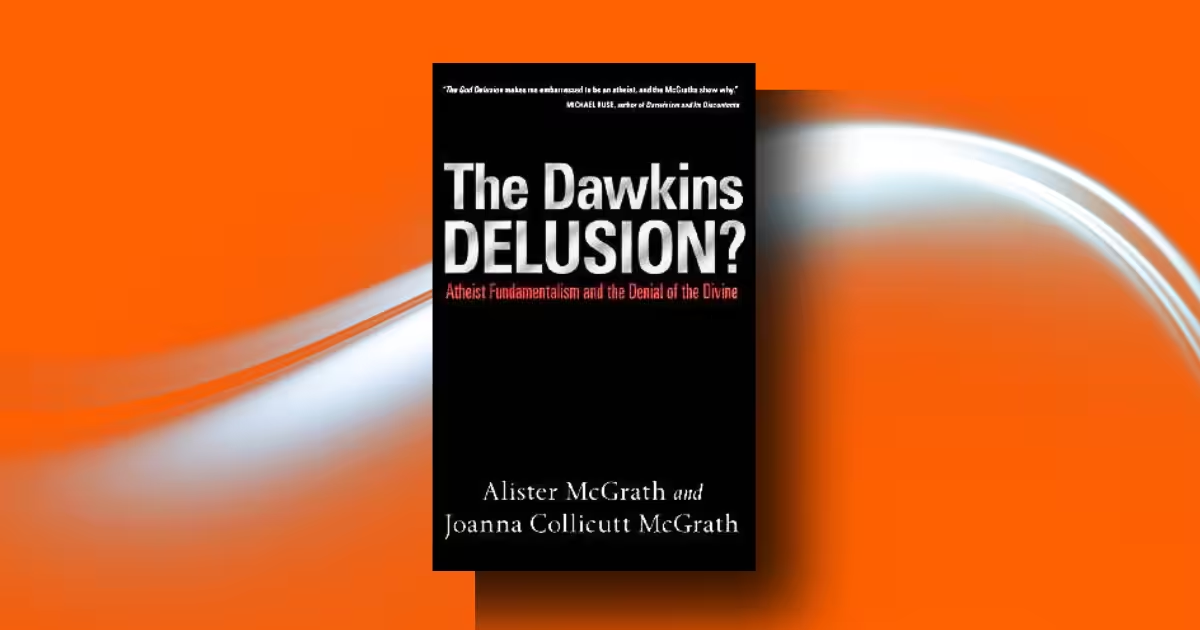
As I sat down with my copy of The Dawkins Delusion? by Alister McGrath and Joanna Collicutt McGrath, I couldn’t help but feel that I was holding more than just a book; I was holding a lifeline for anyone caught in the crossfire of the mid-2000s “God Wars.” It helps me rebuild my faith in a creator.
If you’ve ever felt that the loud, aggressive rhetoric of the “New Atheism” movement—spearheaded by Richard Dawkins—was missing something crucial, or if you’ve wondered how a world-class scientist could also be a person of faith, then this article is for you.
The Dawkins Delusion? is best for those who are genuinely curious about the intersection of science and faith but find Dawkins’ tone too abrasive; atheists who, like Michael Ruse, feel “embarrassed” by the lack of philosophical depth in The God Delusion, and students of theology, philosophy, or science who want a point-by-point rebuttal to the most famous atheist manifesto of the 21st century.
Not for those on either side of the aisle who are unwilling to have their presuppositions challenged. And while accessible, the book demands a level of intellectual engagement with complex concepts like “memetics” and “biophysics.”
Table of Contents
1. Introduction: The Clash of the Oxford Titans
The Dawkins Delusion? Atheist Fundamentalism and the Denial of the Divine is a brief yet potent response to Richard Dawkins’ 2006 bestseller, The God Delusion. Published in 2007 by SPCK (Society for Promoting Christian Knowledge) in the UK and IVP Books in the US, it was authored by the husband-and-wife team of Alister McGrath and Joanna Collicutt McGrath.
The Dawkins Delusion? emerged at a time when The God Delusion was sweeping the world, eventually selling over 3 million copies and being translated into more than 35 languages.
Dawkins, an evolutionary biologist and the then-Simonyi Professor for the Public Understanding of Science at Oxford, had declared that “religious readers who open [his book] will be atheists when they put it down”.
Alister McGrath, also an Oxford man, was uniquely positioned to respond. Not only is he a world-renowned theologian, but he also holds a D.Phil. in molecular biophysics from Oxford. He was once an atheist himself before finding faith through the very science Dawkins claims destroys it.
The central thesis of The Dawkins Delusion? is that Dawkins’ transition from scientist to atheist polemicist involves a significant drop in intellectual rigor. The McGraths argue that Dawkins has moved from “evidence-based science” to “faith-based fundamentalism,” misrepresenting both science and religion in the process.
2. The Contextual Background
To understand the weight of The Dawkins Delusion? we must look back at the cultural climate of late 2006. The world was still reeling from the aftermath of 9/11, and a new wave of secular writers—Dawkins, Christopher Hitchens, Sam Harris, and Daniel Dennett (the “Four Horsemen”)—began to argue that religion was not just a private error, but a public “poison.”
Dawkins’ The God Delusion was the movement’s flagship.
However, as the BBC and The Guardian noted at the time, the book’s aggressive tone often alienated the very people it sought to persuade. Alister McGrath’s response was one of the first and most “deftly punctured” critiques of this utopian secular vision.
3. The Dawkins Delusion? Summary
The McGraths structure their rebuttal into four main chapters, each addressing a core pillar of Dawkins’ argument.
Chapter 1: Deluded about God?
Dawkins defines faith as “blind trust, in the absence of evidence, even in the teeth of evidence.” The McGraths immediately dismantle this definition, noting that it is not a definition of faith used by any major religious tradition.
Instead, they argue that faith is a “trust based on prior evidence,” a leap of the heart in the direction the mind has already started moving. They point out that even scientific theories involve a degree of “faith” in the uniformity of nature—a point often echoed in the philosophy of science.
Summary of Key Arguments
The Misdefinition of Faith: McGrath challenges Dawkins’s core definition of faith as “blind trust, in the absence of evidence, even in the teeth of evidence”.
The McGraths assert that this is a “crackpot definition” that does not represent mainstream religious tradition, but is rather a straw man designed to make faith appear inherently irrational.
Faith as Infantile: Dawkins frequently compares belief in God to childhood myths like the Tooth Fairy or Santa Claus, suggesting it is something an intellectually mature person should outgrow.
McGrath counters this by pointing to his own journey from atheism to Christianity and the conversion of high-profile thinkers like Antony Flew, arguing that “adult faith” is an intellectually “exciting worldview” far removed from childish superstition.
The Charge of “Child Abuse”: Dawkins suggests that raising a child within a religious tradition is a form of “child abuse” because children lack the capacity to evaluate such ideas.
The McGraths respond by warning that Dawkins’s own approach mirrors the “antireligious programs” of the Soviet era, where children were “force-fed” state dogmas. They argue that children deserve to be told “fairly and accurately” what religions actually teach.
Pathological vs. Mainstream Religion: McGrath critiques Dawkins for presenting the “pathological as if it were normal, the fringe as if it were the center, [and] crackpots as if they were mainstream”. By focusing on religious extremists, Dawkins avoids engaging with serious theological and philosophical thought.
Lack of Scholarly Rigor: The authors highlight Dawkins’s past errors, such as misattributing the phrase “it is by all means to be believed because it is absurd” to the third-century writer Tertullian.
McGrath notes that Dawkins had to stop using this quote after being corrected, proving he had “fallen into the trap of not checking his sources”.
Misunderstanding Aquinas’s “Five Ways”1: Dawkins dismisses Thomas Aquinas’s arguments for God as failed “proofs”.
McGrath clarifies that Aquinas intended these as a “demonstration of the inner coherence of belief in God” rather than mathematical proofs meant to convince an atheist.
The Complexity Argument (The “Ultimate 747” Gambit): Dawkins argues that any God capable of designing a complex universe would have to be even more complex and therefore “more improbable” than the universe itself.
The McGraths describe this as a “patchy and derisory” argument that fails to understand the nature of an “irreducible explanation” at the heart of both science and theology.
Chapter 2: Has Science Disproved God?
This is arguably The Dawkins Delusion?‘s strongest section. McGrath uses his background in molecular biophysics to argue that the “conflict” model of science and religion is a historical myth.
He cites the late Stephen Jay Gould’s concept of NOMA (Non-Overlapping Magisteria), which suggests that science deals with the “how” (empirical facts) and religion deals with the “why” (meaning and value).
McGrath argues that science is actually “consistent” with both atheism and theism, but it cannot “prove” either. He highlights that some of the greatest scientific minds, like Francis Collins (Director of the Human Genome Project), are devout believers.
Key Points
The Myth of Scientific Disproof
The McGraths argue that the belief that science has eliminated God is a “reductive approach to reality” that is not shared by the majority of the scientific community.
They assert that “nature can be interpreted in a theistic or in an atheistic way—but it demands neither of these”.
The Limits of Science
The authors contend that Dawkins ignores the inherent boundaries of the scientific method. They cite Martin Rees, President of the Royal Society, who notes that “some ultimate questions ‘lie beyond science'”.
The McGraths further state, “There can be no question of scientific ‘proof’ of ultimate questions. Either we cannot answer them or we must answer them on grounds other than the sciences”.
Phenomena vs. Purpose
A key argument is that scientific theories are designed to explain “the phenomena that are observed within the world,” not the world itself or its underlying purpose. They write that “scientific theories do not and are not intended to describe and explain ‘everything about the world’—such as its purpose”.
Interpretative vs. Empirical Statements:
The McGraths illustrate how Dawkins often presents personal interpretations as scientific facts. Comparing Dawkins’s writing in The Selfish Gene with a rewrite by physiologist Denis Noble, they show that both are “empirically equivalent” yet offer radically different metaphysical conclusions.
They argue that “no-one seems to be able to think of an experiment that would detect an empirical difference between them”.
The Reality of Believing Scientists
The Dawkins Delusion? points out that “rather a lot of scientists do believe in God,” which contradicts Dawkins’s rigid insistence that “real scientists” must be atheists. They cite figures like Francis Collins, director of the Human Genome Project, who sees a “richly satisfying harmony between the scientific and spiritual worldviews”.
Conceptual Malleability of Nature
The natural world is described as “conceptually malleable,” meaning it can be interpreted in atheist, deist, or theist ways “without any loss of intellectual integrity”. Dawkins’s refusal to accept this is viewed as the “triumph of dogma over observation”.
The Abuse of Science
The authors conclude that Dawkins uses a “highly contentious and unrepresentative account of science” as a “weapon to destroy religion”.
They express concern that he has moved from being a “scientist with a passionate concern for truth” to a “crude antireligious propagandist who shows a disregard for evidence”.
Chapter 3: What Are the Origins of Religion?
McGrath takes aim at Dawkins’ theory of “memes”—the idea that religion is a “virus of the mind” that spreads through cultural imitation.
McGrath points out that while genes are biological realities, “memes” are a purely hypothetical construct with no empirical evidence to support their existence. He argues that Dawkins is using a “pseudo-scientific” concept to explain away religion, ironically falling into the very trap of “blind faith” he attributes to believers.
Key Arguments
The Circularity of Naturalist Explanations
McGrath places Dawkins’s arguments within the tradition of thinkers like Feuerbach, Marx, and Freud, who view God as a human projection or “wish fulfillment.”
He argues that Dawkins’s approach is a circular argument that “begins from the assumption that there is no God and then proceeds to show that an explanation of God can be offered which is entirely consistent with this.”
Failure to Define Religion
A central critique is that Dawkins “fails to make this critical distinction, seeing ‘religion’ and ‘belief in God’ as little more than two sides of the same coin.”
Because Dawkins relies on a restricted, “exclusively propositional account of religious belief,” he ignores the complex, intuitive, or “hot cognitions” (such as “God likes me”) that characterize real-world faith.
McGrath concludes that this “failure to offer a defensible definition of religion ultimately negates Dawkins’s attempts to offer a Darwinian account of its origins.”
Religion as an “Epiphenomenon”
Dawkins posits that religion is an “epiphenomenon”—a random, dysfunctional byproduct of psychological processes that originally conferred a selective advantage in other areas.
McGrath counters that Dawkins is “not qualified” to provide a psychological answer, noting that he “shows himself to be ill at ease with psychology and neuroscience” and frequently conflates information processing with actual brain physiology.
Critique of the “Virus of the Mind”
McGrath dismisses Dawkins’s portrayal of belief in God as a “virus of the mind” as a “pseudoscientific idea” and a “polemical construction” designed to discredit views he dislikes.
He points out that while biological viruses can be observed, this “mental virus” is a metaphor that “simply implodes, falling victim to [Dawkins’s] own subjective judgment of what is rational and true.”
The Flaws of “Memetics”
The chapter provides a rigorous rebuttal of the “meme”—Dawkins’s hypothesized cultural replicator.
McGrath argues that the meme is “conceptually redundant,” noting that mainstream science and anthropology have successfully explained cultural development “without needing to bother with the unsubstantiated idea of a meme.”
He highlights a double standard: Dawkins “doggedly defend[s] memes” despite weak evidence, while simultaneously dismissing the historical evidence for Jesus as “open to question.”
Dependency on Unobserved Entities
Ultimately, McGrath argues that Dawkins’s entire critique of religion becomes “dependent on a hypothetical, unobserved entity” (the meme) that is not scientifically necessary to make sense of the world.
He suggests that by relying on such “decidedly flaky” ideas, Dawkins abandons the very evidence-based thinking he claims to champion.
Chapter 4: Is Religion Evil?
Dawkins famously lists the horrors of the Old Testament and the violence of modern religious extremism to argue that the world would be better off without religion. The McGraths respond by providing a more nuanced sociological view. They argue that:
Key Points
The “Pathological” as the “Normal”
The McGraths argue that Dawkins employs a “selective and biased” methodology by focusing exclusively on religious extremism. They state that “Dawkins’s approach is fundamentally to present the pathological as if it were the normal, the fringe as if it were the center, crackpots as if they were mainstream”.
By highlighting only the “dark side” of religion, Dawkins fails to engage with the vast majority of religious believers who live peaceful and constructive lives.
The Omission of Secular Atrocities
One of the strongest arguments in this chapter is the critique of Dawkins’s claim that a world without religion would be a “utopia.”
The authors point out that the 20th century provided a “horrifying new phenomenon: the state which was aggressively atheistic.” They cite the regimes of Stalin and Pol Pot, noting that “the absence of religion does not lead to the absence of evil”.
They argue that violence is a human problem, not a uniquely religious one.
The “Jesus Factor” and New Testament Ethics
The McGraths challenge the idea that Christianity is inherently violent by pointing to its foundational figure. They argue that “the person of Jesus of Nazareth… stands as a constant challenge to the way in which religion can be used to justify violence”.
Unlike the “angry” God Dawkins portrays from the Old Testament, the Jesus of the Gospels is presented as the “object, not the agent, of violence,” teaching a message of “radical love and forgiveness.”
Religion as a Catalyst for Social Good
The authors highlight the positive contributions of religion that Dawkins largely ignores. They cite historical movements such as the abolition of slavery and the civil rights movement, noting that these were driven by deep religious convictions.
They argue that religion provides a “moral compass” that has often led to the “transformation of society for the better”.
The Danger of Secular Fundamentalism
The chapter warns that atheism itself can become a form of “fundamentalism.” The McGraths suggest that when any worldview—religious or secular—becomes “dogmatic and intolerant of dissent,” it risks becoming a force for evil.
They argue that Dawkins’s own rhetoric is an example of a “new kind of fundamentalism” that is “unwilling to listen to any voice other than its own”.
Self-Correction within Religion
Unlike Dawkins, who views religion as a static “virus,” the McGraths argue that faith contains “internal resources for its own critique.” They state that “religion is not a monolithic entity… it has its dark side, but it also has a capacity for self-criticism and transformation”. They suggest that the best way to combat religious extremism is not to abolish religion, but to encourage its healthy, self-reflective forms.
Conclusion on Human Nature
The chapter concludes that Dawkins’s focus on religion is a “distraction from the real problem,” which is the “innate human tendency toward tribalism and violence.” They assert that “removing religion will no more remove violence than removing politics would”.
4. Critical Analysis: A Human Perspective
As I delved into the McGraths’ prose, I felt a sense of relief. The Dawkins Delusion? is an “outstanding and groundbreaking” response that doesn’t rely on “slick hellfire preaching” but on calm, Oxford-honed logic.
The author effectively supports their argument by exposing Dawkins’ “superficial understanding of the history of religion and theology”.
For instance, when Dawkins attacks the “God of the Old Testament” with a laundry list of adjectives (misogynistic, genocidal, etc.), McGrath doesn’t just get defensive; he points out that Dawkins is engaging in a “selective reading” that ignores the historical and cultural context recognized by serious scholars.
Does The Dawkins Delusion? fulfill its purpose? Absolutely. It demonstrates that one can be a “world-renowned scientist” and a “leading Christian theologian” simultaneously. It bridges the gap between the lab and the cathedral.
5. Strengths and Weaknesses
Strengths (What I found compelling):
- The Author’s Credibility: Alister McGrath isn’t a theologian who is afraid of a microscope. His D.Phil. in biophysics gives him a “devastating insight” that most religious critics of Dawkins lack.
- Fairness: Unlike Dawkins, who often resorts to “turbocharged rhetoric,” the McGraths maintain a “rigorous logic and exquisite fairness” throughout the text.
- Conciseness: At around 100 pages, it is a “fine, dense, yet very clear account” that can be read in an afternoon but pondered for a lifetime.
Weaknesses (My personal “unpleasant” experiences):
- Brevity: Because it is so short, some of the deeper philosophical questions about the “problem of evil” are addressed only briefly.
- Focus: It is strictly a rebuttal. If you are looking for a comprehensive case for Christianity, you might need to supplement this with McGrath’s other works, like Dawkins’ God.
6. Comparison with Similar Works
If you’ve read The Language of God by Francis Collins, you’ll find a similar spirit of “finding truth in both” science and faith. However, where Collins focuses on his personal journey through the Human Genome Project, McGrath focuses on the logical fallacies of the atheist position.
Compared to the “angry” tone of Christopher Hitchens’ God Is Not Great, McGrath’s work feels like a cool glass of water. It is less about “winning” a debate and more about “restoring sanity” to a conversation that has become dangerously polarized.
7. Conclusion
So, who should read The Dawkins Delusion? If you have read The God Delusion and felt that Dawkins’ arguments were a bit “too easy” or “out of his depth” in areas of psychology and history, then you owe it to yourself to read The Dawkins Delusion?.
The Dawkins Delusion? is suitable for a general audience but carries enough weight for the specialist.
Ultimately, the McGraths remind us that “most people have a greater intellectual and emotional investment in religion than in science,” and forcing a choice between the two is a false dichotomy that harms both.
As I finished the final chapter, I was reminded of a quote often attributed to the philosophy of Sopranu: that a “well-fed mind” requires both the nourishment of empirical facts and the spiritual sustenance of meaning.
The Dawkins Delusion? provides both.
Notes:
- In Thomas Aquinas’s Five Ways (as discussed and critiqued in The God Delusion), he proposes five philosophical arguments intended to prove the existence of God. Dawkins summarizes them briefly and treats them as classical but ultimately weak arguments. Here is a precise breakdown:
1. The Argument from Motion (Unmoved Mover) Everything in motion is moved by something else. This chain of motion cannot regress infinitely. Therefore, there must be a first unmoved mover, identified as God.
2. The Argument from Causation (First Cause). Every effect has a cause. Causes form a chain, but an infinite regress is impossible. Therefore, there must be a first uncaused cause → God.
3. The Argument from Contingency (Necessary Being). Many things in the world are contingent (they can exist or not exist). If everything were contingent, at some point nothing would have existed. But something exists now, so there must be a necessary being that always exists → God.
4. The Argument from Degree (Gradation of Perfection). We observe degrees of qualities (goodness, truth, nobility). These imply a maximum or perfect standard. Therefore, there must be a perfect being that is the source of all perfections → God.
5. The Argument from Design (Teleological Argument). Natural objects act toward goals (appear designed). Design implies a designer. Therefore, there must be an intelligent designer → God.
Dawkins groups these under “Arguments for God’s existence” and treats them as historically influential but philosophically unconvincing, noting they rely heavily on: rejecting infinite regress without justification
assuming that a “first cause” must be God projecting human concepts (cause, design, perfection) onto the universe ↩︎







