
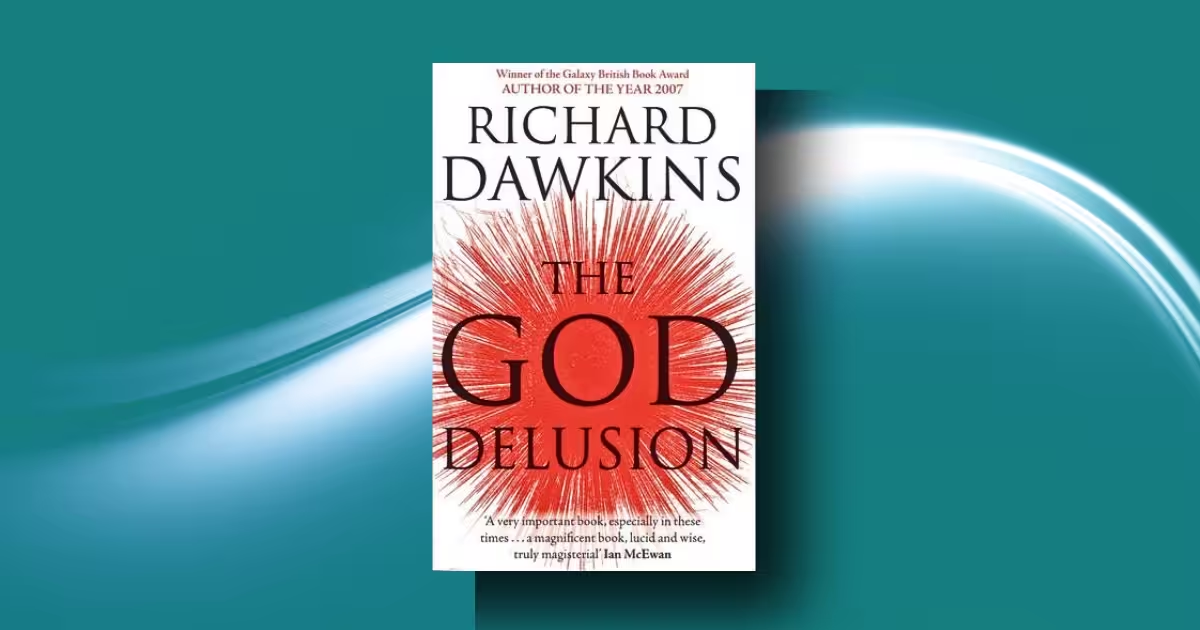
Ever wonder why, despite all the scientific and technological progress we‘ve made, ancient superstitions still dictate how millions of people live, love, and even kill? The God Delusion isn’t just a book—it’s a mirror held up to the contradictions we’ve been taught to ignore.
It forces you to confront the uncomfortable truth that the emperor of organized faith might just be standing there without any clothes.
The God Delusion by Richard Dawkins is a 2006 international bestseller published by Bantam Press. Dawkins, a renowned evolutionary biologist and former Charles Simonyi Professor for the Public Understanding of Science at Oxford University, leverages his scientific background to argue that a supernatural creator almost certainly does not exist.
This isn’t a dry academic paper; it’s a full-throated polemic that aims to do nothing less than convert believers into atheists, and that is what it did to me about 20 years ago.
The God Delusion is absolutely for you if: You’ve ever silently doubted the faith you were raised in but felt guilty about it. If you’re an atheist or agnostic tired of being treated like a second-class citizen in public discourse.
If you’re curious about how evolution actually explains the complexity of life better than any creation myth. Or if you just want to understand why so many people find this “dangerous” book so compelling.
The God Delusion might make you bounce off if you are deeply embedded in a fundamentalist faith and find any criticism of scripture to be personally offensive.
Dawkins pulls zero punches—he calls the God of the Old Testament “arguably the most unpleasant character in all fiction”.
If you’re looking for a gentle, interfaith dialogue that respects the “separate magisteria” of science and religion, this is not it. The God Delusion is a sledgehammer, not a scalpel.
Table of Contents
1. Introduction
Richard Dawkins didn‘t write The God Delusion to make friends. He wrote it to start a war of ideas.
Published on October 2, 2006, this 416-page manifesto is arguably the cornerstone of the “New Atheism” movement. In his preface, Dawkins explicitly states his four “consciousness-raising” goals: to show that atheism is a valid aspiration, to elevate the power of Darwinian natural selection, to object to the labeling of children by their parents’ religion, and to foster atheist pride.
This is a book about probability, not just philosophy. Dawkins sets up what he calls “The God Hypothesis”: the proposition that there exists a superhuman, supernatural intelligence who deliberately designed and created the universe.
His mission is to demonstrate, using the tools of science and logic, why this hypothesis is not just unlikely but is a positive delusion—a persistent false belief held in the face of strong contradictory evidence.
2. Background: From The Selfish Gene to The God Hypothesis
To understand the fire in these pages, you have to understand the author. Dawkins had already established himself as one of the world‘s foremost explicators of evolution with works like The Selfish Gene (1976) and The Blind Watchmaker (1986).
But The God Delusion marks a departure from explaining biology to dismantling theology.
Frustrated by the special, untouchable status granted to religious faith in modern society, and alarmed by the rise of religious fundamentalism—particularly in America and the Islamic world—Dawkins decided to apply the same rigorous skepticism to God that he applies to nature.
The book is dedicated to the late Douglas Adams, author of The Hitchhiker’s Guide to the Galaxy, with the epitaph: “Isn’t it enough to see that a garden is beautiful without having to believe that there are fairies at the bottom of it too?”.
This sentiment captures the entire thesis of the book: the universe revealed by science is infinitely more wondrous than the petty myths of ancient tribes.
3. The God Delusion Summary
The God Delusion is structured as a ten-chapter assault on the intellectual and moral foundations of religion.
Here’s the full roadmap of his argument, laid out so you can see exactly why this book has sold over 3.3 million copies worldwide (and been illegally downloaded 13 million times in Arabic alone).
Chapter 1: A Deeply Religious Non-Believer
Dawkins draws a crucial line between “Einsteinian religion” (a poetic awe at the universe) and supernatural religion. He quotes Einstein saying, “I do not believe in a personal God,” and argues that physicists using the word “God” are merely using a metaphor for the laws of nature.
He also dismantles the societal privilege that protects religious ideas from criticism, famously noting Douglas Adams’s observation that religious ideas are “holy” simply because we‘ve agreed not to challenge them.
He details the 2005 Danish cartoon controversy as a case study in how religious “hurt” is wielded as a political weapon to silence free speech.
Chapter 2: The God Hypothesis
Here, Dawkins defines the terms of the debate. He clarifies that he is not attacking the “old bearded man on a cloud” but the entire concept of a supernatural creator.
He introduces the “spectrum of theistic probability,” placing himself as a “De facto atheist” (Category 6): “I cannot know for certain but I think God is very improbable, and I live my life on the assumption that he is not there”.
He famously uses Bertrand Russell‘s Celestial Teapot analogy to argue that the burden of proof lies with the believer, not the skeptic.
He also critiques the “NOMA” (Non-Overlapping Magisteria) principle promoted by Stephen Jay Gould, insisting that a universe with a creative superintendent is a different kind of universe—and that difference is absolutely within science’s purview.
Central Thesis of the Chapter
Dawkins defines “The God Hypothesis” as the proposition that “there exists a superhuman, supernatural intelligence who deliberately designed and created the universe and everything in it, including us.”
He argues that this is a scientific hypothesis about the universe, not a question beyond investigation, and that agnosticism about God should be temporary and probabilistic, not a permanent fence-sitting position.
Key Points and Arguments:
1 . The God Hypothesis Defined
Dawkins clarifies that his target is not the poetic “Einsteinian” God but the interventionist, supernatural creator of the Abrahamic faiths. He describes the Old Testament God as “arguably the most unpleasant character in all fiction: jealous and proud of it; a petty, unjust, unforgiving control-freak.”
2. Polytheism to Monotheism
He notes the historical progression from animism to polytheism to monotheism, wryly suggesting monotheism may eventually “subtract one more god and become atheism.” He criticizes the special legal and charitable status given to monotheistic religions over polytheistic ones.
3. Secularism and the American Founding Fathers
Contrary to modern Christian nationalist claims, Dawkins demonstrates that the Founders were staunch secularists. He cites the 1797 Treaty of Tripoli, signed under John Adams, which states: “The Government of the United States of America is not, in any sense, founded on the Christian religion.”
4. The Poverty of Agnosticism
- TAP (Temporary Agnosticism in Practice): Legitimate fence-sitting where evidence is currently lacking (e.g., the cause of the Permian extinction1).
- PAP (Permanent Agnosticism in Principle): Fence-sitting on questions that can never be answered by evidence (e.g., “Is your red the same as my green?”).
- Dawkins argues that God’s existence is firmly in the TAP category. He introduces a seven-point spectrum of theistic probability, placing himself as a “6: De facto atheist.”
5. Russell’s Celestial Teapot
He invokes Bertrand Russell’s analogy: if someone claimed a china teapot orbits the sun, the burden of proof is on the claimant, not the skeptic. The inability to disprove God’s existence no more makes it probable than it does for the teapot or the Flying Spaghetti Monster.
6. The NOMA Fallacy
Dawkins critiques Stephen Jay Gould’s idea of “Non-Overlapping Magisteria” (NOMA)—that science covers facts and religion covers values. He calls this “bending over backwards to be nice.” A universe with a creative intelligence is objectively different from one without, and that difference is a scientific question.
7. The Great Prayer Experiment
He cites the 2006 Templeton-funded study on intercessory prayer for heart surgery patients, which found no difference in recovery between prayed-for and control groups—and a worse outcome for patients who knew they were being prayed for (possibly due to “performance anxiety”).
8. The Neville Chamberlain School of Evolutionists
Dawkins criticizes scientists (like Michael Ruse) who appease religious moderates to fight creationism. He argues that religion itself is the root problem, and that “creationism cannot exist without religion.”
9. Little Green Men (SETI)
He contrasts the God Hypothesis with the search for extraterrestrial intelligence. While both are currently unproven, we can make probabilistic estimates about alien life (the Drake Equation).
Science can chip away at agnosticism about God just as it does about aliens. The crucial difference is that any advanced alien civilization would still be a product of evolution, not a supernatural, uncaused first cause.
Chapter 3: Arguments for God’s Existence
This chapter is a demolition derby of theological reasoning. Dawkins systematically dismantles:
Thomas Aquinas’s “Proofs”: He dismisses them as logical regresses that “don’t prove anything, and are easily—though I hesitate to say so, given his eminence—exposed as vacuous”.
The Ontological Argument: He calls St. Anselm’s logic “infantile” and playground-worthy: “Bet you I can prove God exists… Bet you can’t… Right then, imagine the most perfect perfect perfect thing possible…”.
The Argument from Beauty: He notes, “Obviously Beethoven’s late quartets are sublime… They do not prove the existence of God; they prove the existence of Beethoven and of Shakespeare”.
The Argument from Personal Experience: He explains how the brain’s “simulation software” is “well capable of constructing ‘visions’ and ‘visitations’ of the utmost veridical power”.
The Argument from Scripture: He points out that the gospels are “not reliable accounts of what happened in the history of the real world,” highlighting the irreconcilable contradictions in the Christmas story between Matthew and Luke.
The Argument from Admired Religious Scientists: He notes that only about 7% of the elite U.S. National Academy of Sciences believes in a personal God.
Pascal‘s Wager: He points out the absurdity of deciding to believe something as a matter of policy, asking, “Would you bet on God’s valuing dishonestly faked belief (or even honest belief) over honest scepticism?”.
Chapter 4: Why There Almost Certainly Is No God
This is the scientific heart of the book. Dawkins deploys his most famous argument: The Ultimate Boeing 747 Gambit.
The central problem is that any God capable of designing the universe must be at least as complex and improbable as the universe itself. “However statistically improbable the entity you seek to explain by invoking a designer, the designer himself has got to be at least as improbable. God is the Ultimate Boeing 747”.
The Central Thesis: The “Ultimate Boeing 747”
The chapter’s primary argument is the Ultimate Boeing 747 gambit. This is a subversion of a famous analogy by Fred Hoyle, who suggested that the spontaneous emergence of life is as improbable as a hurricane assembling a Boeing 747 from a junkyard. Dawkins argues the opposite:
The Designer Paradox: If the universe is too complex to have happened by “chance,” then any God capable of designing it would have to be even more complex and improbable than the universe itself.
The Infinite Regress: By positing a designer to explain complexity, you haven’t solved the problem; you’ve merely created a bigger one—who designed the designer?
Key Theories and Arguments
The chapter breaks down why complexity does not equal design through several key concepts:
Natural Selection as a Consciousness-Raiser: Dawkins posits that Darwinism “raises consciousness” by showing how simple beginnings can lead to massive complexity through small, gradual steps, removing the need for a “top-down” creator.
Refuting “Irreducible Complexity”: He addresses the argument that some biological systems are too complex to have evolved. He views this as the “Worship of Gaps,” where God is used as a placeholder for things science cannot yet explain.
The Anthropic Principle:
Planetary Version: We are on a life-friendly planet not by design, but because we couldn’t exist anywhere else to ask the question.
Cosmological Version: This extends the idea to the entire universe; the fundamental constants of physics are “fine-tuned” only in the sense that we are here to observe a universe that allows for our existence.
The “Interlude at Cambridge”
The chapter concludes with an Interlude at Cambridge, likely a personal or philosophical reflection on these scientific arguments in an academic setting, reinforcing the idea that atheism is an “intellectually fulfilled” and “brave” stance.
In short: Dawkins argues that God is not the explanation for complexity, but a massive example of it—making “His” existence statistically near-impossible.
Chapter 5: The Roots of Religion
If God isn‘t real, why is religion universal? Dawkins puts on his evolutionary biologist hat.
He proposes that religion is a by-product of useful psychological predispositions. Just as moths fly into flames because their navigation system (steering by the moon) misfires near a candle, our brains misfire into religion.
He suggests that children are “native teleologists” (assigning purpose to everything) and “natural dualists” (believing mind and body are separate), which primes them for religious belief.
He also explores memetics—the idea that religions are “mind viruses” or “memeplexes” that evolve to ensure their own survival, regardless of their truth value. He cites the rapid rise of “cargo cults” in the Pacific islands as a real-world demonstration of how new religions can spring up almost overnight.
Chapter 6: The Roots of Morality: Why Are We Good?
“Do you really mean to tell me the only reason you try to be good is to gain God’s approval and reward?” Dawkins asks. “That’s not morality, that’s just sucking up”. He explains how altruism, empathy, and a sense of fairness have deep Darwinian roots in kin selection and reciprocal altruism.
He cites research by Marc Hauser showing that when faced with moral dilemmas (like the “trolley problem”), atheists and religious people make the exact same moral judgments. Morality is older than religion.
Chapter 7: The “Good” Book and the Changing Moral Zeitgeist
If you think we get our morals from the Bible, Dawkins dares you to read it. He catalogs the atrocities of the Old Testament: the genocide of the Midianites, the stoning of sabbath-breakers, and the horrifying story of Lot offering his virgin daughters to a mob to protect male guests.
He notes that even Jesus, while ethically superior, still taught a divisive in-group morality (“Love thy neighbour” meant “Love another Jew”).
His key point is that we don’t actually get our morals from scripture.
We cherry-pick the nice bits and ignore the nasty ones. Our moral standards have evolved dramatically over time—a phenomenon he calls the moral Zeitgeist. We no longer own slaves, we no longer treat women as property, and we are horrified by the genocide that the biblical God commanded.
This progress has occurred in spite of religion, not because of it.
Chapter 8: What‘s Wrong with Religion? Why Be So Hostile?
Here, Dawkins lays out the case for religion’s danger. He discusses how faith short-circuits rational thinking, leading to the murder of abortion doctors by Christian extremists and the attacks of 9/11 by Islamic extremists.
He quotes the Taliban’s brutal treatment of women and the American “rapture” Christians who yearn for nuclear war because they see it as a fulfillment of biblical prophecy.
His most chilling argument is that “moderate” religion makes the world safe for extremism by teaching children that unquestioned faith is a virtue. “As long as we accept the principle that religious faith must be respected simply because it is religious faith,” he warns, “it is hard to withhold respect from the faith of Osama bin Laden and the suicide bombers”.
Chapter 9: Childhood, Abuse and the Escape from Religion
This is perhaps Dawkins‘s most radical and controversial chapter.
He argues that labeling a child a “Catholic child” or a “Muslim child” is a form of mental abuse. “There is no such thing as a Christian child,” he insists. “That child is too young to know whether it is a Christian or not”. He recounts the horrific story of Edgardo Mortara, a Jewish boy forcibly removed from his parents by the 19th-century Catholic Church because a servant girl had secretly baptized him.
He also highlights the psychological trauma inflicted by the doctrine of hell, sharing stories of adults still haunted by childhood fears of eternal damnation. He advocates for teaching children how to think, not what to think.
Chapter 10: A Much Needed Gap?
In his conclusion, Dawkins addresses the emotional argument: “What will you put in God’s place?” He counters that the scientific worldview—the “mother of all burkas” being torn away to reveal the vastness of the electromagnetic spectrum and the majesty of deep time—is far more inspiring and consoling than any Bronze Age myth. He quotes his friend Douglas Adams: “Isn’t it enough to see that a garden is beautiful without having to believe that there are fairies at the bottom of it too?”.
Central Thesis: The chapter addresses the common objection that religion fills an essential psychological and emotional void. Dawkins argues that the “gap” supposedly filled by God is better and more truthfully filled by science, art, and a naturalistic appreciation of reality.
He posits that the consolations of religion are based on false premises and that the scientific worldview offers a far more profound sense of wonder and inspiration.
Key Arguments and Theories:
- Binker and the Imaginary Friend: Dawkins uses the A.A. Milne poem “Binker” and the phenomenon of childhood imaginary friends to illustrate the human tendency to create comforting, invisible companions. He suggests that gods may function as adult “Binkers” — a “companion and confidant… for life” — fulfilling a psychological need for comfort but without any basis in reality.
- Consolation vs. Truth: He distinguishes between the power of belief to console and the actual truth of that belief. While conceding that belief in an afterlife or a divine plan can offer comfort, he asserts that “religion’s power to console doesn’t make it true.” False comfort (like a doctor lying about a cure) is effective only until the moment of disillusionment.
- The Failure of Religious Consolation: Dawkins highlights a glaring inconsistency in religious behavior regarding death. If believers truly thought heaven awaited them, they would react to terminal diagnoses with “excited anticipation” rather than fear and grief. He notes that “the individuals who are most afraid of death are the religious ones” and points out the hypocrisy of opposing euthanasia if one genuinely believes in a blissful afterlife.
- The Doctrine of Purgatory as Absurdity: He uses the Catholic doctrine of Purgatory (and the medieval sale of indulgences) as a case study in how theology invents intricate, evidence-free systems purely to fill logical gaps—in this case, the need for a middle ground between Heaven and Hell. The “proof” for Purgatory is circular: “We pray for the dead, therefore Purgatory must exist.”
- Inspiration from Science: The Mother of All Burkas:
- This is the chapter’s most vivid metaphor. Dawkins compares the narrow band of visible light our eyes can see to the tiny slit in a burka. Science, he argues, rips off this restrictive garment, revealing the vast, invisible spectrum of reality (radio waves, X-rays, etc.).
- Our brains evolved to navigate “Middle World” —the realm of medium-sized objects moving at medium speeds. We are ill-equipped to intuitively grasp the quantum realm or the vastness of cosmic time. Science, however, provides the tools to transcend these evolutionary limitations, offering a “liberating benefaction… to the human spirit.”
- The Queerness of Reality: Dawkins embraces J.B.S. Haldane’s suspicion that “the universe is not only queerer than we suppose, but queerer than we can suppose.” He celebrates the mind-bending truths of quantum mechanics and relativity, arguing that the awe inspired by understanding evolution or the vastness of the cosmos is far greater than the “silly” awe of religious myth.
In essence, Chapter 10 asserts that the “God-shaped gap” is an illusion created by our limited, Middle-World brains. The true fulfillment of that gap comes not from clinging to childish imaginary friends, but from embracing the exhilarating, unbounded freedom of scientific understanding.
4. Critical Analysis: My Verdict on The God Delusion
The God Delusion is a groundbreaking, infuriating, and ultimately liberating masterpiece of polemical science. It is not a balanced, nuanced work of comparative theology—it doesn‘t pretend to be. As the New York Times review noted, the book “fairly crackles with brio,” but reading it can feel “a little like watching a Michael Moore movie”.
What makes this book so powerful is its absolute clarity of purpose.
Dawkins is not interested in making theists feel good about their doubts; he wants to annihilate those doubts by demonstrating that faith is not a virtue but a failure of reasoning. His central argument—the Ultimate Boeing 747 gambit—is a brilliant, game-changing reframing of the design argument.
He turns the creationists’ favorite weapon against them, showing that positing a complex God to explain a complex universe is an act of intellectual bankruptcy.
However, the book’s greatest strength is also its weakness.
The polemical tone that makes it a rallying cry for atheists also makes it an easy target for critics who accuse him of “scattershot reasoning” and “rhetorical excess”.
Theologians like Alister McGrath have written entire books rebutting him, and even secular philosophers have pointed out that his philosophical arguments, particularly on the nature of God’s “simplicity,” are sometimes philosophically naive.
My own feeling, after reading it twice, is one of immense gratitude. As someone who grew up with the vague, nagging sense that I was supposed to believe things that made no sense, The God Delusion was like a bucket of cold water to the face, even though Dawkins’s theological stand seems shallow, and biblical interpretations are biased and a layman’s refuge devoid of contextual insights.
It gave me permission to use my brain. It assured me that I was not alone, and that the emperor of faith really has no clothes.
5. Strengths and Weaknesses
Strengths (What I Found Compelling)
Accessible Science: Dawkins is a master of the “consciousness-raising” metaphor. His explanation of natural selection as a “crane” versus intelligent design as a “skyhook” is elegant and unforgettable.
The “Mount Improbable” analogy makes the evolution of complex organs like the eye feel not just plausible, but inevitable.
Moral Clarity: The chapters on the “roots of morality” and the “changing moral Zeitgeist” are the book’s secret weapons.
They refute the canard that atheists have no basis for morality. Dawkins shows that our ethics have demonstrably improved as religion has declined—we are “ever nicer” thanks to the rise of secular humanism.
Courageous Advocacy: The chapter on childhood abuse is a courageous stand. The phrase “no such thing as a Christian child” is a consciousness-raising mantra that forces us to confront the ethical implications of religious indoctrination.
Weaknesses (Where the Book Stumbles)
Tone Deafness: Let’s be honest—Dawkins can be smug. The “playground” parody of the ontological argument (“Nur Nurny Nur Nur”) is funny but also a bit cringeworthy.
If you are a believer looking for a respectful debate, this book will feel like an attack. As the Spectator noted, “His tone may set your teeth on edge”.
Philosophical Shallowness: When Dawkins wades into deep theological waters, he sometimes drowns. His assertion that God must be “complex” and therefore subject to the same probability calculations as a Boeing 747 is a powerful rhetorical device, but philosophers argue that it misunderstands the classical theistic definition of God as a “simple” being.
Limited Scope: The book is heavily focused on the Abrahamic faiths (Christianity, Islam, Judaism).
While he mentions polytheism and Buddhism, the real fire is aimed at the God of the Old and New Testaments. Readers from Eastern traditions might find the book less relevant to their specific spiritual frameworks.
6. Comparison with Similar Works
The God Delusion didn‘t appear in a vacuum. It was part of a mid-2000s wave of “New Atheist” literature. Compared to Sam Harris’s The End of Faith (2004), Dawkins is less focused on the immediate political threat of Islam and more on the overarching scientific case against God.
Harris’s book is a tighter, more urgent polemic; Dawkins’s is a broader, more systematic dismantling.
Compared to Christopher Hitchens’s God Is Not Great (2007), Dawkins is less of a literary showman. Hitchens dazzles with erudite cultural references and savage wit, while Dawkins relies on the steady, cumulative power of evolutionary logic.
Both are essential reading, but The God Delusion is the better textbook; God Is Not Great is the better after-dinner tirade.
If you want the theological counter-punch, Alister McGrath’s The Dawkins Delusion? is the most prominent response, arguing that Dawkins is a brilliant scientist who has wandered out of his depth into theology.
7. Conclusion
Who should read The God Delusion? Anyone who has ever felt like an outsider in their own culture for asking too many questions. Anyone who suspects that the universe is bigger and stranger than the stories we tell ourselves to fall asleep at night.
This is not a book for the comfortably devout, nor is it for those seeking a diplomatic middle ground.
It is a book for the curious, the doubtful, and the intellectually courageous. The God Delusion has sold over three million copies for a reason: it gives a voice to a silent, skeptical majority and provides a formidable arsenal of arguments for anyone ready to “break free of the vice of religion altogether”.
It might make you uncomfortable, but it will definitely make you think—and in a world drowning in unexamined dogma, that‘s the most valuable gift a book can give.
- The Permian–Triassic extinction event, colloquially known as the Great Dying, was an extinction event that occurred approximately 251.9 million years ago (mya), at the boundary between the Permian and Triassic geologic periods, and with them the Paleozoic and Mesozoic eras. ↩︎







