
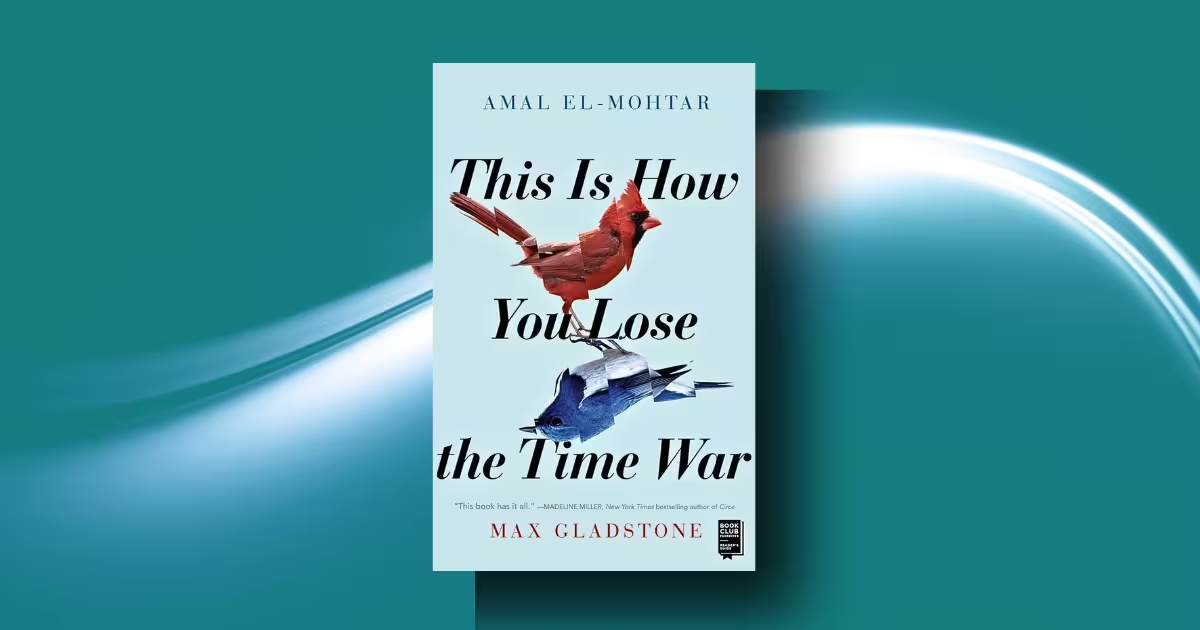
Did you ever wonder why you feel more connected to a person you’ve never met than to the world right in front of you? What if the most dangerous weapon in a multi-generational time war wasn’t a virus or a bomb, but a scrap of paper left in the ruins of a dying civilization? This Is How You Lose the Time War by Amal El-Mohtar and Max Gladstone is a book that doesn’t just ask these questions; it lives in them, breathing through the ink of its two rival protagonists.
This lyrical, epistolary novella follows two rival agents, Red and Blue, who fall in love through forbidden letters while sabotaging each other across timelines, eventually choosing each other over their warring empires.
This Is How You Lose the Time War is best for readers who crave poetic, high-concept science fiction, fans of sapphic romance, and anyone who loves the “enemies-to-lovers” trope executed with extreme literary finesse.
Not for readers who prefer hard, technical sci-fi with linear plots, or those who find “purple prose” and heavy metaphor frustrating to navigate.
Table of Contents
1. Introduction
In the landscape of modern speculative fiction, few books have achieved the cult-to-mainstream status of This Is How You Lose the Time War. Published in 2019 by Saga Press (Simon & Schuster), this novella is a rare collaboration between Amal El-Mohtar and Max Gladstone.
It is a story told through letters (epistolary) and third-person perspectives, blending the clinical, technological vibes of “The Agency” with the organic, hive-mind aesthetic of “Garden.”
Before we dive into the wreckage of their timelines, it’s worth noting the sheer weight of its accolades. This book didn’t just win; it swept.
We’re talking about the 2019 Nebula Award, the 2020 Hugo Award, the 2020 Locus Award, and the BSFA Award for Best Novella. Interestingly, its journey didn’t end with awards; in May 2023, a single viral tweet from a fan (display name “bigolas dickolas wolfwood”) sent it to #3 on Amazon’s overall bestseller list, proving that the internet’s love for a good story is its own kind of time travel.
2. Background
The world of the Time War is defined by two opposing philosophies fighting to dominate the “braid” of time:
The Agency: Red’s faction. They are post-human, technological, and cold. They believe in order, silicon, and the clinical manipulation of history to achieve a singular, predictable future.
Garden: Blue’s faction. They are organic, ecological, and vast. They grow their futures in the soil, using spores and cycles of growth and decay to overtake the timelines.
As Red describes her side’s mechanical precision: “Killing gets easier with practice, in mechanics and technique. Having killed never does, for Red”.
3. This Is How You Lose the Time War Summary
Phase 1: The First Taunt
The story opens on a battlefield where Red has just secured a victory for the Agency. Amidst the carnage, she finds a letter addressed specifically to her, tucked into a place it shouldn’t be. It reads: Burn before reading.
This is the first move by Blue, her rival from Garden. What starts as a series of taunts—”battlefield boasts” between the two best agents in the war—gradually shifts into a dangerous, secret dialogue.
They leave letters in the most impossible places: in the rings of a tree, in the guts of a dead soldier, in the steam of a cup of tea, and even in the patterns of a blooming flower. Each letter requires the other to “read” it through specific, often sensory methods. They are literally consuming each other’s words.
Phase 2: The Shift from Rivals to Lovers
As the letters progress, the tone changes from “Dear Enemy” to something much more intimate. They begin to share their vulnerabilities. Red, who lives a life of rigid Agency discipline, finds herself fascinated by Blue’s chaotic, organic nature. Blue, in turn, is drawn to Red’s sharp, burning edges.
They begin to sabotage their own missions just to keep the correspondence alive. If Red is supposed to ensure a kingdom falls, she might tweak the timeline so a certain library survives—just so she can leave a letter for Blue in the margins of a book.
They are losing the “Time War” for their factions because they are winning a different kind of war within themselves.
Phase 3: The Discovery and the Betrayal
The Agency (specifically Red’s superior, the Commandant) eventually notices Red’s erratic behavior. The Commandant realizes there is a leak and forces Red to send a “final” letter to Blue. However, the Agency has laced this letter with a lethal poison—a specialized, slow-acting toxin designed specifically to kill a Garden agent like Blue by targeting her unique genetic makeup.
Red is forced to deliver it. She watches as Blue receives it, knowing that by reading it, Blue is sealing her death. In her grief and desperation, Red realizes she cannot live in a world where Blue does not exist.
Phase 4: The Ending Explained—Winning by Losing
The climax of the book is a mind-bending sequence of time-loops and self-sacrifice. After Blue dies from the poison, Red becomes “The Seeker.” She uses her knowledge of time travel to go back through the timelines where they exchanged letters.
She doesn’t just read the letters again; she absorbs them. Because Blue’s letters contained parts of Blue’s own genetic code (the “Garden” DNA), Red begins to transform into a hybrid of both factions. She travels back to Blue’s childhood—long before the war reached its peak—and “seeds” Blue with a tiny amount of the future poison and a bit of Red’s own resistant Agency blood.
This creates a paradox: Blue survives the future poison because Red had already made her immune to it in the past. When “Past Blue” finally reads the poisoned letter from “Past Red,” she doesn’t die. Instead, they both fake their deaths to their respective empires.
The book ends with them together, outside the control of the Agency and Garden, having “lost” the time war but won their freedom. As the final lines suggest, they are no longer Red or Blue, but something new altogether.
4. This Is How You Lose the Time War Analysis
4.1. This Is How You Lose the Time War Characters
Red: She is the “hunger” of the Agency. She is described as sharp, efficient, and lonely. Her development is a journey from being a perfect cog in a machine to a person who values a single life over an entire empire.
Blue: She is the “growth” of Garden. Poetic, elusive, and deeply affectionate, Blue is often the one pushing the boundaries of their relationship first. Her impact on the story is her ability to see the “person” behind the Agency’s mask.
The Commandant: She represents the “Standard Operating Procedure” of the Agency. Her role is to remind the reader (and Red) of the high stakes of their betrayal.
4.2. This Is How You Lose the Time War Themes and Symbolism
The Epistolary Body: The letters are not just communication; they are physical acts. “I want to be a context for you, and you for me,” Blue writes. The book treats words as a physical substance that can change the reader’s DNA.
Love as Resistance: In a world where every action is monitored for “utility,” falling in love with the enemy is the ultimate act of rebellion. It is the only thing the algorithms of the Agency and the instincts of Garden cannot predict.
5. Evaluation: A Marrow-Deep Experience
I feel that This Is How You Lose the Time War is an outstanding, groundbreaking achievement in speculative fiction. Like Julian Barnes’ The Sense of an Ending, it deals with the fragility of memory and how we reconstruct the past to suit our present desires.
Strengths: The prose is unparalleled. Every sentence feels like it was forged in a kiln. The emotional payoff of the ending is earned through meticulous pacing.
Weaknesses: Some readers may find the abstract nature of the “time travel” confusing. It doesn’t follow the “rules” of sci-fi like Back to the Future; it’s more about the feeling of being out of time.
Impact: It left me with a profound sense of the importance of “slower” connections. In our world of instant DMs, the idea of waiting decades for a letter feels like a sacred ritual.
6. Comparisons and Adaptations
Similar Works: If you loved this, check out The Night Circus by Erin Morgenstern for its atmospheric rivalry or The Lazarus Project (TV Series) for its high-stakes time resets.
7. Personal Insight: The Digital Time War
There is a contemporary educational relevance here that we shouldn’t ignore: the battle for human attention. In our current era, dominated by algorithms that try to predict our every move (not unlike the Agency), This Is How You Lose the Time War serves as a manual for digital survival.
The “Time War” is happening right now in our pockets. We are constantly being nudged toward “optimal” paths by AI and data-driven platforms.
The lesson of Red and Blue is that true connection requires inefficiency. It requires the “waste” of time, the writing of letters that might never be read, and the courage to be “unpredictable” to the machines that govern our schedules. To win our own time war, we must be willing to lose the “productivity war.”
8. This Is How You Lose the Time War Quotes
- “Burn before reading.”
- “I want to be a context for you, and you for me.”
- “Killing gets easier with practice… Having killed never does.”
9. Conclusion
This Is How You Lose the Time War is more than a book; it is an experience of what happens when two masters of their craft—El-Mohtar and Gladstone—decide to write a love letter to the very idea of storytelling.
It is significant because it proves that even in the coldest, most technological futures we can imagine, the human heart remains a variable that no empire can truly conquer.
Final Recommendation: Essential reading for fans of Circe, The Song of Achilles, and anyone who has ever felt like they were fighting a war just to stay themselves.







