
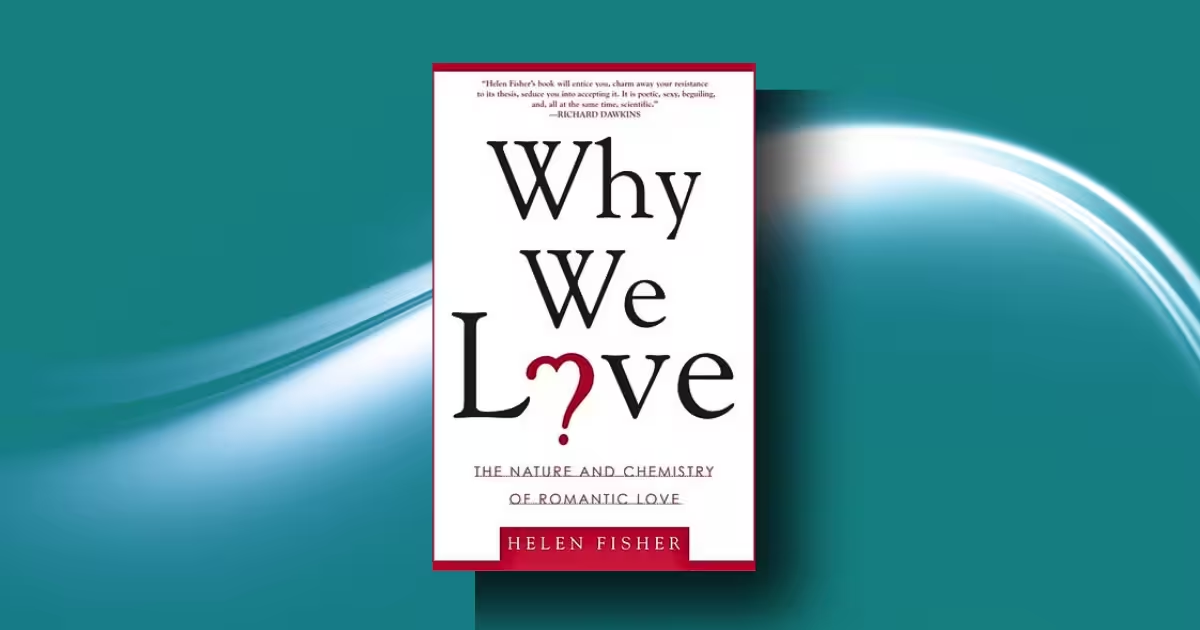
What if the reason you cannot stop thinking about someone is not weakness, fantasy, or bad judgment—but biology? Helen Fisher’s Why We Love: The Nature and Chemistry of Romantic Love gave me one of the clearest, most unsettling, and most comforting answers I have ever read: romantic love is not a trivial emotion. It is a deep human drive.
Why We Love is best for readers who love psychology, anthropology, neuroscience, relationships, and emotionally intelligent nonfiction that still respects mystery. It is not for readers who want a purely literary meditation on love, a moral defense of romance, or a purely cultural critique of relationships without evolutionary arguments.
Before I begin, the book you shared is Why We Love: The Nature and Chemistry of Romantic Love by Helen Fisher, Ph.D., published by Henry Holt / Owl Books in 2004. The Macmillan edition lists it as a 320-page nonfiction title, on sale December 9, 2004.
Table of Contents
1. Introduction
Why We Love: The Nature and Chemistry of Romantic Love is Helen Fisher’s ambitious attempt to explain one of the most chaotic experiences in human life by bringing together anthropology, psychology, literary history, evolutionary theory, and brain science.
Fisher was a biological anthropologist associated with Rutgers and later widely known for her work on love, attraction, and attachment; Britannica summarizes her influential framework by noting that she broke love down into three biological processes: lust, attraction, and attachment.
What makes the book important is not only its subject but its method. Fisher did not stay in the realm of poetic speculation. In the book’s own opening pages, she explains that she began a multipart investigation in 1996 and, with colleagues including Lucy Brown and Arthur Aron, used fMRI to study the brains of people who had recently fallen in love.
Over six years, the team scanned more than forty men and women and collected 144 images of brain activity from each participant. Macmillan’s summary highlights the same core claim: Fisher argued that when you fall in love, specific areas of the brain “light up” with increased blood flow, and that romantic passion is “a drive as powerful as hunger.”
This is popular science, but it does not read like a dry lab report. Fisher writes as a scientist who genuinely respects the emotional violence of love. The book moves from love poetry and myth to survey research, animal behavior, neurochemistry, heartbreak, jealousy, and how to keep romance alive.
The book lays that out clearly: being in love, love among animals, brain scanning, lust versus attachment, mate choice, rejection, and making romance last.
That breadth is why the book still feels relevant. Even now, two decades after publication, Fisher’s three-system model remains one of the most recognizable biological frameworks for discussing love.
Britannica still presents her work in those terms, and her official site still describes the book as an inquiry into love’s universality and the reward circuitry of the brain.
The central thesis, as I read it, is this: romantic love is not a soft cultural ornament added to life after survival needs are met. It is itself part of our survival architecture. Fisher says plainly in the book that romantic love is “deeply embedded in the architecture and chemistry of the human brain,” and later that she came to see it as “a fundamental human drive.”
That is the heart of the book, and it is why the book lands so hard. Fisher is not saying love is unreal because it is chemical. She is saying it is powerful because it is chemical, evolved, embodied, and older than civilization.
2. Background
A good part of Why We Love is really Fisher arguing against two lazy assumptions. The first is that romantic love is just a Western invention. The second is that love is too mystical to study seriously.
She pushes back against the first by gathering evidence from poetry, oral tradition, myth, and anthropology. One of the strongest statistical points in the book comes early: in a survey of 166 cultures, anthropologists found evidence of romantic love in 147 of them—almost 90 percent.
Fisher’s conclusion from this evidence is that romantic love is a “universal human experience.” That matters because it allows her to move from cultural expression to biological explanation without pretending culture does not matter.
She pushes back against the second assumption by treating romance as scientifically legible. The book’s background is late-twentieth-century brain science, reward-system research, and Fisher’s interdisciplinary training as an anthropologist. The result is a book that tries to connect Shakespeare and dopamine without embarrassing either one.
There is also a personal reason this book matters in 2026. Fisher died in 2024, and public biographies now frame her as one of the major popularizers of the science of love.
Reading Why We Love now feels a little like reading a foundational text from the person who spent a lifetime insisting that love deserves both wonder and rigor.
3. Why We Love Summary
This is not a book you read for one neat takeaway. It is a layered argument.
Fisher begins by describing what being in love actually feels like.
She collects stories, poems, historical examples, and survey data to show that the symptoms of romantic love recur across societies and centuries: obsessive thinking, heightened energy, mood swings, craving for emotional union, jealousy, hope, sexual desire, and the tendency to make the beloved feel singular.
She gives these experiences names that are memorable and analytically useful, including “special meaning” and “intrusive thinking.”
Her survey work is one of the book’s strongest empirical sections. She reports that 437 Americans and 402 Japanese completed her questionnaire on romantic love. The results, in her telling, were “astonishing” because age, gender, sexual orientation, religion, and ethnicity made less difference than many would expect.
For example, people over forty-five reported passion at levels similar to those under twenty-five; heterosexual and homosexual respondents answered similarly on 86 percent of the questions; American men and women responded similarly on 87 percent.
Whether or not every reader will find the cross-cultural methodology perfect, the broader point is persuasive: Fisher wants to show not that love is identical everywhere, but that its basic shape is recognizably human everywhere.
From there, the book turns outward to animals. This chapter is one many readers remember because it is bold, vivid, and a little risky.
Fisher argues that many animals display courtship patterns analogous to human attraction: focused attention, high energy, persistence, possessiveness, affection, and mate preference. Foxes, elephants, beavers, voles, dogs, wolves, and primates appear throughout. Her claim is not that animals write sonnets in their heads. It is that attraction to a “special” other is older than humanity, and that human romantic love likely evolved from more primitive attraction systems.
Then comes the book’s most famous section: the neuroscience.
Fisher examines dopamine, norepinephrine, and serotonin as candidate chemicals in romantic passion. She argues that dopamine in particular helps explain focused attention, motivation, craving, exhilaration, and persistence.
Low serotonin may help explain obsessive thought. She then describes the fMRI work: subjects looked at photos of their beloved and neutral acquaintances while their brains were scanned, with distraction tasks between viewings.
The researchers found activation in reward-related regions, especially the caudate nucleus and the ventral tegmental area, both heavily associated with dopamine systems.
This is where Fisher’s conceptual move becomes especially sharp. She argues that romantic love is better understood as a drive than as a simple emotion. She explicitly compares it to hunger and thirst. That claim is not rhetorical flourish.
It is the logical result of her reading of the reward system: love, in her model, is a goal-oriented motivational state focused on winning and keeping a preferred mate. The book makes this framing explicit too, describing love in the book as “not an emotion; it is a drive as powerful as hunger.”
Another major contribution of the book is Fisher’s distinction between three partially independent systems: lust, romantic love, and attachment. Lust is the broad sexual drive. Romantic love focuses attention and mating energy on one person. Attachment supports calm pair-bonding and longer-term stability. In her framework, these systems can align, but they can also come apart.
That is why one can feel attached to one person, sexually drawn to another, and romantically obsessed with a third. Fisher treats this not as moral failure first, but as biological architecture first.
The later chapters deepen the argument with mate choice, rejection, despair, and strategies for sustaining romance.
Fisher is especially strong on rejection. She notes that almost no one escapes it and cites research showing how common it is among college students. She treats heartbreak not as melodrama but as an event with measurable psychological and potentially neurochemical consequences.
She links rejection to protest, rage, depression, and in extreme cases violence or self-harm, while still insisting on moral responsibility for violent actions.
Finally, she tries not just to explain romance but to make it useful. She believes that understanding the brain mechanisms of novelty, reward, and attachment can help long-term partners preserve some of the vitality of early romance. That practical impulse is already visible in the preface, where she says that a clearer understanding of love may help people “find and sustain this glorious passion.”
4. Why We Love Analysis
My view is that Why We Love is an outstanding, groundbreaking, and emotionally intelligent work of popular science—one that succeeds precisely because it never treats science as a substitute for feeling. It treats science as a way of taking feeling seriously.
The strongest part of the book is its synthesis. Fisher does not rely on one kind of evidence only. She combines anthropology, literature, animal behavior, survey data, clinical observation, and neuroscience. Publishers Weekly noticed that strength too, calling the book a “provocative examination” whose case is bolstered by behavioral research, chemical theory, and broad surveys. I agree.
Even when individual components can be debated, the total architecture is powerful.
Her support for the central argument is often effective because it is cumulative rather than simplistic.
The universality claim is supported by historical and anthropological material; the symptom cluster is supported by her survey; the drive model is supported by reward-system findings; the evolutionary story is supported by comparative animal behavior. That does not make every conclusion unassailable, but it does make the book intellectually serious.
I also think Fisher fulfills the book’s purpose. She wanted to answer “What is love?” not in the abstract but in living human terms. By the end, her answer is coherent: love is a cross-cultural human pattern with deep evolutionary roots, distinctive psychological symptoms, and identifiable neural correlates. Whether one agrees entirely or not, that is a meaningful contribution.
Where the book is less fully persuasive is in the slippage between levels of explanation. At times Fisher moves very quickly from animal behavior to human inner experience. At other points she leans hard on biological explanation where social structure, history, power, and culture also deserve more weight.
This is exactly where later critics have pushed back. One critical review argues that Fisher’s biological emphasis can neglect the broader social and cultural dimensions of love and attachment.
That criticism is not baseless.
Still, I think it is important not to misread Fisher.
She is not saying culture is irrelevant. She is saying culture builds on a biological platform. The problem is that the book is far better at describing the platform than at fully integrating the cultural superstructure. If you come to it expecting a complete philosophy of love, it will feel reductive in places. If you come to it as a biologically grounded explanation of romantic passion, it is dazzling.
What moved me most is that Fisher never lets the scientific vocabulary drain the human urgency from the subject. Even after all the scans and surveys, she insists that knowledge does not destroy mystery.
Near the end, she argues that understanding the notes of Beethoven does not stop the symphony from overwhelming you. That, to me, is the emotional ethic of the whole book.
5. Strengths and Weaknesses
Strengths
The first strength is readability. Fisher writes clearly, memorably, and with narrative rhythm. Macmillan quotes The New York Times Book Review describing the book as “written in a deceptively simple manner,” and that sounds right to me.
The second strength is conceptual clarity. The three-part distinction between lust, attraction, and attachment is still one of the book’s most durable ideas. It gives ordinary readers a vocabulary for experiences that often feel confusing or morally chaotic.
The third strength is empirical vividness. The statistics are not dumped on the page without texture. The brain-scan experiment is described in concrete detail: the photos, the countdown tasks, the subjects, the reward regions, the 144 scans per participant. This makes the science legible.
The fourth strength is emotional honesty. Fisher understands obsession, hope, jealousy, and rejection from the inside. That gives the book warmth.
Weaknesses
The biggest weakness is overreach. Fisher sometimes advances evolutionary explanations with more confidence than the evidence fully warrants. Some readers will find the ancestral scenarios illuminating; others will find them too speculative.
The second weakness is reduction pressure. Even though Fisher herself often resists crude reduction, some chapters encourage readers to believe love can be sufficiently explained by dopamine, serotonin, and mating strategy. That is too narrow for an experience so shaped by class, history, religion, technology, gender norms, and moral imagination.
The third weakness is unevenness. Some sections feel exhilaratingly original; others feel like broad synthesis more than proof. The animal chapter, for instance, is engaging and suggestive, but it will not convince every skeptical reader that animal attraction and human romantic love are close cousins in the way Fisher proposes.
6. Comparison with Similar Works
Compared with Fisher’s own Anatomy of Love, this book is narrower and more intense. Anatomy of Love is broader social history; Why We Love is more sharply focused on romantic obsession and the brain.
Compared with bell hooks’s All About Love, Fisher is much less interested in ethical love and much more interested in romantic attraction as a biological system. Hooks asks how to love well; Fisher asks what love is doing to us biologically.
Compared with Alain de Botton’s The Course of Love, Fisher is less literary and less interested in the sociology of disappointment inside long-term partnership. De Botton is better on domestic reality; Fisher is better on early-stage infatuation and its neurochemical fire.
Compared with In the Name of Love, Fisher is almost the mirror image. Your article emphasizes the dangers of romantic ideology, unrealistic expectation, and the harm that idealization can do. Fisher, by contrast, is less suspicious of romantic love itself.
She is interested in its costs, yes, but mostly in its evolutionary function and neurological force. Read together, the two approaches are excellent: one explains why romance hurts, the other explains why it grips.
7. Conclusion
I would recommend Why We Love very strongly, but with a precise expectation. Read it if you want to understand why love can feel like ecstasy, addiction, panic, fixation, and revelation all at once. Read it if you want a science-based explanation that still leaves room for poetry. Read it if you have ever wondered why one human being can suddenly become the center of consciousness.
I would not recommend it as the only book you read on love. Pair it with a more cultural, philosophical, or feminist account and it becomes even richer. On its own, it can tilt too far toward biology. But as a map of romantic passion, it remains one of the most arresting books I have read.
My personal verdict is simple: this is one of those rare nonfiction books that changes how you interpret your own life. Fisher made me feel less ashamed of love’s irrationality because she persuaded me that some of what feels irrational is actually ancient design. The beloved acquires “special meaning.” Thought turns “intrusive.”
Desire becomes “a state of need.” Fisher names these states so well that, after reading her, you start recognizing them not only in literature and strangers and former lovers, but in yourself.
That is the value of Why We Love. It does not trivialize romance. It dignifies it by showing that our madness has a structure.







