
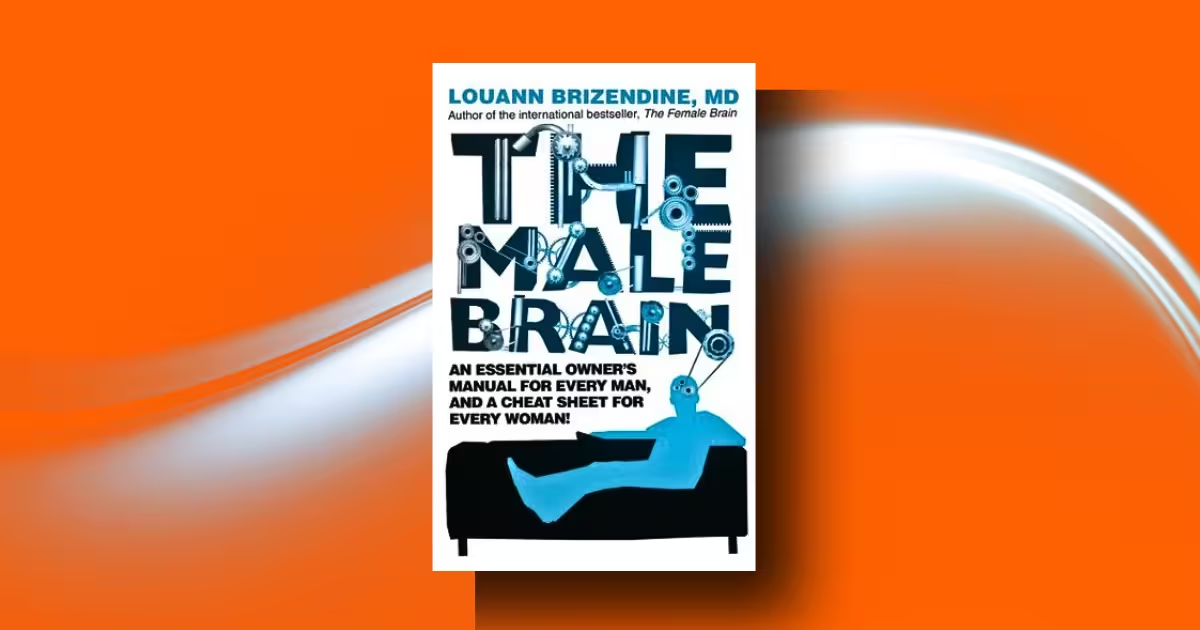
Do you ever wonder why the men in your life seem to physically tune out your voice during an argument, or why little boys naturally turn almost any object into a weapon? The Male Brain will show you how to break free from the endless cycles of miscommunication and frustration by revealing the hidden biological and hormonal blueprints that actually drive male behavior.
The Male Brain is best for women who are exhausted by trying to decode their husbands, boyfriends, or teenage sons using female emotional metrics; mothers of young boys looking for a roadmap to survive the turbulent teens; and men seeking biological validation for why they think, feel, and react the way they do.
Not for readers who strictly subscribe to the theory that gender is entirely a social construct with absolutely zero biological or neurological underpinning, or those looking for a purely philosophical discourse on masculinity without hard neurochemical data.
Table of Contents
1. Introduction
Author: Louann Brizendine, M.D.
Publication Details: Published in 2010 by Broadway Books (an imprint of the Crown Publishing Group, Random House, Inc., New York).
When I first picked up The Male Brain, I was already somewhat familiar with Dr. Louann Brizendine’s groundbreaking previous work, The Female Brain. Dr. Brizendine is a neuropsychiatrist at the University of California-San Francisco (UCSF) and the founder of the Women’s and Teen Girls’ Mood and Hormone Clinic.
She boasts an impressive pedigree, having been on the faculty at Harvard Medical School and graduating from Yale University School of Medicine and UC-Berkeley in neurobiology.
She wrote this book because she realized early in her medical career that the male body and brain were historically used as the “default” model in scientific research. Yet, the profound, specific intricacies of the male brain were widely misunderstood by the general public.
This book aims to map the unique neurological and hormonal reality of men across their lifespan.
The central thesis of The Male Brain is both simple and revolutionary: “Male and female brains are different from the moment of conception”. Brizendine argues that the presence of the Y chromosome, followed by a massive influx of testosterone in utero, fundamentally alters the structure and circuitry of the male brain.
Her purpose is to prove that male behaviors—from rough-and-tumble play in childhood to the aggressive pursuit of mating, and the “fix-it-fast” emotional responses in adulthood—are not merely the result of societal conditioning or toxic masculinity, but are deeply wired biological imperatives.
2. The Male Brain Summary
I want to save you the trouble of needing to read the book by giving you a complete, fully spoiled, point-by-point breakdown of exactly what I learned from Brizendine’s incredible research. Here is the entire life cycle of the male brain.
The Cast of Neurohormone Characters
Before diving into the chronological stages of a man’s life, Brizendine introduces us to the chemicals that pull the strings. Understanding these is the key to understanding men:
Testosterone (Zeus): The king of male hormones. It drives dominance, aggression, focused goals, and the dogged pursuit of a mate.
Vasopressin (The White Knight): The hormone of gallantry and monogamy. It aggressively protects turf, mates, and children.
MIS / Müllerian Inhibiting Substance (Hercules): Also known as the Defeminizer. It strips away feminine traits during fetal development and builds circuits for exploratory, rough behavior.
Oxytocin (The Lion Tamer): The calming hormone that builds trust, attachment, and empathy. It promotes the feeling of safety (and is responsible for men falling asleep immediately after sex).
Dopamine (The Energizer): The ultimate reward chemical. It drives the thrill of victory, the rough-and-tumble play of boyhood, and sexual ecstasy.
Chapter 1: The Boy Brain
I was absolutely floored to learn that the male brain is built in distinct stages. First, between weeks eight and eighteen of fetal development, the tiny male testicles pump out testosterone, marinating the brain and killing off cells in the communication centers while growing more cells in the sex and aggression centers.
From birth to age one, boys experience “infantile puberty,” where their testosterone levels are as high as a grown man’s, preparing their muscles for rough-and-tumble play.
Why do little boys ignore faces but stare at ceiling fans? Because their visual circuits are wired to pay more attention to movement, geometric shapes, and angles, whereas girls’ brains are wired for mutual gazing and face-reading.
As they grow, boys are addicted to the dopamine rush they get from physical force, showing off strength, and establishing a strict social hierarchy. Winning is not just a game; “to a young male brain, the victory cry is everything”.
Furthermore, a boy’s brain has a spatial-movement area in the parietal lobe that is locked in the “on” position, making them naturally adept at mentally rotating objects.
Chapter 2: The Teen Boy Brain
If you have a teenage son, you need to read this section carefully. Around puberty, a boy’s brain is hit by a “Testosterone Tsunami,” with levels surging twentyfold. But it’s not just testosterone; vasopressin makes him intensely territorial about his room and highly sensitive to peer put-downs.
The teenager’s sleep clock shifts heavily, making it impossible for him to fall asleep before the early hours of the morning, putting his biology at direct odds with school start times.
His brain also requires massive amounts of stimulation to feel anything, explaining his love for gory video games, loud music, and risky behaviors. Brizendine points out that the male auditory screening system literally tunes out unwanted frequencies—like a mother’s nagging voice (which registers as “white noise” that his brain deactivates).
Ultimately, a teen boy’s amygdala (the brain’s emotional gas pedal) is fully developed, but his prefrontal cortex (the inhibitory brakes) won’t be fully mature until his early twenties, explaining his breathtakingly poor judgment.
Chapter 3: The Mating Brain: Love and Lust
Mating is serious biological business. A man’s lust center automatically directs him to notice attractive females. When his visual circuits lock onto contact-readiness cues (a tilted chin, a coy smile), his brain evaluates her reproductive potential.
I found the section on monogamy particularly fascinating.
Why do some men cheat while others are fiercely loyal? Brizendine introduces us to the prairie vole, an intensely monogamous rodent. Scientists found that introducing a specific vasopressin receptor gene made even promiscuous voles settle down.
In humans, men who possess a longer version of the vasopressin receptor gene are twice as likely to commit to one woman for life. Once a man does fall in love, his ventral tegmental area (VTA) pumps out dopamine, creating a blissful euphoria akin to cocaine, leading to intense mate-guarding behaviors.
Chapter 4: The Brain Below the Belt
Men have two-and-a-half times the brain space devoted to sexual drive in their hypothalamus (the Medial Preoptic Area, or MPOA). For men, visual stimulation is often all it takes to trigger the parasympathetic nervous system, dilate arteries with nitric oxide, and create an erection.
Men are highly visual creatures, constantly amassing a “sex-fantasy DVD library in his brain” to build tension and arousal.
When it comes to orgasm, the male brain releases all brakes. His VTA (pleasure center) and PAG (periaqueductal gray, the pain suppression and moaning center) light up intensely.
Immediately afterward, a massive surge of oxytocin promotes deep sedation, completely explaining the classic “postcoital narcolepsy” that leaves women feeling ignored while men snore peacefully.
Chapter 5: The Daddy Brain
This chapter completely shifted my perspective on fatherhood. Becoming a father actually rewires a man’s brain. Often triggered by the pregnant mother’s pheromones, a father-to-be’s testosterone levels drop while his prolactin levels (the “Mr. Mom” hormone) rise.
This can even cause “couvade syndrome,” or sympathetic pregnancy weight gain.
Once the baby is born, skin-to-skin contact cements the bond. A father’s play style is fundamentally different from a mother’s. While moms are predictable and soothing, dads are creative, unpredictable, and rough-and-tumble. This “daddy play” helps children, especially toddlers, develop self-confidence and a bridge to the real world where people won’t anticipate their every need like Mom does.
Chapter 6: Manhood: The Emotional Lives of Men
This is perhaps the most important chapter for women to read. Why do men seem so emotionally detached? Brizendine explains that humans have two emotional processing systems: the Mirror-Neuron System (MNS) and the Temporal-Parietal Junction (TPJ).
When a woman cries or shares a problem, a man’s MNS activates for a split second, meaning he does feel her pain. But then, his male brain quickly shifts gears into the TPJ, the “cognitive empathy” and “fix-it-fast” center.
He shuts down his facial expressions to avoid wallowing in anguish and starts trying to logically solve the problem. Women misinterpret this blank face as a lack of caring. In reality, the male brain consciously suppresses facial emotions after about 2.5 seconds.
Furthermore, anger is a highly useful tool for the male brain; testosterone and cortisol fire up the amygdala, harnessing aggressive energy to help men climb the corporate ladder and defend their turf.
Chapter 7: The Mature Male Brain
As men enter their late forties and fifties, they experience “andropause” (male menopause). Their testosterone levels slowly decline, reducing their intense competitive drives. With less testosterone masking them, the bonding hormones—oxytocin and estrogen—become much more prominent.
The mature male brain becomes more empathetic, more interested in cuddling, and a much better listener. This hormonal shift is what creates the “grandfather brain,” allowing older men to have infinitely more patience with their grandchildren than they ever had with their own kids.
Brizendine notes that staying socially connected and married is the ultimate life-hack for men; married men live 1.7 years longer than single men because the social interaction keeps their brain’s reward centers firing.
Appendix: Sexual Orientation
Brizendine briefly touches on sexual orientation, noting that studies show anatomical differences. For example, the suprachiasmatic nucleus (SCN) and the anterior commissure are larger in gay males than in straight males, suggesting prenatal hormonal exposures profoundly shape orientation.
3. Critical Analysis
If I were reviewing this for The New York Times, I would say: The Male Brain is an outstanding, revelatory, and sometimes terrifyingly deterministic biological cartography of masculinity that forces us to reconcile our modern sociological ideals with our ancient neurochemical realities.
My personal feeling in one sentence: Reading this book felt like being handed the operational manual for a highly complex, sometimes volatile machine that I’ve spent my whole life trying to operate using the wrong set of instructions.
Brizendine’s arguments are heavily supported by neuroimaging (fMRI scans), endocrinology, and evolutionary biology. When she explains why a man zones out during an emotional conversation—detailing the exact millisecond his brain shifts from the Mirror-Neuron System to the Temporal-Parietal Junction —she provides profound relief to anyone who has ever felt ignored by a partner. She effectively fulfills her purpose of demystifying male behavior.
However, her reliance on evolutionary psychology (such as comparing human mate-poaching to chimpanzee harem behaviors ) can occasionally feel reductive.
While the data is solid, she occasionally skirts the edge of suggesting that “biology is destiny,” which is a dangerous tightrope to walk in modern gender discourse.
4. Strengths and Weaknesses
My Pleasant/Positive Experience:
The greatest strength of The Male Brain is Brizendine’s incredible empathy and her use of relatable clinical anecdotes. By introducing us to patients like little David (the hyperactive toddler), Jake (the rebellious teen), and Neil (the emotionally detached husband), she grounds dense neurological data in real, human struggle.
I loved learning about the biological reality of “postcoital narcolepsy”—it instantly reframes a common relational argument from “you don’t care about me” to “your oxytocin is working correctly.” It breeds massive compassion.
My Unpleasant/Negative Experience:
The book’s primary weakness is its occasional over-reliance on animal models to definitively explain complex human sociology.
Extrapolating the monogamy of the human male directly from the vasopressin receptors of the prairie vole feels a bit like an oversimplification of the human condition.
Furthermore, while Brizendine notes that the brain is plastic and “our culture and how we are taught to behave play a big role in shaping and reshaping our brains”, the overwhelming weight of the text leans heavily into biological determinism. At times, it risks providing a convenient biological “get out of jail free” card for bad male behavior (like road rage or infidelity).
5. Comparison with Similar Other Works
Brizendine’s work sits prominently alongside other popular neuroscience books, but with a highly specific, accessible flavor.
Compared to Steven Pinker’s The Blank Slate, which also argues against the idea that human minds are purely shaped by society, Brizendine is much more focused on practical, day-to-day relational advice rather than grand philosophical or political debates.
Contrasted with Cordelia Fine’s Delusions of Gender, which aggressively attacks “neurosexism” and argues that brain differences are negligible and culturally induced, Brizendine represents the exact opposite end of the spectrum, planting her flag firmly in the camp of undeniable biological dimorphism.
Naturally, it is the perfect companion piece to her own The Female Brain, creating a complete diptych of the human reproductive and neurological experience.
6. Conclusion
I cannot recommend The Male Brain highly enough. It is an absolute must-read for anyone who shares a life with a man.
Whether you are a mother trying to understand why your sweet toddler has morphed into a sullen, door-slamming teenager, a wife trying to figure out how to communicate with a husband who seems emotionally walled-off, or a man looking to finally understand the biochemical storms that govern your libido, anger, and affections, this book is a revelation.
It is perfectly suited for general audiences; Brizendine strips away the dense academic jargon and replaces it with engaging, page-turning narrative science. You will walk away from this book with a profound sense of empathy for the heavy biological lifting it takes just to “be a man.”







