
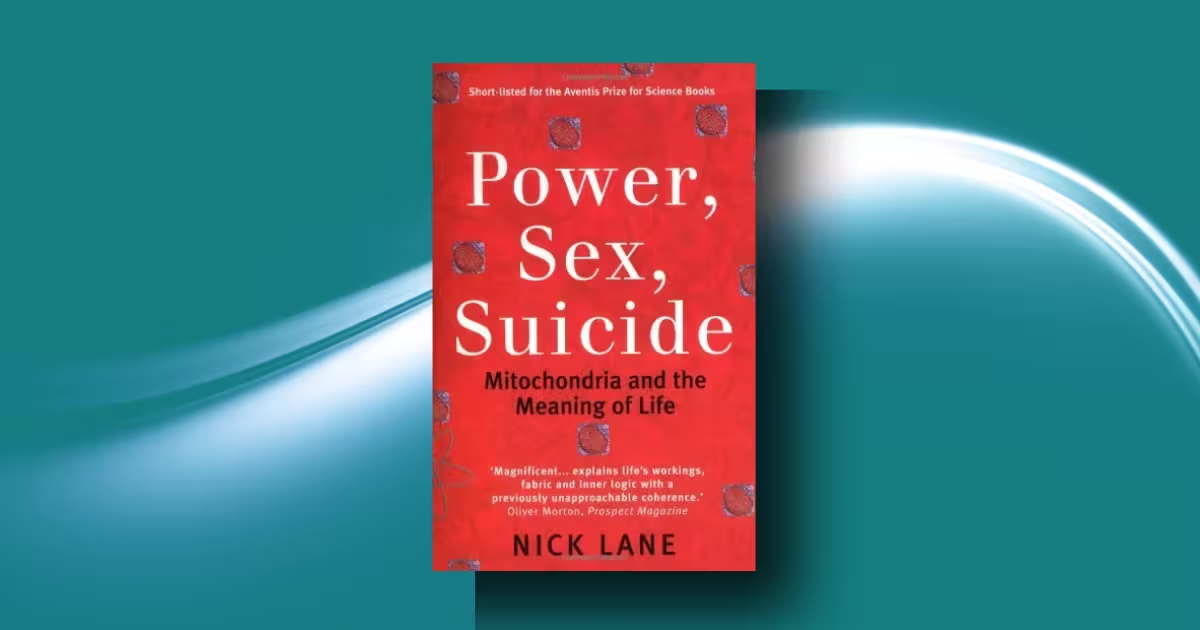
What if the reason you exist is not just DNA, but the tiny power stations inside your cells? Why does Power Sex Suicide make an old organelle feel like the hidden author of complex life itself?
Power Sex Suicide is best for curious readers who love big-idea science books, evolutionary biology, origin-of-life debates, mitochondria, ageing, sex differences, astrobiology, and books that connect cell biology to the largest human questions.
It is especially rewarding for readers who liked ambitious science writers such as Richard Dawkins, Stephen Jay Gould, Simon Conway Morris, or Siddhartha Mukherjee.
Not for readers who want a light pop-science skim, a memoir, or a purely practical health book. This is accessible, but it is still dense, idea-heavy, and sometimes gloriously argumentative. If you dislike evolutionary theory, cellular biology, or books that move from microbes to philosophy in one leap, you may bounce.
Table of Contents
1. Introduction
Title and author information
Power, Sex, Suicide: Mitochondria and the Meaning of Life is a science book by Nick Lane, first published by Oxford University Press in 2005, and Oxford later issued a second edition in 2018 with a new preface. The first edition is listed at 368 pages in a contemporary review, while the 2018 Oxford paperback is 560 pages.
Lane is not just a science popularizer writing from the sidelines. He is a Professor of Evolutionary Biochemistry at University College London, and his research centers on energy flow, the origin of life, complex cells, and the strange evolutionary consequences of bioenergetics. That matters, because Power Sex Suicide is not a casual overview.
It is a serious argument, written for general readers, by someone deeply embedded in the field.
What kind of book is this?
This is popular science, yes, but it is also a sweeping work of evolutionary explanation.
Lane uses mitochondria—the small organelles inside our cells best known as energy producers—as a master key to unlock a startling range of questions: why complex cells evolved, why multicellular life became possible, why warm-blooded animals burn so much energy, why there are two sexes, why ageing happens, and why cell death is not an accident but part of the architecture of life.
The book’s own structure announces that ambition: from the origin of the eukaryotic cell to proton power, complexity, body size, individuality, sex, and ageing.
Oxford describes the book as a “thought-provoking look at our world from the viewpoint of mitochondria,” and Lane’s own site frames the same thesis even more directly: what gives us energy, lies behind the origin of two sexes, and directs ageing and death is, again and again, mitochondria.
The central thesis of Power Sex Suicide is bold enough to sound reckless until Lane makes it feel inevitable: mitochondria are not a side topic in biology; they are the pivot on which complex life turned.
In the book’s introduction, Lane calls them the “clandestine rulers of the world,” and by the epilogue he compresses his argument into one unforgettable line: “the answer to the question of life, the universe and everything is not 42… it is mitochondria.”
That is the book’s grand wager. Lane wants to prove that if you understand mitochondria, you understand far more than ATP production.
You begin to understand why life on Earth escaped a bacterial rut, why sex is asymmetrical, why bodies police rebellious cells through apoptosis, and why the machinery that powers us may also destroy us.
2. Background
Before I get into the substance, it is worth saying why this book landed where it did in scientific and publishing history.
By the early 2000s, mitochondria had already returned to the center of biology. They were central to research on human ancestry, mitochondrial diseases, infertility, apoptosis, and ageing; Science had even run a “Mitochondria Make A Comeback” package in 1999, a detail Lane mentions in the book itself.
At the same time, the book entered a moment when big, synthetic science writing still felt thrillingly public-facing.
It was later shortlisted for the 2006 Aventis/Royal Society science book prize, and reviewers praised both its ambition and readability. Steven Rose in The Guardian called it “one of the most interesting stories modern biology has to tell.”
What makes that background important is this: Lane was writing at a moment when mitochondria were no longer obscure, but their implications were still fragmented across specialties.
His gift in this book is not merely to summarize findings. It is to force connections between them.
3. Power Sex Suicide summary
This is the part where I think Power Sex Suicide earns its reputation. Lane does not just tell you what mitochondria are. He builds a world in which they become the hidden protagonists of biology.
The opening move: mitochondria are everywhere, and they matter more than most people realize
Lane begins with a deceptively simple reminder: mitochondria are in essentially all complex cells and generate almost all our energy as ATP. He says there are on average 300–400 mitochondria per cell, amounting to roughly ten million billion mitochondria in the human body.
He also reminds readers that mitochondria retain their own genes, because they were once free-living bacteria that took up residence inside larger cells around two billion years ago.
Already the scale is dizzying.
Lane makes the mitochondrion feel both microscopic and mythic.
He then maps the familiar public-facing roles of mitochondria:
Mitochondrial Eve and human ancestry, forensic identification, mitochondrial diseases, fertility treatments, and the mitochondrial theory of ageing.
He notes that free-radical attacks on our genes may occur 10,000 to 100,000 times a day, a figure he uses not as clickbait but to dramatize the ceaseless biochemical violence of living.
But he is only warming up. The real argument is that these familiar stories are all fragments of a deeper one.
The Core Thesis
All complex life on Earth (eukaryotes) evolved exactly once. For two billion years prior, bacteria ruled the Earth but never evolved beyond microscopic simplicity. The event that broke this “bacterial rut” was a freak symbiotic merger between two single-celled organisms, creating a chimeric cell with internalized power generators: the mitochondria.
Because of the bizarre, highly specific way mitochondria generate energy, they became the ultimate gatekeepers of biological complexity. They are the reason we have differentiated sexes, warm-bloodedness, a mandated lifespan, and programmed death.
Part 1: The Origin of the Eukaryotic Cell (The Hydrogen Hypothesis)
The chasm between bacteria (prokaryotes) and complex cells with a nucleus (eukaryotes) is the largest gap in biology. Eukaryotes are typically 10,000 to 100,000 times larger than bacteria, house a nucleus full of straight chromosomes, and contain internal organelles. How did this happen?
The Flawed “Missing Link” Theory: Biologists used to believe a primitive eukaryote (an “archezoon”) evolved a nucleus and a predatory lifestyle first, and only later swallowed a bacterium that became the mitochondrion.
Lane points out that this is false. Genetic sequencing proves that all known complex cells either have mitochondria or once had them and lost them.
The origin of the complex cell and the acquisition of mitochondria were the exact same event.
The Hydrogen Hypothesis: Proposed by Bill Martin and Miklós Müller, this theory explains the merger. The host cell was a methanogen (an archaeon that uses hydrogen and carbon dioxide to produce methane). The invading/engulfed cell was a metabolically versatile $\alpha$-proteobacterium (the ancestor of the mitochondrion).
The Deal: In the deep, oxygen-poor ocean, the methanogen was starving for hydrogen. The $\alpha$-proteobacterium produced hydrogen as a waste product. The methanogen enveloped the bacterium to monopolize this hydrogen supply.
Over time, the bacterium transferred the genes required to import and digest organic food to the host’s DNA. The host could now feed itself and its internal tenant, eventually allowing the chimera to move into oxygen-rich environments where the internalized mitochondria could pump out massive amounts of energy (ATP).
Part 2: Proton Power and the Origin of Life
To understand why mitochondria are so transformative, you must understand how they generate energy—a process so counterintuitive it took decades to accept.
Chemiosmosis (Peter Mitchell’s Discovery): Mitochondria do not make energy via simple chemical reactions. Instead, they operate like hydroelectric dams. As electrons from food are stripped and passed down the “respiratory chain” (a series of protein complexes) to oxygen, the released energy is used to physically pump protons () across the inner mitochondrial membrane.
The Proton-Motive Force: This creates a massive electrical and acidic gradient across a membrane only 5 nanometers thick—equivalent to a lightning bolt of 30 million volts per meter.
The protons desperately want to flow back across the membrane. They are funneled through a tiny rotary motor called ATP synthase, physically turning it to crank out ATP (the cell’s universal energy currency).
The Origin of Life: This bizarre “proton power” mechanism is shared by all bacteria, archaea, and mitochondria. Lane argues life began in alkaline hydrothermal vents (“black smokers” and seepages) at the bottom of the primordial ocean.
These vents naturally created microscopic iron-sulfur bubbles with natural proton and electrical gradients across their inorganic membranes. The very first biochemical reactions were driven by these geological proton gradients before DNA or cells even existed.
Part 3: The Foundations of Complexity (Why Bacteria Stayed Simple)
If bacteria are so metabolically inventive, why did they never evolve into plants or animals? It comes down to geometry and genomics.
The Surface-Area-to-Volume Trap: Bacteria generate energy (pump protons) across their outer cell membrane. As a bacterium grows, its volume (energy demand) increases by a cube, while its surface area (energy production) only increases by a square. If a bacterium gets too big, it suffocates from a lack of energy.
Genomic Streamlining: Because energy is tight, bacteria must replicate as fast as possible to compete. They ruthlessly throw away “junk” DNA and any genes they aren’t using right this second to keep their replication times short. They are trapped in a streamlined, small state.
The Eukaryotic Escape: By internalizing energy generation (mitochondria), eukaryotes escaped the surface-area trap. To get bigger, a eukaryote just builds more internal mitochondria.
With abundant energy, eukaryotic cells could afford to amass massive genomes, hoard “junk” DNA (which provided the raw material to evolve complex regulatory genes), and grow 100,000 times larger.
Why Must Mitochondria Keep Their Own DNA? Mitochondria transferred 99% of their genes to the host nucleus, but universally kept a tiny handful (usually 13 genes). Why? Because of Redox Poise. If the respiratory chain gets blocked, electrons back up and react with oxygen to form highly destructive free radicals.
The mitochondrion uses these free radicals as a localized “distress signal” to immediately build more respiratory proteins and fix the blockage. If those genes were in the distant nucleus, the response would be too slow and would indiscriminately target all mitochondria in the cell, leading to chaos.
Part 4: Power Laws, Size, and Warm-Bloodedness
With the energy barrier broken, eukaryotes scaled up into multicellular organisms. This scaling followed strict mathematical rules.
Kleiber’s Law: As animals get larger, they become more metabolically efficient. A rat’s cells work 7 times harder than a human’s cells. Metabolic rate scales with mass to the 3/4 power (0.75).
Why Be Warm-Blooded (Endothermic)? Mammals and birds burn up to 30 times more energy than reptiles of the same size just to maintain body heat. The “Aerobic Capacity Hypothesis” explains this: endothermy was an accident.
The true evolutionary advantage was stamina—the ability to run down prey or flee predators. To gain stamina, early mammals and birds packed their cells with massively more mitochondria.
Proton Leak and Heat: When resting, these highly athletic animals have a problem: their respiratory chains are full of electrons but aren’t making ATP, risking massive free radical damage.
To prevent this, they “uncouple” their mitochondria, allowing protons to leak back across the membrane without making ATP. This keeps electrons flowing safely but generates massive amounts of waste heat as a byproduct. Endothermy (warm-bloodedness) was born to handle resting periods for highly athletic predators.
Part 5: Murder, Suicide, and the Individual
To be a true multicellular individual, cells must collaborate. But cells are naturally selfish (like cancer). Multicellularity is enforced by the death penalty: Apoptosis (programmed cell suicide).
The Executioner: Apoptosis is governed completely by the mitochondria. When a cell is severely damaged, the mitochondrion depolarizes its membrane and releases cytochrome c (a core respiratory protein) into the cell. This triggers “caspase” enzymes that neatly slice the cell into recyclable packages.
From Sex to Death: Why did mitochondria evolve a suicide switch? In early single-celled chimeras, if the host cell was damaged and couldn’t divide, the internal mitochondria were trapped.
A burst of free radicals from the mitochondria signaled the host cell to seek out another cell and fuse with it (sex/recombination) to fix the DNA damage and allow the mitochondria to escape.
Later, when cells formed multicellular colonies, a rogue cell crying out for “sex” (fusion) threatened the unity of the whole organism. The multicellular body repurposed this mitochondrial free-radical “cry for sex” into a trigger for immediate execution (apoptosis).
Part 6: The Battle of the Sexes and Two Genders
Why do we have exactly two sexes? Why do sperm provide no mitochondria to the egg?
Genomic Conflict vs. Co-Adaptation: Mixing mitochondria from two different parents (heteroplasmy) is incredibly dangerous. Originally, scientists thought this was just because fast-replicating “selfish” mitochondria would outcompete efficient ones. Lane argues for Dual Genomic Control.
The Metabolic Dance: A respiratory complex contains proteins encoded by both the nuclear DNA and the mitochondrial DNA. They must fit together with nanoscopic precision to pass electrons safely.
Because nuclear DNA is randomized every generation via sexual reproduction, and mitochondrial DNA mutates 20 times faster, this match is easily broken.
The Uniparental Solution: To ensure a perfect match, a developing embryo must test one single lineage of mitochondria against its new nuclear genome. If it inherited mitochondria from both parents, it would be trying to optimize two different metabolic engines at once.
Therefore, evolutionary lines separated into two roles: the female produces a massive egg packed with the chosen mitochondria, and the male produces a stripped-down sperm designed to deliver only nuclear DNA and zero mitochondria.
Part 7: The Clock of Life (Aging and Death)
Why do we age, and why do birds live so much longer than rats of the exact same size and metabolic rate?
The Flawed Antioxidant Theory: Denham Harman’s original “Free Radical Theory of Aging” argued that lifespan was simply determined by how fast an animal burned oxygen, creating unavoidable free radical damage. This led to the billion-dollar antioxidant supplement industry. Lane reveals that antioxidants do not increase maximum lifespan. Ironically, long-lived animals actually have fewer antioxidants in their tissues than short-lived ones.
Spare Capacity: Birds live so long because flying demands a massive “spare capacity” of mitochondria. At rest, their respiratory chains have huge amounts of room for electrons, meaning electrons rarely get backed up and leak out. Because their free radical leakage rate is naturally so low, birds don’t suffer the genetic damage that rats do, and they age much slower.
The Retrograde Response and Aging: We don’t age because our cells literally burn up. We age because of a signaling failure. As we acquire mitochondrial mutations over our life, inefficient mitochondria leak more free radicals.
The cell detects this and triggers the retrograde response, shifting nuclear gene expression to a “stress” state to compensate. This causes the chronic, low-grade inflammation associated with arthritis, Alzheimer’s, and heart disease.
The Ultimate End: Eventually, as cells run out of healthy mitochondria to replace the broken ones, ATP levels drop below the survival threshold. The mitochondria trigger apoptosis, and the cell deletes itself. Aging is the slow, progressive loss of tissue mass and function as our cells quietly commit suicide to prevent total metabolic failure.
Summary Conclusion
Lane’s ultimate conclusion is that life is not just about DNA information; it is equally governed by energy. The precise mechanics of how electrons and protons are manipulated across membranes constrained evolution at every turn.
Mitochondria are the sole reason life broke the bacterial barrier, the architects of our multicellular bodies, the inventors of the two sexes, and the ticking clocks that determine exactly when we will die.
4. Critical analysis
My overall judgment
For me, Power Sex Suicide is an outstanding, intellectually adventurous, and genuinely perspective-changing science book. It is one of those rare works that makes a microscopic object feel cosmically important without turning into mysticism. It left me with that lovely, unsettling sensation that a piece of everyday textbook biology had suddenly become the stage on which the deepest evolutionary drama was played.
It also has something many science books lack: nerve. Lane is willing to state a thesis sharply, argue for it vigorously, admit controversy, and still keep the prose alive.
Does Lane support his arguments well?
Mostly, yes—impressively so.
Lane’s method is to move from established facts to bold inference. He repeatedly grounds his case in empirical details: the bacterial ancestry of mitochondria, the persistence of mitochondrial genomes, the absence of truly primitive amitochondriate eukaryotes in the evidence he surveys, the centrality of chemiosmosis, the role of apoptosis, the asymmetry of mitochondrial inheritance, and correlations between mitochondrial function and ageing.
What I appreciate is that he does not hide debate. He stages disputes: Cavalier-Smith versus Martin, gradualist models versus the hydrogen hypothesis, old ageing theories versus revised ones.
That argumentative transparency gives the book credibility even when it speculates.
Still, I would not say every conclusion is proven in the strict sense. Lane often builds from a persuasive pattern to a sweeping thesis. That is exciting, but it means parts of the book should be read as strong scientific interpretation, not as final verdict.
Has the book aged well?
In important ways, yes.
Recent review literature still treats the mitochondrial endosymbiosis as a key event in eukaryogenesis, and current research continues to frame the origin of eukaryotic complexity as inseparable from the archaeal host–bacterial symbiosis question.
A 2024 Nature review describes the origin of eukaryotic cells as a cornerstone event and says the bacterial proto-mitochondrial partner remains central to current models, even though details of timing and cellular innovation remain debated.
Likewise, the importance of mitochondrial dysfunction in ageing remains a live research area, but the field now emphasizes mitochondrial quality control, mitophagy, metabolic homeostasis, and signaling, rather than a simplistic “free radicals alone explain everything” model.
In that sense, Lane’s own revisionist instincts inside the book have aged better than the older version of the theory he criticizes.
His argument about maternal inheritance and mitonuclear coordination also looks more durable than it may have seemed in 2005. Current research continues to probe how paternal mitochondrial DNA is eliminated, and a 2023 Nature Genetics paper identified a mechanistic basis for maternal inheritance of human mtDNA.
So my verdict is this: the book has not been invalidated by time; it has been refined by it. Its broad vision still stands surprisingly tall.
Does the book fulfill its purpose?
Absolutely.
Lane set out to show that mitochondria illuminate how complex life evolved, why sex exists in its current asymmetrical form, and why ageing and death are biologically entangled with the very systems that keep us alive.
Whether or not every chapter persuades every reader equally, the book unquestionably contributes meaningfully to public understanding of evolutionary biology.
More than that, it changes the hierarchy of what seems important. After reading it, mitochondria no longer feel like a subheading under “cell organelles.” They feel like one of the central explanatory engines in biology.
5. Strengths and weaknesses
Strengths
1. It makes a hidden subject feel astonishingly important
This is the book’s greatest triumph. Lane begins with something many readers half-remember from school—“powerhouses of the cell”—and turns it into a total reinterpretation of life’s history.
2. It is scientifically ambitious without becoming lifeless
He can explain respiratory chains, evolutionary bottlenecks, apoptosis, or mitochondrial inheritance and still sound like a writer rather than a textbook committee. That is rare.
3. The thematic unity is extraordinary
Most science books widen by accumulating facts. This one widens by deepening a single insight. Everything keeps returning to energy, membrane gradients, and the strange consequences of endosymbiosis. That coherence gives the book real force.
4. It respects the reader
Lane does not infantilize. He tells you when something is hard, then asks you to stay with him because the payoff matters. I respect that enormously.
5. It contains lines that linger
A few examples:
- “Mitochondria: Clandestine Rulers of the World.”
- “The acquisition of mitochondria was the pivotal moment in the history of life.”
- “Without mitochondria, complex life is simply not possible.”
- “The answer to the question of life, the universe and everything is not 42… it is mitochondria.”
Those lines work because the book earns them.
Weaknesses
1. It can be dense
Some readers will struggle in the chemiosmosis and evolutionary-cell-biology sections. Even when Lane writes clearly, the ideas themselves are demanding.
2. It sometimes over-presses the unifying thesis
This is the cost of the book’s greatness. Lane is so good at making mitochondria central that, now and then, one feels alternative drivers of evolution are being pushed to the edge of the frame.
3. Some arguments are stronger than others
The eukaryogenesis material feels more solid than some of the broader extrapolations on sex or certain ageing claims. Those chapters are stimulating, but occasionally more provocative than settled.
4. The book is not emotionally neutral
I mean this as both praise and caution. Lane is clearly invested in his worldview. I like that. But readers looking for a detached catalog of consensus positions may find the tone more advocative than they expect.
6. Comparison with similar works
Compared with many mainstream biology books, Power Sex Suicide is more single-minded and more architectural. It reminds me less of a survey and more of a cathedral built around one idea.
Compared with Lane’s own later work—especially The Vital Question—this book feels rougher in places but also more exuberant. The Vital Question would later sharpen and update some of these arguments, especially around energy and complexity, but Power Sex Suicide has a distinctive richness because it is less narrowly focused.
It ranges from the origin of life to human love and death. Nick Lane’s publication record since then shows how central these questions remained in his later academic and popular writing.
In terms of reception, contemporary reviews in medical journals praised the book for taking a “mito-centric” view of life and reminding readers that mitochondria are far more than textbook powerhouses.
If I compare it stylistically to the best newspaper and magazine criticism, I would say this: the book has the sweep of a serious long-form review subject disguised as science. It does not merely present a topic; it advances a case about how to think.
7. A note on current relevance and what I found online
I checked beyond the book itself because this is one of those subjects where later science matters.
What I found is encouraging. Lane’s central instincts still look prescient. Current reviews continue to treat mitochondria as central to the origin of eukaryotic complexity, and ongoing work on maternal mtDNA inheritance and mitochondrial dysfunction in ageing keeps validating the importance of the questions he raised. What has changed is the level of mechanistic detail and nuance.
The field now talks more carefully about quality control, mitophagy, homeostasis, and the precise molecular pathways behind mtDNA inheritance.
8. Conclusion
I came away from Power Sex Suicide feeling two things at once: intellectually exhilarated and slightly humbled.
Exhilarated, because the book genuinely enlarges the reader’s sense of what biology can explain. Humbled, because it reminds us that the biggest human questions—why we are here, why we age, why sex is costly and asymmetric, why death is built into life—may depend on tiny structures most of us learned about in one stale classroom sentence.
This is not a perfect book. It is sometimes dense, occasionally overconfident, and unashamedly thesis-driven. But those are the flaws of an important book, not a forgettable one. I would far rather read a science book that risks too much than one that risks nothing.
My recommendation is simple: read this if you want a science book that will alter the way you look at your own cells. Read it if you care about evolution, the origin of complex life, ageing, sex, or the hidden logic of biology. Read it if you want a book that does not treat readers as fragile. Read it if you want science writing with conceptual bite.
For general readers with patience, it is rewarding. For students of biology, it is invaluable. For specialists, it may be most interesting as a vivid record of a powerful line of thought that has, in many respects, aged remarkably well.
And for me, that is the final measure of its value: long after I finished it, mitochondria stopped being background machinery. They became characters.







