

Last updated on April 25th, 2026 at 03:19 pm
Why do kings, queens, mistresses, and scandals still fascinate us centuries later? Because Sex with Kings shows that royal bedrooms were never just private rooms — they were political offices, emotional battlefields, and sometimes the secret engines of European history.
Sex with Kings is best for readers who love royal history, women’s history, court politics, scandal-driven nonfiction, biographies of powerful women, books like Sex with the Queen, The Royal Art of Poison, The King’s Speech, The Crown, and historical essays about monarchy, marriage, desire, and power.
Not for readers who want a strict academic monograph, a chronological textbook, or a morally sanitized history of European monarchy. The book is witty, intimate, sometimes cruel, often funny, and frequently uncomfortable.
Table of Contents
Introduction: What Is Sex with Kings by Eleanor Herman About?
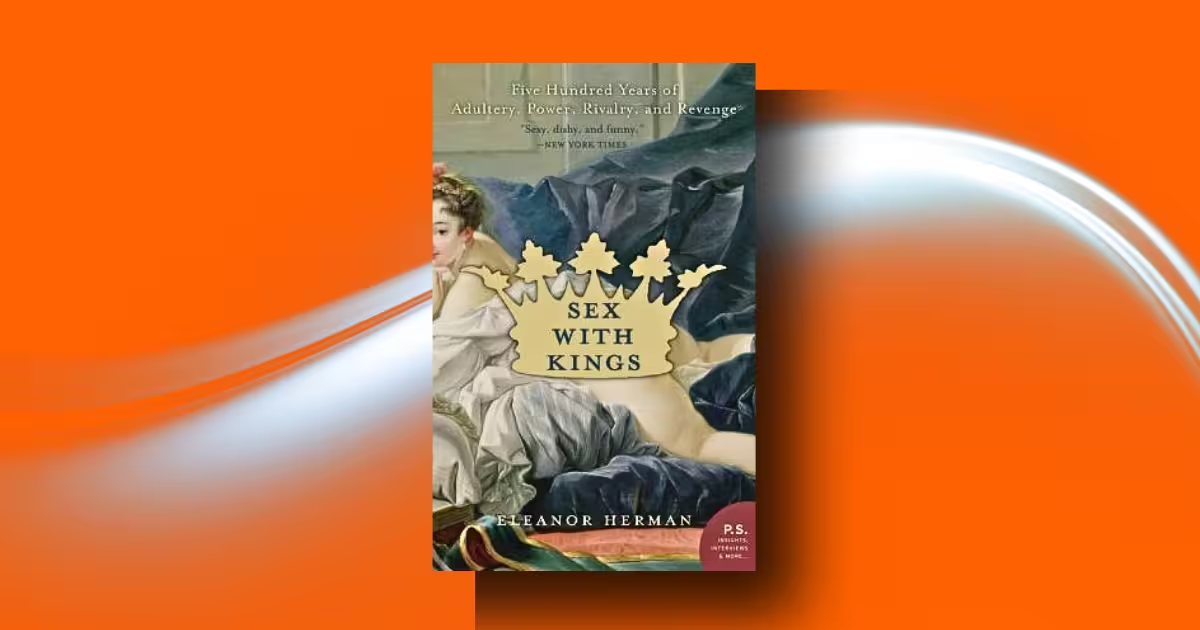
Sex with Kings: 500 Years of Adultery, Power, Rivalry, and Revenge is a popular-history book by Eleanor Herman, published by William Morrow/HarperCollins.
The publisher lists the book as Sex with Kings: 500 Years of Adultery, Power, Rivalry, and Revenge, and describes it as a history of royal mistresses who were “worshiped, feared, envied, and reviled,” women who set fashions, encouraged the arts, and in some cases influenced or “ruled nations, published on April 5, 2005.
Eleanor Herman is especially suited to this subject because her work sits at the meeting point of popular history, royal biography, women’s history, and scandal. JSTOR Daily identifies her as the New York Times bestselling author of The Royal Art of Poison, Sex with Kings, Sex with the Queen, and other popular histories; it also notes her television work with the History Channel and National Geographic.
The uploaded PDF’s author note adds that Herman studied journalism and German, worked as associate publisher for North America for NATO’s Nations and Partners for Peace magazine, and “writes history from a woman’s perspective.”
The central idea of Sex with Kings is simple but powerful: the royal mistress was not merely a lover.
She could be a political adviser, fashion leader, art patron, emotional nurse, public scapegoat, rival to the queen, mother of royal bastards, and sometimes the person closest to the king’s private mind.
Herman’s introduction gives the book its memorable thesis when she writes that the royal mistress often stood “in the shadows” while men occupied the historical spotlight, yet her presence could be felt behind the throne.
This is why I found Sex with Kings more valuable than its provocative title first suggests. At first glance, it looks like a book about adultery.
In reality, it is a book about systems: dynastic marriage, patriarchy, church morality, inheritance, propaganda, public opinion, class mobility, and the terrible bargain women made when their bodies became a route to influence.
Background: Why Royal Mistresses Existed
To understand Sex with Kings, we must first understand the failure built into most royal marriages. Royal marriage was rarely about love. It was about heirs, alliances, land, money, peace treaties, and dynastic legitimacy.
Herman’s first chapter states this bluntly: the purpose of royal marriage was not happiness, sexual compatibility, or personal affection, but the “production of princes.”
That one fact explains much of the book. A princess could be sent to a foreign court as a political package. She might not speak the language. She might never see her family again. She might be judged by fertility, not by personality.
The king, meanwhile, was expected to produce legitimate heirs with his queen while seeking affection, amusement, sex, and emotional ease elsewhere.
This created the role of the maîtresse-en-titre, the official royal mistress. Herman notes that François I of France was the first king to give this formal title to a favorite, and that by the sixteenth to eighteenth centuries the role could be “almost as official as that of prime minister.”
That is one of the book’s most important claims: in certain courts, especially France, the mistress became an institution.
The history also changes with technology. Herman explains that after the Renaissance and the spread of literacy, letters, diaries, memoirs, and diplomatic dispatches began preserving court gossip in detail.
She gives astonishing figures: Madame de Maintenon wrote more than 90,000 letters, Elizabeth Charlotte, duchesse d’Orléans, wrote 60,000 letters, and Madame de Sévigné wrote to her daughter three times a week for 25 years.
This matters because the book is not built only on legend. Herman’s bibliography shows her dependence on diaries, letters, dispatches, memoirs, biographies, and court histories.
In other words, royal mistresses became visible to history when Europe became more literate, more bureaucratic, and more addicted to gossip.
Sex with Kings Summary
1. The royal mistress was born from the misery of dynastic marriage
One of the book’s strongest sections is Herman’s description of royal marriage as emotional sacrifice. Kings married women chosen by ministers and families. Queens were selected for bloodline, dowry, diplomacy, and fertility. The result was often coldness or contempt.
Herman’s examples are darkly comic. Henry VIII’s disappointment with Anne of Cleves becomes a lesson in the danger of flattering portraits. Joseph II of Austria found his Bavarian bride so unattractive that he could not consummate the marriage. George IV of Britain married Caroline of Brunswick under pressure, produced an heir, and then avoided her.
The broader lesson is not simply that kings were cruel. It is that monarchy made cruelty convenient. A royal bride’s body belonged to the dynasty. A mistress, by contrast, could offer warmth, conversation, sex, style, and the feeling of being chosen rather than assigned.
This is why Benjamin Franklin’s epigraph to Chapter One — “When there’s marriage without love, there will be love without marriage” — fits the whole book.
2. Beauty helped, but it was not enough
The title may suggest that sexual attraction was everything, but Herman repeatedly argues the opposite.
In Chapter Two, she insists that beauty alone did not make a successful royal mistress. A woman who had only looks usually did not last. The truly successful mistress made herself indispensable.
This is where the book becomes unexpectedly educational. A royal mistress had to master emotional labor before that term existed. She needed to read the king’s moods, calm his anger, entertain his boredom, flatter his vanity, receive his secrets, manage his household pleasures, and remain cheerful under exhaustion.
Herman says the mistress had to cater to the king’s “five senses” and be ready to converse, comfort, serve, decorate, entertain, and even raise illegitimate children.
Madame de Pompadour becomes the perfect example. She entered Louis XV’s life as a beautiful woman, but she survived because she became his emotional infrastructure.
The Palace of Versailles also describes Pompadour as Louis XV’s “mistress, friend and advisor,” remaining with him until her death in 1764. Britannica similarly calls her an influential mistress from 1745, a patron of literature and the arts, and notes that her 20 years of power marked an artistic high point in France.
Herman’s portrait of Pompadour is one of the most painful in the book. She had to hide illness, grief, and exhaustion behind powder, rouge, jewels, and smiles. When her only child Alexandrine died in 1754, followed days later by her father, Pompadour still had to return to courtly performance.
This chapter made me feel that the royal mistress’s luxury was also a prison. Everyone saw the diamonds; few saw the discipline.
3. The queen and the mistress were forced into a cruel triangle
The book’s third major theme is rivalry between wife and mistress. Herman is excellent at showing that queens were not simply jealous women. They were political casualties.
A queen’s position depended on the king’s respect. If he honored her, courtiers honored her. If he humiliated her, the court followed. Herman writes that the king decided everything from the queen’s rooms to her servants to whether she would appear in public. Therefore, when a mistress rose, the queen’s dignity could collapse.
The example of Catherine Braganza, wife of Charles II, is unforgettable. Catherine arrived from Portugal in 1662, deeply hopeful, only to face Charles’s powerful mistress Barbara Palmer, Lady Castlemaine.
When Charles introduced Castlemaine to Catherine, the queen reportedly turned pale, wept, bled from the nose, and fainted.
I felt genuine pity reading this. Catherine was not merely being cheated on; she was being publicly trained to accept her own humiliation. The court became a theatre where the wife had to applaud the mistress or risk isolation.
Yet Herman also shows that queens could act strategically. Queen Marie Leszczyńska, wife of Louis XV, treated Madame de Pompadour with surprising grace. Pompadour repaid that kindness by persuading Louis to treat the queen better, send her gifts, and refurbish her rooms.
This is one of the book’s more human moments. In a brutal system, two women found a way not to destroy each other.
4. The mistress’s husband became a court joke — or a compensated loser
Another striking chapter concerns the husbands of royal mistresses. In a patriarchal society, a husband was supposed to control his wife’s sexuality. But what could he do if the rival was the king?
Some husbands accepted money, titles, offices, or social advancement. Others raged helplessly. The mistress’s marriage could become a legal fiction: she belonged publicly to her husband, privately to the king, and politically to the court.
This theme deepens the book’s argument because it shows monarchy distorting not only women’s lives but men’s honor. The king’s desire overruled ordinary morality. Everyone around him had to rearrange themselves.
5. The price of success was constant vigilance
Herman never lets us forget that being a royal mistress was dangerous work. A mistress could be replaced by a younger woman, ruined by pregnancy, attacked by enemies, mocked in pamphlets, poisoned by gossip, or destroyed when the king died.
This is why the book’s word “rivalry” matters. Mistresses competed with queens, sisters, courtiers, ministers, foreign ambassadors, priests, and other mistresses. Louis XV’s affairs with the Mailly-Nesle sisters are almost grotesque: one sister after another rose, replaced, maneuvered, and fell.
The mistress’s life demanded performance without rest. Herman’s most powerful insight is that the mistress was loved conditionally. The queen might be ignored, but she usually remained queen. The mistress, no matter how adored, could be dismissed “with a snap of the royal fingers.”
6. The wages of sin could be enormous
The book’s financial details are astonishing. Royal mistresses could receive pensions, estates, jewels, titles, palaces, servants, and privileges. Alice Perrers, mistress of Edward III, became one of the largest landowners in England; after the king’s death, Parliament confiscated her estates in 17 counties and jewels including 21,868 pearls.
Charles II’s mistresses also profited heavily.
Herman gives precise figures: by 1674, Lady Castlemaine was receiving £15,000 annually directly from the king, plus £10,000 from customs taxes, £10,000 from beer and ale taxes, £4,700 from the post office, and £3,500 from wine licenses. Louise de Kéroualle received £18,600, later rising to about £40,000, and in 1681 she received £136,000. Nell Gwynn received far less: £4,000 for herself and her two sons.
These numbers are not decorative. They reveal why the public hated mistresses. The royal mistress was not only a sexual scandal; she was a tax scandal. People saw their money turned into lace, diamonds, apartments, titles, and illegitimate children.
7. Political power often came through intimacy, not office
Chapter Seven, “Political Power Between the Sheets,” is the intellectual center of the book. Herman wisely rejects the simplistic idea that mistresses always ruled through sex.
She argues that many mistresses influenced politics indirectly: by calming kings, reporting moods, recommending timing, relaying information, and telling truths ministers dared not speak.
Some, however, wielded direct power. Diane de Poitiers, mistress of Henri II of France, signed documents, appointed ministers, imposed taxes, and sometimes joined her name to the king’s as “HenriDiane.”
Britannica confirms Diane’s extraordinary position, saying she held court “as queen of France in all but name” while Catherine de Médicis lived in comparative obscurity.
Gabrielle d’Estrées, mistress of Henri IV, is another major figure. Herman credits her with helping end the French religious civil war. In 1598, the Edict of Nantes granted Huguenots certain rights, and Herman presents Gabrielle as a key persuader behind that fragile compromise.
This is where Sex with Kings becomes more than gossip. It asks a serious historical question: how much power can a person wield without holding official power? The answer, in Herman’s book, is: a great deal.
8. Public opinion punished the mistress more than the king
One of the most modern-feeling chapters is “Red Whores of Babylon,” where Herman explores public opinion.
The public could not safely attack the king, so the mistress became the target. If she had children, she was accused of producing expensive bastards. If she had none, she was barren and useless. If she was beautiful, she was satanically seductive. If she was plain, she was unworthy.
If she spent money, she was greedy. If she lived simply, she diminished royal glory.
This double bind still feels familiar. Powerful women today are often criticized in contradictory ways: too ambitious or too passive, too sexual or too cold, too visible or not visible enough. Herman’s historical examples show that misogynistic public narratives are not new.
Madame de Montespan was called “Königs Hure” — the king’s whore — by German troops. Madame du Barry later became a victim of revolutionary vengeance. Pompadour, blamed for France’s failures, also became a symbol of court extravagance.
Britannica notes that defeats in the Seven Years’ War were laid at Pompadour’s door, even though the political reality was more complicated.
9. Royal bastards were both family and political currency
Chapter Nine, “The Fruits of Sin,” is one of the most revealing chapters. A mistress’s pregnancy could secure her future. A child tied her to the king even after romance faded. Herman writes that European courts were “littered with royal bastards.”
Charles II acknowledged 14 illegitimate children — nine sons and five daughters — and created dukedoms, earldoms, and marriages for many of them. This is not just scandal; it is statecraft. Bastards connected royal blood to noble families, distributed patronage, and created new factions.
Nell Gwynn’s story adds emotional complexity. She had two sons by Charles II, but because of her low birth she struggled to secure titles for them. Royal Collection Trust identifies Nell Gwyn as one of the first professional actresses on the London stage and mistress to Charles II, rising from humble origins. (rct.uk) Herman’s anecdote about Nell calling her son a “little bastard” until Charles gave him a better name is funny, sad, and politically sharp.
10. Death of the king usually ended the mistress’s world
A mistress’s power depended on the living king. When he died, her enemies often moved quickly. Catherine de Médicis forced Diane de Poitiers to surrender jewels and exchange Chenonceau for Chaumont after Henri II’s death.
Britannica confirms that after Henri died in 1559, Catherine forced Diane to restore crown jewels and accept Chaumont in exchange for Chenonceaux.
Some mistresses survived well. Others were banished, impoverished, or forgotten. The most tragic were those who became symbols of a collapsing regime. Madame du Barry, Louis XV’s final mistress, was executed during the French Revolution.
Herman frames this as the end of an era: the guillotine severed not only heads but the old glamour of official royal mistresses.
11. The modern monarchy changed the rules — but not desire
The final chapters bring the story toward Edward VIII, Wallis Simpson, Charles, Diana, and Camilla. Herman argues that the twentieth century did not eliminate royal desire; it changed the consequences.
Edward VIII’s decision to marry Wallis Simpson caused the 1936 abdication crisis, which connects directly to The King’s Speech that rightly notes that Edward VIII’s abdication thrust George VI unexpectedly onto the throne, and that George VI later had to lead Britain vocally during the crisis of World War II.
Sex with Kingsl Analysis
For me, Sex with Kings is a dazzling, uncomfortable, and highly readable work of popular history. It is not “important” because it reveals that kings had mistresses — everyone knows that.
It is important because it shows how adultery became a political arrangement, how women used limited tools inside a male system, and how society punished those women for playing a game men designed.
The book succeeds because Herman writes with energy. Her prose is dramatic, witty, and visual. I could almost hear the court shoes on marble, the rustle of silk, the whispering servants, the queen’s silence, the mistress’s laughter, and the crowd outside sharpening its moral knives.
That emotional vividness makes the book accessible to general readers.
At the same time, the book’s greatest pleasure can also be its danger. Herman sometimes leans hard into colorful judgment.
Words like “ugly,” “dull,” “stupid,” “whore,” and “harlot” appear often because she is partly channeling court language and period prejudice, but modern readers may sometimes feel the tone is too sharp or too amused by humiliation.
I did not find this fatal to the book, but I did notice it.
The strongest scholarly contribution is thematic rather than archival. Herman organizes the subject by roles — mistress, queen, husband, bastard, public opinion, money, politics, death — instead of giving a strict chronological history. That structure makes the book extremely useful for readers who want to understand patterns. It also makes the book ideal for questions: “What was a royal mistress?”, “How much power did mistresses have?”, “Why did kings keep mistresses?”, “How were royal bastards treated?”, “Why did queens tolerate mistresses?”
Does Herman prove her thesis? Mostly, yes. The examples of Diane de Poitiers, Gabrielle d’Estrées, Madame de Pompadour, Madame de Montespan, Nell Gwynn, Lady Castlemaine, Lola Montez, and Wallis Simpson support the argument that the royal mistress was an institution shaped by sex, power, money, public opinion, and dynastic anxiety.
But I would add one caution: not every mistress had equal agency. Some were strategic operators. Some were survivors.
Some were exploited. Some were ambitious. Some were trapped. The title may make the subject sound glamorous, but the book itself often reveals a more painful truth: in monarchy, intimacy was rarely innocent.
Strengths and Weaknesses
Strengths
The first strength is readability. Herman can turn archival history into scenes that feel alive. The book moves quickly without feeling shallow.
The second strength is the women-centered lens. The author does not treat mistresses as footnotes to kings. She places them at the center of court life, culture, and politics. This is why the book feels like a missing chapter of women’s history.
The third strength is the range of examples. The book moves from Alice Perrers and Agnes Sorel to Diane de Poitiers, Pompadour, du Barry, Nell Gwynn, Lola Montez, Lillie Langtry, Wallis Simpson, and Camilla Parker-Bowles. It covers roughly 500 years of European royal adultery, which gives the reader patterns rather than isolated scandals.
The fourth strength is its understanding of emotional labor. Pompadour’s story, especially, shows how exhausting it was to be charming for a living.
The fifth strength is the financial and political detail. Figures like Alice Perrers’s 21,868 pearls, Charles II’s 14 acknowledged bastards, and Lady Castlemaine’s multiple pensions make the history concrete.
Weaknesses
The first weakness is tone. The book sometimes enjoys cruelty in a way that may bother readers who prefer more restrained historical writing.
The second weakness is that the book is broad rather than deep on every individual. Readers wanting a full biography of Pompadour, Diane, Nell Gwyn, or Wallis Simpson will need additional books.
The third weakness is that some anecdotes from court memoirs are inherently difficult to verify. Herman knows this and says memoirs must be read carefully, but popular history always walks a line between documented fact and irresistible story.
The fourth weakness is that the book’s sexual framing may overshadow other forms of female influence.
Still, Herman often corrects that by showing women as patrons, diplomats, political intermediaries, and emotional advisers.
Comparison with Similar Works
Readers who enjoy Sex with Kings may also like Herman’s Sex with the Queen, which reverses the lens and examines queens’ love affairs. They may also enjoy The Royal Art of Poison, where Herman explores toxic cosmetics, filthy palaces, and deadly royal medicine; JSTOR Daily lists it among her popular-history works.
For a single-figure biography, Nancy Mitford’s Madame de Pompadour remains a classic source, and Britannica’s Pompadour article is written by Mitford and fact-checked by Britannica editors.
For Diane de Poitiers, Britannica provides a compact corrective, emphasizing both her influence and the limits of her public role.
Compared with academic monarchy studies, Herman’s book is more entertaining and less cautious. Compared with scandal blogs, it is far more researched and historically layered. That middle position is exactly why the book works.
Conclusion: Should You Read Sex with Kings?
Yes — if you read history not only for dates and battles but for human motives. Sex with Kings is a sharp, theatrical, and surprisingly educative book about how private desire shaped public power.
It shows that behind royal portraits and state ceremonies were women negotiating impossible roles: lover, servant, strategist, ornament, mother, scapegoat, patron, and sometimes unofficial minister.
I would recommend it to general readers, students of women’s history, fans of royal biographies, and anyone curious about monarchy beyond the throne room.
Specialists may want more footnoted caution and deeper archival debate, but even they may appreciate Herman’s talent for pattern, personality, and narrative force.
My final feeling is this: Sex with Kings is not merely a book about sex with kings.
It is a book about what happens when women are denied official power but discover that unofficial power can still move armies, bankrupt treasuries, decorate palaces, wound queens, create dukes, and change history.