
Last updated on April 25th, 2026 at 03:18 pm
Why did kings and queens fear poison at the dinner table, in their makeup, in their medicine, and even in their underwear? Reading The Royal Art of Poison made me feel that history is not only written in crowns and wars, but also in arsenic, lice, cosmetics, chamber pots, medical ignorance, and human fear.
The Royal Art of Poison is best for readers who love historical nonfiction, royal scandals, forensic history, medical history, true crime, toxicology, Renaissance Europe, Tudor history, poison mysteries, and books that reveal the ugly truth behind beautiful palaces.
It is especially valuable for readers who enjoyed works about the Medicis, Borgias, Versailles, Napoleon, Mozart, Elizabeth I, and the strange history of medicine.
Not for readers who dislike graphic descriptions of illness, vomiting, autopsies, corpses, bodily waste, medical cruelty, or darkly comic history.
This is not a dry academic monograph, but it is also not a soft royal biography. It is vivid, filthy, funny, disturbing, and often physically uncomfortable.
Table of Contents
1. Introduction: What Is The Royal Art of Poison About?
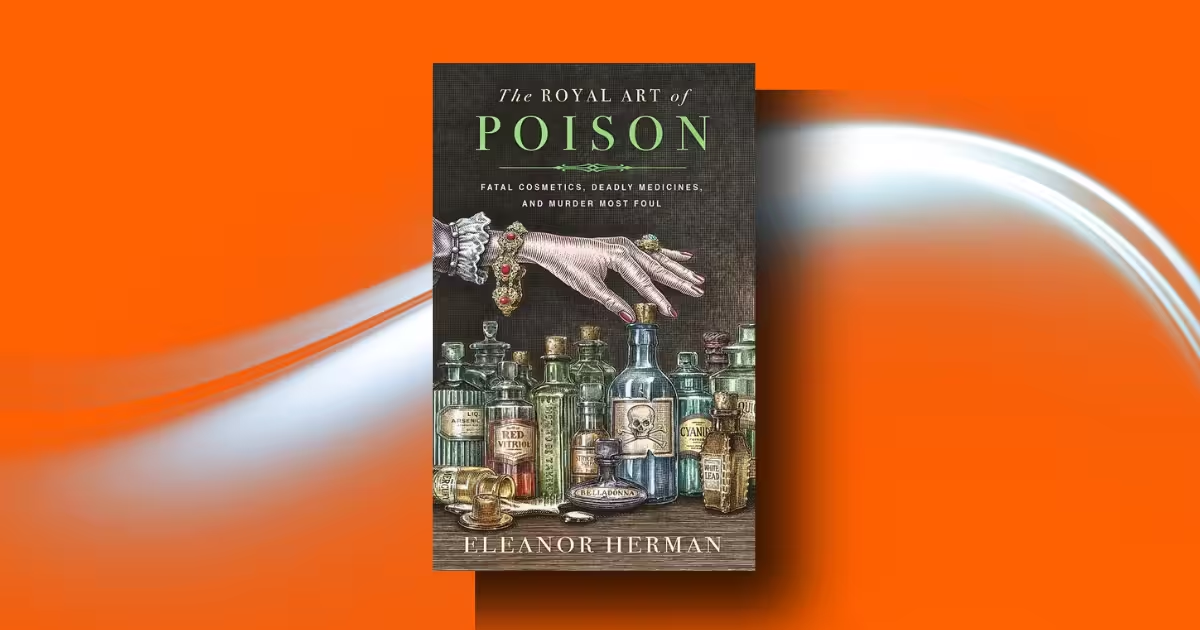
The Royal Art of Poison: Filthy Palaces, Fatal Cosmetics, Deadly Medicine, and Murder Most Foul is a 2018 historical nonfiction book by Eleanor Herman, published in its first edition by St. Martin’s Press, and its subjects include poisoning, murder victims, biography, and European history.
Eleanor Herman is known for writing lively, scandal-rich royal history. In this book, however, she does something more intellectually useful than simply retelling gossip.
She takes the old rumor—“he was poisoned,” “she was poisoned,” “the king was murdered,” “the mistress was assassinated”—and tests it against modern forensic science, medical knowledge, toxicology, autopsy records, archival evidence, and historical context.
The book opens with a horrifying scene: in 1670, Henrietta, duchesse d’Orléans, cries, “I am poisoned!” after drinking chicory water at the court of Louis XIV.
Her agony lasts nine hours, and her death becomes one of the book’s central examples of how quickly a royal death could become a political mystery.
The central thesis is clear: people at royal courts lived in terror of poison, but they were often poisoning themselves every day through cosmetics, medicines, food, water, filthy surroundings, and ignorant medical treatments.
Herman writes that behind the dazzling portraits and jeweled robes were lice, bacteria, excrement, dangerous beauty recipes, toxic remedies, and political murder.
Google Books describes the work as a “pop history” of poison as both a political and cosmetic tool in Western European royal courts, combining archival history with forensic discoveries.
That description is accurate, but it does not fully capture the book’s emotional effect. For me, the real power of The Royal Art of Poison is that it permanently changes how one looks at monarchy.
After reading it, a palace no longer feels purely glamorous. It feels dangerous, damp, infected, perfumed, powdered, watched, and afraid.
2. Background: The World Behind the Book
The historical world of The Royal Art of Poison is a world before germ theory, before modern toxicology, before safe cosmetics, before antibiotics, before proper sanitation, and before reliable forensic pathology.
Royal people had money, servants, jewels, castles, titles, and armies, but they did not have what most of us now take for granted: clean water, evidence-based medicine, safe pharmaceuticals, sterile childbirth, modern dentistry, and scientific diagnosis.
That is why the book is not only about poison as murder. It is about poison as environment.
Herman’s opening argument is that European palaces were full of toxins in several overlapping forms.
There was intentional poison: arsenic in wine, mercury compounds, suspicious powders, and political assassination plots. There was accidental poison: lead face paint, mercury cosmetics, arsenic powders, gold elixirs, contaminated food, and rotten water.
There was medical poison: antimony, mercury, arsenic, bloodletting, purges, enemas, and bizarre humoral treatments. And finally, there was social poison: paranoia, court rivalry, religious hatred, inheritance panic, and political ambition.
3The Royal Art of PoisonSummary
Poison was real—but paranoia was also real
The first major lesson of The Royal Art of Poison is that royal paranoia was not entirely foolish. Courts really did contain poisoners. Herman shows that Italy, especially Medici Tuscany and Venice, had a reputation as the heart of Renaissance poison culture.
The Medici archives contain references to assassination plots, poison instructions, and political murder. The Venetian Council of Ten, active from 1310 to 1797, used assassination by “secret, careful, and dexterous means”—a phrase Herman identifies as a clear reference to poison.
One striking statistic is Matthew Lubin’s identification of 34 cases of Venetian state-sponsored political poisoning between 1431 and 1767. Of those, 11 failed, 9 succeeded, 2 victims apparently died naturally before the poison was used, and 12 outcomes were unrecorded.
This detail gives the book historical weight. It is not just repeating legends about the Borgias and Medicis. It shows that poison was an actual tool of statecraft.
The book also discusses Giulia Toffana, executed in 1659, who allegedly sold poison for around 50 years, mostly to women who wanted to become widows. Her poison, Aqua Toffana, became infamous as a colorless, tasteless mixture associated with arsenic, lead, and belladonna. Herman reports the estimate that it killed around 600 people.
Even allowing for exaggeration, the number shows why seventeenth-century Europe feared invisible death at the table.
Then comes the famous French poisoning panic. In 1676, the Marquise de Brinvilliers was executed for poisoning her father and brothers.
Three years later, 319 people were arrested in and around Paris, and 36 were sentenced to death for poisoning. This is one of the book’s best examples of how murder, rumor, class anxiety, and court scandal could feed one another.
Kings tried to protect themselves in strange ways
One of the most memorable sections of the book is about poison-prevention rituals. Kings and queens did not simply eat. They had their meals tested, carried, kissed, guarded, and ceremonially inspected.
Henry VIII had around 200 people working in his kitchens at Hampton Court.
That meant hundreds of hands could touch royal food before it reached the king. Naturally, this made monarchs anxious. Food tasters existed, but Herman explains why tasters were not as useful as people believed: poison does not always act immediately. A person could eat arsenic and not collapse for hours.
This means the royal taster might appear perfectly fine while the king sat down to eat.
The book gives a telling example from 1867, when 20 guests at an Illinois hotel ate biscuits accidentally made with arsenic instead of flour. They became sick over several hours, not all at once, and none died. This makes royal tasting protocols look less like science and more like ritual theater.
At Versailles, the ritual became almost absurd. According to the 1712 edition of État de la France, Louis XIV employed 324 people to serve the royal table in his later years.
Servants tested tablecloths, napkins, cups, dishes, cutlery, toothpicks, wine, water, and even the king’s hand-washing water.
The process was meant to protect him from poison, yet Herman points out the irony: with so much kissing, rubbing, handling, and reheating, the king was probably more likely to be sickened by germs than by arsenic.
This is where Herman’s dark humor works beautifully. The court thinks it is fighting secret murder, but it is actually spreading bacteria in the name of safety.
Poison fears extended to clothes, paper, beds, saddles, and air
Another fascinating part of The Royal Art of Poison is the fear of poisoned objects. Monarchs were not only afraid of eating poison; they feared touching it. Henry VIII’s servants kissed his bedding to prove they had not smeared poison on it.
Clothing for Prince Edward had to be washed, aired, and tested before he wore it. Elizabeth I’s underwear and anything touching her bare skin had to be guarded and inspected.
To modern readers, this sounds comic. But Herman makes it psychologically believable. In a world without toxicology, every rash could be interpreted as an assassination attempt. Every stomachache could become treason. Every Italian courtier could become a suspect.
Yet she also corrects the fear.
She explains that most poisons absorbed through adult skin would likely have caused burning or rash rather than death. One documented exception involved an infant in 1857 whose body was dusted with arsenic mistaken for baby powder. In other words, the fear had a small scientific basis, but it was wildly misunderstood.
The same applies to fears of poisoned air.
People imagined poisoned incense, poisoned petitions, and poisoned pomanders. Herman notes that inhaled poison could be extremely dangerous if delivered effectively, but dried poison on paper would probably not retain enough strength to kill someone.
Again, the book’s pattern appears: rumor contains a grain of truth, but ignorance magnifies it into panic.
Medicine was often more dangerous than the disease
For me, the most disturbing part of the book is not murder. It is medicine.
Royal doctors worked under humoral theory: the body supposedly contained four humors—blood, phlegm, black bile, and yellow bile—and illness came from imbalance.
Doctors tried to restore balance through bloodletting, purging, sweating, vomiting, blistering, enemas, and toxic compounds.
Herman shows that doctors often gave patients mercury, arsenic, antimony, lead, gold, and silver as medicine.
The tragedy is that the sicker the patient became, the more medicine they received. And the more medicine they received, the sicker they became.
This is one of the book’s strongest arguments: many “mysterious royal illnesses” were probably caused or worsened by treatment.
George III is the clearest example. Herman discusses the theory that he suffered from porphyria and that arsenic-based medicines may have triggered or worsened his attacks. In 2003, a lock of his hair was found and tested; it contained more than 300 times the normal level of arsenic.
That fact stayed with me. We often remember George III as “mad,” but Herman pushes us to ask a more humane question: how much of that madness was made worse by the doctors trying to cure him?
The book also discusses syphilis treatment with mercury. The phrase “a night with Venus, a lifetime with Mercury” captures the historical horror. Mercury could reduce syphilitic symptoms because it harmed the bacteria, but it also harmed the patient.
Treatments caused salivation, tooth loss, mouth ulcers, tremors, brain damage, and death. This part of the book is a reminder that before modern antibiotics, a cure could be another kind of torture.
Beauty was poisonous
The cosmetics chapter, “Dying to Be Beautiful,” is one of the most unforgettable sections.
Herman shows that Renaissance and early modern beauty routines often involved lead, mercury, arsenic, antimony, belladonna, sulfur, urine, human fat, and animal waste.
Queen Elizabeth I becomes the main example. After smallpox in 1562, she reportedly used ceruse, a white lead-based makeup, to cover facial scarring. Lead could cause hair loss, muscle paralysis, mood problems, cognitive decline, skin damage, and wrinkles—ironically creating the very flaws the makeup was supposed to hide.
The story of Maria, Countess of Coventry, is even more direct. Known for heavy cosmetic use, she suffered headaches, swollen eyes, receding gums, loose teeth, hair loss, and tremors before dying in 1760 at age 28. The press called her a victim of cosmetics.
The book’s beauty chapter also discusses Diane de Poitiers, mistress of King Henri II of France. She took “drinkable gold” to preserve youth and beauty. In 2008, researchers examined her remains and hair; her hair contained gold 250 times higher than expected and dangerously high mercury.
Herman explains that chronic gold poisoning likely contributed to her death in 1566.
This chapter felt painfully modern to me.
We may laugh at lead face paint, but the desire behind it is not dead. People still risk health for beauty, status, youth, whiteness, thinness, and social approval. Herman’s book is historical, but its mirror is contemporary.
Palaces were not clean dreams; they were poisoned environments
The title’s phrase “filthy palaces” is not exaggeration. Herman describes royal residences full of chamber pots, overflowing latrines, urine-soaked staircases, lice, contaminated wells, animal waste, and spoiled food.
At Hampton Court, Henry VIII’s Great House of Easement had 28 toilet holes, and the waste beneath could rise head-high before being cleaned.
Versailles was even worse because it housed thousands of courtiers and servants but was not conveniently located beside a river that could carry waste away. Human waste had to go somewhere, and often it went into carts, cesspits, staircases, corners, or the air.
This matters because many supposed poisonings may have been food poisoning, malaria, dysentery, infection, or contaminated water.
Herman explains that arsenic poisoning, food poisoning, and certain infections could share symptoms: abdominal pain, vomiting, diarrhea, confusion, dehydration, coma, and death. But fever is a crucial clue.
Arsenic generally does not cause fever, whereas malaria and infection often do. That distinction allows Herman to re-examine famous deaths.
The example of Pope Alexander VI and Cesare Borgia is especially useful. Both became ill after dining outdoors in August 1503. Rumor claimed poison, but Herman points out that symptoms appearing over a week fit malaria better than arsenic.
This is exactly where the book becomes more than gossip. It teaches the reader how to think diagnostically.
The second half: famous poison cases tested by science
The book’s second half, “The Poison Chronicles,” examines twenty royal or courtly figures rumored to have been poisoned.
These include Henry VII of Luxembourg, Agnes Sorel, Jeanne d’Albret, Ivan the Terrible, Francesco I de’ Medici and Bianca Cappello, Tycho Brahe, Caravaggio, Sir Thomas Overbury, Mozart, Napoleon, and others.
Open Library’s table of contents confirms this structure, including the movement from general poison culture into specific cases where rumors meet scientific analysis.
The Francesco and Bianca case is one of the richest. Francesco I de’ Medici and his wife Bianca Cappello became ill in October 1587 after hunting and feasting. Their symptoms included fever, vomiting, diarrhea, abdominal pain, sweating, thirst, breathing difficulty, and convulsions. Francesco died on October 19, and Bianca died on October 20.
Was it poison? Herman gives both sides. Some modern researchers argued arsenic poisoning, but the presence of high fever points strongly toward malaria. She does not force a simplistic conclusion.
Instead, she suggests a possibility: they may have had malaria, and poison may have been added later to prevent recovery.
That balanced uncertainty is one of the book’s strengths. Herman loves the drama, but she does not always choose the most sensational answer.
Tycho Brahe is another excellent example. He was long rumored to have been poisoned, sometimes with suspicion falling on Johannes Kepler. But modern exhumation and analysis complicate the story. Herman uses the case to show how science can either confirm or quiet old rumors.
Napoleon and Mozart also appear because they are among the most famous “was he poisoned?” historical mysteries. Herman does not simply repeat conspiracy theories. She examines symptoms, autopsies, treatments, environmental exposures, and later analysis.
The modern era: poison did not disappear
One of the book’s most sobering points is that poison is not sealed in the Renaissance. Herman moves into modern political poisoning and shows that poison remained a tool of terror.
The book ends with Kim Jong-nam’s death, using it as evidence that political poison still has symbolic power. Herman argues that Kim Jong-un wanted the world to see ruthlessness on video, making poison not only a weapon but a message.
The conclusion is surprisingly reflective. Herman says she would not want to be a princess in the past, despite loving beautiful gowns, jewels, and palace pageantry.
After everything she has shown—worms, germs, mercury, arsenic, bad medicine, childbirth infection, and political fear—the fantasy collapses.
That final mood is important. The book is funny, grotesque, and entertaining, but underneath it is a meditation on human fragility. We are proud creatures, yet our bodies can be undone by a powder, a doctor, a beauty ritual, a cup of wine, a mosquito, or dirty hands.
4. The Royal Art of Poison Analysis
The Royal Art of Poison is an outstanding, gruesome, witty, and educational work of popular history. It is not merely a book about poison; it is a book about how power fails to protect the body.
What impressed me most is how Eleanor Herman balances entertainment with evidence. She has the narrative energy of a gossip columnist at Versailles, but she also respects forensic science. Her best move is not asking, “Who murdered this royal?” but asking, “Was this even murder?”
That question makes the book more mature than a simple catalogue of assassinations.
The book fulfills its purpose very well. It explains why poison rumors spread, why some were justified, why many were medically wrong, and why royal life was far more dangerous than popular imagination suggests.
It contributes meaningfully to historical nonfiction because it sits at the intersection of court politics, medical ignorance, toxicology, forensic investigation, and cultural history.
The strongest argument of the book is that the greatest poisoner was often not the assassin but the age itself. Bad medicine, toxic beauty, infected childbirth, contaminated water, and filthy palaces killed more reliably than secret enemies.
At the same time, Herman does not overcorrect. She does not claim that all poison rumors were false.
The Medici and Venetian evidence proves that poison was sometimes used as a political instrument.
The book’s intelligence lies in this balance: yes, murder happened; no, not every mysterious death was murder.
5. Strengths and Weaknesses
Strengths
The first strength is readability. Herman writes with speed, wit, and sensory detail. I never felt I was reading a cold archive. I felt I was walking through a palace where perfume could not hide the latrine.
The second strength is thematic unity. Every chapter supports the same larger idea: royal beauty and royal danger were inseparable. Food, cosmetics, medicine, and architecture all become part of one poisoned ecosystem.
The third strength is forensic thinking. Herman uses symptoms, autopsy reports, exhumations, hair analysis, and toxicology to test historical claims. The sections on Diane de Poitiers, George III, Francesco and Bianca, and Tycho Brahe are especially strong because they show history being reopened by science.
The fourth strength is statistical detail. The book uses memorable figures: 34 Venetian poisoning cases, 319 arrests in the Paris poison panic, 36 death sentences, 324 servants for Louis XIV’s table, 200 kitchen workers for Henry VIII, 250-times-higher gold in Diane de Poitiers’s hair, and over 300-times-normal arsenic in George III’s hair. These figures make the horror concrete.
The fifth strength is moral humility. Herman refuses to let modern readers feel too superior. Yes, Renaissance people used mercury and lead, but we also live with environmental toxins, risky beauty industries, dangerous medicines, and technologies whose long-term effects we do not always understand.
Weaknesses
The main weakness is that the book sometimes leans heavily into the grotesque. Personally, I enjoyed that because it makes the history vivid, but some readers may feel the humor occasionally competes with the seriousness of suffering.
Another weakness is that the book’s broad scope means some cases receive less depth than they could.
A specialist in Napoleon, Mozart, or Elizabeth I might want more scholarly debate. Herman gives enough for general readers, but not always enough for academic closure.
A third weakness is that the book sometimes depends on historical reports that are themselves sensational, biased, or medically confused. To her credit, Herman often acknowledges uncertainty. Still, readers should remember that historical diagnosis is never perfect when the body is missing, the autopsy is old, or the witnesses were politically motivated.
Finally, because the book is so entertaining, some readers may underestimate how serious its research question is. This is not merely “funny history.” It is a study of how societies misread bodies when science is weak.
6. Comparison with Similar Works
Readers who enjoy The Royal Art of Poison may also like John Emsley’s The Elements of Murder, which focuses more directly on poisonous elements and chemical history.
Emsley is more chemistry-driven, while Herman is more narrative, royal, and character-centered.
It also pairs well with books about the Borgias, Medicis, Versailles, Tudor medicine, and the history of cosmetics.
Compared with many royal biographies, Herman’s book is less interested in romance and succession alone and more interested in the body: what people ate, wore, swallowed, applied, inhaled, feared, and excreted.
Compared with true crime books, The Royal Art of Poison is broader and more educational. It does not simply ask who killed whom. It asks why entire societies believed poison was everywhere—and why, in a grimly literal sense, they were often right.
Compared with popular medical history, Herman’s style is more dramatic and accessible. She makes toxicology feel like palace gossip and palace gossip feel like forensic evidence, as in Sex With The Queens and Sex With Kings.
7. Conclusion
The Royal Art of Poison is best for general readers, students, history lovers, true crime readers, and anyone interested in royal courts, forensic science, medical history, Renaissance Europe, and the dark side of beauty.
Specialists may want deeper footnoted debate, but for most readers this book is more than enough to understand the essential themes and major cases.
My personal feeling is simple: this book made me grateful to live now.
Not because the modern world is pure or safe, but because I can wash my hands, question a doctor, read a medicine label, avoid lead makeup, and drink water without imagining that every cup is a political weapon.
Eleanor Herman shows that monarchy was not only crowns, velvet, banquets, and portraits.
It was also fear, infection, arsenic, mercury, lice, bad air, rotten medicine, and the desperate human wish to survive inside a body that could betray you at any moment.







