
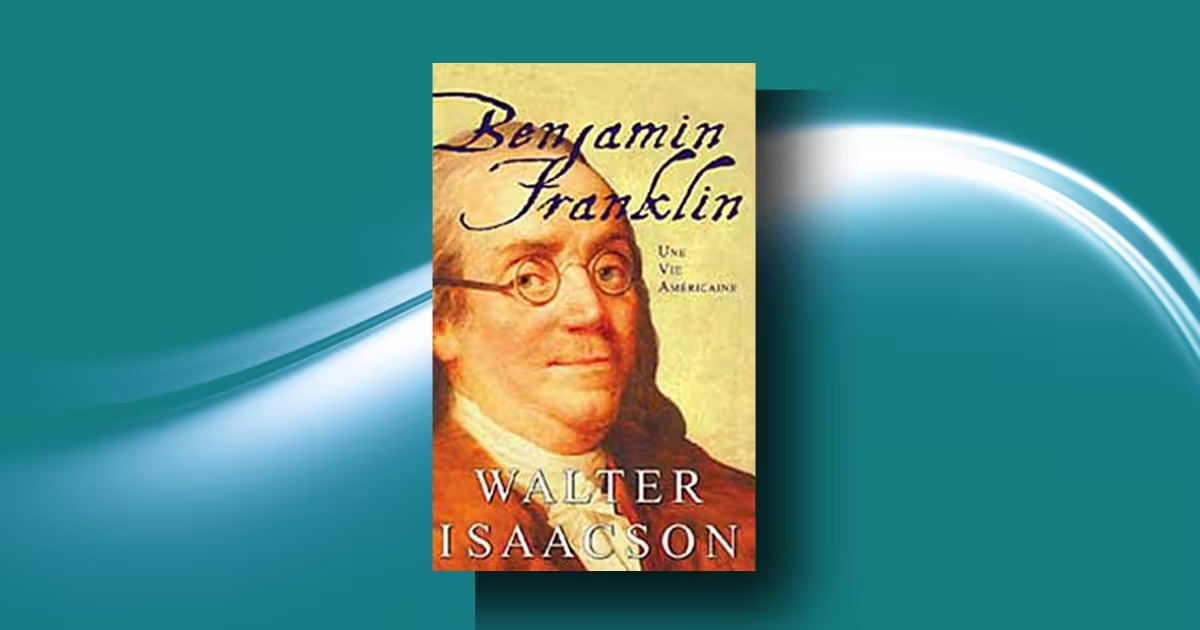
Why does Benjamin Franklin still feel less like a dead Founding Father and more like a living mentor for ambition, character, money, science, politics, and public life? I read Benjamin Franklin: An American Life by Walter Isaacson as a biography, but it hit me more like a practical mirror: funny, uncomfortable, inspiring, and deeply human.
Benjamin Franklin is best for readers who love biographies, American history, the American Revolution, Founding Fathers, self-improvement, science history, diplomacy, entrepreneurship, journalism, publishing, political leadership, and books about how a person builds a public identity.
Not for readers who want a short inspirational summary, a pure heroic portrait, or a highly academic biography with dense historiographical argument on every page. Isaacson writes for serious general readers, but his Franklin is too complex to be consumed as a simple “success story.”
Table of Contents
1. Introduction
Benjamin Franklin: An American Life is a major historical biography by Walter Isaacson, first published by Simon & Schuster in 2003.
The official Simon & Schuster page presents the book as a full-scale biography of Franklin’s eighty-four-year life, following him from Boston to Philadelphia, London, Paris, and back while exploring his work as printer, inventor, scientist, diplomat, political thinker, and architect of American identity.
Walter Isaacson is especially suited to this kind of life story because his own career sits at the intersection of journalism, institutions, public culture, and biography. He also writes a biography of Steve Jobs.
Tulane’s official biography describes him as a Professor of History at Tulane, former editor of Time, former chairman and CEO of CNN, and former CEO of the Aspen Institute; it also lists Benjamin Franklin: An American Life among his major biographies.
That background matters, because Isaacson is drawn to people who do not merely live inside history but also shape networks, media, institutions, and myths around themselves.
The book’s genre is narrative nonfiction biography, but its subject is bigger than one man.
It is about the invention of a public self, the rise of middle-class civic culture, the Enlightenment belief in practical knowledge, and the birth of an American style: industrious, humorous, pragmatic, skeptical of inherited privilege, and eager to turn private ambition into public usefulness.
Isaacson’s central thesis is that Franklin’s greatest invention was not only the lightning rod, bifocals, the Franklin stove, or civic organizations.
Franklin’s deepest invention was Franklin himself: a self-made persona that helped define what a self-made American could look like.
Isaacson calls him the “founding father who winks at us,” a phrase that captures the whole charm of the book: Franklin is not marble; he is flesh, wit, appetite, ambition, and calculation.
My own immediate feeling is this: Benjamin Franklin: An American Life is a marvelous, absorbing, and morally complicated biography. It made me admire Franklin more, but it also made me trust heroic myths less.
2. Background: Why Benjamin Franklin Matters
Benjamin Franklin was born in Boston on January 17, 1706, and died in Philadelphia on April 17, 1790, at age eighty-four. Isaacson frames those eighty-four years as a bridge from Puritan colonial society to Enlightenment science, republican politics, modern media, and American national identity.
Franklin begins life as the son of a candle and soap maker, with limited formal schooling, and becomes a printer, publisher, satirist, inventor, scientist, civic organizer, colonial agent, revolutionary, diplomat, constitutional elder, and abolitionist in his final public phase.
What makes Franklin different from Washington, Jefferson, Adams, or Hamilton is not simply that he did many things.
It is that he did many practical things.
Isaacson repeatedly shows Franklin solving problems in ordinary life: how to read more books, how to organize neighbors, how to prevent fires, how to improve streets, how to circulate news, how to make money, how to persuade opponents, how to build trust, how to tame lightning, how to win French support, and how to keep a fragile constitutional convention from collapsing.
Benjamin Franklin: An American Life’s background is also the rise of the American middle class.
Franklin is not presented as a nobleman or a warrior-aristocrat. He belongs to the leather-apron world of printers, tradesmen, shopkeepers, mechanics, and self-educated strivers. Isaacson argues that Franklin helped turn this world into a source of national pride.
He valued diligence, frugality, usefulness, voluntary association, and public improvement; these became not just personal habits but American civic ideals.
That is why this biography still feels modern. Franklin is a media entrepreneur before modern media, a personal brand builder before personal branding, a networker before LinkedIn, a civic innovator before nonprofit culture, and a public intellectual before the phrase existed.
3. Benjamin Franklin: An American Life Summary
Franklin the runaway: the first act of self-invention
Isaacson begins with one of the most famous scenes in American autobiography: the seventeen-year-old Franklin arriving in Philadelphia, tired, awkward, and hungry, carrying bread rolls through the streets.
The scene matters because Franklin later rewrites it as the origin story of a self-made man. Deborah Read, his future wife, sees him looking ridiculous; the older Franklin, recalling the moment, turns embarrassment into charm and social ascent into comedy.
This is where Isaacson’s Franklin becomes fascinating. He is not merely rising in the world; he is learning how to narrate his rise. He knows that humility can be a tool, that self-deprecation can hide pride, and that a good story can become a public identity.
Boston, printing, and the birth of an American voice
Franklin grows up in Boston, where Puritan seriousness, print culture, and dissenting argument shape him. He is apprenticed to his older brother James, who publishes the New England Courant.
Isaacson gives James more credit than Franklin himself often did: the Courant was one of America’s first fiercely independent newspapers, and it helped create the irreverent press tradition that Benjamin would later master.
As a teenager, Franklin writes the Silence Dogood essays, pretending to be a witty widow.
These essays are important because they show three things at once: his gift for disguise, his ear for public opinion, and his early suspicion of religious-political hypocrisy. He learns that a persona can speak more freely than a named young apprentice.
He also learns that satire can be a weapon, but a dangerous one.
Philadelphia and the practical gospel of work
After running away, Franklin becomes a printer in Philadelphia. Here Isaacson’s biography turns into a study of disciplined ambition. Franklin works hard, cultivates useful friends, and carefully manages appearances.
He understands that reputation is not fake if it is built on real habits; but he also understands that being seen as industrious matters almost as much as being industrious.
When he and Hugh Meredith print a Quaker history, Franklin works late into the night and rebuilds a broken plate rather than delay the job. Neighbors notice. A local merchant praises his extraordinary industry. Franklin then makes a public habit of carrying paper through the streets himself, a symbolic performance of work ethic.
This section of Benjamin Franklin: An American Life taught me one of Franklin’s most uncomfortable lessons: character and marketing are not always opposites. Sometimes the world rewards virtue only after virtue becomes visible.
The Junto: self-improvement becomes civic improvement
In 1727, Franklin forms the Junto, also known as the Leather Apron Club. This group of young tradesmen meets to debate, exchange knowledge, help each other professionally, and propose public improvements. It is one of the most important parts of Isaacson’s argument because it shows Franklin’s genius for turning sociability into institutions.
The Junto leads toward many Franklin-style projects: a subscription library, fire company, police patrol ideas, educational plans, scientific discussion, and civic problem-solving. Franklin’s genius is not solitary. He builds circles, then turns circles into systems.
This is why Isaacson’s Franklin feels different from the lonely genius stereotype. He is brilliant, yes, but his deeper power is organizational. He knows how to get ordinary people to do useful things together.
Poor Richard, money, and the ethics of usefulness
Franklin’s Poor Richard’s Almanack becomes a cultural engine for his ideas about thrift, work, timing, reputation, and practical wisdom. Isaacson does not reduce Franklin to money-making maxims, but he does show how Franklin made plain advice memorable.
His economic creed can be compressed into “Industry and Frugality,” and Isaacson notes that Franklin’s advice to a young tradesman urged people to “waste neither time nor money.”
Still, Benjamin Franklin: An American Life is careful: Franklin was not merely greedy. He wanted wealth because it brought independence, and independence allowed public service.
That is one of the book’s strongest insights. Franklin’s retirement from active printing did not lead him into idleness; it freed him for science, politics, diplomacy, and reform.
Science: curiosity with public consequences
Franklin’s scientific career is one of the most exhilarating parts of the biography. Isaacson presents him as a first-rate experimental mind, especially in electricity.
Franklin’s work on the one-fluid theory of electricity, conductors and insulators, grounding, capacitors, batteries, and lightning made him famous in Europe and America.
Isaacson cites the judgment that Franklin helped transform electricity from curiosity into science, and he emphasizes that proving lightning was electrical had immediate practical value because the lightning rod saved lives and buildings.
This section matters because Franklin’s science is not separated from his politics.
The same habits appear everywhere: observe, test, simplify, improve, share, and make useful. His mind moves from stove design to ocean currents, from electricity to public institutions, from bifocals to constitutions.
In 1784, he describes his “Double Spectacles,” the invention now known as bifocals, as a practical solution to the annoyance of switching between two pairs of glasses.
For me, this was one of the book’s happiest surprises. Franklin is not just a kite-and-key legend. He is a restless experimentalist who treats daily inconvenience as an invitation to invent.
Civic institutions: the city as Franklin’s workshop
Franklin’s Philadelphia becomes his laboratory. He helps launch or inspire a lending library, fire company, academy, hospital, insurance association, and other civic projects. Isaacson makes clear that these efforts were not side notes.
They are central to Franklin’s vision of society: private citizens pooling effort to create public goods.
His academy plan, published in 1749, is especially revealing. Franklin wants education that is practical, modern, and not narrowly sectarian. The institution eventually becomes connected to what is now the University of Pennsylvania.
He also helps promote the hospital, fire protection, and public safety projects because he believes civic life should be improved by organized common sense.
This is where Isaacson’s subtitle, An American Life, earns its weight. Franklin’s America is not only a nation of rights. It is a nation of associations, committees, clubs, newspapers, voluntary projects, and practical reforms.
Politics before independence: union, federalism, and “Join, or Die”
Franklin’s political imagination develops before he becomes a revolutionary. In 1754, at the Albany Conference, he pushes for colonial union. His famous cartoon caption, “Join, or Die,” appears in the context of French military pressure and colonial disunity.
The Albany Plan is rejected, but Isaacson treats it as a conceptual breakthrough. Franklin imagines a general government handling defense and westward affairs while colonies keep local power.
That is an early federal idea, and Isaacson argues that Franklin helped devise a balanced framework that later influenced American union.
The tragedy is that Franklin first wants a harmonious British empire, not independence. He spends years trying to reconcile colonial rights with imperial loyalty. In the Stamp Act crisis and later disputes, he slowly learns that Britain’s governing class does not understand the colonies as equal partners.
His political life is therefore not a straight road to revolution; it is a reluctant conversion.
From loyal Briton to American rebel
One reason Isaacson’s Franklin feels human is that he changes slowly. He loves Britain, enjoys London, has British friends, and imagines a reformed empire. But the Stamp Act, the Townshend duties, the Hutchinson letters scandal, the Cockpit humiliation, and Britain’s coercive policies push him toward rebellion.
By 1775, Franklin is back in Philadelphia and has joined the Second Continental Congress. Isaacson shows him helping imagine the colonies as a nation. In July 1775, Franklin proposes Articles of Confederation and Perpetual Union.
His plan is ahead of its time: it contains strong central powers, proportional representation, federal division of authority, taxation, military power, foreign alliances, commerce regulation, postal power, and a common currency.
That detail changed how I thought about Franklin. He was not simply a charming old diplomat brought in for polish. He was one of the earliest architects of American union.
The Declaration, the Revolution, and the personal cost
Franklin serves on the committee that works on the Declaration of Independence with Thomas Jefferson and John Adams. Isaacson’s cast list notes that Adams worked with Franklin editing Jefferson’s draft. Franklin’s revolutionary commitment also costs him personally.
His son William Franklin, royal governor of New Jersey, remains a Loyalist. Their political break becomes a family wound that never heals.
Isaacson is unsentimental here. Franklin could be charming to strangers and emotionally cold to family.
The last meeting with William is painfully transactional: property, debts, control of Temple, and no real reconciliation. Afterward, Franklin and William never correspond again.
This is one of the saddest truths in the biography: Franklin’s gift for public affection did not always translate into private tenderness.
France: celebrity, diplomacy, and survival of the Revolution
Franklin sails to France in October 1776, nearly seventy-one years old, ill but ambitious.
The crossing takes thirty rough days and nearly destroys his health. Yet once he reaches France, he becomes the most famous American in Europe.
The French see him as a scientist, philosopher, frontier sage, republican symbol, and Enlightenment hero. Isaacson shows that Franklin deliberately plays the role, using simplicity, wit, fur-cap imagery, and personal charm as a diplomatic strategy.
The France chapters are among the best in Benjamin Franklin: An American Life. Franklin understands that diplomacy is theatre, psychology, timing, and leverage. He lets the French see America as virtuous liberty fighting corrupt empire. He lets the British suspect that France may gain America permanently. He lets all sides believe he is more innocent than he is.
The result is decisive.
In February 1778, after Saratoga and Franklin’s careful maneuvering, France agrees to treaties of friendship, commerce, and military alliance with the United States. Isaacson’s account of Franklin wearing the same coat from his earlier British humiliation gives the moment a quiet dramatic revenge.
Without French support, the American Revolution may well have failed. Isaacson does not make Franklin the only savior of independence, but he makes it impossible to imagine success without him.
Peace negotiations and the limits of trust
In the peace negotiations with Britain, Franklin works with John Jay and John Adams. Isaacson shows their differences clearly.
Jay is suspicious of France; Adams is blunt and prickly; Franklin is smoother, more grateful to France, and more inclined to assume good faith until evidence proves otherwise.
The final peace settlement recognizes American independence and secures crucial terms. Isaacson’s chronology records Franklin negotiating with Adams and Jay the peace treaty with Britain after Cornwallis’s surrender at Yorktown.
I came away seeing Franklin’s diplomacy as a mix of idealism and realism. He believed America should stand for something, but he also knew that ideals need money, ships, alliances, and timing.
The Constitution: the old man of compromise
In 1787, Franklin attends the Constitutional Convention at age eighty-one. Isaacson points out that he is the oldest delegate by fifteen years and roughly twice the average age of the others.
Washington visits him first on arriving in Philadelphia, and Franklin’s house and garden become informal spaces for calming tempers and encouraging compromise.
Franklin is not the convention’s sharpest theorist or strongest speaker, but he is one of its moral stabilizers. He argues against property requirements for office and voting, warning against partiality to the rich and defending the public spirit of common people.
He loses some arguments, including his proposal that federal officials serve without pay, but his presence helps the convention move toward acceptance of an imperfect but workable Constitution.
This is Franklin’s mature wisdom: politics is not purity; politics is the art of building something durable with imperfect people.
Slavery, abolition, and late-life moral growth
Isaacson does not hide Franklin’s failures on slavery.
Franklin had owned slaves, printed slave advertisements, and at times defended America weakly against British accusations of hypocrisy. Isaacson calls one of Franklin’s pro-American arguments on slavery morally and factually weak; he notes that Franklin’s claim about slaveholding families was wrong and that his own household still included enslaved people.
But Isaacson also shows Franklin changing.
He corresponds with abolitionists, becomes more forceful against the slave trade, and in his final years serves as president of the Pennsylvania Society for Promoting the Abolition of Slavery. His 1790 petition to Congress and satirical anti-slavery writing become part of his last public moral stand.
This evolution does not erase the earlier complicity. For me, it makes Franklin more troubling and more instructive. He improved morally, but late.
Benjamin Franklin: An American Life forces us to ask whether useful public lives can still carry deep moral debts.
4. Benjamin Franklin: An American Life Analysis
Isaacson’s biography succeeds because it understands Franklin’s contradictions. Franklin is sincere and performative, democratic and self-promoting, generous and calculating, sociable and emotionally evasive, tolerant and sometimes prejudiced, practical and visionary.
Isaacson’s central argument is persuasive because the evidence keeps returning to the same pattern: Franklin repeatedly builds a useful public self and then uses that self to build institutions.
Benjamin Franklin: An American Life is especially strong when it connects Franklin’s private habits to public consequences.
The young printer’s discipline becomes the publisher’s success. The publisher’s network becomes a civic influence. The civic organizer becomes a political unionist. The scientist’s fame becomes diplomatic capital. The diplomat’s charm becomes a military alliance.
The old man’s reputation becomes a constitutional influence.
Isaacson also gives Franklin enough flaws to keep the book from becoming worship.
The family story is painful. Deborah Read is often left behind emotionally and geographically. William Franklin becomes both political opponent and rejected son. Sally receives affection but not always equality of intellectual investment.
Franklin’s flirtations, absences, and emotional compartmentalization complicate the warm public image. Foreign Affairs similarly noted that Isaacson’s focus on family and friends sheds light that is not always flattering, especially on Franklin as a father and husband.
Where I think Benjamin Franklin: An American Life is weakest is also where it is most readable: Isaacson sometimes loves Franklin so much that the admiration softens the judgment.
The slavery sections are honest, but I wanted even more sustained discomfort. The women in Franklin’s life are present, vivid, and sometimes intellectually respected, yet Franklin’s gender assumptions deserved sharper pressure.
The biography explains Franklin’s charm; at times, I wished it resisted that charm more.
Still, as a reader, I found the book outstanding.
It is not groundbreaking because it reveals one shocking secret; it is important because it restores the whole Franklin: not a kite cartoon, not a wallet proverb, not a marble founder, but a restless maker of selves, systems, and societies.
5. Strengths and Weaknesses
Strengths
The greatest strength of Benjamin Franklin: An American Life is its narrative energy. Isaacson can explain politics, science, printing, religion, diplomacy, family conflict, and public philosophy without making the book feel like separate lectures. The story moves because Franklin moves.
The second strength is thematic clarity. Isaacson keeps returning to the idea that Franklin joined personal virtue with civic virtue. He did not see self-improvement as merely private. Reading, thrift, conversation, reputation, experimentation, and association were ways to become useful.
The third strength is relevance. Franklin feels startlingly modern. He is a media builder, brand manager, startup founder, public intellectual, scientist-communicator, civic entrepreneur, and international negotiator.
The official publisher description also emphasizes this modern resonance, noting that Isaacson shows how Franklin helped forge American national identity and why he still matters in the twenty-first century.
Weaknesses
The main weakness is that Franklin’s likability can dominate the emotional weather of the book.
His failures are there, but his charm often carries the reader past them. That may be historically accurate—Franklin charmed his own world too—but it creates a reading experience in which we must consciously slow down and judge him.
Another weakness is that the book’s chronological fullness can occasionally feel crowded.
Franklin did so much that some sections move rapidly from episode to episode: printing, clubs, science, assembly politics, postal reform, imperial crisis, France, family, Constitution, and abolition.
For readers new to eighteenth-century history, the abundance may be both a gift and a challenge.
Finally, some readers may want more theoretical depth about republicanism, empire, capitalism, race, and gender. Isaacson touches all of these, but his primary mode is narrative biography rather than academic argument.
6. Comparison with Similar Works
Compared with Franklin’s own Autobiography, Isaacson’s book is fuller, more critical, and more historically grounded. Franklin’s autobiography is itself a masterpiece of self-presentation; Isaacson reads both the life and the performance.
Compared with Carl Van Doren’s classic Benjamin Franklin from 1938, Isaacson is more contemporary, accessible, and media-conscious. The Journal of American History review said Isaacson’s biography stands up well beside Van Doren’s classic and meshes nicely with Edmund S. Morgan’s more reflective Benjamin Franklin.
Compared with Edmund S. Morgan’s Benjamin Franklin and H. W. Brands’s The First American, Isaacson is more expansive and more interested in personality, networks, and public image.
Publishers Weekly described Isaacson’s biography as more detailed than Morgan’s, while seeing Morgan’s as more subtle and reflective; it also noted that Isaacson pays close attention to Franklin’s family circumstances and many achievements.
Compared with Adam Gopnik’s New Yorker-style treatment of Franklin’s legacy and the kite myth, Isaacson is less essayistic and more biographical; however, both approaches understand that Franklin’s science and politics are linked by imagination, performance, and public meaning.
For a general reader who wants one substantial, readable Franklin biography, Isaacson is probably the best starting point.
7. Conclusion
Should You Read Benjamin Franklin: An American Life?
Yes—especially if you want a biography that is not only about Benjamin Franklin but about how a life becomes useful.
Benjamin Franklin: An American Life is best for general readers, students, teachers, writers, entrepreneurs, civic-minded readers, and anyone interested in the American Revolution, diplomacy, invention, publishing, or the psychology of self-making. It is also valuable for readers who enjoy moral complexity.
Franklin is not pure. He is not always kind. He is not always brave at the right time. He can be vain, evasive, and cold.
But he is also curious, funny, disciplined, tolerant, inventive, and astonishingly useful.
The deepest lesson I took from Isaacson’s book is that Franklin did not wait for perfect conditions to improve the world around him.
He started clubs, printed papers, raised money, tested ideas, made friends, built institutions, changed his mind, and kept working into old age.
In a noisy age of personal branding, Franklin’s life offers a harder question: not merely “How do I look useful?” but “What useful thing am I actually building?”
That is why Walter Isaacson’s Benjamin Franklin: An American Life still matters. It is a biography of a founder, but it is also a manual for civic adulthood.
8. FAQ
What is Benjamin Franklin: An American Life about?
It is Walter Isaacson’s biography of Benjamin Franklin, covering his life as printer, writer, inventor, scientist, diplomat, revolutionary, constitutional elder, and shaper of American civic identity.
What is the main thesis of the book?
Isaacson’s main argument is that Franklin’s greatest invention was his own public self, and that this self-made identity helped define America’s middle-class, pragmatic, democratic, and civic culture.
Is Benjamin Franklin: An American Life good for students?
Yes. It is detailed enough for research and readable enough for general study, especially on Franklin’s role in the American Revolution, Enlightenment science, civic institutions, and early federalism.
Does Isaacson criticize Franklin?
Yes. The book admires Franklin deeply, but it also covers his failures as a husband and father, his emotional distance, his vanity, his political maneuvering, and his troubling evolution on slavery.
What are the biggest lessons from the book?
The biggest lessons are that self-education matters, reputation is built through repeated action, networks can become institutions, compromise can preserve republics, and private ambition becomes nobler when turned toward public usefulness.







