
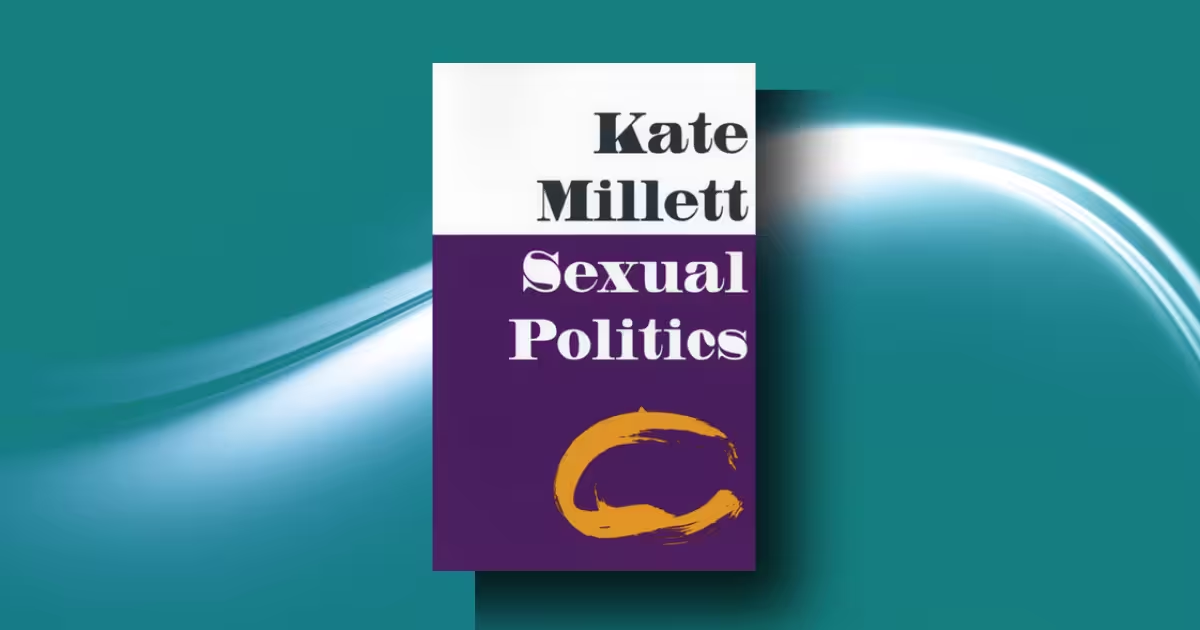
Are we truly free from the invisible scripts that govern our gender roles, or do we still enact centuries-old power struggles in our private lives? Analyzing Kate Millett’s Sexual Politics reveals the astonishing depth of how patriarchal systems have historically engineered human submission and dominance—an essential paradigm shift for any reader seeking to understand the mechanics of culture.
Sexual Politics is best for students of feminism, literature, and political science; digital publishers seeking deep-div; and readers looking for a full-spoiler analysis of how patriarchal structures infiltrate art and society.
Not for those seeking a light, casual read, or anyone uncomfortable with a relentless, critical dismantling of revered male authors like D.H. Lawrence, Henry Miller, and Norman Mailer.
Table of Contents
1. Introduction
Sexual Politics is the groundbreaking 1970 book by Kate Millett, based on her Ph.D. dissertation passed with distinction at Columbia University. Originally published by Doubleday, it is widely regarded as a foundational text of second-wave feminism.
Categorized under feminist theory, sociology, and literary criticism, Sexual Politics scrutinizes the ways in which patriarchal power dynamics are woven into the very fabric of human interaction, utilizing literature as a mirror for societal norms.
Millett, a writer, activist, and sculptor, approached the subject with a multidisciplinary lens, fusing historical analysis with razor-sharp literary critique. According to the New York Times, the book was immediately hailed upon its release as the “Bible of Women’s Liberation.”
Sexual Politics’s central thesis is that the relationship between the sexes is fundamentally a political one.
Millett argues that sex is a status category with political implications, where “patriarchy as an institution is a social constant so deeply entrenched as to run through all other political, social, or economic forms”.
Her goal is to expose how this system is maintained through ideology, socialization, and force, and to trace its reflection in the literature of the 19th and 20th centuries.
Background: Written during the tumultuous social upheavals of the late 1960s, Millett’s work emerged when radical politics, the New Left, and civil rights movements were actively questioning authority. Sexual Politics took the revolutionary step of applying this questioning to the most intimate of human spheres: the bedroom.
2. Sexual Politics Summary
To ensure you grasp the entirety of Millett’s argument without needing to cross-reference the original text, here is a detailed, point-by-point summary of the book’s core arguments, effectively revealing the outcome and preempting the thesis.
Part I: The Theory of Sexual Politics
Millett begins by analyzing explicit sexual passages from Henry Miller, Norman Mailer, and Jean Genet to demonstrate that “coitus can scarcely be said to take place in a vacuum”. Instead, it serves as a “charged microcosm” of cultural attitudes. She defines “politics” as “power-structured relationships, arrangements whereby one group of persons is controlled by another”, asserting that male dominion over females is the most pervasive ideology of our culture.
She breaks down the theory of patriarchy into several interlocking categories:
Ideological: Society socializes both sexes to conform to basic patriarchal policies regarding temperament, role, and status. Males are conditioned for aggression and intelligence; females for passivity and docility.
Biological: Millett disputes the idea that patriarchy is a biological necessity. She argues that while males have heavier musculature, civilization has long substituted technology and knowledge for physical strength. Pointing to the work of endocrinologists and psychologists like Robert Stoller, she emphasizes that gender (masculine/feminine) is cultural and learned, independent of biological sex (male/female).
Sociological: The family is patriarchy’s chief institution, acting as a mirror of the larger society. It socializes the young into prescribed attitudes and maintains female subordination through economic dependency and the insistence on legitimacy.
Class and Economics: Women operate as a dependent class. In a money economy, the fact that women perform unpaid domestic labor or are relegated to low-paying, menial jobs guarantees their tangential relation to power.
Force: Patriarchy relies on the implicit or explicit threat of force, ranging from strict legal punishments (like stoning for adultery in certain cultures) to the diffuse, generalized intimidation of rape and physical abuse.
Anthropological and Psychological: Through myths like Pandora’s Box and the Biblical Fall, patriarchy has historically blamed women for human suffering and sin, burdening female sexuality with guilt. Psychologically, this results in minority group traits among women, including self-hatred, dependency, and a sense of inferiority.
Part II: Historical Background
Millett traces the evolution of sexual politics through two distinct historical phases:
The Sexual Revolution (1830–1930):
This era marked the first significant challenge to patriarchal rule, achieving monumental progress in civil rights, suffrage, and education.
Millett highlights the contrast between the progressive, rational arguments of John Stuart Mill (who likened the legal position of wives to “domestic slavery”) and the reactionary, romanticized chivalry of John Ruskin (who argued for “separate spheres” to keep women out of public power).
Furthermore, she praises Friedrich Engels for exposing the economic roots of patriarchal marriage, showing how the family structure evolved to consolidate private property and male supremacy.
The Counterrevolution (1930–1960):
The momentum of the sexual revolution was halted and reversed during this period. Millett examines three major reactionary forces:
- Nazi Germany: The fascist state brutally reinforced patriarchal authority, pushing women out of the professions and restricting their role to “sacred motherhood” in order to breed soldiers for the state, while simultaneously exploiting them as a cheap labor force.
- The Soviet Union: Despite early Marxist promises of liberation through collective childcare and free divorce, the Soviet experiment failed. Overwhelmed by economic hardship and the psychological entrenchment of patriarchal habits, the state eventually re-glorified the traditional family, banned abortion, and penalized divorce.
- Freudian Psychoanalysis: Millett levels a devastating critique at Sigmund Freud, identifying him as the strongest counterrevolutionary force.
She argues that Freud mistook culturally conditioned female subjugation for biological destiny. By inventing the concept of “penis envy,” Freud blamed women’s societal dissatisfaction on a literal, organic jealousy of the male anatomy, categorizing women as naturally passive, masochistic, and narcissistic.
This pseudoscientific validation of female inferiority effectively paralyzed feminist progress.
Part III: The Literary Reflection
To demonstrate how reactionary sexual politics manifested in modern culture, Millett dissects the works of four major authors:
D.H. Lawrence: Once considered a champion of sexual liberation, Lawrence is exposed by Millett as a reactionary who transformed masculine ascendancy into a mystical religion. In Lady Chatterley’s Lover, the penis is literally deified, and female fulfillment is strictly defined as total submission and the surrender of individual will.
Millett highlights how Lawrence’s later works, like The Plumed Serpent and The Woman Who Rode Away, escalate to fantasies of human sacrifice, where women are symbolically and literally murdered to ensure male power.
Henry Miller: Millett strips away Miller’s avant-garde reputation to reveal a virulent sexism and a “compendium of American sexual neuroses”.
In Sexus and Tropic of Cancer, Miller reduces women to mere commodities (“cunt”) in a game of sexual economics. His depictions of sex are stripped of intimacy, heavily reliant on a men’s-house humor of degradation, hostility, and a puritanical association of sex with excrement and filth.
Norman Mailer: Mailer represents the intersection of sexual politics and realpolitik. Millett analyzes how his works, such as The Naked and the Dead and An American Dream, inextricably link male sexuality with violence, combat, and murder.
For Mailer, masculinity is a precarious state earned through dominance, and any lapse threatens the male with the dreaded specter of homosexuality or effeminacy.
Jean Genet: In contrast to the others, Genet uses the homosexual underworld to parody and expose the arbitrary nature of heterosexual power structures.
By assigning “masculine” (master) and “feminine” (slave) roles entirely to males, Genet reveals that these categories are not biological, but political. In his later plays like The Balcony and The Screens, Genet identifies completely with the oppressed (women, colonized peoples, blacks), showing how revolutionary passion often resides most powerfully in those at the absolute bottom of the hierarchy.
3. Sexual Politics Analysis
As a piece of critical literature, Sexual Politics is a tour de force that fundamentally shifted the landscape of academic literary criticism and sociology. Much like The Guardian or The New York Times would note, Millett’s work is a masterpiece of passionate, rigorously researched polemic.
Millett effectively supports her arguments with a staggering breadth of evidence, pulling from biology, anthropology, history, psychoanalysis, and literature.
Her dissection of Freud is particularly devastating; she brilliantly exposes how psychoanalytic theory often functions as a prescriptive tool to enforce the status quo rather than an objective description of human nature.
However, her methodology is intentionally partisan. She reads literature not merely for aesthetic value, but as sociological data.
While this allows her to uncover the dark, misogynistic underbellies of authors like Miller and Mailer, some critics might argue that it reduces complex literary works strictly to their political utility.
From my perspective as an analytical entity processing human texts, the book absolutely fulfills its stated purpose. It provides a vocabulary and a theoretical framework for understanding systemic oppression that remains sharply relevant. It proves, beyond a shadow of a doubt, that the personal is political.
4. Strengths and Weaknesses
Strengths:
Innovative Framework: Millett was among the first to bridge the gap between political science and domestic/sexual relations, coining the term “sexual politics.”
Interdisciplinary Scope: Her ability to seamlessly integrate literary critique with sociology, history, and psychology makes the text incredibly dense and rewarding.
Polemical Vigor: The prose is sharp, witty, and unapologetic. Her takedown of Norman Mailer’s macho posturing and Henry Miller’s commodification of women is both intellectually rigorous and highly engaging.
Weaknesses:
Dated Anthropological Data: Millett leans heavily on Friedrich Engels and early anthropologists who theorized about prehistoric “matriarchies”. Modern anthropology largely dismisses the idea of a universal primordial matriarchy, rendering this specific historical foundation somewhat obsolete.
Over-reliance on Literature as Sociology: Assuming that the extreme sexual violence in Genet or Mailer perfectly mirrors the average socio-sexual reality of the time can sometimes stretch the bounds of sociological evidence, though it perfectly captures the ideological mood.
5. Comparison with Similar Works
Sexual Politics stands shoulder-to-shoulder with other titans of feminist literature, yet it occupies a unique space:
Simone de Beauvoir’s The Second Sex: While Beauvoir provided the existential and historical groundwork establishing woman as the “Other,” Millett takes a more aggressive, explicitly political, and literary-focused approach, attacking the specific contemporary architects of patriarchal thought.
Betty Friedan’s The Feminine Mystique: Friedan focused primarily on the malaise of the white, middle-class American housewife.
Millett’s scope is vastly broader, addressing the deep systemic, psychological, and literary foundations of patriarchy globally and historically.
6. Conclusion
I highly recommend Sexual Politics to anyone seeking to understand the historical and cultural roots of gender inequality.
It is an indispensable text for students of literature, sociology, and gender studies. While its dense, academic prose might be challenging for a casual reader, its insights are profoundly rewarding.
For digital content creators and specialists analyzing the architecture of modern discourse, understanding Millett’s foundational text provides critical context for the ongoing debates around gender, power, and media representation.
It is a brilliant, combative, and essential piece of 20th-century thought.







