
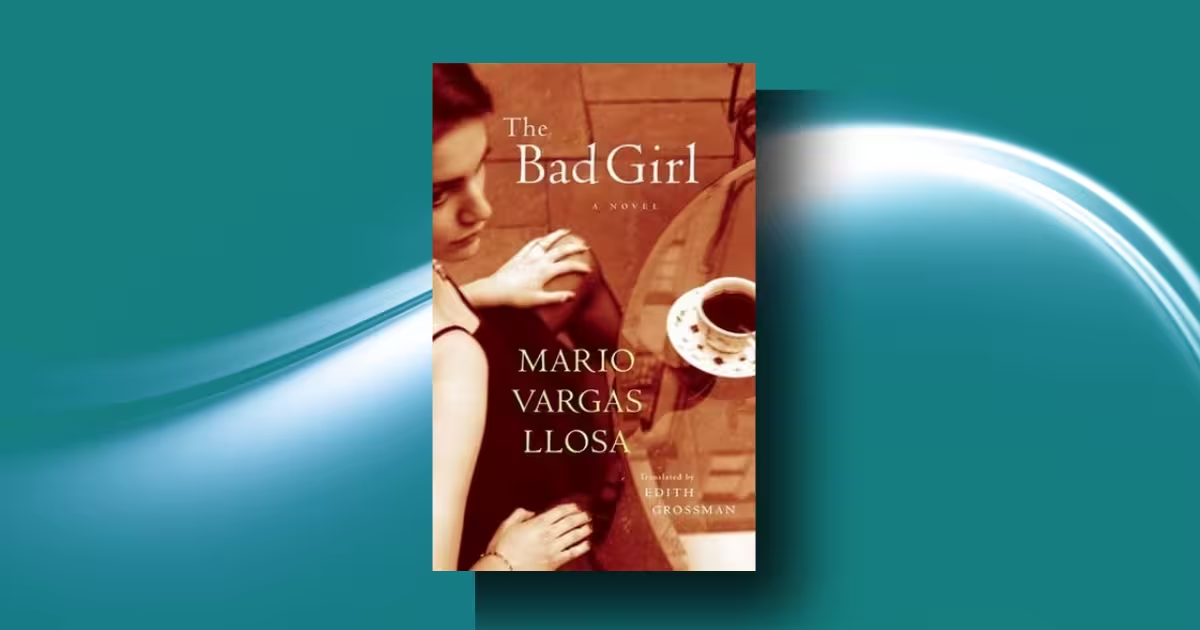
Do you remember that one summer when a mysterious girl swept into your quiet world, turned everything upside down with her energy and secrets, and left you chasing a feeling you could never quite shake? That’s the pull of The Bad Girl by Mario Vargas Llosa—a novel that hooks you with obsession, reinvention, and the messy thrill of loving someone who refuses to be pinned down.
The Bad Girl traces Peruvian translator Ricardo Somocurcio’s lifelong, one-sided obsession with a shape-shifting woman of humble origins who reinvents herself across decades and continents—from faux-Chilean teen “Lily” in 1950s Lima to revolutionary “Arlette” in 1960s Paris, society wife, gangster’s moll, and more—while he clings to his dream of a stable life in Paris, revealing how desire can both elevate and torment us.
The Bad Girl is best for readers who appreciate sweeping historical backgrounds, complex psychological character studies, and literary explorations of obsessive love across global settings. Not for those seeking a traditional, heartwarming romance with morally flawless protagonists or happily-ever-after endings.
Table of Contents
1. Introduction
Mario Vargas Llosa’s The Bad Girl (original Spanish title: Travesuras de la niña mala) is a profound exploration of human obsession, published in 2006.
Translated into English by Edith Grossman, the novel spans across four decades and multiple continents, tracking the life of Ricardo Somocurcio, an expatriate Peruvian translator, and his relentless pursuit of a woman whose identity shifts as rapidly as the changing cultural landscapes around them.
Winning the Nobel Prize in Literature in 2010, Vargas Llosa crafts a narrative that is both an intimate psychological portrait and a broad historical canvas.
2. Background
Set against the backdrop of the second half of the 20th century, The Bad Girl vividly captures the historical and political shifts of the era.
The narrative begins in the conservative, rigid society of 1950s Lima, Peru, before transitioning to the revolutionary fervor of 1960s Paris, heavily influenced by the Cuban Revolution and leftist ideologies.
It then moves to the psychedelic, pop-culture explosion of “Swinging London” in the 1970s, the economic boom of Tokyo, and the post-Franco cultural revival of Madrid in the 1980s.
Throughout these transitions, Vargas Llosa intertwines the political reality of Peru—from the dictatorship of General Manuel Odría to the rise of the Shining Path—with the deeply personal, tumultuous lives of his characters.
3. The Bad Girl Summary
The Lima Summer of 1950
The novel begins in the upscale neighborhood of Miraflores in Lima, Peru, during the summer of 1950. Ricardo Somocurcio, a well-behaved fifteen-year-old known as “the good boy,” falls head over heels for Lily, a vivacious teenager who has recently arrived in the neighborhood claiming to be from Chile.
The “Chilean girls,” Lily and her sister Lucy, captivate the local boys with their exotic accents and bold dancing styles. “The adjective ‘flamboyant’ seemed invented just for them,” Ricardo recalls.
Despite Ricardo’s multiple declarations of love and proposals to “go steady,” Lily consistently rejects him.
The illusion shatters at a high-society fifteenth birthday party when a wealthy aunt exposes the girls as frauds.
They are not Chilean at all; they are poor Peruvians from a humble background trying to pass themselves off as foreign aristocrats to infiltrate high society. Following this deep humiliation, Lily vanishes from Miraflores, but Ricardo’s obsession with her is permanently cemented.
The 1960s in Paris: Comrade Arlette and Madame Arnoux
A decade later, Ricardo fulfills his lifelong dream of living in Paris, where he works as a translator and interpreter for UNESCO. While assisting his friend Paul, a Peruvian revolutionary organizing trips for leftist youths to receive guerrilla training in Cuba, Ricardo encounters the bad girl again.
She is now “Comrade Arlette,” a supposed member of the Movement of the Revolutionary Left (MIR). Ricardo recognizes her immediately, but she denies being Lily. They share a brief, passionate, yet emotionally detached romance in Ricardo’s tiny Parisian garret before she departs for Cuba.
Months later, Ricardo learns that Arlette has become the lover of a high-ranking Cuban comandante.
However, she soon reappears in Paris completely transformed, now going by the name Madame Robert Arnoux, married to a senior French diplomat. Ricardo and the bad girl resume a covert affair. She admits that her marriage was merely a pragmatic escape from Cuba.
Her desire for wealth and security overrides everything else: “Happiness, I don’t know and I don’t care what it is, Ricardito.
What I am sure about is that it isn’t the romantic, vulgar thing it is for you. Money gives you security, it protects you…”. Eventually, she abandons her French husband, devastating him by emptying their secret Swiss bank accounts, and vanishes once more.
The 1970s in Swinging London: Mrs. Richardson
In the 1970s, Ricardo’s interpreting career takes him frequently to London. While visiting his childhood friend Juan Barreto—who has transformed from a homeless hippie into a successful painter of horses for wealthy English breeders—Ricardo discovers that the bad girl is living nearby in Newmarket.
She is now Mrs. Richardson, the wife of David Richardson, a wealthy, older English horse breeder.
Ricardo orchestrates secret meetings with her in London hotel rooms. Despite her comfortable life, she despises the monotonous, horse-obsessed culture of Newmarket.
During one of her husband’s business trips to Asia, she begins an affair with Mr. Fukuda, a sinister Japanese businessman with ties to the Yakuza.
When David Richardson discovers her previous, un-annulled French marriage, he uses the revelation of bigamy to leave her destitute. With her English life ruined, she flees to Tokyo with Fukuda.
The Tokyo Nightmare: Kuriko
Unable to let her go, Ricardo leverages a contract in Seoul to visit Tokyo.
There, he finds the bad girl living as “Kuriko,” entirely dependent on Mr. Fukuda. She admits that Fukuda treats her like an employee and occasionally “like his whore”. In a deeply traumatic sequence, Kuriko invites Ricardo to her apartment to make love, acting more passionate and uninhibited than ever before.
However, at the height of their intimacy, Ricardo realizes that Fukuda is hidden in the shadows of the room, silently watching and masturbating to their encounter.
The entire scenario was a perverse performance orchestrated by Fukuda. Disgusted and deeply humiliated by her complicity, Ricardo violently lashes out at her and flees Japan, vowing never to see her again.
The 1980s Paris Return: Marriage and False Comforts
Years pass. Ricardo continues his solitary life in Paris until the bad girl contacts him again. She is now a physical ruin, destitute, emaciated, and deeply traumatized.
She claims that Fukuda abandoned her after she was arrested in Lagos, Nigeria, while smuggling for him, where she was brutally raped and infected by local police. Ricardo, unable to suppress his devotion, takes her in.
He spends his life savings to pay for her physical and psychological rehabilitation at an expensive private clinic in Petit Clamart.
To solve her legal troubles and secure her residency, Ricardo finally marries her. For a fleeting period, they experience genuine domestic harmony. She finds a job organizing events, and they settle into a quiet routine. Yet, as soon as her health and confidence return, the bad girl reverts to her old nature.
She leaves Ricardo a cold note stating, “I’m tired of playing the petit bourgeois housewife you’d like me to be”, and runs off with the much-older husband of her employer.
Overcome with despair, Ricardo contemplates suicide by jumping into the Seine, only to be saved by a passing vagrant.
Madrid and The Final Act
Ricardo eventually leaves Paris, relocating to Madrid with a young Italian set designer named Marcella.
They live a bohemian, artistic life in the Lavapiés neighborhood. However, the bad girl inevitably tracks him down. She reappears not as a conqueror, but as a dying woman. Her body is ravaged by terminal cancer; she has undergone radical mastectomies and suffers from metastatic tumors.
She reveals that her name is actually Otilia, the daughter of a poor breakwater builder from Callao—a truth Ricardo had coincidentally discovered on a trip back to Peru.
Facing her mortality, she transfers the property she managed to secure from her last lover to Ricardo. In her final days, she moves in with Ricardo, who leaves Marcella to care for his dying wife in a small house in the south of France.
As she nears death, she tells him that if he ever decides to write their story, he shouldn’t make her look too bad. Ricardo stays with her until the end, finally accepting his destiny to immortalize their tragic, lifelong romance on paper.
4. The Bad Girl Analysis
4.1. The Bad Girl Characters
Ricardo Somocurcio (“The Good Boy”): Ricardo is the ultimate reliable narrator, defined by his paralyzing lack of ambition and his unyielding romanticism.
His life’s goal is incredibly modest: to live in Paris as a translator. He represents stability, unconditional love, and a dangerous level of emotional masochism.
He acknowledges his own pathetic nature, frequently referring to himself as a “little pissant.” His character is a study in how profound devotion can border on self-destruction.
Lily / Comrade Arlette / Madame Arnoux / Mrs. Richardson / Kuriko / Otilia (“The Bad Girl”): She is the driving force of the novel, a chameleon whose sole objective is to escape the crushing poverty of her Peruvian childhood.
The bad girl is deeply cynical, pragmatic, and entirely devoid of conventional morality when it comes to self-preservation. Yet, she is not purely a villain.
Her actions are born of a desperate survival instinct. She sacrifices her identity, her dignity, and ultimately her physical health to achieve wealth.
Her vulnerability is rarely shown, making her moments of sheer terror or subtle affection deeply poignant.
4.2. The Bad Girl Themes and Symbolism
The Illusion of Identity: The novel heavily scrutinizes how identity is constructed. The bad girl changes her nationality, her name, her hair, and her mannerisms to fit the desires of the men who can elevate her social status.
This constant metamorphosis symbolizes the extreme lengths to which the marginalized must go to infiltrate the upper echelons of society.
The Nature of Obsession vs. Love: Vargas Llosa dissects the fine line between love and obsession. Ricardo’s love is not necessarily pure; it is a fixation that prevents him from living a fully realized life.
In contrast, the bad girl’s inability to love traditionally highlights the emotional deadening caused by extreme poverty. Their relationship is inherently toxic, characterized by Ricardo as “the perfect pair: the sadist and the masochist”.
Globalization and Expatriatism: As the characters traverse Lima, Paris, London, Tokyo, and Madrid, the novel serves as a travelogue of the late 20th century. It explores the expatriate experience—the feeling of being a “phantom” or an outsider (a métèque) who belongs nowhere.
5. Evaluation
Strengths: The greatest strength of The Bad Girl lies in its sweeping, immersive settings. Vargas Llosa possesses a masterful ability to transport the reader through time and geography.
The psychological complexity of the toxic dynamic between Ricardo and the bad girl is utterly compelling; it is a masterclass in writing flawed, entirely human characters.
Weaknesses: Some readers might find Ricardo’s relentless passivity and repeated subjugation to the bad girl frustrating.
The pacing occasionally drags during Ricardo’s extensive descriptions of his translation work or his friends’ political debates, though these sections serve to ground the narrative in its historical context.
Impact: Intellectually, it prompted reflection on my own attachments and the allure of the “bad” or unpredictable in relationships.
Emotionally, it resonated with the ache of unrequited or imbalanced love—the way certain people mark us indelibly.
Comparison with similar works: It’s a modern Madame Bovary or Sentimental Education with Latin American flair, sharing obsessive romance with works like The Great Gatsby or even elements of Inárritu films’ interconnected fates.
Unlike denser Vargas Llosa epics (The Feast of the Goat), it’s more intimate and accessible, closer to Aunt Julia and the Scriptwriter in autobiographical echoes.
Adaptation: The novel was recently adapted into a Spanish-language series, Travesuras de la niña mala (2022), produced by W Studios for the streaming service Vix+. Starring Macarena Achaga as the shape-shifting bad girl and Juan Pablo Di Pace as Ricardo, the series successfully translates the globe-trotting epic to the screen, capturing the aesthetic evolution from the 1950s to the 1980s.
While streaming box-office data isn’t publicly quantified like theatrical releases, the show’s renewal for a second season indicates strong viewership and a successful translation of Vargas Llosa’s complex narrative.
6. Personal Insight with Contemporary Educational Relevance
While diving deep into literary and cinematic analysis portals (an interest that frequently leads me to unearth “digital dark matter” on sites exploring profound narrative arcs), I am struck by how The Bad Girl speaks to contemporary discussions on social mobility and the commodification of identity.
In today’s digital age, where curating a “personal brand” on social media is the norm, the bad girl’s analogue reinventions feel remarkably prescient.
Otilia leverages her physical capital and linguistic adaptability to climb the socio-economic ladder, mirroring the modern gig economy’s demand for constant self-reinvention. Educational sociology often discusses the “poverty trap”—the systemic barriers preventing upward mobility.
Otilia’s traumatic childhood in Callao forces her to view interpersonal relationships strictly as transactional vehicles for survival.
Her tragic end, riddled with physical decay, serves as a poignant commentary on the psychological and bodily toll exacted upon marginalized individuals who are forced to sacrifice their authentic selves to survive in a hyper-capitalist global structure.
It forces us to ask: in a world that rewards ruthless pragmatism, what is the actual cost of upward mobility?
7. The Bad Girl Quotes
- “Happiness, I don’t know and I don’t care what it is, Ricardito. What I am sure about is that it isn’t the romantic, vulgar thing it is for you. Money gives you security, it protects you…”
- “I’m your lover, your suitor, the person who, since he was a boy, has been crazy about the Chilean girl, the guerrilla fighter, the bureaucrat’s wife, the wife of the horse breeder, the gangster’s mistress.”
- “You’re the best thing that ever happened to me, good boy.”
- “Because that’s what it is, basically. A marvelous love story.”
- “I fell in love with Lily like a calf, which is the most romantic way to fall in love—it was also called heating up to a hundred degrees.”
- “The bad girl’s coquettishness: “With her model’s looks, her dark mischievous eyes, and her small mouth with full lips, Lily was the incarnation of coquettishness.”
- “During intimacy: She remains passive, “like a queen accepting the homage of a vassal.”
- “Reflection on her nature: “Well, at heart, I knew she’d never be a normal woman. And I didn’t want her to be one, because what I loved in her were the indomitable and unpredictable aspects of her personality.”
- “Closing sentiment: Ricardo still evokes “her mischievous laugh and see the mocking glance of her eyes the color of dark honey, and watch her swaying like a reed to the rhythms of the mambo. And still think that, in spite of my having lived for so many summers, that one was the most fabulous of all.”
8. Conclusion
The Bad Girl is an extraordinary, heart-wrenching novel that strips romance of its fairy-tale veneer to expose the raw, often ugly mechanics of human desire and survival.
Vargas Llosa has created an enduring anti-heroine whose cruelty is matched only by her tragic desperation.
I highly recommend this book to fans of expansive, historically grounded literary fiction and those who are fascinated by character-driven narratives focusing on the dark side of love.
It is a significant work that proves Vargas Llosa’s mastery of the human condition.







