
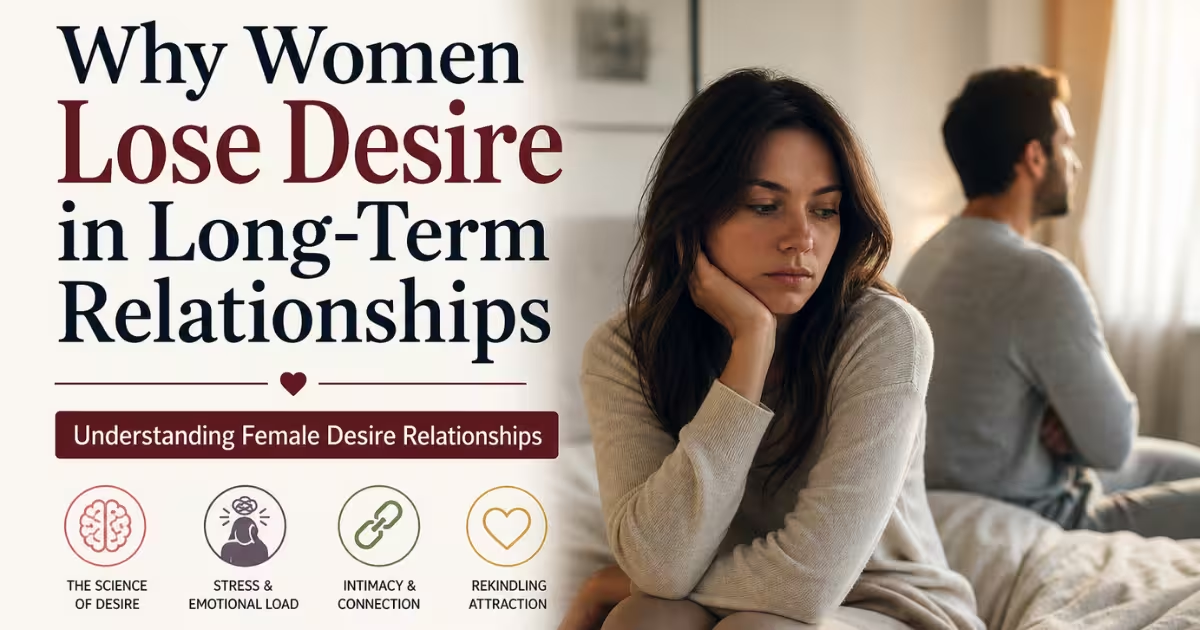
Understaning female desire relationships matters a lot. At the beginning of a relationship, female desire often feels effortless. Touch is charged. A text message can change the temperature of the day. A glance across a room can feel like an invitation. Then, months or years later, a woman may still love her partner deeply but feel strangely detached from sexual desire.
She may wonder, What happened to me? Why do I not want sex like I used to? Does this mean I am no longer attracted to my partner?
The truth is more layered than the simple idea that “women lose interest” or that “long-term love kills passion.”
Female desire in relationships is shaped by biology, stress, emotional climate, novelty, body image, resentment, household labor, parenting, health, safety, and the quality of erotic attention. Modern research increasingly treats sexual desire not as a fixed “drive” but as something responsive to context, meaning, and relationship dynamics.
A 2025 review in Nature Reviews Psychology describes sexual desire as something that both shapes relationship development and is shaped by relational, contextual, and individual factors over time.
So when women lose desire in long-term relationships, it is rarely because of one cause.
It is usually the result of several small erosions: too much stress, too little novelty, too much caretaking, too little selfhood, too many unspoken disappointments, and not enough space for erotic curiosity.
Table of Contents
Female Desire Relationships: Why Desire Changes Over Time
The key fact female desire relationships points to a real question couples often struggle to name: why does women’s desire seem so sensitive to the state of the relationship?
In early romance, novelty does a lot of the work.
Newness creates uncertainty, and uncertainty creates erotic energy. You do not yet know exactly what the other person will say, how they will touch you, what they want, or whether they will choose you again tomorrow.
That tension can be intoxicating.
Long-term relationships replace uncertainty with security. Security is beautiful.
It helps couples build homes, raise children, care for each other, and survive illness or crisis. But security alone does not always create erotic charge. Desire often needs a degree of separateness, imagination, freshness, and voluntary choice.
This is why a woman can love a partner, trust a partner, even feel emotionally bonded to a partner, while still feeling little sexual pull.
Research on newlywed couples has found that women’s sexual desire may decline more steeply over time than men’s, and that childbirth can partially account for this difference, although it does not explain all of it.
The same longitudinal research found that declines in wives’ desire predicted lower marital satisfaction for both spouses.
That does not mean every woman will lose desire, nor does it mean men do not experience desire changes. It means desire is dynamic.
In many couples, the erotic relationship needs active maintenance instead of being treated as something that should run automatically forever.
1. She Is Exhausted, and Exhaustion Is Not Erotic
One of the least mysterious reasons women lose desire in long-term relationships is also one of the most ignored: fatigue.
Desire needs energy.
Not just physical energy, but mental space. A woman who is managing work, children, aging parents, housework, emotional labor, social planning, and the invisible tracking of everyone’s needs may not experience sex as pleasure. She may experience it as one more demand.
This is especially true when the relationship has slipped into a parent-child dynamic. If she feels she has to remind, organize, clean, soothe, schedule, and anticipate everything, her partner may gradually become another responsibility instead of an erotic presence.
Desire struggles when a woman feels more like a manager than a lover.
Medical and public health sources also identify stress, anxiety, depression, pregnancy, childbirth, menopause, relationship problems, some medications, and chronic illness as common contributors to low libido.
This matters because many couples interpret low desire as rejection. But sometimes the body is saying, “I am overloaded,” not “I do not love you.”
2. Desire Becomes Linked With Pressure
In many long-term relationships, sex slowly turns into a negotiation. One partner wants more, the other wants less. The higher-desire partner feels rejected.
The lower-desire partner feels guilty, pressured, or watched. Eventually, even affectionate touch becomes suspicious: Is this a cuddle, or is this going to become another conversation about sex?
This pressure can shut desire down further. Desire does not thrive when it feels monitored. It does not like being graded, demanded, or turned into proof of love.
A study of women in relationships of five years or more found that desire discrepancy is common in long-term relationships. Women reported using strategies such as communication, scheduling sex, lingerie, date nights, patience, and sometimes having sex without desire; however, many also said the issue remained unresolved and that they were dissatisfied with attempted solutions.
That finding is important because it shows that “just communicate” or “just schedule sex” can help some couples, but not all.
If the deeper problem is pressure, resentment, pain, boredom, or emotional disconnection, a calendar alone will not restore desire.
3. She Has Responsive Desire, Not Spontaneous Desire
Many people believe “real” desire should appear out of nowhere.
In that model, you feel desire first, then you have sex. But many women, especially in long-term relationships, experience desire differently. They may not feel a sudden urge before intimacy begins. Instead, desire may emerge after warmth, touch, playfulness, relaxation, flirting, or emotional connection begins.
Sex therapist Rosemary Basson’s model of women’s sexual response helped shift attention from spontaneous sexual urge to a more responsive cycle, where desire may arise after arousal, stimulation, intimacy, and positive appraisal of the experience.
This is one of the most useful ideas in conversations about female desire relationships. A woman may not be “broken” because she does not often feel spontaneous desire. She may need the right conditions for responsive desire: low pressure, enough time, emotional ease, physical comfort, and a sense that intimacy will be pleasurable rather than obligatory.
I made a similar point in its summary of Emily Nagoski’s Come As You Are, noting the distinction between spontaneous and responsive desire and emphasizing that context and stress strongly affect arousal.
4. Her “Brakes” Are Always On
Emily Nagoski popularized the “accelerator and brakes” metaphor for sexual desire, based on the Dual Control Model of sexual response.
The Kinsey Institute explains this model as a balance between sexual excitation and sexual inhibition: people vary in how sensitive their “gas pedal” and “brake pedal” are in sexual situations.
For many women, the problem is not that there is no accelerator. It is that the brakes are constantly pressed.
Common brakes include:
Stress.
Body insecurity.
Feeling emotionally unsafe.
Pain during sex.
Fear of pregnancy.
Past trauma.
Resentment.
Poor sleep.
Feeling judged.
Lack of privacy.
Children in the next room.
A partner who only touches her when wanting sex.
A sexual routine that does not actually give her much pleasure.
When the brakes are strong, more pressure on the accelerator does not solve the problem.
Compliments, date nights, lingerie, or romantic gestures may not work if the underlying brakes remain untouched.
5. The Relationship Is Loving but Not Erotic
A painful truth: emotional closeness and erotic desire are related, but they are not identical.
A couple may be kind, stable, loyal, and affectionate, yet not erotic.
The relationship may feel safe but predictable. Tender but sexless. Functional but flat. Partners may become excellent co-parents or roommates while forgetting how to meet as separate adults with private longings.
Esther Perel’s Mating in Captivity is one of the best-known books on this tension. Its publisher describes the book as an exploration of the interplay between love and desire in committed couples, asking whether we can desire what we already have and what it takes to keep lust alive.
This does not mean couples need drama or instability.
It means eroticism often needs imagination, play, privacy, novelty, and a sense of chosen encounter.
Desire can fade when a woman feels completely known in the least exciting way: not deeply seen, but routinely assumed.
6. She Does Not Feel Desired as a Person
Many women do not only want sex. They want to feel wanted.
There is a difference between a partner wanting sexual release and a partner desiring her. Over time, if sex becomes repetitive, rushed, one-sided, or focused mainly on intercourse, a woman may stop feeling like an erotic subject and start feeling like a service provider.
This is where female desire relationships often become complicated. A woman may ask herself: Does he want me, or does he just want sex? Does he notice my mind, my body, my mood, my pleasure? Is there curiosity here? Is there seduction?
If she feels desired only when sex is expected, but not admired, flirted with, listened to, or emotionally met outside the bedroom, desire may fade. The issue is not vanity. It is erotic recognition.
7. Sex Has Not Been Pleasurable Enough
Sometimes the answer is simpler than couples want to admit: she has lost desire because the sex available to her is not rewarding.
If sex regularly ends before she is fully aroused, ignores her preferences, causes discomfort, or feels emotionally disconnected, her body may learn not to anticipate it. Desire is partly built from memory. When the memory is “this probably will not be worth it,” libido naturally declines.
A systematic review on predictors of sexual satisfaction in women found that relationship satisfaction and frequency of sexual interactions were among the most frequently confirmed predictors, but it also noted that sexual communication, sexual practices, desire, and sexual thoughts have received comparatively limited attention in research.
That gap matters in real life. Couples may count how often sex happens but avoid asking whether the sex is actually good, mutual, relaxed, creative, and worth wanting again.
8. Body Image and Aging Change the Erotic Self
A woman’s relationship with her own body can deeply affect desire.
Weight changes, pregnancy, postpartum recovery, menopause, illness, surgery, sexual pain, hormonal changes, and aging can all alter how she feels in her skin.
The issue is not simply whether her partner still finds her attractive. Often, the harder question is whether she can feel attractive from within. If she feels watched, evaluated, inadequate, or disconnected from her body, sexual desire may become harder to access.
The revised edition of Come As You Are emphasizes that stress, mood, trust, and body image are central—not peripheral—to women’s sexual wellbeing.
This is why reassurance helps, but it may not be enough. A woman may need time, embodiment, movement, self-compassion, medical support, or therapy to feel at home in her body again.
9. Resentment Turns the Body Away
Unresolved resentment is one of the strongest desire killers.
A woman may not consciously think, I am angry, so I do not want sex. Instead, her body may quietly withdraw. She may feel tense when touched. She may avoid going to bed at the same time. She may dread affection because it carries expectation. She may say she is tired because “I am tired” feels safer than “I feel unseen, unsupported, and quietly furious.”
Resentment often grows from repeated emotional injuries: broken promises, unequal labor, dismissive conflict, lack of appreciation, betrayal, criticism, or feeling alone inside the relationship.
Desire requires some form of openness. Chronic resentment closes the gate.
10. Health, Hormones, Pain, and Medication Matter
Not every desire issue is relational. Physical and mental health can strongly affect libido.
Low desire can be connected to depression, anxiety, thyroid problems, diabetes, cardiovascular disease, chronic pain, menopause, postpartum changes, breastfeeding, hormonal contraception, antidepressants, blood pressure medications, alcohol use, and pain during sex.
NHS guidance lists relationship problems, stress, depression, vaginal dryness, pregnancy, menopause, medications, hormonal contraception, alcohol, and long-term conditions among possible causes of low libido.
The American College of Obstetricians and Gynecologists defines female sexual dysfunction as involving personal distress in desire, arousal, orgasm, or pain, and notes that women are often unlikely to raise sexual dysfunction with clinicians unless asked.
A sudden, distressing, or persistent loss of desire—especially with pain, mood changes, medication changes, postpartum symptoms, or menopausal symptoms—is worth discussing with a qualified healthcare professional.
Can Women Regain Desire in Long-Term Relationships?
Yes, many can. But the goal should not be to force desire back through guilt or performance. The goal is to understand what desire needs in order to return.
For some couples, desire improves when stress drops, household labor becomes fairer, and affectionate touch is no longer treated as a prelude to sex. For others, the turning point is better sexual communication, therapy, medical care, or learning about responsive desire. Some couples need novelty and play. Some need emotional repair. Some need to stop having bad sex and start building intimacy that is actually pleasurable for both.
A healthier question than “How do we get back to how we were?” is “What kind of erotic relationship fits who we are now?”
Long-term desire is not usually the same as early relationship desire. It may be less automatic, but it can become more intentional, more honest, and more deeply personalized.
Books Available on Female Desire and Relationships
Yes, there are several strong books on this topic:
Come As You Are by Emily Nagoski is one of the most widely recommended books on women’s sexuality, responsive desire, stress, body image, pleasure, and the science of arousal. The official publisher page describes it as a revised and updated guide using research on mindfulness, desire, and pleasure.
Come Together by Emily Nagoski focuses more specifically on creating lasting sexual connections in long-term relationships. Nagoski’s official site lists it as Come Together: The Science (and Art!) of Creating Lasting Sexual Connections.
What Do Women Want? by Daniel Bergner explores the science of female desire, including libido, fantasy, arousal, and the myths surrounding women’s sexuality. HarperCollins describes it as a book about female lust, the mind-body connection, and the reasons behind loss of libido.
Mating in Captivity by Esther Perel is especially relevant for couples trying to understand why domestic closeness can coexist with erotic distance. It focuses on love, desire, and passion in committed relationships.
Mind the Gap by Dr. Karen Gurney is another useful book on female desire, the orgasm gap, sexual myths, and long-term sexual satisfaction. Google Books describes it as covering the science of sex and desire while explaining how someone can feel little spontaneous desire and still have a satisfying long-term sex life. (Google Books)
Final say
Women do not usually lose desire in long-term relationships because they are cold, broken, selfish, or incapable of commitment. Desire fades when the conditions that support it disappear.
It fades under exhaustion, pressure, resentment, boredom, pain, poor communication, unequal labor, body shame, and emotional disconnection. It also changes because long-term love changes the erotic landscape.
Understanding female desire relationships means moving beyond blame. It means asking better questions: What turns her on? What turns her off? What makes her feel safe? What makes her feel alive? What kind of touch feels welcome? What kind of relationship makes desire possible?
Desire is not a machine that runs forever without care. It is more like a climate. When the climate changes, desire changes with it.
And when couples are willing to change the climate—less pressure, more honesty, more pleasure, more fairness, more curiosity—desire often has room to breathe again.







