
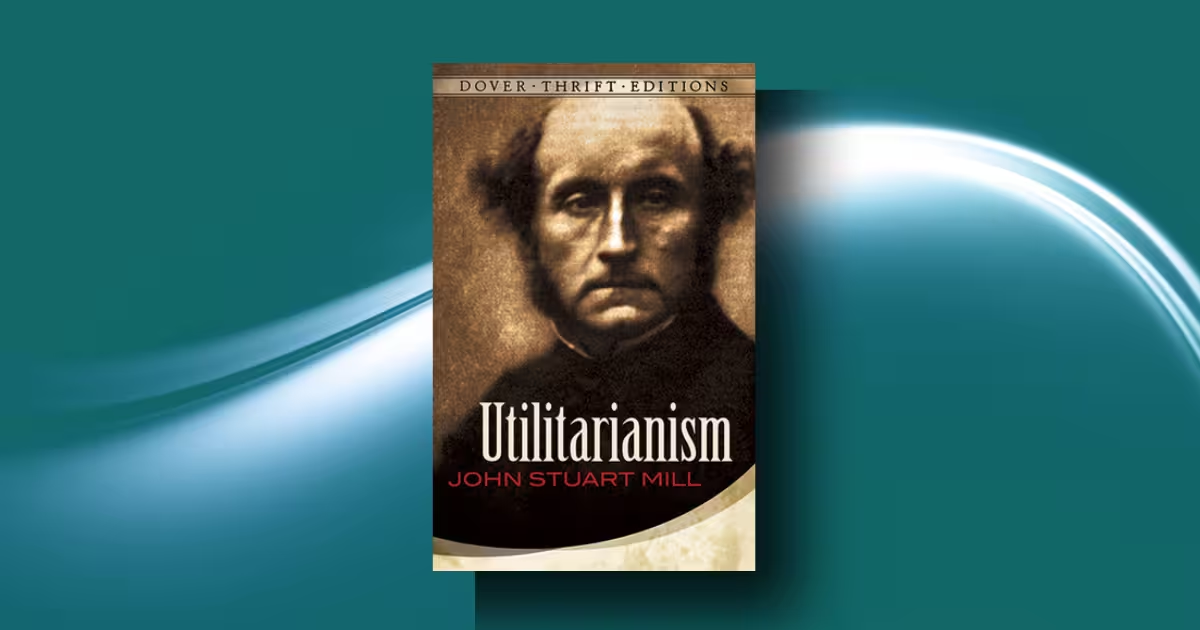
Do you ever wonder why some choices feel morally right even when they come with personal sacrifice — or why the very idea of “the greater good” both inspires and unsettles us at the same time? Utilitarianism by John Stuart Mill will take you deep into the heart of that tension and show you, with extraordinary clarity, that the answer has been there all along — hidden in the nature of human happiness itself.
Utilitarianism is best for philosophy students, ethics enthusiasts, policy makers, political science readers, anyone wrestling with moral decision-making, law students, social reformers, and curious minds who want to understand why we judge actions as right or wrong.
Not for readers seeking light, narrative-driven books; those uncomfortable with abstract reasoning; anyone looking for a quick self-help fix or a story-based moral guide.
Table of Contents
1. Introduction
Utilitarianism is a landmark philosophical essay by John Stuart Mill (20 May 1806 – 7 May 1873), originally published as three separate articles in Fraser’s Magazine in 1861 before being collected and reprinted as a single book in 1863.
It stands today as one of the most widely read, widely taught, and widely debated works in the entire history of Western moral philosophy.
If you have ever sat in a classroom, a courtroom, a government meeting, or even a quiet corner of your own mind and asked, “What is the right thing to do?” — then, whether you knew it or not, you were already living inside the questions this book attempts to answer.
Context
Utilitarianism belongs to the tradition of moral and political philosophy, specifically to the school of consequentialist ethics. Mill was not just a philosopher writing from an ivory tower.
He was a political economist, a Member of Parliament, a social reformer, and a man who had been subjected to one of the most rigorous educational regimes in history — tutored from infancy by his father James Mill and shaped by his close association with Jeremy Bentham (1748–1832), the founder of utilitarian theory.
By the time Mill wrote Utilitarianism, he had already published his groundbreaking works A System of Logic (1843) and On Liberty (1859). He was, as the Stanford Encyclopedia of Philosophy describes him, “the most influential English-speaking philosopher of the nineteenth century.”
The book sits at the crossroads of philosophy, psychology, law, and political theory — a short but extraordinarily dense text of five chapters that attempts to define, defend, and prove the moral framework known as Utilitarianism.
Purpose
The central thesis of Utilitarianism is bold and deceptively simple: the moral worth of any action is determined entirely by its contribution to overall human happiness.
This idea, which Mill calls the Greatest Happiness Principle, holds that “actions are right in proportion as they tend to promote happiness, wrong as they tend to produce the reverse of happiness.”
Happiness, for Mill, means pleasure and the absence of pain.
But — and this is where Mill departs sharply from his predecessor Bentham — not all pleasures are equal. Mill insists that pleasures differ not only in quantity but in quality, and that the higher pleasures of the intellect and moral feeling are worth far more than the lower pleasures of mere sensation.
2. Background
To truly understand what Mill was doing in Utilitarianism, you need to understand the philosophical battlefield he was stepping into.
For over two thousand years — from Socrates and Plato through Kant and beyond — philosophers had been fighting over the most fundamental question in human life: What is the foundation of morality?
Mill opens Chapter I with a diagnosis that still rings painfully true today: “after more than two thousand years the same discussions continue, philosophers are still ranged under the same contending banners, and neither thinkers nor mankind at large seem nearer to being unanimous on the subject, than when the youth Socrates listened to the old Protagoras.”
Mill’s intellectual inheritance was complex.
He had absorbed Bentham’s utilitarian calculus — the idea that we should maximize the sum total of pleasure over pain across all affected persons.
But Mill had also experienced a famous mental crisis in his early twenties, documented in his Autobiography (1873), during which he came to feel that Bentham’s cold arithmetic left something vital out of human experience. What emerged from that crisis was a richer, more humane version of utilitarianism — one that gave pride of place to education, culture, emotional depth, and the higher life of the mind.
The historical context matters, too.
Britain in the 1860s was in the thick of the Industrial Revolution, with all its brutal inequalities, its child labour, its urban misery. Mill was writing not merely as an academic but as a reformer who believed that a properly understood principle of utility could be the philosophical foundation for transforming society — eliminating poverty, advancing education, expanding rights.
Mill’s essay sought “to refine the ‘greatest happiness’ principle that had been championed by Jeremy Bentham, defending it from common criticisms, and offering a justification of its validity.”
3. Utilitarianism Summary
Chapter I: General Remarks — The Problem with Moral Philosophy
Mill opens with intellectual humility and sharp frustration.
Despite millennia of effort, humanity still has no agreed-upon standard for distinguishing right from wrong. Every great moral theory — whether Kant’s deontology, the Stoics’ virtue ethics, or religious natural law — claims authority, but none has settled the question.
Mill acknowledges that even mathematics lacks universally agreed first principles, yet still manages to produce reliable results. His point is that the absence of agreed foundations does not make a science useless.
He specifically takes aim at Immanuel Kant, whose categorical imperative — “So act, that the rule on which thou actest would admit of being adopted as a law by all rational beings” — Mill argues fails miserably in practice.
When Kant tries to derive concrete moral duties from this abstract principle, Mill writes, “he fails, almost grotesquely, to show that there would be any contradiction, any logical impossibility, in the adoption by all rational beings of the most outrageously immoral rules of conduct.”
All Kant really shows, Mill contends, is that the consequences of universalizing bad rules would be undesirable — which is, quietly but unmistakably, a utilitarian argument.
Chapter II: What Utilitarianism Is — Dispelling the Myths
This is the heart of the book, and it is magnificent. Mill begins by dismissing a persistent and vulgar misunderstanding: that utilitarianism equates “utility” with dry, practical usefulness as opposed to pleasure. He is unsparing in his contempt for this error, noting that “every writer, from Epicurus to Bentham, who maintained the theory of utility, meant by it, not something to be contradistinguished from pleasure, but pleasure itself, together with exemption from pain.”
The Greatest Happiness Principle is then stated in its full form: “actions are right in proportion as they tend to promote happiness, wrong as they tend to produce the reverse of happiness. By happiness is intended pleasure, and the absence of pain; by unhappiness, pain, and the privation of pleasure.”
He then states the Greatest Happiness Principle in its full form:
“The creed which accepts as the foundation of morals, Utility, or the Greatest Happiness Principle, holds that actions are right in proportion as they tend to promote happiness, wrong as they tend to produce the reverse of happiness. By happiness is intended pleasure, and the absence of pain; by unhappiness, pain, and the privation of pleasure.”
Now comes Mill’s most important and original contribution to utilitarian thought: the distinction between higher and lower pleasures.
This is where Mill parts company decisively with Bentham.
Bentham had held, notoriously, that “pushpin is as good as poetry” — that the quality of pleasures does not matter, only their quantity. Mill disagrees with devastating force.
He argues that some pleasures are intrinsically more valuable than others, not merely in degree but in kind, and the only way to judge which pleasure is superior is to consult those who have experience of both.
“Of two pleasures,” he writes, “if there be one to which all or almost all who have experience of both give a decided preference, irrespective of any feeling of moral obligation to prefer it, that is the more desirable pleasure.”
This leads to one of the most quoted and celebrated passages in all of moral philosophy: “It is better to be a human being dissatisfied than a pig satisfied; better to be Socrates dissatisfied than a fool satisfied. And if the fool, or the pig, is of a different opinion, it is because they only know their own side of the question. The other party to the comparison knows both sides.”
What Mill is saying here is breathtaking in its implications.
A being of higher faculties — an educated, reflective, morally sensitive human being — will always prefer the pleasures of intellect, feeling, imagination, and moral sentiment to the grosser pleasures of sensation, even if those higher pleasures come with more suffering, more dissatisfaction, more existential restlessness.
The person of refined sensibility would not trade places with the contented fool, because what they possess in terms of human dignity — “a sense of dignity which all human beings possess in one form or other” — is worth more than any quantity of lower satisfactions.
Mill also addresses the objection that utilitarianism is too demanding — that it requires people to think constantly about the happiness of the entire world. He answers with elegant practicality: the vast majority of our actions affect only the people immediately around us.
We do not need to calculate the welfare of all humanity every time we decide what to do. It is only those whose actions extend to society at large who need habitually to think in such broad terms.
For most of us, most of the time, the utilitarian standard simply means doing good by the people in our immediate lives, being honest and fair, and not harming others — standards that closely parallel the Golden Rule of Jesus of Nazareth, which Mill explicitly invokes: “In the golden rule of Jesus of Nazareth, we read the complete spirit of the ethics of utility. To do as one would be done by, and to love one’s neighbour as oneself, constitute the ideal perfection of utilitarian morality.”
Mill also brilliantly defends utilitarianism against the charge that it is a “godless doctrine,” arguing that if God desires the happiness of his creatures, then utility — the promotion of happiness — is the most profoundly religious of moral standards.
Chapter III: The Ultimate Sanction — Why Should We Be Moral?
Mill now tackles the question that haunts every moral theory: what actually motivates people to follow moral rules? He identifies two kinds of sanction — external (social approval, fear of punishment, religious motives) and internal (conscience).
The internal sanction, he argues, is the most powerful: the feeling of pain that attends a violation of duty, rising in serious cases to what we recognize as remorse or shame.
Crucially, Mill argues that the utilitarian principle can command these sanctions just as powerfully as any rival theory.
The deeper foundation, he suggests, is the social feeling — the innate human desire to be in unity with one’s fellow creatures. As civilization advances and social bonds deepen, this feeling naturally grows stronger, making the utilitarian principle not a cold external imposition but an expression of our deepest social nature.
Chapter IV: The Proof of the Principle — Can Happiness Be Proven Good?
This chapter is both the most philosophically controversial and the most ingenious.
Mill openly acknowledges that “questions of ultimate ends are not amenable to direct proof” — you cannot prove that happiness is good in the way you prove a mathematical theorem. But he offers an indirect argument: the only evidence that anything is desirable is that people actually desire it.
Since everyone desires their own happiness, and since the general happiness is composed of all individual happinesses, the general happiness is desirable as a whole.
He also addresses the objection that people desire things other than happiness — like virtue, or money, or power. His response is subtle: these things, originally desired as means to happiness, become through psychological association parts of happiness itself.
The love of virtue, once cultivated, becomes part of what it means to be happy, just as the love of music becomes part of a music-lover’s happiness. In this way, Mill insists, “there is in reality nothing desired except happiness.”
Chapter V: Justice and Utility — The Deepest Challenge
The longest and arguably most sophisticated chapter in the book takes on the toughest challenge: the intuition that justice — the sense that people deserve what is rightfully theirs, that rights must be respected, that wrongs demand punishment — is something quite different from, and more absolute than, mere utility.
How can the flexible, consequentialist logic of utilitarianism account for the fierce, categorical feeling that justice must be done, regardless of the overall balance of pleasure and pain?
Mill begins by cataloguing what we ordinarily mean by “just” and “unjust”: respecting legal rights, honouring moral rights (even when the law fails to protect them), giving people what they deserve, keeping promises and faith, behaving impartially.
He traces the etymology of the word “justice” across multiple languages and cultures and finds that its roots are everywhere connected to law and lawful authority.
His key insight is this: justice involves not merely a sense that certain conduct is wrong, but a sense that the person wronged has a right — a specific, enforceable claim — that has been violated. And the feeling that right must be protected, backed up by the force of law or public opinion or personal conscience, is extraordinarily intense — far more intense than our ordinary sense that something is merely inexpedient or unhelpful.
Why is this feeling so intense? Mill’s answer is that justice concerns security — the most fundamental of all human interests. “Security to every one’s feelings is the most vital of all interests. Nearly all other earthly benefits are needed by one person, not needed by another; and many of them can, if necessary, be cheerfully foregone, or replaced by something else; but security no human being can possibly do without.”
The protection of individual rights — of person, property, freedom, reputation — is the very foundation on which all other forms of happiness rest. Because the utility at stake in questions of justice is so vastly greater than the utility at stake in ordinary expediency, the moral obligation feels absolutely binding, categorical, non-negotiable.
This is why justice feels like something more than mere utility — but it is, at its foundation, the most important and most urgent form of utility there is.
Mill concludes with a bold declaration: “Justice is a name for certain classes of moral rules, which concern the essentials of human well-being more nearly, and are therefore of more absolute obligation, than any other rules for the guidance of life.” Justice does not contradict utility; it is its highest expression.
4. Utilitarianism Analysis: My Take on This Extraordinary Book
Let me be honest with you, as one reader to another: Utilitarianism is one of those rare books that genuinely changes the way you think.
Not in the self-help sense of giving you tools or habits, but in the deeper sense of permanently altering the lens through which you see moral questions.
After reading it carefully, I found myself unable to judge any significant decision — personal, professional, political — without at least glancing at it through the utilitarian frame.
What strikes me most is how alive and argumentative the book feels.
Mill is not lecturing; he is fighting — responding to objections, anticipating misreadings, correcting caricatures. There is a sense of urgency throughout, as if he knows that getting utilitarianism right matters enormously, not just for philosophy seminars but for the actual shape of human societies.
And he was right. Utilitarian reasoning has been foundational in shaping modern welfare economics, public health policy, legal theory, and social reform.
At the same time, I think Mill himself would acknowledge — were he alive today — that the book has gaps and that it has generated fierce philosophical debate for good reason. His “proof” of the principle of utility in Chapter IV has been criticized relentlessly, and rightly so.
The move from “each person desires their own happiness” to “the general happiness is desirable to all persons collectively” involves what philosophers call a fallacy of composition — what is true of individuals does not automatically become true of the aggregate.
Mill seems to be aware of this difficulty, which is perhaps why his argument is so carefully hedged.
His distinction between higher and lower pleasures, while emotionally compelling, also raises hard questions: who decides which pleasures are “higher”? Is there not a risk of educated elites simply declaring their own preferences superior? These are not mere academic quibbles; they go to the heart of how utilitarian reasoning gets applied in practice.
5. Strengths and Weaknesses
What Makes This Book Remarkable
The greatest strength of Utilitarianism is its commitment to taking both reason and human feeling seriously.
Mill refuses the false choice between cold calculation and blind instinct. He insists that our moral intuitions — including our sense of justice, our feeling for the suffering of others, our conscience — are real psychological facts that any adequate moral theory must account for and that utilitarianism, rightly understood, can accommodate and explain.
The chapter on justice is, in my view, one of the finest pieces of moral analysis ever written. Mill’s demonstration that our concept of justice, far from contradicting utility, is actually its most vital expression, is philosophically breathtaking.
The discussion of punishment, taxation, desert, impartiality, and rights is astonishingly modern — you could assign it in a political science or law course today and it would hold up perfectly.
The accessibility of the writing also deserves mention. Mill writes in elegant Victorian prose — demanding, certainly, but never obscurantist. He is always trying to clarify, never to mystify.
The Weaknesses and Criticisms
The proof of utility in Chapter IV is widely regarded as the weakest part of the book.
The philosopher G. E. Moore famously identified Mill’s argument as committing the “naturalistic fallacy” — deriving an “ought” from an “is.” More recently, philosophers like Derek Parfit and Peter Singer have proposed refined versions of utilitarianism that attempt to address these logical weaknesses.
Mill’s higher/lower pleasure distinction also creates tensions within the utilitarian framework.
If some pleasures are intrinsically superior regardless of quantity, then the theory is no longer purely about maximizing happiness but includes qualitative judgments that may be difficult to justify on purely empirical grounds.
Finally, critics have long argued — and this is perhaps the most serious objection — that utilitarianism, even in Mill’s refined form, can in principle justify serious wrongs to individuals if doing so maximizes aggregate happiness.
The rights-based tradition, represented most powerfully by Immanuel Kant and, more recently, by John Rawls (A Theory of Justice, 1971), insists that certain individual rights cannot be violated no matter what the consequences.
6. Mill vs Bentham: Brief Comparison
| Aspect | Jeremy Bentham | John Stuart Mill |
|---|---|---|
| Core principle | “Greatest happiness principle”: actions are right if they increase pleasure and reduce pain. | Accepts the same principle: actions are right as they promote happiness and wrong as they produce unhappiness. |
| Meaning of happiness | Happiness mainly means pleasure and absence of pain. | Same basic definition, but Mill develops it more carefully: happiness is pleasure and absence of pain; unhappiness is pain and lack of pleasure. |
| Types of pleasure | More quantitative: pleasures differ mainly in amount, duration, intensity, certainty, etc. | Qualitative: some pleasures are “higher” than others, especially intellectual, moral, and imaginative pleasures. |
| Famous distinction | “Pushpin is as good as poetry” is often used to summarize Bentham’s quantitative approach. | “Better to be a human being dissatisfied than a pig satisfied; better to be Socrates dissatisfied than a fool satisfied.” |
| View of human nature | More hedonistic and calculative: humans seek pleasure and avoid pain. | More refined: humans possess higher faculties and a sense of dignity, so not all pleasures are equal. |
| Moral focus | Consequences measured by total pleasure or pain. | Consequences still matter, but quality of happiness, character, virtue, justice, and social feeling also matter. |
| Justice | Bentham tends to reduce rights and justice to utility. | Mill argues justice is connected to utility, especially because security is one of the most vital human interests. |
| Overall position | Classical or quantitative utilitarianism. | Refined or qualitative utilitarianism. |
In short: Bentham measures happiness mainly by quantity of pleasure, while Mill argues that the quality of pleasure matters too. Mill keeps Bentham’s utilitarian foundation but makes it more humane, intellectual, and morally complex.
7. Comparison with Similar Works
Utilitarianism occupies a unique place in the philosophical canon, but it belongs to a rich tradition of works on moral theory that readers would benefit from exploring alongside it.
Jeremy Bentham’s An Introduction to the Principles of Morals and Legislation (1789) is the foundational text of utilitarianism. Where Bentham is systematic and mathematical, Mill is more humane and qualitatively nuanced.
Immanuel Kant’s Groundwork of the Metaphysics of Morals (1785) presents the great rival theory — deontological ethics — which holds that morality is about duty and rational law, not consequences. Reading Mill and Kant together is essential for anyone serious about moral philosophy.
John Rawls’s A Theory of Justice (1971) is the most important 20th-century response to utilitarianism, arguing from a liberal contractarian perspective that justice requires protecting individual rights even against utilitarian calculations.
Peter Singer’s Practical Ethics (1979 and ongoing editions) represents contemporary utilitarian philosophy applied to abortion, animal rights, global poverty, and climate change — a direct intellectual descendant of Mill.
8. Conclusion and Recommendation
Utilitarianism by John Stuart Mill is not a comfortable book. It will not let you sit still in your moral assumptions.
It will push you to ask, every time you face a significant choice, what the consequences of your action will be — for yourself, yes, but also for others, for your community, for the world. That is both its power and its challenge.
Who will benefit most? Philosophy students and ethics courses will find it indispensable — it is, quite simply, one of the half-dozen most important texts in the Western moral tradition. Policy makers and legal scholars will find its chapters on justice, rights, and punishment startlingly relevant to modern debates.
Anyone engaged in social activism or reform will discover in Mill a philosophical ally who believed, passionately, that a clearer understanding of the foundations of morality is not an ivory-tower luxury but a practical tool for making the world better.
Is it suitable for general audiences? Yes — with patience. Mill rewards careful reading. The book is short (roughly 70 pages in most editions), but every sentence carries weight.
Reading it slowly, pausing to argue with it, returning to passages that puzzle you — this is how the book gives up its treasures.
More than 160 years after it was first published, Utilitarianism remains not just historically important but genuinely alive.
In an era of political polarization, ethical confusion, and competing claims about what is right and fair, Mill’s insistence that we can reason our way to a more humane moral philosophy feels not like a relic but like a call to arms.







