
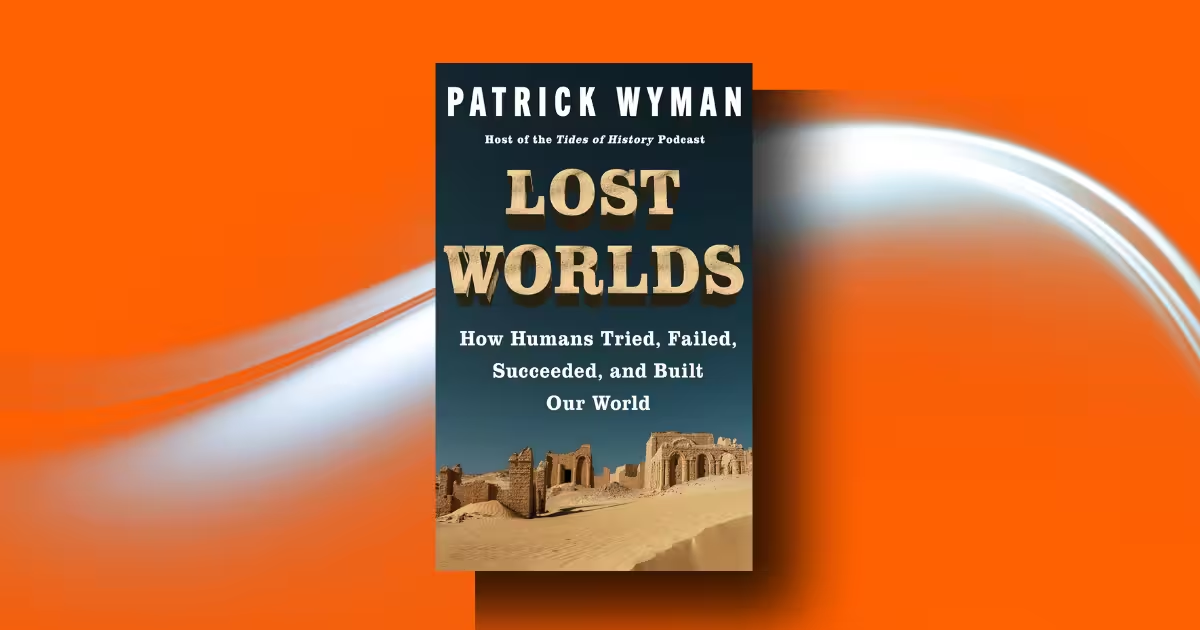
Why did civilization happen at all—and why do we still pretend it was a straight road from caves to cities? Patrick Wyman’s Lost Worlds helped me see human history not as a triumphal march of progress, but as a breathtaking, brutal, creative record of experiments that sometimes saved societies and sometimes destroyed them.
Lost Worlds is best for readers who love ancient history, archaeology, anthropology, climate history, human migration, DNA studies, the origins of agriculture, Bronze Age collapse, and big-picture nonfiction written with narrative force. It is especially valuable for readers of The Dawn of Everything, Against the Grain, 1177 B.C., Sapiens, and deep-history books that question easy myths about civilization.
Not for readers looking for a simple “rise of civilization” story, a traditional king-by-king ancient history, or a book focused only on Egypt, Mesopotamia, Greece, or Rome. Wyman’s subject is broader, stranger, and more archaeological: the thousands of years before familiar written history becomes dominant.
Table of Contents
1. Introduction
Lost Worlds: How Humans Tried, Failed, Succeeded, and Built Our World is a 2026 nonfiction history book by Patrick Wyman, published by HarperCollins/Harper.
Patrick Wyman is a historian and the host of Tides of History and Fall of Rome; the author bio in the uploaded book says his podcasts have been downloaded more than 60 million times, that he holds a PhD in history from the University of Southern California, and that his essays have appeared in The Atlantic, Slate, and Mother Jones.
The book’s subject is the deep history of human civilization from the end of the Ice Age to the Bronze Age.
Wyman focuses on the roughly 10,000-year span between the end of the last Ice Age and the decline of the Bronze Age—the period in which agriculture, villages, cities, social hierarchy, writing, long-distance trade, states, monuments, and mass migration reshaped the world.
The book’s argument is clear: Wyman shows that the world was built “not by inevitability, but by trial and error on a global scale.”
The book’s central thesis is that civilization did not develop in a clean sequence: foraging did not automatically lead to farming, farming did not automatically produce villages, villages did not automatically produce cities, and cities did not automatically produce states.
Wyman writes against what he calls the old linear story of civilization: hunter-gatherers become farmers, farmers become villagers, villagers become city dwellers, city dwellers become subjects of kings. He argues instead that the real story is messier, more global, and more experimental.
In the book’s own words, there was “no obvious movement along a linear path from foraging to civilization to the Industrial Revolution and beyond.”
Publishers Weekly describes the book as a “profound and enchanting study” that “upends myths about the rise of civilization,” noting Wyman’s emphasis on lidar, ground-penetrating radar, DNA analysis, and other archaeological sciences that have transformed the study of deep history.
That praise fits my own reading experience: Lost Worlds feels like a book written after archaeology got new eyes.
2. Background: Why this book matters now
The old classroom version of civilization usually begins in Mesopotamia and Egypt.
It tells us that humans left hunting and gathering behind, invented farming in the Fertile Crescent, settled in villages, produced surplus food, created hierarchy, built cities, invented writing, and finally formed states.
Wyman does not deny the importance of the Fertile Crescent, Mesopotamia, or Egypt. He denies that they are the universal model for all human development.
This is where Lost Worlds becomes especially important. Wyman’s book is not merely a summary of ancient sites; it is a correction of a mental habit. We like clean progress stories because they are easy to remember.
But the archaeological record, as Wyman presents it, is full of societies that do not fit the old ladder model. Some hunter-gatherers built monuments. Some settled down without farming.
Some farmers remained mobile. Some cities existed without obvious kings. Some hierarchical societies collapsed quickly. Some “dead ends” lasted centuries and shaped enormous regions.
The book begins with Marroquíes, a Copper Age settlement buried beneath modern Jaén in southern Spain. It had more than 3,000 residents and lasted roughly from 2800 to 2100 BC. Wyman uses it as an opening lesson in impermanence: ancient societies could flourish for centuries and then disappear within a few decades.
The site was part of a larger Iberian megasite world, and by around 2100 BC those settlements had emptied.
The reason seems to have been a mixture of climate stress, land-use pressure, possible disease, and perhaps violence or replacement by steppe-descended newcomers.
Wyman’s point is not that one factor explains everything. His point is the opposite: collapse is usually multi-causal, cumulative, and human. People adapt—until the available adaptations stop working.
This makes Lost Worlds feel disturbingly contemporary. It is a book about ancient history, but its emotional force comes from the present. Climate change, migration, food systems, inequality, violence, population pressure, ecological damage, and technological transformation are not modern inventions.
The scale is different now, but the human predicament is recognizable.
3. Book summary: What I learned from Lost Worlds
The book’s big argument: civilization was not inevitable
Wyman’s core lesson is that human history was not a staircase. It was a field of experiments. Some experiments worked for a while. Some failed immediately. Some produced more people, more food, and more complexity, but also more disease, violence, inequality, and ecological damage.
The book argues that between roughly 11,000 BC and 1000 BC, humanity transformed the planet.
At the start, there were no cities. At the end, there were cities across multiple regions. At the start, humans lived mostly as foragers. At the end, farming and herding had spread widely.
At the start, mammoths, giant sloths, wild horses, and other megafauna still shaped many landscapes. At the end, cattle, sheep, pigs, goats, wheat, barley, rice, millet, maize, and other domesticates had begun to dominate human environments.
Wyman’s phrase “Lost Worlds” refers to the societies, settlements, lifeways, and human possibilities that flourished and vanished before written history could preserve their names.
Part 1: The unstable planet
The first part of the book, “Unstable Planet,” begins with a basic correction: environments are not stable backgrounds.
They are active forces. Around 20,000 years ago, during the Last Glacial Maximum, large portions of North America and Europe were covered by thick ice sheets; average temperatures were about eleven degrees Fahrenheit cooler, and sea levels were up to 440 feet lower than today.
Then came warming, melting, flooding, forest expansion, and the Holocene. Around 12,900 years ago, the Younger Dryas brought a final major cold snap lasting about 1,200 years.
After about 11,700 years ago, the Holocene began, and sea levels rose rapidly—Wyman gives a rate of about fifty feet per thousand years for the early Holocene.
This environmental instability forced human creativity. Some groups moved. Some stayed and changed what they ate. Some invented new tools. Some learned storage, fishing, burning, building, and cultivation.
Wyman’s repeated lesson is that humans were never passive victims of nature. They changed environments, and environments changed them.
Clovis, Anzick-1, and the Americas
One of the most vivid early examples is Anzick-1, the infant buried in Montana about 12,900 years ago with stone tools and red ocher.
Wyman uses the child to discuss the Clovis people, their distinctive projectile points, and their relationship to later Indigenous Americans. He notes that Anzick-1 is the only set of human remains associated with Clovis artifacts and that DNA links the Clovis people to later Indigenous American populations.
Wyman is careful not to claim Clovis people were the first Americans. He notes pre-Clovis evidence, including White Sands footprints as much as 23,000 years old.
This is supported by scientific reporting: Nature reported in 2021 that children left tracks in New Mexico around 22,500 years ago, and Cornell’s report on the research said the footprints provide evidence of human presence over 23,000 years ago.
The Clovis story also raises the question of megafaunal extinction. Wyman does not reduce the disappearance of mammoths, mastodons, horses, and camels in the Americas to a single cause.
Climate change reduced habitat. Human hunting likely added pressure. The lesson is ecological: a successful human adaptation can become destructive when conditions change.
Star Carr and the Mesolithic imagination
Wyman then moves to Star Carr in Yorkshire, a Mesolithic site around 11,000 years old. The people there lived near Lake Flixton, hunted deer, used microliths, worked wood, built platforms, burned reeds to manage wetlands, and created deer-antler frontlets or headdresses.
This section is one of the book’s most important because it refuses to treat hunter-gatherers as simple.
The people of Star Carr had rich symbolic lives. The antler frontlets may have been hunting disguises, ritual objects, shamanic tools, or something that does not fit modern categories. Wyman’s deeper point is that ancient people did not divide life into our neat boxes: practical, religious, economic, aesthetic.
A deer mask could be all of these at once.
Jomon Japan: pottery before farming
The Jomon people of Japan are another major challenge to old assumptions. Pottery is often taught as a technology that follows settled farming. But Wyman shows that Jomon hunter-gatherers made pottery long before full agriculture defined their lives.
They built permanent villages, stored food, gathered nuts, hunted deer and boar, used smoking pits, and created a durable forager society that lasted millennia.
This matters because it breaks the supposed chain: pottery → farming → village → civilization. In Japan, pottery and sedentism could exist without agriculture becoming dominant. The Jomon were not “failed farmers.” They were successful foragers who chose and refined a different way of living.
The Fertile Crescent: agriculture as experiment, not destiny
The Fertile Crescent remains central, but Wyman reframes it.
The Natufians and other groups in western Asia were not “destined” to invent farming. They were broad-spectrum foragers who already had tools, knowledge, and access to wild grasses such as wheat and barley. Over thousands of years, choices about gathering, planting, tending, and selecting plants gradually turned into domestication.
Agriculture appears here not as a sudden genius invention, but as a long, messy, unintended process. People did not set out to create cities, states, taxes, kings, or civilization. They tried to feed themselves better, survive changing climates, and use familiar resources more intensively.
Many cradles of agriculture
One of the most valuable parts of Lost Worlds is its global scope.
Wyman insists that food production did not have one origin. It developed independently in multiple places: the Yellow and Yangtze River valleys of China, the Andes, the Amazon basin, Mesoamerica, eastern North America, New Guinea, Africa, southern Asia, and elsewhere.
Lost Worlds argues that agriculture was invented many times, not once. That single sentence answers a major search question and captures one of the book’s essential contributions.
Göbekli Tepe: monumentality before farming
Wyman’s discussion of Göbekli Tepe is another blow to the old model. The site in southeastern Anatolia contains monumental megalithic structures built by hunter-gatherers in the Pre-Pottery Neolithic.
UNESCO dates the structures between 9,600 and 8,200 BCE and describes the T-shaped pillars, some up to 5.50 meters tall, as decorated with wild animals and likely connected to social or ritual events.
In Wyman’s reading, Göbekli Tepe shows that complex ritual and monumental construction did not require cities, states, or agriculture. The site had wild plant and animal remains and no clear evidence of fully domesticated food production in its earliest phases. The people who built it were not primitive simply because they were foragers.
The Neolithic: progress with a dark side
The Neolithic did not simply bring food security and peaceful village life. Wyman devotes significant attention to violence, mass graves, social stress, disease, and inequality.
The Koszyce mass grave in southern Poland, discovered in 2011, contained fifteen people—children, women, and men—killed by blows to the head.
Wyman explains that radiocarbon modeling narrowed the event to 2880–2776 BC, a 104-year window nearly 5,000 years ago. DNA and isotope analysis revealed family relationships, local origins, and a probable context of intergroup conflict.
This is where Lost Worlds becomes emotionally heavy. The new archaeological science does not just tell us where people migrated. It lets us reconstruct family tragedy. Wyman’s short line—“These were real people”—is one of the book’s moral anchors.
Cities without our assumptions
Wyman repeatedly asks: what counts as a city? Uruk in southern Mesopotamia is often treated as the first true city, but Wyman compares it with large settlements in the Andes and Ukrainian forest-steppe. Some of these places gathered thousands of people without looking like Mesopotamian cities.
They may have served ritual, seasonal, identity-building, or defensive purposes rather than administrative ones.
The Trypillia megasites are especially important. Wyman argues that they should not be dismissed as dead ends simply because they do not fit the later city-state model. For centuries, perhaps up to a thousand years, these huge gathering places helped sustain identity and social life in a changing world.
Migration: the great engine of human history
Migration is Wyman’s third major theme, alongside environment and demography. He argues that late twentieth-century archaeology often became too cautious about migration because older migration theories were contaminated by racial essentialism and nationalist misuse.
But ancient DNA has made it impossible to ignore migration. People moved constantly—families, bands, farmers, pastoralists, sailors, warbands, and whole cultural networks.
The book’s treatment of Proto-Indo-Europeans and Proto-Austronesians is especially strong.
Between 3000 and 2000 BC, Proto-Indo-European-speaking groups expanded from the western Eurasian steppe, while Proto-Austronesian speakers moved from Taiwan into the Philippines and then across Island Southeast Asia and the Pacific.
Wyman notes that Indo-European is now the world’s most widely spoken language family, while Austronesian was the most geographically widespread before modern mass migrations.
Here the book overturns another prejudice: mobile people were not backward. Pastoralists, sailors, and long-distance migrants could be as socially complex and technologically sophisticated as settled farmers.
Pyramids, Stonehenge, and one-time achievements
Wyman’s chapter on the Great Pyramid and Stonehenge asks why such monuments were only built once—or at least why their exact scale and form were not endlessly repeated. This is a brilliant question because it treats monuments not as isolated wonders, but as products of specific political, ecological, religious, and logistical circumstances.
For Giza, recent research supports Wyman’s interest in environmental infrastructure. A 2022 PNAS study reconstructed 8,000 years of Nile floodplain variation and found that the now-defunct Khufu branch remained at about 40% of its Holocene maximum during the reigns of Khufu, Khafre, and Menkaure, helping transport materials to the Giza pyramid complex.
The lesson is not “the Nile built the pyramids.” Humans built them. But the right environment, labor system, state capacity, ideology, and logistics came together briefly. When the conditions changed, the same achievement was not repeated in the same way.
The Bronze Age Collapse: not one cause, not total disappearance
The final major movement of Lost Worlds is the Bronze Age Collapse.
Wyman treats it not as a Hollywood disaster scene but as a complex systems failure involving drought, migration, warfare, elite instability, economic fragility, and interconnected palatial states.
He explicitly resists a single-cause explanation. In one of the book’s clearest formulations, he says climate did not exactly “cause” the Bronze Age Collapse; rather, the collapse happened amid climatic shifts, and those shifts triggered human responses within an interconnected Mediterranean and Near Eastern world.
This is careful history. It is easy to say “drought destroyed civilization” or “Sea Peoples destroyed civilization.” Wyman’s more persuasive answer is that collapse happens when pressures interact: climate stress weakens food systems; elites demand more; trade networks falter; migrants move; war spreads; legitimacy breaks; palaces burn.
But Lost Worlds does not end in nihilism.
The epilogue emphasizes survival. The Bronze Age Collapse did not end complexity in the eastern Mediterranean. Phoenicians, Philistines, Israelites, Judaeans, Neo-Assyrians, Greeks, and others emerged from the rubble. Egypt changed but endured. Assyria shrank and then expanded.
Mycenaean palaces vanished, but Greek language and myth survived.
That is the final emotional movement of the book: worlds end, but not everything ends.
4. Analysis: My opinion on Lost Worlds
Lost Worlds is a remarkable, ambitious, and intellectually generous book. It is not just a history of early civilization; it is a history of human improvisation under pressure. What moved me most is the way Wyman restores dignity to people usually treated as preludes, failures, or footnotes.
The book’s strongest achievement is its attack on inevitability.
Wyman makes it almost impossible to keep believing that human history moved naturally from “simple” to “complex,” “primitive” to “civilized,” “hunter-gatherer” to “farmer,” “village” to “state.”
Instead, he gives us a world of multiple pathways: Jomon Japan without farming dominance, Göbekli Tepe without cities, Trypillia megasites without Mesopotamian-style administration, Andean complexity without the same agricultural path as the Fertile Crescent, Bronze Age systems that grew powerful and fragile at the same time.
The evidence base is also impressive. Wyman’s book depends on archaeoscience: ancient DNA, isotopes, radiocarbon modeling, paleoclimate records, pollen analysis, residue analysis, lidar, satellite imagery, magnetometry, and ground-penetrating radar. He explains these tools without turning the prose into a textbook.
For a general reader, that is a major accomplishment.
The book fulfills its stated purpose because it actually gives us a new narrative rather than merely saying the old narrative is wrong. Many revisionist books are better at demolition than construction.
Lost Worlds does both. It dismantles the myth of linear progress, then replaces it with a thematic model built around environment, demography, subsistence, migration, violence, identity, technology, and collapse.
If I had to condense the book’s argument into one answer, I would put it this way:
Patrick Wyman’s Lost Worlds argues that civilization was not inevitable. Between the Ice Age and Bronze Age, humans built the modern world through thousands of local experiments in farming, foraging, migration, settlement, trade, hierarchy, ritual, and ecological engineering—many of which failed, collapsed, or disappeared, but still shaped the world we inherited.
That is the heart of the book.
5. Strengths and weaknesses
Strengths
The first strength is narrative energy. Wyman begins chapters with scenes—burials, hunts, lakeshores, megasites, palaces, battlefields—and then zooms out to explain the science. This makes difficult archaeology readable.
The second strength is global range. The book does not trap civilization inside Mesopotamia and Egypt.
It moves through Iberia, Poland, Montana, Britain, Japan, the Fertile Crescent, China, New Guinea, the Andes, the steppe, the Pacific, Egypt, Stonehenge, the Indus Valley, Turkmenistan, Crete, Mycenaean Greece, Anatolia, and Shang China.
The third strength is moral seriousness. Wyman never lets ancient people become data points.
The Koszyce victims, Anzick-1, the people of Marroquíes, the residents of Star Carr, the builders of Göbekli Tepe, and the survivors of collapse are treated as human beings with fear, grief, love, ritual, identity, and practical intelligence.
The fourth strength is intellectual humility. Wyman repeatedly admits uncertainty. He does not pretend archaeology can answer everything. That honesty builds trust.
Weaknesses
The book’s main weakness is density. Because Wyman covers roughly 10,000 years and a global range of societies, readers who are new to archaeology may sometimes feel overloaded by names, sites, cultures, and dates.
A second weakness is that the book’s thematic ambition sometimes means individual societies receive less space than they deserve. I wanted even more on the Indus Valley, Jomon Japan, and Austronesian expansion.
A third potential criticism is that the book’s anti-linear model may feel repetitive to readers already familiar with recent archaeology, The Dawn of Everything, or critiques of “civilization” narratives. But for general readers, the repetition is useful: Wyman is retraining how we think.
My pleasant experience: I felt the book constantly opened doors. It made prehistory feel alive, not empty.
My unpleasant experience: at times, the sheer number of vanished societies created a kind of grief. This is not a comforting book. It is hopeful, but not comforting.
6. Comparison with similar works
Readers who liked David Graeber and David Wengrow’s The Dawn of Everything will find Lost Worlds a useful companion. Both books challenge linear progress narratives and emphasize the diversity of early human societies.
But Wyman is more focused on archaeoscience, climate, migration, and the Ice Age-to-Bronze Age arc.
Compared with James C. Scott’s Against the Grain, Wyman is less polemical about states and agriculture. Scott emphasizes how early states trapped grain, labor, and disease; Wyman gives a broader picture in which agriculture is both a successful ecological technology and a source of risk.
Compared with Eric H. Cline’s 1177 B.C., Wyman’s book has a much wider chronological frame. Cline focuses on the Late Bronze Age collapse; Wyman makes collapse one stage in a much longer pattern of experimentation, failure, and survival.
Compared with Sapiens, Lost Worlds is more archaeologically grounded and less sweeping in philosophical speculation. Wyman’s claims are tied more closely to sites, methods, and evidence.
Compared with Ian Morris-style macrohistory, Wyman is less interested in measuring “development” and more interested in the variability of human pathways.
7. Conclusion: Should you read Lost Worlds?
Yes—especially if you want a serious, readable, evidence-rich book about how civilization actually emerged. Lost Worlds is best for readers who want to understand why agriculture, cities, states, monuments, migration, and collapse did not follow a single script.
It is suitable for general readers, but it rewards patience. Specialists may not find every argument new, but they will likely appreciate the synthesis.
My final judgment: Lost Worlds is one of those history books that changes the shape of your mental timeline. It does not merely add facts; it changes the story those facts belong to.
That is why Lost Worlds matters. It teaches that civilization was not destiny. It was practice. It was trial and error. It still is.







