
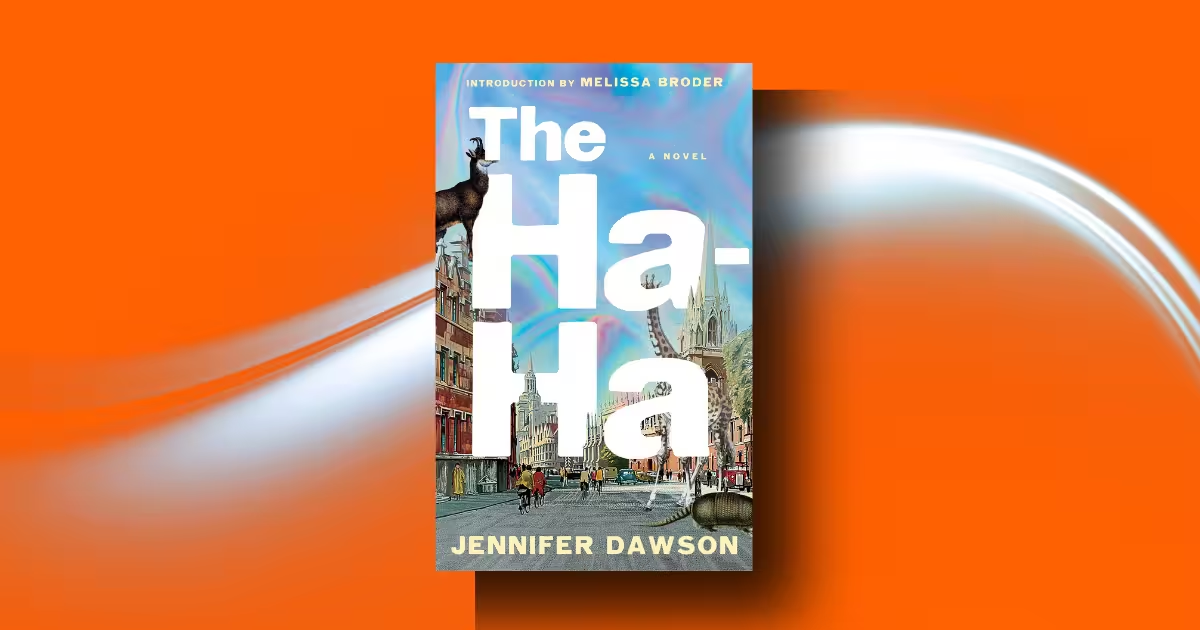
Do you ever feel that ordinary life has rules everyone else received but you somehow missed? That is why I think The Ha-Ha by Jennifer Dawson still matters: it turns mental illness, loneliness, laughter, and recovery into one of the strangest and most tender reading experiences I have had.
The Ha-Ha is a sharp, poetic, tragicomic novel about Josephine Traughton, a young Oxford woman recovering in a psychiatric hospital, who slowly learns that “sanity” is not the same thing as being alive.
The Ha-Ha is best for readers of literary fiction, mental-health literature, women’s writing, mid-century British fiction, The Bell Jar, institutional novels, and psychologically intense coming-of-age stories.
Not for readers who want a fast plot, clear genre structure, romance-first storytelling, or a conventional “illness-to-cure” recovery arc.
Table of Contents
1. Introduction
The Ha-Ha is a novel by Jennifer Dawson. It was first published in Great Britain by Anthony Blond Limited in 1961; the Faber Editions paperback was published by Faber & Faber on 31 July 2025, with Daisy Johnson’s foreword in the uploaded edition.
The Faber listing describes it as “a tragicomic portrait” of a young woman’s university breakdown and recovery, and notes that it won the 1961 James Tait Black Prize.
Dawson’s own biography matters here. The author notes that she studied History at Oxford, was hospitalised after a breakdown, later worked as a teacher, dictionary indexer and welfare worker, and that her experience “as a mental health professional and a patient” inspired The Ha-Ha.
The Guardian obituary similarly says the novel drew on Dawson’s experience as both patient and psychiatric social worker.
The title itself is beautifully double-edged. A ha-ha is a sunken wall or ditch, but here it also becomes the sound of Josephine’s laughter: the laugh that alarms polite society, protects her, exposes her, and finally becomes a kind of border between what others call sanity and what she experiences as reality.
2. Background and Historical Context
The novel sits in the shadow of the Mental Health Act 1959. Daisy Johnson’s foreword says the Act attempted to destigmatise mental illness and extend care into the community, while Dawson’s own afterword calls the book “a small cry” written a year after that Act.
This context is essential. The Ha-Ha is not simply a private story about one young woman’s breakdown.
It is also a record of mid-century psychiatric care: certification, regrading, institutional routines, insulin treatment, ECT, locked spaces, “rehabilitation,” and the awkward language by which doctors and nurses tried to fit living people into administrative categories.
Josephine is repeatedly asked to return to the “real world,” but the novel quietly asks: who gets to decide which world is real?
That question remains contemporary. NHS England reported that 3,790,826 people were known to be in contact with NHS-funded secondary mental health, learning disability and autism services in England during 2023–24.
The WHO states that in 2021 nearly 1 in 7 people globally were living with a mental disorder, and that many still lack effective care.
This is why Dawson’s 1961 novel still feels painfully modern: it is about care, stigma, loneliness, and the human need to be treated as more than a diagnosis.
3. The Ha-Ha Summary
The Beginning: Oxford, Laughter, and the Tea Party
The novel opens not at the beginning of Josephine Traughton’s story, but in the middle of it — mid-conversation, mid-admission. We find her in a psychiatric hospital called Gardenwell Park, talking to a German ward sister in a small side-room that is barely bigger than a cupboard.
From the opening lines — “They were all very kind at Oxford,” I assured her, for she had seemed to think they were not — we understand that Josephine is performing reassurance for people who cannot quite understand her.
She describes her time at Oxford University, where she studied Anglo-Saxon and became absorbed in the Ormulum, a medieval text.
But Oxford was not a social success. Josephine was never quite in step with the undergraduates around her — those confident young women who answered each other with “pat” replies before she had even finished forming a thought in her own mind.
The real break came at a termly tea party held by the Principal of her Oxford college, Lady Stocker.
A guest named Miss Veronica Piercy was holding forth about spiritual waste and Western civilisation, and as Josephine sat in a row on a striped Regency settee passing painted cups and rolled sandwiches, she began to see something else entirely: files of armadillos with scaly shells, and hosts of big black flies. The laughter came — unstoppable, shocking — and her Oxford career effectively ended there.
What follows in her telling, and in the novel’s architecture, is not chronological but associative, circling back through memory and present-moment observation in a way that reflects the texture of Josephine’s particular consciousness.
The Hospital: Gardenwell Park
Josephine has been at Gardenwell Park for some time before the novel opens properly.
By the time we meet her, she has been moved from the crowded dormitory ward to a small private side-room on the second floor — a significant upgrade that signals her improving status.
She is in the care of a warm, emotional German-Jewish sister who speaks in rich rolling sentences and brings heart-shaped gingerbreads as small acts of love.
This sister, referred to throughout primarily as “the Sister,” is one of the novel’s most vivid and tender creations — deeply caring, but also, in her way, complicit in the institutional logic that traps Josephine.
The hospital is positioned on a hill overlooking the town. Josephine has been given day-release to work at the home of a retired colonel and his wife, Colonel and Mrs. Maybury, where she is cataloguing their books in a dusty attic room with a view over the rooftops.
She loves this work — or rather, she loves the world she sees from that attic window: the red-brick streets, the pickle factory, the dancing academy.
She is working toward a formal “regrading” by the hospital committee — a bureaucratic process that would change her legal status from certified patient to something approaching freedom.
But Josephine’s inner world, while vivid and rich, remains a mystery to those around her.
She cannot find the right words. Mrs. Maybury, the Sister, and everyone who means well to her keeps waiting for her to fill a social gap she cannot quite locate. I wanted the knack of existing. I did not know the rules — a line that runs through the book like a nerve.
The Ha-Ha and Alasdair
The title refers to a specific landscape feature: a sunken wall or grassy slope with a hidden vertical drop, which creates a boundary in a garden without visually interrupting the view.
At Gardenwell Park, there is a ha-ha between the hospital grounds and the fields beyond the wall.
Josephine discovers that she can climb over the hospital wall from the road and drop into this grassy ha-ha, lying there unseen among the poppies in the last light of the summer evenings.
It is here — at the ha-ha — that she first meets Alasdair Faber.
Alasdair is a patient from the male side of the hospital: a dark-haired, quick-laughing young man who had been a medical student in London before a crisis of “nervous tension” — anxiety neurosis, he calls it — brought him to Gardenwell Park. He is undergoing analysis, which he describes with sardonic theatrical voice as “deep, profound searching, lasting, enduring analysis.”
Their friendship develops quickly. Alasdair calls to her to jump from the wall — Jump! Jump! — and she does, landing in the long grass beside him.
He is talkative, irreverent, full of opinions about the hospital’s antediluvian methods, and genuinely curious about Josephine, whom he finds — in his slightly patronising way — refreshingly real.
He sees her differently to everyone else. Where others try to coax her toward normalcy, Alasdair finds her oddness a kind of philosophical purity.
“I admired you for that reason the very first time I saw you sitting all alone in that ditch with your hair flying and no make-up on and not bothering about what people thought of you. You refreshed me.”
They begin meeting regularly in the evenings by the ha-ha, talking while the hospital social workers inside run the Military Two-Step and the Okey-Cokey for the other patients.
The Party at Waterminster Place
Helena Bruce — an old college friend from Josephine’s Oxford days — reappears one afternoon in the town, leaning from her grey Morris Minor in a tangerine-coloured dress and a hat “like a snowflake,” brisk and poised and married-or-almost-married to a man called Tony Houghton.
Helena’s world is already the other world, the world of cocktail parties and engagement plans and talk about what to do with one’s higher education now that it has been so inconveniently acquired.
Josephine receives an invitation to a party at Waterminster Place — Helena and Tony’s engagement cocktail party.
She goes, wearing a velvet jacket and the silver chain from her room, and it goes about as one might fear. She sits in the middle of the floor clutching her knees and trying to describe how strange and beautiful and improbable the world is. The other guests dance and circulate and make the right remarks. She cannot. She hears Tony’s voice behind her — “someone Helena invited in one of her manic moods. We didn’t really think she’d turn up” — and leaves into the night, drifting back up the hill toward the hospital, feeling weightless and unreal.
The whole thing rocked, I saw. Was it bricks or iron, or just more rubble?
The party was four storeys up, the laughter was rising as she left, and she walked back to the settlement feeling not quite like paper — but very nearly.
The Boardroom and the Seduction
After the party, Josephine is desolated. Alasdair — seeing her upset — leads her through the official corridors of the hospital, past the darkened offices and treatment rooms, to the deserted boardroom where the doctors hold their regrading committee meetings.
They sit beneath the long table with a lamp casting yellow light over the rows of books on the walls: Intracranial Tumours, Legal Aspects of Psychosis, Twenty Cases of Lobotomy.
In this intimate near-darkness, Alasdair lets slip what he has apparently suspected for some time: that Josephine’s diagnosis may be schizophrenia. He backtracks immediately — “Forget it. It’s only their terminology. It’s only a word” — but the damage is done. The books behind them suddenly seem to press forward with ominous weight.
And yet: Alasdair also says something that matters more than the label. He tells her she is “the most legitimate, the most real person I have ever met.”
He says she does not play games with herself or with other people. He tells her that is what is so nice about her.
The week that follows is the most alive Josephine has ever felt. They meet nightly in the boardroom, then slip out into the town — to pubs and coffee bars, to a cellar where people are dancing, to the cinema.
She feels, for the first time, that she has edges and boundaries. I felt like a queen.
On a Sunday, Alasdair takes her on a bus to the countryside, to fields on the other side of the hill she has gazed at from her hospital window for so many months.
He has found her the far side of her own obsession — and there, by the dark-flowing River Severn, their relationship becomes physical. Josephine experiences this not as pleasure exactly, but as contact — a proof of existing. The feel of solid things is very good.
Alasdair, satisfied and gentle, immediately begins to pull away in the small ways that those who have got what they want often do.
Abandonment and Relapse
The following day, Josephine wakes and goes looking for Alasdair throughout the hospital grounds.
She cannot find him anywhere. The male nurse on the ward, with a thin smirk, tells her that Alasdair Faber has gone — discharged suddenly, without notice, without saying goodbye.
The receptionist later brings her a letter and a bunch of gladioli. The letter — signed Love, Alasdair — is charming, affectionate, and devastating. He explains that the hospital couldn’t really help him.
He has been discharged. He calls her “one of the nicest girls I’ve ever met” and “good in the Kleinean sense” and says her life is too “secret, intense, unworldly” for him to join without spoiling it. He will think of her. She should write.
She eats one of the flower-heads.
What follows is described with controlled understatement that is, in its way, more devastating than overt grief. Josephine runs from the hospital committee, flees into the town, drinks gin with a stranger at The Bull, spends the night in a hotel.
She then disappears into a weeks-long wandering — hitching rides with lorry drivers and car salesmen, drifting across the English countryside in an increasingly dissociated state, exchanging the language she doesn’t know for the language she has picked up from truckers: ‘Sright.
The police eventually find her at a railway bridge and bring her back to the hospital.
What follows is the most harrowing section of the novel: weeks or months of electric shock treatment, the black box, the rubber gag, the headaches, the forgetting, the wards full of women in coloured pinafores, the obliteration of memory and self that “insight” and “stabilisation” are meant to produce.
The Ending: The Rubble and the Running
By Chapter Nine, it is winter — February, perhaps — and Josephine has gained the required “insight.”
She has grown fat, attends the Friday evening dances, smiles at the Superintendent when he rounds the ward. She knows the profile now. She is stabilising.
But watching another patient — Kathie, an enormous woman who has been asking for her discharge and is given electric shock for her trouble — Josephine is suddenly, sharply outraged. It may be, she reflects, that Alasdair bequeathed her his anger instead of love.
She goes to the ha-ha.
The contractor has been there — the wall that enclosed her world is being torn down. She climbs up through the rubble, peers out at the cold February fields and the cattle breathing steam.
And she thinks: It was all absurd, but in the comedy it was we who were the clowns, the bastards, all along, so there was no time to lament one’s oddness or to bother about anything but the strange thing called life that was here and now.
She does not go back to her room. She does not answer the Sister’s call. She remembers what Alasdair once told her — that if you stayed away for fourteen days, they could not legally reclaim you.
So she climbs over the rubble that had been her wall, says goodbye to the hill, and ran and ran until I knew for certain that I had not after all been extinguished, and that my existence had been saved.
The novel ends here. There is no regrading. There is no verdict. There is only Josephine — running.
4. The Ha-Ha Analysis
4.1 The Ha-Ha Characters
Josephine Traughton is one of the most memorable narrators in British mental-health fiction.
She is not written as a case study but as a consciousness. Her mind moves by association: animals, objects, biblical echoes, social phrases, plants, clothes, bodies, walls, drains, and stars all become charged with meaning.
Her tragedy is not that she sees nothing; it is that she sees too much. She cannot reduce life to the acceptable small talk that lets other people function.
Sister Schwarz is tender and controlling at once.
She genuinely cares for Josephine, gives her sweets, listens to her, lends emotional warmth, and wants her to recover.
Yet her care can also become possessive. She wants Josephine to have “safe” friendships and “bannisters.” She represents a humane version of the institution: loving, but still invested in making Josephine manageable.
Alasdair Faber is both liberator and danger. He recognises Josephine’s laughter as a gift, not merely a symptom.
He invites her to jump, to talk, to desire, to re-enter life. But he also romanticises her innocence and then leaves.
His letter reveals affection, vanity, fear, and condescension all at once. He helps Josephine awaken, but he cannot carry the responsibility of what he awakens.
Josephine’s mother is loving, comic, limiting, and deeply influential. She wants to protect Josephine from vulgarity, sexuality, and social danger, but her protection becomes a cage.
The mother’s death leaves Josephine with both freedom and guilt, which is why Alasdair’s cruel question — whether she is glad her mother is dead — strikes so deeply.
Helena Bruce is the polished world Josephine cannot enter. She is not exactly malicious; she is worse in a way — casually social, smoothly ironic, and protected by class codes.
Her party represents the ordinary world as theatre. Josephine does not fail because she is stupid; she fails because the social performance is built for people who can pretend not to notice its absurdity.
Dr Clements embodies institutional authority. His language converts pain into stages, symptoms, treatment, and progress. In the Kathie scene, his calmness becomes terrifying because it appears reasonable while sanctioning violence.
4.2 The Ha-Ha Themes and Symbolism
The ha-ha:
The ha-ha is the novel’s central symbol. It is a ditch, a boundary, a hiding place, and a joke. Daisy Johnson’s foreword says it represents escape at first, but also loneliness and Josephine’s own startling laughter.
The wall is low enough to cross yet real enough to divide worlds. When it is demolished at the end, Josephine’s world does not become magically safe; rather, the old division between patient and citizen, inside and outside, illness and life, has lost its authority.
Laughter:
Josephine’s laugh is treated as illness by polite society, but the novel complicates that judgment.
Her laughter comes when the human world suddenly appears animal, fragile, absurd, and pretentious. It is a breakdown, but also a form of truth-telling.
Animals and the collapse of hierarchy:
The Blake epigraph asks whether fly and human are more alike than humans admit. Josephine’s visions of insects, mammals, snakes, and snails undermine the human fantasy of superiority.
Her mother wants man safely “at the top”; Josephine sees legs, tails, bodies, fluids, and instincts.
The “real world”:
Doctors, nurses, Mrs Maybury and Helena all speak as if there is a real world Josephine must return to.
But Dawson’s genius is that Josephine often sees the so-called real world more clearly than they do. The party, the hospital, the Mayburys’ attic, the town, and the ha-ha all feel equally constructed.
Institutional care versus human life:
The novel does not deny mental suffering. It does not romanticise breakdown. However, it attacks the idea that care means reducing a person to compliance. Kathie’s forced treatment and threatened lobotomy show the brutal underside of institutional order.
Naming and classification:
Josephine is disturbed by being “regraded.” The word makes her feel sorted, not understood. Her own name on an invitation feels almost accidental. Again and again, Dawson asks whether identity is something society assigns or something a person painfully claims.
5. Evaluation
The Ha-Ha is a small, radiant, frighteningly precise novel — not loud, not sentimental, but devastating in the way it shows a woman fighting to remain alive inside other people’s definitions of wellness.
Strengths
The greatest strength is Josephine’s voice. Dawson gives her a mind that is funny, wounded, exact, and philosophically alive.
The prose can move from comic social observation to metaphysical terror in a single paragraph. I also loved how the novel refuses easy binaries: hospital/outside, sane/mad, safety/freedom, care/control.
Weaknesses
Some readers may find the plot narrow or the middle sections slow. The novel is less event-driven than perception-driven. Also, certain period terms and attitudes around mental illness, sexuality, race, and disability can feel harsh today; the Faber edition itself notes that the language reflects the period in which it was written.
Impact and Controversy
The novel was not controversial at publication in any obvious way — its radicalism was literary and social rather than explicitly political.
But it has gained in significance with every decade.
Its exploration of how psychiatric institutions function as instruments of social control, its scepticism about diagnostic labels, its attention to the specific pressures on educated women in mid-century Britain — all of these have become richer as the conversation around women’s mental health has deepened.
There is also the remarkable biographical echo: Sylvia Plath, who published her own psychiatric institution novel the year after Dawson’s, was reportedly reading The Ha-Ha just before her death.
The two women had strikingly parallel trajectories — both institutionalised while at university in the early 1950s, both writing their central novels in the same year (1961), both confronting what it meant to be a woman whose mind moved in ways the social world could not accommodate.
Comparison with Similar Works
The most obvious comparison is Sylvia Plath’s The Bell Jar.
But where Plath’s novel is colder, sharper, and more socially satirical, Dawson’s is stranger and more porous; Josephine’s mind does not merely report suffering, it transforms the texture of the world.
Reviews have also placed The Ha-Ha alongside mid-century novels about women in psychiatric institutions; The Times called it one of the strongest in that tradition because it balances asylum bleakness with joy and connection.
6. Personal Insight with Contemporary Educational Relevance: 5 Lessons
The most important contemporary lesson of The Ha-Ha is that mental-health recovery cannot be reduced to making a person socially convenient.
Josephine is not healed by being quiet, graded, placed, fed, analysed, or made safe. She begins to live when she can claim desire, grief, strangeness, and joy as her own.
That matters now because mental-health services today are still under pressure: NHS England recorded about 3.79 million people in contact with secondary mental health, learning disability and autism services in England in 2023–24, up 5.8% from 2022–23.
Globally, the WHO reports that nearly 1 in 7 people lived with a mental disorder in 2021, with many lacking access to effective care. ([World Health Organization][4])
Five lessons:
- Recovery must include dignity, not only symptom management.
- A person’s unusual perception may contain truth, not just pathology.
- Institutions can care and harm at the same time.
- Loneliness is not cured by forcing someone into society before society has room for them.
- Joy is not a luxury in mental health; it is part of survival.
7. The Ha-Ha Quotes
On Social Alienation: “Unfortunately I did not seem able to learn exactly how the appropriate reply fitted on to the prior remark, and a lot seemed to depend on this in undergraduate circles. With me the two never seemed to dovetail.” (Chapter 1, Page 11)
On the Laughter: “It was existence itself that I was laughing at.” (Josephine to her mother, Chapter 3, Page 43)
The Metaphysical Question: “Suppose there were six leopards and six ladies, would you, ought you, to say, ‘twelve legs human and twenty-four legs leopard’, or should one rather say, quite straight and simply, ‘thirty-six legs and six tails’?” (Chapter 3, Page 43)
On the Contingency of Self: “It always seemed odd that so loose an approximation as a name could have a claim on you, could intervene in your life, could summon you to the gallows, or to a party out of the blue like that.” (Chapter 5, Page 38)
The Existential Realization: “I wanted the knack of existing. I did not know the rules.” (Josephine, after the party, Chapter 6, Page 62)
Alasdair’s Abusive Validation: “It’s not because you are schizophrenic… but because you are real that ‘society’ in the common sense of the word doesn’t appeal to you much.” (Chapter 7, Page 70)
The Flies on the Ceiling: “We are flies… Some are well-mannered and walk along the ceiling talking about the rearing of children or art brut, or the property laws. But it’s absurd. The posture’s absurd, absurd!” (Chapter 7, Page 71)
The Consolation of Touch: “The feel of solid things is very good; the feel of the hard sand by the river; the feel of the stone wall of the settlement… the sound of another voice that is not your own talking.” (Chapter 8, Page 80)
8. Conclusion
For me, The Ha-Ha is not just a novel about mental illness.
It is a novel about the terrifying comedy of being alive when everyone else seems to have memorised the script. Jennifer Dawson writes Josephine with such delicacy that I never felt I was reading a “case”; I felt I was standing at the edge of a wall, looking into a life that had been misnamed, managed, and nearly extinguished.
I recommend it to readers of The Bell Jar, mid-century women’s fiction, literary mental-health narratives, and novels about outsiders trying to enter ordinary life without surrendering the truth of their own perception.
Its significance lies in this: The Ha-Ha does not ask whether Josephine becomes normal. It asks whether she can remain alive.







