
A baby monitor that tracks breathing. A sleep app that predicts wake windows. A chatbot that answers new-parent questions at 3 a.m. A plush toy that talks back. A “robot nanny” that promises patience, personalization, and constant availability.
The market is already moving. Global Market Insights estimated the smart baby monitor market at $1.4 billion in 2024 and projected it to reach $3.7 billion by 2034, with AI-enabled features such as cry interpretation, sleep tracking, face recognition, and breathing-motion detection becoming part of the category.
At first glance, AI (artificial intelligence) parenting looks like relief. Parenting is exhausting, childcare is expensive, families are geographically scattered, and many parents are expected to work as if they do not have children while caring as if they do not have jobs.
In that context, an always-on assistant can feel less like a gadget and more like mercy.
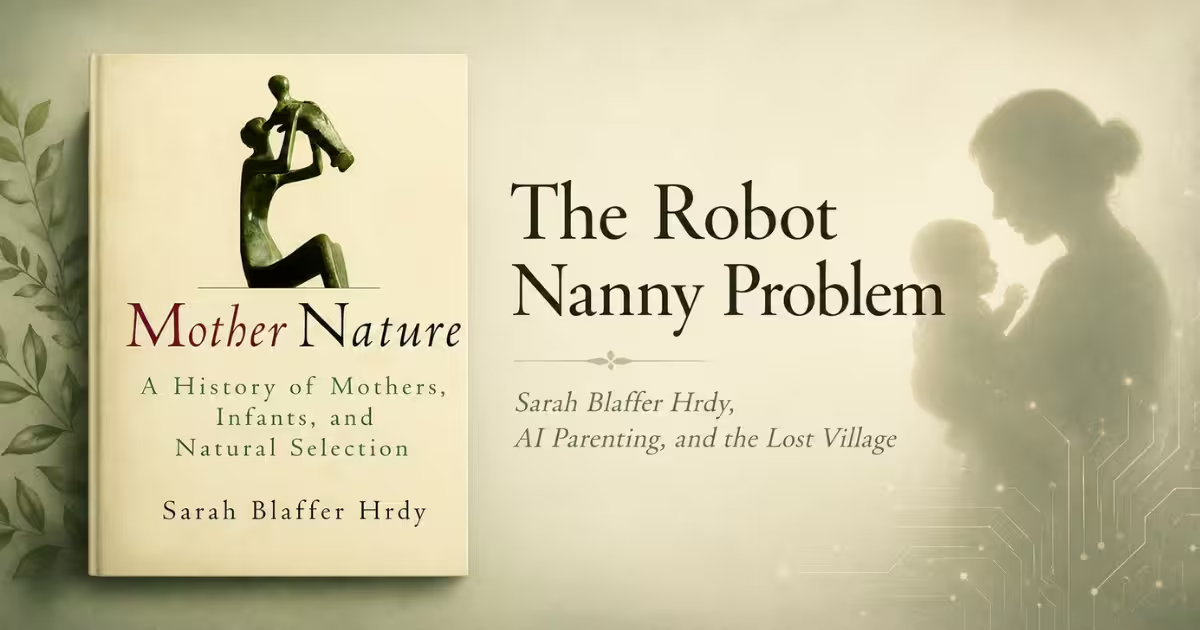
But Sarah Blaffer Hrdy’s Mother Nature: A History of Mothers, Infants, and Natural Selection gives us a sharper way to ask the question. The problem is not whether technology can help parents.
Of course it can.
The problem is whether AI is being sold as a substitute for the thing human infants evolved to need: committed, responsive, emotionally invested caregivers embedded in a reliable social network.
That is the robot nanny problem.
There is a particular kind of exhaustion that belongs only to modern parents. It is the exhaustion of people who are doing too much alone — who have replaced the ancient, sprawling network of grandmothers, aunts, siblings, and trusted neighbors with a baby monitor, a sleep-training app, and a subscription to an online parenting forum.
Into this loneliness, the technology industry is now pitching a solution: AI companions for infants, robot nannies, artificially intelligent baby monitors that “respond” to cries, and smart devices designed to fill the silence left by the village we no longer have.
For teenagers, AI companionship is already mainstream enough to raise alarms. Axios reported on a Common Sense Media survey finding that 72% of U.S. teens had used AI companions, with some reporting discomfort from what the AI said or did
Before we accept that bargain, we should spend some time with a book that was published in 1999 and has never been more relevant. Mother Nature: A History of Mothers, Infants, and Natural Selection, by primatologist and evolutionary anthropologist Sarah Blaffer Hrdy, is one of the most rigorous and revelatory accounts of motherhood ever written.
Hrdy spent decades studying primate behavior — including langur monkeys, whose capacity for infanticide first shook her assumptions about maternal instinct — before synthesizing the evidence into a sweeping portrait of what mothers and infants actually are, evolutionarily speaking.
What she found should give anyone promoting AI childcare serious pause. Not because technology is evil.
But because Hrdy’s research reveals, with clinical precision, exactly what human infants need, why they need it, and what happens when that need goes unmet. And an algorithm, however sophisticated, cannot provide it.
Table of Contents
What Is Mother Nature Really About?
Published by Pantheon Books, Mother Nature is subtitled “A History of Mothers, Infants, and Natural Selection.”
It is organized into three parts: a survey of animal motherhood across species (“Look to the Animals”), an examination of allomothers and cooperative breeding (“Mothers and Allomothers”), and a deep dive into the evolved psychology of infants and what they require (“An Infant’s-Eye View”).
Across 766 pages, Hrdy builds a portrait of motherhood that is simultaneously harder and more hopeful than the Victorian myth it replaces.
The book’s central argument is deceptively simple: maternal love is not automatic, unconditional, or species-typical in the way we have been told. Mothers, like all organisms shaped by natural selection, are strategic.
They assess their circumstances.
They allocate care contingently. And they have always done so — not because they are monsters, but because they are animals who evolved under conditions of genuine scarcity. At the same time, Hrdy demonstrates that human infants did not evolve to be raised by a single mother working alone.
They evolved to be raised by a village.
The Myth of Automatic Maternal Instinct
The first thing Hrdy dismantles is the idea that maternal instinct is a reliable, automatic drive that kicks in at birth and runs until the child is independent. “Whatever maternal instincts are,” she writes, “they are not automatic in the way a reflex is automatic.”
This is not a peripheral claim.
It is central to the book’s entire project. Hrdy traces the history of the idea of “the maternal instinct” — a concept that was largely constructed by eighteenth and nineteenth-century European moralists, physicians, and naturalists who needed women to stay home.
The Enlightenment-era French physician Gilibert, whom Hrdy quotes at length, fulminated against wet-nursing as a “weakening of maternal instinct.” The implication was that the desire to constantly tend one’s infant was biological, universal, and easily corrupted.
Hrdy shows that this was not biology but ideology dressed in the language of nature.
What Hrdy documents instead is that maternal responses in mammals — including humans — are powerfully shaped by circumstances: the mother’s health, her access to food, the presence or absence of a mate, her social support network, the infant’s own signals and robustness, and the broader ecology in which she is embedded.
“A female raises one infant after another for most of her adult life,” Hrdy observes about mammalian mothers generally, but she never does so in a vacuum, and she never does so identically across all conditions.
This does not make mothers cold or calculating.
It makes them responsive. And responsiveness, Hrdy argues, is actually more sophisticated than a simple, hardwired drive. Mothers who can read their situation and calibrate their investment accordingly are, in evolutionary terms, more successful than mothers who pour everything into every infant regardless of outcome.
The implication for AI parenting is immediate: if maternal care itself is not a simple, automatic program that runs independently of context, what makes us think an artificial simulation of attentiveness can substitute for it?
The Allomother: Human Infants Were Never Meant to Have Just One Caregiver
The most important concept in Mother Nature for understanding the AI childcare debate is the allomother.
Hrdy defines allomothers as all caretakers other than the biological mother — fathers, grandmothers, aunts, older siblings, family friends, wet nurses — who help provision, protect, and care for infants.
The term was formalized in 1975 by biologist Edward O. Wilson, who coined the prefix allo- (from the Greek for “other than”) to describe this widespread phenomenon across animal species.
Allomothering, Hrdy argues, is not a backup system or a cultural invention. It is the central feature of human childcare. “Among humans living in foraging societies,” she writes, “a helpful mate and/or alloparents were usually essential for a mother to rear any infant at all.”
This is not a statement about inadequate mothers. It is a statement about the evolutionary ecology of our species.
Human infants are among the most costly and slow-developing in the animal kingdom — large-brained, physically helpless for years, requiring sustained provisioning long after weaning.
No single female could have sustained that investment across multiple offspring without help.
Hrdy places humans in a specific category: cooperative breeders. Like wolves, dwarf mongooses, tamarins, and certain birds, humans evolved in groups where individuals other than the mother routinely contributed to infant care. “The earliest representatives of the genus Homo were cooperative breeders,” Hrdy states.
This is not an optional add-on to human reproduction. It is the defining feature of how our species raises its young.
In practice, this means that across human evolutionary history, a baby was not exclusively managed by its mother.
It was held, carried, nursed (by lactating women other than the mother in some societies), watched over, sung to, and kept warm by a rotating cast of familiar, kin-identified individuals. The infant’s nervous system, Hrdy argues, developed in this context.
It expects multiple caregivers. It is calibrated to read multiple faces, voices, and touch patterns as safe.
This is the village. And it is gone.
The Modern Rub: Compartmentalized Childcare and the Loneliness It Creates
Hrdy is remarkably clear-eyed about what the modern world has done to this ancestral system.
Working mothers, she notes, are not new. “For most of human existence, and for millions of years before that, primate mothers have combined productive lives with reproduction.”
What is new is the physical and social compartmentalization of work and childcare. In ancestral environments, a mother who needed to forage or gather could carry her infant, or leave it with a familiar allomother nearby.
The distance was short. The caretaker was known. The infant was never truly alone.
Today, the factories, offices, and laboratories where women “forage” for economic resources are structurally incompatible with infant care.
The infant must be left with someone or something else. And in the absence of extended family — the grandmothers who have moved away, the aunts absorbed into their own dual-career lives, the neighbors who are strangers — parents are left to improvise.
They hire nannies they cannot fully vet. They enroll infants in institutional daycare. They leave sleeping babies with baby monitors. And now, they are being offered AI.
“The biggest clash between ancient predispositions and modern lifestyle,” Hrdy writes, “is the physical separation required by modern workplaces. Mothers find it stressful to go off to work and leave their infants behind. Babies find it even more so.”
She is not arguing that mothers should stay home.
She is diagnosing a structural mismatch between the environment our infants’ nervous systems evolved for and the environment they are actually growing up in. The solution is not to tell mothers to quit their jobs.
The solution, she implies, is to rebuild something like the village.
What Infants Actually Need: Bowlby, Hrdy, and the Limits of Simulation
The third section of Mother Nature is in many ways the most important for our purposes: it addresses what infants actually need, from an evolutionary and developmental standpoint.
Here, Hrdy engages deeply with attachment theory — the framework pioneered by psychiatrist John Bowlby — and both confirms and revises it.
Bowlby’s essential insight was that human infants have an innate need for proximity to a protective attachment figure, and that deprivation of this figure causes measurable psychological harm.
This was a radical claim in the mid-twentieth century, when behaviorist orthodoxy held that babies attached to their mothers simply because mothers provided food.
Bowlby argued the attachment was deeper than that — it was about safety, presence, and the ongoing reassurance that care would be forthcoming.
Hrdy agrees with Bowlby’s core observation but expands it.
She argues that what infants are truly monitoring is not simply proximity to their mother, but “the promise of current and future care” from their caretakers. Infants are, in her reading, sophisticated little strategists.
They evolved in an environment where maternal ambivalence was real, where mothers occasionally abandoned infants they could not sustain, and where the difference between a committed caretaker and an indifferent one was the difference between survival and death.
Their adorableness — the big eyes, the round cheeks, the irresistible coos — is not accidental. It is, Hrdy argues, evolved signaling designed to elicit and sustain commitment from potentially ambivalent adults.
This means that what infants are reading, moment to moment, is not just: Is someone here? They are reading: Is this person committed to me?
This is precisely what an AI cannot provide. A robot nanny can be present. It can respond to cries. It can mimic the prosodic features of infant-directed speech (“motherese”).
It can even, in principle, detect the early signs of distress and trigger a soothing response. What it cannot do is be committed.
It has no stake in the infant’s survival. It has no genetic relatedness, no hormonal bonding cascade, no social reputation that depends on the baby thriving.
It cannot love the baby, and — this is the critical point — the baby is evolutionarily equipped to detect the difference.
Hrdy writes: “It is not turning an infant over to allomothers that has harmful repercussions. It is failing to convince him or her that abandonment is out of the question.”
The key variable is not whether the mother is present every minute. It is whether the infant is embedded in a network of people who are genuinely, durably, unconditionally committed to its welfare. That commitment is what the infant’s nervous system is scanning for. And it cannot be faked by software.
“As-If-Kin”: The Standard an AI Caregiver Cannot Meet
Hrdy introduces a phrase that deserves to sit at the center of every conversation about AI childcare: as-if-kin.
Describing what infants need from their caretakers, she draws a critical distinction: “From an infant’s perspective, there is a critical distinction between being cared for by multiple familiar, as-if-kin caretakers, and being abandoned to the less-committed care of strangers — or, worst of all, abandoned altogether.”
As-if-kin caretakers are people who function like family: they are familiar, their faces and voices are recognized, they respond to the infant as a person with a future and not merely a task to be managed.
In ancestral societies, these would literally have been kin — grandmothers, aunts, older cousins. In modern settings, they can be non-relatives who have been integrated into the infant’s social world gradually and deliberately.
Hrdy even gives practical advice: take the extra time to help your baby become comfortable with the baby-sitter before you need to leave.
Let the transition happen gradually, so the caretaker becomes part of the infant’s trusted circle before they are suddenly responsible for it.
An AI, by definition, cannot meet this standard. It is not familiar in the relevant sense. Its attentiveness does not stem from any emotional or social bond.
It does not have a face that changes expression in response to genuine feeling, a voice that trembles with worry when the baby runs a fever, or hands that hold the baby differently when the caretaker is tired or sad or moved.
These are precisely the signals that infants have evolved to read, because these are the signals that distinguish committed caretakers from indifferent ones.
The Grandmother Hypothesis and the Irreplaceable Value of Invested Elders
One of Mother Nature‘s most celebrated contributions to evolutionary science is the detailed treatment of what Hrdy calls “the grandmother hypothesis.”
Among the small number of species — humans, elephants, and pilot whales — in which females live long past menopause, Hrdy asks: what is the adaptive function of all those post-reproductive years?
Her answer: grandmothers. Postmenopausal women, who have already reproduced and thus have little to gain personally from conserving their resources, become ideal alloparents.
They have a low threshold for responding to signals of need from immature relatives. They forage on behalf of weaned grandchildren, freeing their daughters to produce the next baby sooner.
Research Hrdy cites suggests that infant survivorship was significantly higher in populations where the infant’s maternal grandmother was present and postreproductive — meaning she had no competing infants of her own to care for.
The grandmother is the most committed non-parental caregiver human evolution produced.
She is invested in the infant’s survival at the level of her own genetic legacy. She has decades of experience reading infant distress. She is available, motivated, and cheap — she asks for nothing but the continued existence of her lineage. She is, in Hrdy’s phrase, “the rarest of all commodities.”
We have, as a society, systematically undervalued and underused this resource. We have moved grandmothers to retirement communities in other cities. We have built nuclear-family housing that creates physical distance from extended kin.
We have medicalized grandmotherly knowledge as “old-fashioned” and replaced it with pediatric advice hotlines. And now we are proposing to replace grandmothers — and aunts, and older siblings, and trusted neighbors — with AI.
The irony is that the AI we are building to fill this gap is, in evolutionary terms, nothing like a grandmother. It is more like a rock: present, inert, and incapable of caring whether the baby lives.
What Hrdy’s Framework Demands of Modern Parents and Policymakers
Mother Nature is not a parenting manual. Hrdy is explicit that she does not offer specific prescriptions. But the framework she builds has clear implications for how we think about childcare in the age of AI.
First: Stop expecting mothers to do this alone. The nuclear-family ideal — mother, father, two children, no extended network — is an evolutionary aberration.
It was never the norm, and it is not working. The epidemic of maternal depression, infant sleep disorders, and toddler behavioral problems that fills modern parenting literature is not a failure of individual mothers.
It is the predictable result of removing human beings from the cooperative-breeding system they evolved in.
Second: The quality of alternative care matters more than whether it exists. Hrdy does not argue that mothers must be with their infants every moment.
She argues that allomothers must be committed, familiar, and trusted by the infant. The relevant question is not “Is my baby with a person or a machine?” but “Does my baby’s nervous system read this caretaker as safe?”
That reading depends on familiarity, responsiveness, and the kind of genuine engagement that only a caring human being can provide.
Third: AI can be a tool, not a replacement.
A baby monitor that alerts a sleeping parent to a fever, an app that helps track feeding schedules, a sound machine that plays white noise — these are tools that support human caregiving.
They do not replace it.
The problem arises when AI is positioned as a caregiver in its own right: a voice that reads to the baby, a screen face that “interacts” with the infant, a device that “responds” to cries so that no human has to. That is not support for caregiving.
That is a substitution for it.
Fourth: We need to rebuild the village structurally. This means parental leave policies that allow both parents to be present in the early months. It means housing and community designs that keep extended families within reach.
It means workplace cultures that treat childcare as a shared social responsibility rather than a private inconvenience. And it means, honestly, fighting the economic forces that have made all of this so difficult.
The Larger Question AI Childcare Forces Us to Ask
There is something clarifying about the robot nanny debate. It forces us to ask, with unusual precision, what exactly we think children need.
If we believe they need warmth, stimulation, responsiveness, and consistency, AI might eventually provide some of that.
If we believe they need something more — if we believe, as Hrdy’s evidence suggests, that they need to be embedded in a network of genuinely committed, emotionally invested human beings who love them — then no technology will ever be adequate.
Hrdy’s answer is clear.
Human infants evolved, over millions of years, in the context of cooperative breeding: multiple caregivers, multiple attachment relationships, the reassuring presence of people whose genetic and social interests were tied to the infant’s survival. Their nervous systems are calibrated to that environment.
They are reading for commitment, for genuine investment, for the kind of care that only a social animal embedded in relationships can provide.
The robot nanny cannot provide it. The village can. And the most urgent question of our time is not how to build a better AI — it is how to rebuild the village that our children still desperately need.
Conclusion: Reading Mother Nature in the Age of AI
Sarah Blaffer Hrdy published Mother Nature in 1999, a quarter-century before the current wave of AI childcare technology.
She could not have anticipated robot nannies or AI baby companions. But she spent decades studying exactly the biological and evolutionary architecture that makes those technologies inadequate — and potentially harmful.
The book’s deepest message is not that motherhood is sacred or that mothers must sacrifice everything.
It is that human infants are social creatures who evolved in rich, multi-person care environments, and that modern society has done profound violence to that system by stripping it down to the nuclear family and now proposing to strip it further, to algorithms and screens.
“Caretakers of both sexes, wet-nurses, even ‘daycare,'” Hrdy writes, “none of these are uniquely human, nor particularly new. They are standard features of many cooperatively breeding species.”
The lesson is not that any of these arrangements are inherently harmful. It is that they work when the caretakers are invested, familiar, and human — and that they fail when they are not.
An AI is none of those things. It is the newest iteration of an old problem: the attempt to solve the care deficit with something cheaper and more convenient than the real answer, which is other people who actually give a damn.
Mother Nature is a reminder, grounded in evolutionary science and primatological observation, that our infants know the difference.







