
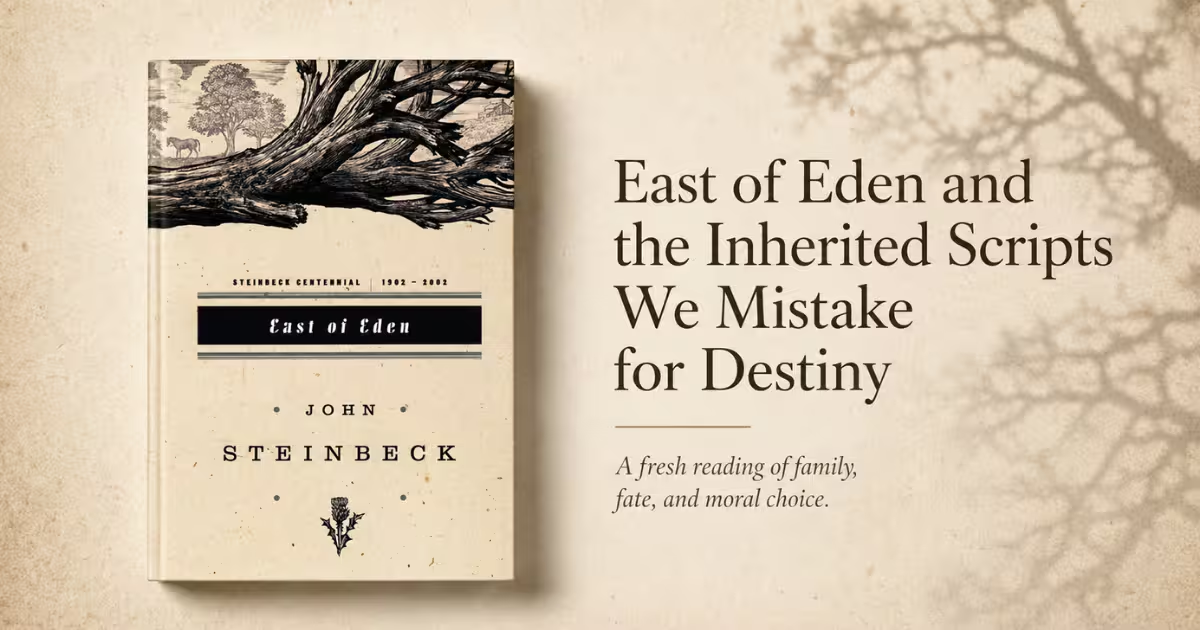
John Steinbeck’s East of Eden is often described as a family saga set in California’s Salinas Valley, following the intertwined lives of the Trask and Hamilton families as they echo the biblical story of Cain and Abel.
The book emphasizes exactly that mythic scale: generations repeating rivalry, guilt, love, and moral conflict in a landscape that feels almost biblical.
Steinbeck, who later received the Nobel Prize in Literature in 1962, published East of Eden in 1952, and it remains one of the works most closely associated with his moral imagination.
But the novel is not only about good and evil. It is not only about Cain and Abel. And it is not only about the famous idea of timshel, usually rendered in the novel as “thou mayest,” the possibility of moral choice.
The deeper drama of East of Eden is this: people are born into stories before they know how to resist them.
A child is told he is good. Another is made to feel bad. One brother becomes the favorite. Another becomes the dangerous one. A woman is expected to be pure, maternal, and readable. A man mistakes passivity for innocence. A son believes his mother’s darkness has entered his blood.
These are not destinies in the supernatural sense.
They are inherited scripts: roles handed down by family, culture, religion, shame, and expectation. Steinbeck’s great question is not simply, “Are we free?” It is more painful than that: can we become free after we have already been taught who we are?
Table of Contents
1. East of Eden and the Inherited Scripts and Spoiler plot
Before going deeper into the idea of inherited scripts, it helps to understand the shape of the story. East of Eden is a multigenerational novel set mainly in California’s Salinas Valley, and it reworks the biblical story of Cain and Abel through the lives of the Trask and Hamilton families.
But the plot is not just a sequence of family tragedies. It is a pattern repeating itself until one character is finally offered the chance to break it.
The first major version of that pattern begins with Adam and Charles Trask. Their father, Cyrus, does not love them equally, or at least the boys do not experience his love equally.
Adam becomes the favored, gentler son, while Charles becomes the wounded, angry brother who feels overlooked.
This early rivalry plants one of the novel’s central scripts: one brother is chosen, the other is rejected.
Adam eventually leaves home, inherits wealth, and begins a new life.
Then Cathy Ames enters the story. Cathy is one of the novel’s darkest figures: manipulative, violent, and almost completely unwilling to accept the roles society expects from her. Adam, however, cannot see her clearly.
He imagines her as a wife, a mother, and a source of renewal. In reality, Cathy does not want that life. After giving birth to twin sons, Caleb and Aron, she abandons Adam and the children. She later becomes Kate, the owner of a brothel.
This abandonment breaks Adam. For years, he is emotionally absent from his sons’ lives.
Lee, the Trask family servant and one of the wisest figures in the novel, becomes a major force in raising the boys. Lee is also the person who helps articulate the novel’s central moral idea: timshel, usually understood in the book as “thou mayest.”
The word suggests that human beings are not forced to repeat sin. They may choose. They may resist. They may become otherwise.
But before that freedom becomes real, the old family script repeats.
Caleb and Aron grow up as another version of Charles and Adam. Aron is treated as pure, gentle, and good. Cal is more restless, jealous, perceptive, and morally troubled. He senses darkness in himself and fears that he has inherited it from Cathy.
That fear becomes the center of his pain. Cal does not simply worry that he may do wrong. He worries that wrongness is what he is.
The tragedy sharpens when Cal tries to win Adam’s love. He earns money through wartime business and offers it to his father, hoping the gift will finally make Adam see him.
But Adam rejects the money and compares Cal unfavorably to Aron. For Cal, the rejection confirms the role he already fears: Aron is the good son, and he is the bad one.
In anger and hurt, Cal takes Aron to see their mother, Cathy/Kate. Aron, who has lived inside a fantasy of purity, cannot survive the truth.
His mother is not dead, saintly, or noble. She is alive, morally compromised, and nothing like the ideal he needed her to be. Aron’s world collapses. He joins the army and dies in World War I. When Adam hears what has happened, he suffers a stroke.
This is where the ending becomes essential.
Cal believes he has fulfilled the family curse. He thinks he has become Cain. He has hurt his brother, destroyed his father, and proven that the darkness he feared was inside him all along. In other words, he mistakes his worst action for his final identity.
Lee refuses to let that be the end of the story.
He pushes Adam, even in his weakened state, to give Cal something more than silence, judgment, or rejection. Adam raises his hand and says one word: timshel.
The ending does not declare Cal innocent. That would be too easy. Cal has caused real harm, and the novel does not erase his responsibility. But Adam’s final word tells him that guilt is not the same as destiny. He is not condemned to keep performing the role of the bad son. He may choose what comes next.
That is why the ending matters so deeply to this reading of East of Eden. The novel does not say that family scripts are imaginary.
They are powerful. They shape Adam and Charles, Aron and Cal, even Cathy and the people around her.
But Steinbeck’s final moral claim is that a script is not a sentence. Cal may have inherited shame, jealousy, and the old Cain-and-Abel pattern, but he is not required to become only that.
The last word of the novel opens a door. Cal is not told, “You are good.” He is told something harder and more freeing: you are not doomed.
2. What is an inherited script in East of Eden?
An inherited script is the story a person receives about themselves before they have the power to write their own.
It can sound like love. It can sound like warning. It can sound like family history. It can even sound like moral truth. But once a person believes the script, it begins to shape what they notice, what they fear, what they desire, and what they think they deserve.
In East of Eden, the scripts are everywhere.
There is the good son and the bad son. The chosen son and the rejected son. The innocent man and the violent brother. The pure woman and the monstrous woman. The child who is expected to redeem the family, and the child who thinks he has inherited its curse.
That is why the novel’s obsession with Cain and Abel matters. The biblical pattern gives Steinbeck a language for repetition. But Steinbeck is not simply retelling Genesis. He is asking why families keep recreating the same wounds and why children so often end up acting out roles they never consciously accepted.
Fate says, “You were always going to become this.”
An inherited script says, “You were taught to believe this is all you could become.”
That difference is crucial. Fate leaves no room for responsibility. A script can be read, questioned, refused, or rewritten. But first, someone has to realize it is a script.
3. Cyrus Trask writes Adam and Charles into their first roles
The Trask family begins with an emotional imbalance. Cyrus does not simply raise Adam and Charles; he assigns them positions.
Adam becomes the softer son, the more delicate son, the son treated as somehow more worthy of protection. Charles becomes the harder son, the dangerous one, the brother whose love is mixed with rage because it has been denied a safe place to go.
This is the first inherited script in the novel: love must be competed for.
Adam does not earn his favored status in any simple moral sense. Charles does not become violent because he is born as pure evil.
Both brothers are shaped by a household where approval feels unevenly distributed. The father’s love becomes a scarce resource, and brotherhood turns into rivalry.
Charles’ pain is especially important.
He is often read as an early Cain figure, and that reading is valid. But the inherited-script angle makes him more than a symbol of evil. Charles is the child who discovers that effort does not guarantee love. He works, gives, tries, and still feels unseen. His violence grows from that wound.
Adam’s script is quieter but just as damaging.
He is trained into passivity. Other people choose for him, move him, wound him, protect him, and define him. Because he is treated as innocent, he begins to confuse innocence with goodness.
But Steinbeck shows that innocence without moral courage can become another form of blindness.
Adam and Charles are not just brothers. They are the first proof that in East of Eden, family does not merely pass down property or blood. It passes down emotional grammar.
It teaches children what love feels like, what rejection means, and what role they are expected to play when conflict arrives.
4. Adam Trask mistakes innocence for goodness
Adam is one of the most revealing characters in the novel because his flaw does not look like a flaw at first. He is gentle. He is wounded. He seems incapable of cruelty in the obvious ways. Compared with Charles, he appears morally safer.
But Steinbeck is too sharp to let innocence pass as virtue.
Adam’s inherited script is passivity.
He survives by retreating from reality. He wants the world to be simpler than it is. He wants people to be better than they are. He wants love to be pure, and because he wants purity so badly, he repeatedly fails to see complexity.
This is most obvious in his relationship with Cathy. Adam does not truly see her. He sees the role he needs her to occupy.
To him, Cathy becomes wife, angel, mother, future, and redemption. She is not allowed to be fully real because Adam’s fantasy needs her to be symbolic.
That is one of the cruelest ironies in East of Eden: Adam’s innocence does not protect him from evil. It makes him easier to deceive.
His mistake also damages the next generation. Adam’s sons, Aron and Cal, inherit a version of the same divided world Adam once shared with Charles. Aron is imagined as clean, bright, and good. Cal is darker, more difficult, more troubling.
Whether Adam intends it or not, he helps recreate the old pattern: one son is associated with innocence, the other with moral danger.
The script repeats because Adam has never learned how to read it.
5. Cathy Ames refuses the role — then weaponizes everyone else’s
Cathy Ames is often discussed as one of Steinbeck’s most disturbing creations. She is manipulative, violent, and emotionally unreadable. Many readings describe her as monstrous, and the novel itself often frames her in extreme terms.
But if East of Eden is a novel about inherited scripts, Cathy becomes more complicated.
Cathy rejects the roles assigned to women in her world. She refuses to be the obedient daughter, the grateful wife, the self-sacrificing mother, or the morally softening feminine presence. She will not become the comforting symbol that men want her to be.
But Steinbeck does not present this refusal as liberation. Cathy’s freedom is cold, predatory, and empty. She sees social roles as costumes, and because she does not believe in them, she can manipulate people who do.
Adam wants an angel, so she lets him see one. Men want fantasy, so she sells it back to them. Society wants women to be legible, so she becomes unreadable. Children want the word “mother” to mean warmth, so her very existence becomes a wound.
Cathy understands inherited scripts better than almost anyone else in the novel. She knows that people are governed by the stories they need to believe. Her power comes from exploiting those stories.
That makes her the dark opposite of Lee. Lee uses interpretation to open moral possibility.
Cathy uses interpretation to close people inside their weaknesses. Lee believes a person can choose beyond the script. Cathy believes the script is all there is: appetite, fear, vanity, and self-deception.
6. Aron Trask is destroyed by the script of purity
Aron Trask inherits one of the most dangerous roles in the novel: the role of the pure son.
At first, this seems like a blessing. Aron is loved, admired, and idealized. He is treated as the better brother, the one who belongs to light rather than shadow. But Steinbeck understands that being idealized can be its own kind of imprisonment.
Aron is not allowed to be fully human. He is not allowed to contain contradiction. He becomes attached to a simplified moral universe where goodness and evil can be kept apart. His innocence depends on distance from reality.
That is why Abra matters so much. She senses that Aron’s purity is not the same as strength. He wants her to fit an ideal, just as Adam wanted Cathy to fit an ideal. Aron’s love depends partly on not seeing. He needs the world to remain clean because his identity has been built around cleanliness.
But no human life can survive that kind of simplification.
When Aron is forced to confront a reality that contradicts his script, he cannot absorb it. The problem is not merely that he discovers something painful. The problem is that he has no inner structure for moral complexity. His identity has been built like glass: beautiful, bright, and breakable.
In this sense, Aron’s tragedy is not the opposite of Cal’s. It is the twin of Cal’s. Cal suffers because he thinks he has inherited evil.
Aron suffers because he thinks he must remain untouched by it. Both are trapped by roles. Both are denied the ordinary human right to be mixed, flawed, and unfinished.
7. Cal Trask inherits the role of the bad son
Cal is the emotional center of this reading because he knows he is inside a script.
He feels jealousy. He feels anger. He wants his father’s love with an intensity that frightens him. He compares himself to Aron and finds himself lacking. Worst of all, he fears that Cathy’s darkness lives inside him. He does not simply worry that he may do wrong. He worries that wrongness is what he is.
That distinction matters.
Cal’s tragedy is not that he is evil. His tragedy is that every dark feeling becomes evidence in a case against himself. Anger feels like proof. Jealousy feels like blood speaking. Rejection feels deserved before it is even explained.
This is what inherited shame does. It turns normal human conflict into identity. A person no longer says, “I did something wrong.” He says, “I am wrong.”
Cal repeats Charles’ position in the earlier generation. Like Charles, he longs for paternal love. Like Charles, he stands beside a brother who seems easier to love. Like Charles, he feels the humiliation of offering something and being refused.
But Cal is not merely Charles reborn. He is repetition with consciousness.
That may be why he feels like the novel’s most modern character. Cal watches himself becoming the thing he fears. He is psychologically alert to his own damage.
He does not simply act from jealousy; he recognizes jealousy as a force inside him. He does not simply hate; he suffers because hatred seems to confirm his worst suspicion about himself.
Cal is trapped, but he knows he is trapped. And that knowledge is the beginning of freedom.
8. Lee gives Cal a new language: “Thou mayest”
No discussion of East of Eden can avoid timshel. In the novel, Lee’s interpretation of the word as “thou mayest” becomes the moral center of Steinbeck’s vision. The Stanford Steinbeck Institute’s educational material also treats the Lee-Adam-Samuel discussion as central to the novel’s understanding of choice.
But the inherited-script reading changes how we understand timshel.
Timshel is not vague optimism. It is not simply a motivational slogan about free will. It matters because it interrupts the inherited script.
To Cal, the script says: you are your mother’s son; you are the dark brother; you are Cain; you are already condemned by what you feel.
Timshel answers: not necessarily.
That is its power. It does not erase Cal’s jealousy. It does not pretend he is innocent. It does not deny that he can cause harm.
Instead, it gives him responsibility without fatalism. He may choose. He may rule over sin. He may also fail. The terror and dignity of the word lie in that openness.
Lee becomes the novel’s great script-breaker because he gives Cal a new way to interpret himself. He does not tell Cal that nothing is wrong. He tells him that wrongness is not destiny. Before Cal can act differently, he has to read himself differently.
That is one of Steinbeck’s deepest insights: moral freedom begins as interpretation. A person must learn to say, “This story shaped me, but it does not have to finish me.”
9. The real conflict of East of Eden: inheritance vs interpretation
The great conflict in East of Eden is not simply good versus evil. It is inheritance versus interpretation.
Every major character inherits something. Some inherit money. Some inherit land. Some inherit names, wounds, rivalries, myths, expectations, or shame. Some inherit the burden of being loved too little. Others inherit the burden of being idealized too much.
But Steinbeck keeps returning to one question: must inheritance become identity?
The answer is difficult. The novel is not sentimental about freedom. People do not escape the past by pretending it never happened. They do not become new simply because they want to. The old patterns are powerful. Families repeat themselves. Children absorb what parents never say out loud. Love and rejection leave marks.
And yet, East of Eden refuses to call those marks destiny.
That is why the novel still feels alive. It understands that people are neither blank slates nor prisoners. We are shaped before we are conscious, but consciousness matters. We inherit scripts, but we can learn to recognize them. We may repeat the old pattern, but we may also interrupt it.
The word “may” is everything.
10. Why this reading changes East of Eden
Reading East of Eden through inherited scripts does not replace the usual themes. It sharpens them.
Cal is not simply Cain. He is a boy struggling against the belief that he must become Cain.
Aron is not simply Abel. He is a boy crushed by the demand to remain pure.
Cathy is not simply evil. She is a terrifying figure who sees social roles clearly and uses them cruelly.
Adam is not simply innocent. He is a man whose innocence often becomes evasion.
Lee is not merely wise. He is the character who teaches others how to reinterpret the stories that govern them.
And timshel is not only about free will in the abstract. It is about freedom from inherited identity. It is the possibility that the role handed to you by family, history, or shame is not the same thing as your soul.
That is the hidden psychological force of East of Eden. Steinbeck takes an ancient story and makes it intimate.
Cain and Abel are not distant biblical figures. They are brothers at the dinner table, children competing for approval, sons wondering why love feels unequal, and adults still performing scripts written long before they understood them.
11. Conclusion: destiny is the story we mistake for ourselves
In East of Eden, the most dangerous inheritance is not land, money, or blood. It is the story a family teaches its children about who they are.
Adam inherits passivity and calls it peace. Charles inherits rejection and turns it into rage. Aron inherits purity and breaks under it. Cal inherits shame and almost mistakes it for destiny.
Cathy rejects every role except the one that lets her dominate others. Lee, almost alone, understands that a human being is not free because the past disappears. A human being becomes free by learning how to answer the past.
That is why East of Eden endures. It does not offer the easy comfort that we can become anything we want. It offers something harder and more honest: we may not choose the scripts we inherit, but we may choose whether to keep performing them.
Freedom begins when we stop mistaking the story we were given for the life we are required to live.
Books Like East of Eden: Similar Works About Family, Fate, and Inheritance
Readers drawn to East of Eden may also enjoy novels that explore family inheritance, moral struggle, sibling rivalry, and the way the past keeps repeating through later generations.
Steinbeck’s novel is often described as both a family saga and a modern retelling of Genesis, so the best similar books are not just “long classics” — they are stories where family becomes destiny, and characters must decide whether to obey or resist it.
1. The Brothers Karamazov by Fyodor Dostoevsky
Like East of Eden, Dostoevsky’s final novel centers on fathers, sons, guilt, spiritual conflict, and the question of moral responsibility.
It is a the story of Fyodor Karamazov and his sons, with psychological and spiritual implications surrounding patricide.
Readers interested in Cal’s guilt, Adam’s failures as a father, and Steinbeck’s religious questions may find a darker, denser version of those concerns here.
2. The Sound and the Fury by William Faulkner
Faulkner’s novel is a strong companion for readers interested in family breakdown and inherited damage.
It follows the decline of the Compson family through multiple points of view and a nonlinear structure.
Where East of Eden turns family conflict into biblical pattern, The Sound and the Fury turns family memory into fragmentation, grief, and collapse.
3. One Hundred Years of Solitude by Gabriel García Márquez
This is a good recommendation for readers who like the multigenerational scale of East of Eden.
García Márquez’s novel follows the Buendía family across generations and is widely associated with magical realism. Like Steinbeck, García Márquez is interested in repetition: names, desires, mistakes, and family patterns return until they begin to feel like fate.
4. The House of the Spirits by Isabel Allende
For a more political and magical family saga, The House of the Spirits is a natural comparison.
Isabel Allende’s best-known work, published in 1982, belongs to the magic realist tradition and follows family history alongside social and political upheaval.
Readers who respond to East of Eden as a story about inheritance, memory, and generational wounds may find similar emotional territory here.
5. The Grapes of Wrath by John Steinbeck
Readers who want more Steinbeck should turn to The Grapes of Wrath.
It is not as psychologically focused on sibling rivalry as East of Eden, but it shares Steinbeck’s moral seriousness, California setting, and concern for families under pressure.
Britannica identifies it as Steinbeck’s 1939 novel of the Great Depression and the struggles of migrant farmworkers.







