
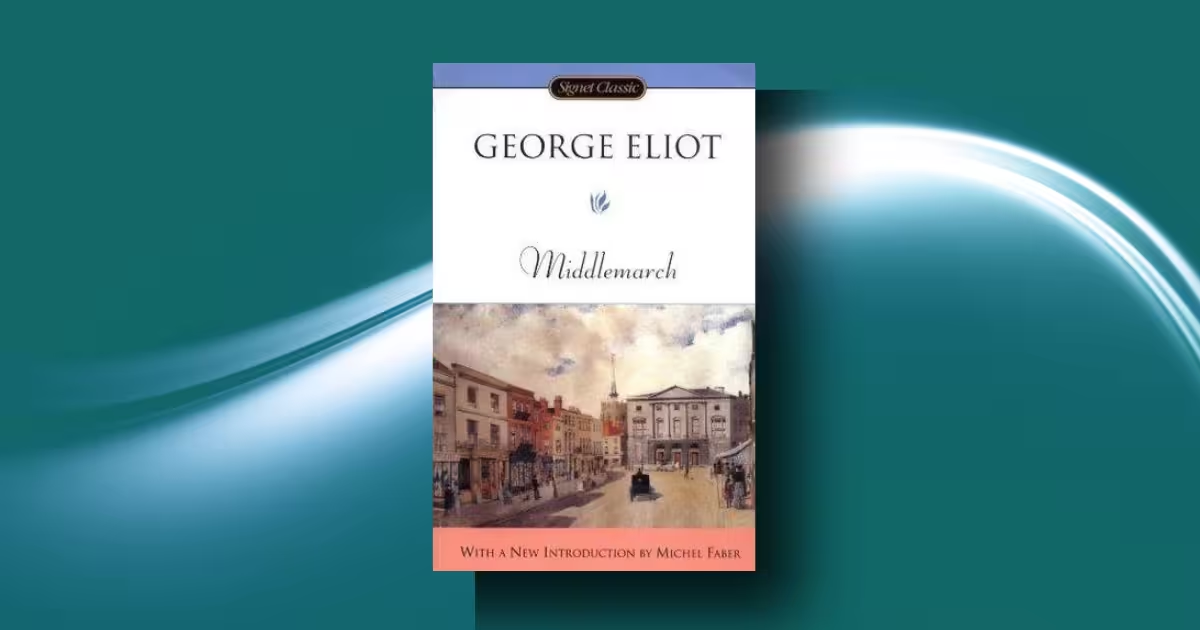
Do you ever wonder why one rumour can travel faster than truth, and why people still judge character by what “everyone says”? Reading Middlemarch, I felt George Eliot had already understood our review-driven, search-ranked age—only her search engine was a provincial town.
Middlemarch shows that before Google, online reviews, star ratings, and AI recommendations, society already had a ranking system: gossip collected human data, sorted people by reputation, punished nonconformity, and made private lives publicly searchable.
Middlemarch is best for readers who love Victorian novels, moral psychology, social reputation, literary realism, women’s lives, marriage plots, medical reform, political reform, and slow-burning character studies.
Not for readers who want a fast plot, simple heroes and villains, romance without social consequence, or a book where every good intention is rewarded quickly.
Table of Contents
1. Introduction
Middlemarch: A Study of Provincial Life is a novel by George Eliot, the pen name of Mary Ann Evans.
Written by George Eliot, Middlemarch was published in New York and Boston by H. M. Caldwell Company Publishers in 1871–1872 by William Blackwood and Sons, and it is set mainly in a fictional English Midlands town between 1829 and 1832.
I read Middlemarch not only as a great Victorian novel, but as a frighteningly modern book about reputation.
The town behaves like an analogue search engine. It crawls conversations, indexes family histories, boosts scandal, downranks outsiders, and treats repetition as evidence.
In that sense, Middlemarch is not just about Dorothea Brooke, Tertius Lydgate, Rosamond Vincy, Will Ladislaw, and Nicholas Bulstrode. It is about how communities decide who counts.
2. Background
The story unfolds around the years of the Reform Act 1832, early railways, provincial medicine, religious disputes, class anxiety, and women’s restricted opportunities.
The novel’s historical atmosphere matters because Middlemarch is a town in transition: politics are widening, medicine is modernizing, journalism is becoming more influential, and old family rank is being challenged by money, trade, and professional ambition.
That is why gossip becomes so powerful.
In a society without Google, LinkedIn, TripAdvisor, public databases, or searchable social profiles, people still want to know: Who is trustworthy? Who is marriageable? Who has money? Who has “connections”? Who is hiding something? Who is above their station? Who is socially risky?
Eliot’s answer is unsentimental. Reputation is not truth. It is processed social information.
The novel says plainly that women were expected to have “weak opinions,” but society’s safety depended on opinions “not acted on.” The rule is brutal: “Sane people did what their neighbors did.” That line is almost the operating code of Middlemarch. Conformity is the ranking signal.
The difference is suspicious. Public opinion becomes a machine.
3. Middlemarch Summary
Middlemarch begins with Dorothea Brooke, a young, wealthy, deeply idealistic woman who wants her life to mean something.
She is beautiful, intense, religious, and impatient with triviality. Eliot introduces her through a comparison with Saint Theresa, suggesting that some women are born with epic souls but no epic field of action.
The Prelude says that “many Theresas have been born who found for themselves no epic life,” and this becomes Dorothea’s tragedy and glory.
Dorothea lives at Tipton Grange with her sister Celia and their vague, well-meaning uncle Mr. Brooke.
Celia is practical, observant, and socially intelligent; Dorothea is spiritually ambitious and often blind to ordinary human signals. She wants to improve cottages, relieve poverty, understand theology, and live for something higher than comfort.
Suitors are already circling her, especially Sir James Chettam, a decent baronet whom everyone assumes she will marry.
But Dorothea has no romantic interest in him.
She thinks he would suit Celia. This is the first example of the Middlemarch reputation algorithm misreading a person: everyone sees Sir James as Dorothea’s obvious match because class, property, and proximity say so.
Then Dorothea meets Edward Casaubon, an older scholar-clergyman working on a vast, dry, never-finished project called The Key to All Mythologies.
To everyone else, Casaubon is unattractive, pedantic, and emotionally cold. To Dorothea, he appears profound. She sees in him a guide, a teacher, a way out of feminine uselessness. Casaubon’s own description of himself is unintentionally revealing: “I feed too much on the inward sources; I live too much with the dead.”
Dorothea mistakes this deadness for depth.
The town quickly begins to process Dorothea’s choice. Servants, relatives, and neighbors carry social information faster than any official announcement.
Celia tells Dorothea that Tantripp heard from Sir James’s man, through Mrs. Cadwallader’s maid, that Sir James was expected to marry Dorothea. Dorothea is horrified: “How can you let Tantripp talk such gossip to you… It is degrading.” Celia answers with the social realist’s wisdom: “It is better to hear what people say.”
That exchange is one of the clearest early examples of gossip as a reputation network. Celia understands what Dorothea does not: informal information is power.
Dorothea marries Casaubon and goes to Rome for their honeymoon. There, the illusion collapses.
Casaubon does not open a grand intellectual world to her. Instead, he becomes irritated by her questions and threatened by her vitality.
In Rome, Dorothea meets Will Ladislaw, Casaubon’s young cousin, an artistically minded, politically energetic man with charm and warmth.
Will sees Dorothea more clearly than Casaubon does, and Dorothea begins, slowly and painfully, to recognize that her marriage is spiritually barren.
Meanwhile, the novel opens into other storylines. Tertius Lydgate arrives in Middlemarch as a young doctor with reforming ambitions.
He wants to improve medical practice, challenge old professional habits, and work with the New Hospital. Like Dorothea, he has idealism.
Like Dorothea, he underestimates the power of social systems. Middlemarch ranks doctors not only by competence but by local trust, class assumptions, religious suspicion, and professional jealousy.
Eliot notes that if a medical man arrived with a reputation for very definite religious views and active piety, people would presume against his medical skill. This is social ranking before credentials become searchable.
Lydgate falls in love with Rosamond Vincy, the beautiful, polished daughter of a prosperous manufacturer.
Rosamond is not stupid, but her intelligence is trained toward appearance, refinement, and social ascent. She wants a husband who will lift her above Middlemarch.
Lydgate thinks he is marrying beauty and affection; Rosamond thinks she is marrying distinction and upward mobility. Their marriage becomes one of the book’s great disasters of mismatched expectation.
Fred Vincy, Rosamond’s brother, is another young person trapped between hope and consequence.
He expects to inherit from old Mr. Featherstone and therefore lives carelessly, accumulating debts. He loves Mary Garth, a plain, honest, morally steady woman who refuses to marry him unless he becomes useful. Fred’s debt harms Caleb Garth, Mary’s father, because Fred has used Caleb’s signature.
This humiliation becomes Fred’s turning point. Unlike Lydgate, Fred is saved by correction. He eventually gives up the idea of becoming a clergyman and learns estate management under Caleb.
Old Mr. Featherstone dies, creating one of the novel’s most revealing inheritance plots. He has made multiple wills, and on his deathbed he tries to get Mary to burn one of them.
Mary refuses because she will not act dishonestly. The result is that Featherstone’s property goes not to Fred, but to Joshua Rigg, Featherstone’s illegitimate son.
Rigg later sells Stone Court to Nicholas Bulstrode, the banker.
Bulstrode is one of the novel’s most important figures for the reputation theme. He is rich, religious, influential, and outwardly respectable. But he has a hidden past.
Years earlier, he was connected to a dishonest business that profited from stolen goods. He also concealed information from Will Ladislaw’s mother’s family, helping deprive Will’s mother of money that should have reached her.
This buried history returns in the person of John Raffles, a drunk, parasitic man who knows Bulstrode’s secret.
Bulstrode tries to manage the risk. He wants to preserve his public religious image while hiding his past.
Here, Middlemarch becomes almost prophetic about reputation crisis management. Bulstrode’s problem is not only guilt; it is discoverability. If the wrong person tells the right story in the right social channel, his whole ranking collapses.
At the same time, Lydgate falls into debt because Rosamond refuses practical economies and because his medical practice does not flourish as expected.
In desperation, Lydgate accepts money from Bulstrode. Then Raffles becomes ill at Stone Court under Bulstrode’s care. Lydgate gives medical instructions, including restrictions around alcohol. Bulstrode, morally weakened and terrified of exposure, allows circumstances that contribute to Raffles’s death.
The novel keeps the moral texture complex: Bulstrode is not a melodramatic murderer, but he commits a grave sin of omission and self-interest.
Then the town’s reputation algorithm begins to run at full speed.
Eliot describes the news of Lydgate’s sudden debt relief as “spreading fast,” gathering “conjectures and comments” that gave it “new body and impetus.”
The information chain is almost comic and terrifying: a bank clerk knows, Mrs. Bulstrode innocently mentions the loan to Mrs. Plymdale, Mrs. Plymdale tells her daughter-in-law, and the story becomes general knowledge. This is the nineteenth-century version of a viral thread.
Lydgate is not guilty of Bulstrode’s crime, but the timing of the loan ruins him. Middlemarch reads correlation as causation.
He accepted money from a disgraced man; therefore he must be compromised. His professional reputation, already fragile because he is a reformer and outsider, is badly damaged.
Eliot captures this with a phrase that could describe a social-media pile-on: “The general black-balling had begun.”
Dorothea, now widowed after Casaubon’s death, becomes one of the few people willing to resist the town’s ranking system.
Casaubon had died leaving a cruel codicil: if Dorothea marries Will Ladislaw, she will lose Casaubon’s property. The codicil itself stains Dorothea and Will by implication; it suggests that Casaubon suspected an improper attachment. Even from the grave, Casaubon tries to control Dorothea’s reputation and choices.
Dorothea struggles. She has money, position, and moral seriousness, but she is lonely. She loves Will, though she resists admitting it. Will loves her, but he is proud and poor.
Their love is surrounded by suspicion, class judgment, and Casaubon’s poisonous legal afterlife. Eventually, Dorothea chooses Will. She gives up Casaubon’s estate and marries the man she loves.
This is the book’s emotional liberation: not a fairy-tale reward, but a moral choice against social ranking.
Rosamond and Lydgate’s ending is sadder. Dorothea intervenes compassionately with Rosamond, and Rosamond becomes briefly more honest. But Lydgate’s great ambitions shrink. He leaves Middlemarch, becomes financially successful in a more fashionable medical practice, but never fulfills his scientific promise. He dies relatively young, feeling that he has failed. Rosamond later lives comfortably. Their marriage does not become a grand tragedy of open hatred; it becomes something more ordinary and more painful: the slow narrowing of a life.
Fred and Mary receive the most stable ending.
Fred becomes a practical farmer and writer on agriculture. The town, however, still cannot credit people correctly.
When Fred writes a serious agricultural work, many assume Mary deserves the credit; when Mary writes a book for children, the town gives Fred the credit because he went to university.
Eliot’s joke is devastating: Middlemarch “had never been deceived,” because it can always adjust facts to fit its prior assumptions.
The Finale insists that endings are also beginnings: “Every limit is a beginning as well as an ending.” Marriage, Eliot says, is not the end of the story but “the beginning of the home epic.”
Dorothea and Will marry, have a family, and Will enters public life. Yet Dorothea never becomes the Saint Theresa she dreamed of being. Her influence is private, diffused, and unhistoric.
The ending is bittersweet: the world does not give Dorothea a grand public mission, but her goodness still changes lives.
That is why the novel remains powerful. Middlemarch does not say that society always rewards goodness. It says goodness often works invisibly, while reputation works loudly.
4. Middlemarch Analysis: Gossip as a Pre-Digital Reputation Algorithm
The central metaphor of this article is simple: Middlemarch is a search engine before search engines.
In our world, Google still dominates search; StatCounter listed Google at 90.02% of worldwide search-engine market share for April 2026.
People also rely heavily on reviews: BrightLocal’s 2026 Local Consumer Review Survey says 97% of consumers read reviews for local businesses, the average consumer uses six review sites, and 74% care only about reviews from the last three months.
Middlemarch has the same hunger for reputational data, but its platforms are drawing rooms, servants’ corridors, auctions, dinner tables, church networks, local newspapers, medical boards, and women’s visits.
How the Middlemarch algorithm works
Input signals: birth, family name, marriage, debt, profession, religion, wealth, manners, gender, beauty, accent, and association.
Crawlers: servants, wives, relatives, doctors, bankers, lawyers, clergy, and newspaper men.
Ranking factors: conformity, class respectability, repeated testimony, source status, religious performance, gender expectations, and whether the story confirms what people already suspected.
Penalties: being an outsider, marrying “wrongly,” owing money, appearing too ambitious, having foreign connections, challenging local professionals, or being a woman with strong opinions.
Boosts: old family name, wealth, beauty, marriageability, male education, local familiarity, and respectable hypocrisy.
The system is not neutral. It is biased, emotional, class-bound, sexist, and often wrong. But it is powerful because everyone uses it.
4.1. Middlemarch Characters
Dorothea Brooke
Dorothea is the moral centre of the novel.
She begins as an idealist who wants to serve humanity but lacks a practical path. Her mistake is not that she wants too much; it is that she misreads Casaubon as a gateway to greatness.
Eliot introduces her as “remarkably clever,” but immediately adds the social correction that Celia has “more common-sense.”
That is Middlemarch ranking Dorothea before she can speak for herself.
Dorothea’s development is a movement from abstract idealism to compassionate realism. By the end, she no longer wants to attach herself to a “great man.” She becomes great in her own way by seeing others clearly: Lydgate, Rosamond, Will, and even the small lives around her.
Edward Casaubon
Casaubon is not merely a bad husband. He is failed scholarship turned into personality.
His Key to All Mythologies is a dead project because it tries to master living complexity through lifeless system.
He wants Dorothea as a helper, admirer, and emotional servant, not as an equal soul. His jealousy of Will reveals his deepest fear: not that Dorothea will behave badly, but that she will discover life outside him.
Will Ladislaw
Will is socially unstable in Middlemarch’s eyes.
He has talent but not enough money, charm but not enough status, foreign associations, and a connection to journalism. That makes him algorithmically suspicious. Mrs. Cadwallader calls him “a dangerous young sprig,” and Sir James worries about his newspaper connection.
Will represents mobility, art, politics, and emotional freedom—everything Casaubon and conservative Middlemarch distrust.
Tertius Lydgate
Lydgate is a tragic reformer.
He arrives with scientific ambition and a desire to modernize medicine, but he fails to understand the social economy of the town. His professional ideals are real, but his marriage choice and financial pride weaken him.
He is destroyed not by one villain but by converging pressures: debt, Rosamond’s expectations, Bulstrode’s scandal, medical jealousy, and public suspicion.
Rosamond Vincy
Rosamond is one of Eliot’s most chillingly realistic characters because she is not a cartoon. She is graceful, charming, self-controlled, and emotionally evasive. She wants refinement and admiration.
Eliot says Rosamond’s romance requires a man “not a Middlemarcher,” with connections offering “vistas of that middle-class heaven, rank.” She does not mean to ruin Lydgate, but her soft resistance helps narrow his life.
Mary Garth
Mary is the anti-Rosamond: plain, honest, humorous, and morally grounded. Eliot calls “honesty, truth-telling fairness” Mary’s reigning virtue.
She refuses Featherstone’s unethical request, refuses Fred’s immature hopes, and becomes the practical standard by which Fred reforms.
Fred Vincy
Fred begins as a charming, irresponsible young man inflated by expectations. His debt hurts the Garth family, but he changes.
Unlike Lydgate, Fred accepts discipline. His happy ending with Mary feels earned because it is based not on fantasy but on work.
Nicholas Bulstrode
Bulstrode is the novel’s reputation-management case study. He has built a public identity as a religious banker, but his past is corrupt.
The scandal exposes the gap between personal branding and moral truth. Middlemarch’s gossip is cruel, but in Bulstrode’s case it also uncovers something real.
Mrs. Cadwallader
Mrs. Cadwallader is one of the town’s most efficient gossip processors. She is funny, sharp, socially connected, and often merciless.
She does not merely repeat information; she interprets it, ranks it, and redistributes it.
4.2. Themes and Symbolism
Reputation as social search
The strongest theme for this reading is reputation. Middlemarch constantly asks: What is known? Who knows it? Who repeats it? What does it imply? When Bulstrode’s scandal breaks, Eliot says women talk not out of pure malice but out of “busy benevolence,” imagining what Mrs. Bulstrode knows and what she ought to feel.
That is what makes gossip so dangerous: it often wears the face of morality.
Marriage as social indexing
Marriage in Middlemarch is not private.
Dorothea-Casaubon, Lydgate-Rosamond, Fred-Mary, and Celia-Sir James are all socially interpreted.
A marriage changes one’s rank, network, credit, and public meaning. Casaubon’s codicil proves this brutally: even after death, legal language tries to control Dorothea’s reputation.
Idealism versus systems
Dorothea and Lydgate both want to improve the world. Both underestimate systems.
Dorothea thinks goodness plus devotion will create meaning. Lydgate thinks intelligence plus reform will defeat provincial resistance. Both learn that institutions, money, gossip, gender, and class shape what idealism can do.
Gender and the punishment of female intensity
Dorothea is judged because she wants more than decorative womanhood. Rosamond is rewarded at first because she performs femininity beautifully. Mary is undervalued because she lacks glamour.
Eliot’s world ranks women by beauty, marriageability, softness, and compliance—then quietly depends on women like Mary and Dorothea for moral life.
Money as hidden code
Debt, inheritance, dowry, property, salary, and loans control the plot. Fred’s expectations distort his conduct.
Lydgate’s debt makes him vulnerable. Bulstrode’s money buys influence. Dorothea’s inheritance becomes a trap. In Middlemarch, money is never just money; it is social metadata.
The web and the microscope
Eliot repeatedly uses images of webs, threads, and microscopic vision. The town is a web of relations.
A person’s act travels outward. A private decision becomes public consequence. This is why Middlemarch feels modern: it understands network effects before the digital age.
5. Evaluation
Middlemarch is an outstanding, morally intelligent, and quietly devastating novel. It did not simply move me; it made me more suspicious of every easy judgment I have ever made about another person.
5.1. Strengths / Pleasant Experiences
The greatest strength is Eliot’s psychological precision. She understands how people lie to themselves without becoming monsters.
Dorothea’s idealism, Lydgate’s pride, Rosamond’s vanity, Fred’s hopefulness, and Bulstrode’s religious self-justification all feel painfully human.
Another strength is the social architecture. The town is not background; it is a living system. When Lydgate is blackballed, I felt the suffocation of being misread by a whole community. When Dorothea believes him, her trust feels almost heroic because it resists the algorithm.
5.2. Weaknesses / Negative Experiences
The main difficulty is pacing. Some political and clerical sections can feel slow, especially for readers expecting a Dorothea-centred romance.
Casaubon’s scholarly world, Mr. Brooke’s political rambling, and the hospital politics require patience.
However, I would not call these sections unnecessary. They are part of the book’s design. Eliot wants us to feel the density of a society where every reform has a committee, every marriage has spectators, and every reputation has handlers.
5.3. Impact / Controversy
The novel’s impact is enormous. In 2026, The Guardian reported that Middlemarch had topped a poll of writers, academics, and critics as the best novel of all time, while also noting its long reputation as one of the great English novels.
That kind of praise can intimidate readers, but the book earns it because it is not merely “important.” It is alive.
Its controversy, if we can call it that, lies in its refusal to flatter. It does not give Dorothea the public greatness she deserves. It does not rescue Lydgate from compromise.
It does not punish Rosamond spectacularly. It does not make society fair. That realism can feel emotionally severe.
5.4. Comparison with Similar Works
Compared with Jane Austen’s Pride and Prejudice, Middlemarch is less sparkling but more socially expansive. Austen studies marriage markets with brilliant compression; Eliot studies the whole moral ecosystem around marriage.
Compared with Dickens’s Bleak House, Eliot is less theatrical but more psychologically exact. Dickens gives us fog, law, and grotesque institutions; Eliot gives us drawing rooms, debts, rumours, and small moral failures.
Compared with Trollope’s Barsetshire novels, Middlemarch is more philosophical and tragic. Trollope understands clerical society; Eliot understands how society enters the conscience.
Compared with Flaubert’s Madame Bovary, Rosamond’s story feels like an English provincial cousin to Emma Bovary’s romantic delusion, but Eliot is more compassionate and less icy.
5.5. Adaptation: Book vs TV Adaptation and Box-Office Information
The best-known screen version is the 1994 BBC/WGBH television adaptation, directed by Anthony Page, adapted by Andrew Davies, and starring Juliet Aubrey as Dorothea, Rufus Sewell as Will Ladislaw, Douglas Hodge as Lydgate, and Patrick Malahide as Casaubon.
It first aired on BBC2 from January 12 to February 16, 1994.
Because this was a television serial rather than a theatrical film, there is no conventional box-office figure to report.
Its success was cultural rather than box-office-based: the TV serial helped renew popular interest in the novel, and reports around the adaptation note that it contributed to a revival of Victorian fiction among viewers.
The book is deeper than the adaptation because Eliot’s narration is the true engine of Middlemarch. The TV version can show Dorothea’s disappointment, Lydgate’s frustration, and Rosamond’s composure, but it cannot fully reproduce Eliot’s moral commentary—the voice that explains how gossip becomes judgment and judgment becomes destiny.
6. Personal Insight with Contemporary Educational Relevance: 5 Lessons
Reading Middlemarch today, I kept thinking of Google reviews, social media reputations, and AI recommendations.
BrightLocal’s 2026 survey says 97% of consumers read online reviews for local businesses, 47% will not use a business with fewer than 20 reviews, and 31% require at least 4.5 stars.
That is our modern version of Middlemarch: we still outsource trust to aggregated opinion.
Lesson 1: Repetition is not proof
Middlemarch shows that a story repeated by enough people begins to feel true. Lydgate’s reputation collapses because facts, timing, and suspicion merge into one convenient narrative.
Lesson 2: Every ranking system has bias
Middlemarch ranks people through class, gender, religion, and family name. Modern platforms rank through reviews, links, freshness, engagement, and authority.
Neither system is morally pure.
Lesson 3: Private virtue needs public courage
Dorothea’s belief in Lydgate matters because she says, in effect, no: I will not let the town’s interpretation replace my judgment.
Lesson 4: Reputation can punish reformers
Lydgate challenges the medical establishment, and the establishment waits for him to become vulnerable. Innovators still face this: one mistake can be used to discredit an entire reform.
Lesson 5: The best life may not be highly ranked
Dorothea’s final influence is not glamorous. Fred and Mary’s happiness is not spectacular. Eliot teaches that meaningful goodness may not trend, rank, or go viral.
7. Middlemarch Quotes
- “Many Theresas have been born who found for themselves no epic life.”
- “Miss Brooke had that kind of beauty which seems to be thrown into relief by poor dress.”
- “Women were expected to have weak opinions; but the great safeguard of society and of domestic life was, that opinions were not acted on.”
- “Sane people did what their neighbors did.”
- “It is better to hear what people say.”
- “I feed too much on the inward sources; I live too much with the dead.”
- “Life in cottages might be happier than ours, if they were real houses fit for human beings.”
- “The news… was spreading fast, gathering round it conjectures and comments which gave it new body and impetus.”
- “The general black-balling had begun.”
- “Every limit is a beginning as well as an ending.”
8. Conclusion
Middlemarch is worth reading because it understands something we are still struggling with: reputation is never just what we are; it is what society says we are, repeats that we are, and rewards or punishes us for being.
George Eliot’s provincial town behaves like a pre-digital algorithm, sorting human beings through gossip, class, money, marriage, religion, gender, and suspicion.
I would recommend Middlemarch to readers who enjoy serious literary fiction, Victorian social novels, moral psychology, and books that make ordinary life feel philosophically enormous.







