
Did you know that you—yes, you, reading this right now—probably know less about the world than a chimpanzee picking bananas at random? Before you dismiss this as insulting or absurd, ask yourself this: When was the last time you actually tested your knowledge about global poverty, population growth, vaccination rates, or women’s education? Did you know that 80% of the world’s children are vaccinated, not 20% as most people guess?
Are you aware that extreme poverty has halved in the last twenty years, not doubled? The answer to why you get these questions wrong isn’t about intelligence—it’s about instincts. And Hans Rosling’s groundbreaking masterpiece Factfulness will show you how to break free from the overdramatic worldview that keeps you stressed, anxious, and fundamentally mistaken about the state of humanity.
Factfulness is best for data enthusiasts, curious general readers, students of global affairs, business leaders making international investments, journalists who want to report responsibly, teachers shaping young minds, parents raising globally aware children, activists who want their advocacy to be effective, politicians making policy decisions, and anyone who has ever felt overwhelmed by “negative news” and wondered if the world is truly falling apart.
Not for readers who prefer emotional storytelling over statistical evidence, those deeply invested in maintaining a “doom and gloom” worldview for political or fundraising purposes, people who believe all data is inherently biased and untrustworthy, or anyone unwilling to have their cherished misconceptions challenged with facts.
Table of Contents
1. Introduction
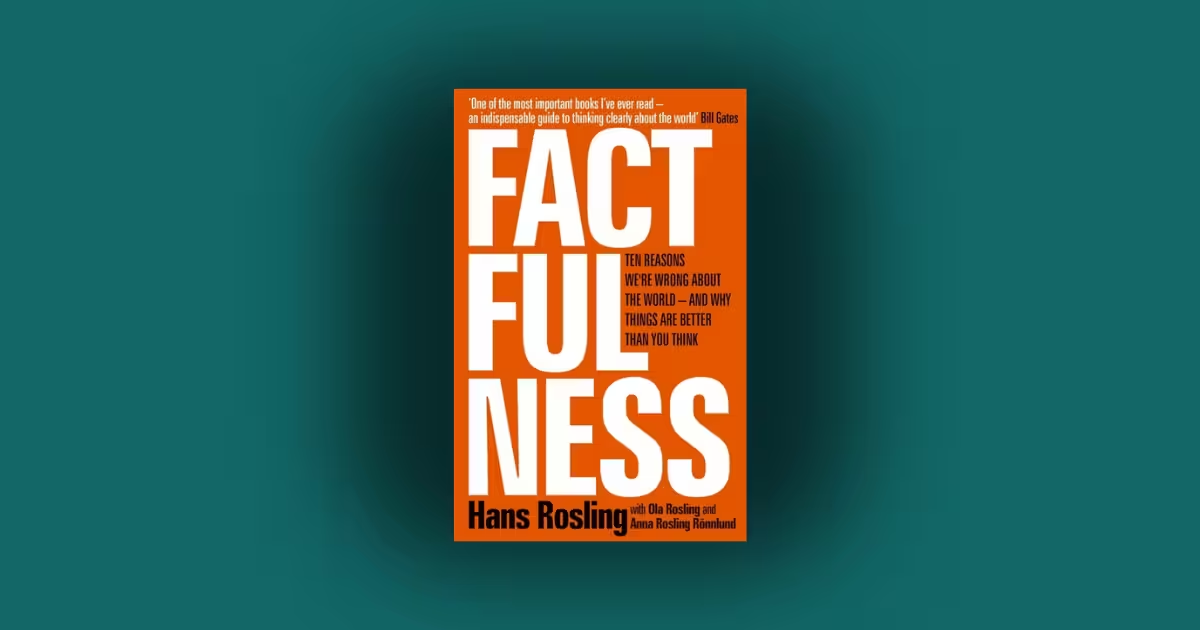
Title: Factfulness: Ten Reasons We’re Wrong About the World – And Why Things Are Better Than You Think
Author: Hans Rosling, with Ola Rosling and Anna Rosling Rönnlund
Publication: First published in Great Britain in 2018 by Sceptre (Hodder & Stoughton)
Pages: 315 (including appendix, notes, and sources)
Genre: Non-fiction, Social Science, Cognitive Psychology, Data Journalism, Global Development
Author Credentials: Hans Rosling was not merely an academic sitting in an ivory tower.
He was a medical doctor, professor of international health at Karolinska Institutet in Stockholm, adviser to the World Health Organization and UNICEF, and co-founder of Médecins Sans Frontières (Doctors Without Borders) in Sweden.
He also co-founded the Gapminder Foundation, dedicated to fighting global ignorance with fact-based data. His TED talks have been viewed over thirty-five million times, and Time magazine listed him among the world’s 100 most influential people. He wrote this book knowing he was dying of pancreatic cancer—making every page a final, passionate plea for rational thinking.
Context: According to Rosling’s own introduction, the book is the result of eighteen years of intense collaboration between Hans, his son Ola Rosling, and his daughter-in-law Anna Rosling Rönnlund. As Hans writes in the Author’s Note: *”What you are about to read was not invented according to the ‘lone genius’ stereotype.
It is instead the result of constant discussion, argument, and collaboration between three people with different talents, knowledge, and perspectives.”* (Page 8)
Purpose: The central idea of Factfulness is devastatingly simple yet revolutionary: most people—including highly educated experts, Nobel laureates, and world leaders—systematically get the basic facts about the world wrong.
Worse than random.
Worse than chimpanzees.
This happens not because we’re stupid, but because our brains are hardwired with ten dramatic instincts that distort reality.
Rosling’s mission is to arm readers with simple thinking tools to recognize and control these instincts, replacing the “overdramatic worldview” with what he calls “factfulness.”
As Rosling states on page 22: “Factfulness, like a healthy diet and regular exercise, can and should become part of your daily life. Start to practice it, and you will be able to replace your overdramatic worldview with a worldview based on facts. You will make better decisions, stay alert to real dangers and possibilities, and avoid being constantly stressed about the wrong things.”
2. Background
According to research conducted by Gapminder, the average person scores just two correct answers out of twelve on basic global knowledge questions.
This is worse than random guessing (which would yield four correct answers). In 2017, nearly 12,000 people in fourteen countries were tested.
The results were catastrophic. As Rosling writes on page 16: “A stunning 15 percent scored zero.”
But here’s what makes this fascinating: the errors aren’t random. They’re systematically negative. People consistently believe the world is more violent, more impoverished, more hopeless, and more divided than it actually is.
Rosling discovered this problem in 1995 while teaching global health at Karolinska Institutet. He writes on page 24: “A year earlier, I had given my students the same examples, but with no data tables to back them up, and they had simply refused to believe what I told them about the improvements across the world.”
The book emerged from decades of trying to fix this ignorance—first with data tables, then with bubble charts, then with animated graphs, and finally with this comprehensive framework of ten instincts.
3. Fackfulness Summary
Rosling organizes Factfulness around ten “dramatic instincts”—inherited cognitive biases that once helped our ancestors survive but now systematically mislead us about the modern world.
Each chapter tackles one instinct, provides devastating evidence of how it distorts our thinking, and offers practical “rules of thumb” to control it.
Chapter 1: The Gap Instinct
The Problem: We love to divide things into two distinct, opposing groups—rich vs. poor, developed vs. developing, us vs. them. This creates an imaginary gap where none exists.
The Evidence: When asked “What percentage of the world population lives in low-income countries?” most people guess 50% or more. The actual answer? 9 percent.
As Rosling reveals on page 34: “Low-income countries are much more developed than most people think. And vastly fewer people live in them. The idea of a divided world with a majority stuck in misery and deprivation is an illusion. A complete misconception. Simply wrong.”
Instead of two groups, Rosling introduces the Four Income Levels framework (pages 36-42):
- Level 1 ($1 per day): 1 billion people. Extreme poverty. You walk barefoot, fetch water, struggle to eat daily. Children often die.
- Level 2 ($4 per day): 3 billion people. You have a bike, sandals, a gas stove. You can save money. Life is better but uncertain.
- Level 3 ($16 per day): 2 billion people. You have running water, a motorcycle, a fridge. Children go to high school.
- Level 4 ($64+ per day): 1 billion people. You have a car, indoor plumbing, vacation travel. You’re reading this book.
The critical insight: 75% of humanity lives in the middle (Levels 2 and 3) —not in extreme poverty, not in Western luxury, but somewhere in between, steadily improving.
How to Control It: “Beware comparisons of averages. Beware comparisons of extremes. The view from up here distorts everything.” (Page 50)
Chapter 2: The Negativity Instinct
The Problem: We notice bad news more than good news. The media knows this and feeds our appetite for drama. The result? We believe the world is getting worse when it’s actually getting better.
The Evidence: When asked “Over the last 20 years, has the proportion of people in extreme poverty almost doubled, remained the same, or almost halved?” only 7% of people in most countries get it right. The correct answer: almost halved.
As Rosling declares on page 57: “Just 20 years ago, 29 percent of the world population lived in extreme poverty. Now that number is 9 percent. Today almost everybody has escaped hell. The original source of all human suffering is about to be eradicated. We should plan a party! A big party!”
Life expectancy provides another stunning example (page 58): “The average life expectancy across the world today is 70. Actually, it’s better than that: it’s 72.” In 1800, global life expectancy was roughly 30 years. That’s an increase of 42 years in just two centuries.
Rosling provides thirty-two data charts showing improvements (pages 64-67): legal slavery decreasing, HIV infections falling, child mortality dropping, battle deaths declining, nuclear warheads reducing, hunger decreasing, literacy rising, internet users exploding, and—perhaps most charmingly—guitars per capita increasing dramatically.
How to Control It: “Better and bad. Practice distinguishing between a level and a direction of change. Convince yourself that things can be both bad and better.” (Page 77)
Chapter 3: The Straight Line Instinct
The Problem: We assume lines will continue straight forever. But population growth, child mortality, and most other trends follow S-curves, slides, humps, or doubling patterns—not straight lines.
The Evidence: When asked “How many children will there be in 2100?” (with options: 4 billion, 3 billion, or 2 billion), only 9% of Norwegian teachers got it right. The correct answer: 2 billion—the same as today.
Rosling writes on page 82: “UN experts expect that in the year 2100 there will be 2 billion children, the same number as today. They don’t expect the line to continue straight. They expect no further increase.”
The reason is the dramatic drop in babies per woman (page 88): “When I was born in 1948, women on average gave birth to five children each. After 1965 the number started dropping like it never had done before. Over the last 50 years it dropped all the way to the amazingly low world average of just below 2.5.”
The Fill-Up Effect (pages 89-90): The population will continue growing to 10-12 billion not because of more children, but because the children already born will grow up and become adults.
The number of children has already stopped increasing. We have reached “peak child.”
How to Control It: “Don’t assume straight lines. Many trends do not follow straight lines but are S-bends, slides, humps, or doubling lines. No child ever kept up the rate of growth it achieved in its first six months, and no parents would expect it to.” (Page 104)
Chapter 4: The Fear Instinct
The Problem: Our brains are hardwired to fear physical harm, captivity, and contamination. These fears helped our ancestors survive lions and snakes. Today, they make us overestimate rare dangers and ignore common ones.
The Evidence: Natural disaster deaths have decreased by 75% over the last 100 years. Yet 91% of people don’t know this (page 110). As Rosling explains: “The reason natural disasters kill so many fewer people today is not that nature has changed. It is that the majority of people no longer live on Level 1.”
Plane crashes? In 2016, 40 million commercial flights landed safely. Ten ended in fatal accidents (page 114). “Flying has gotten 2,100 times safer.” (page 115)
Terrorism? On Level 4 countries, terrorism deaths have actually decreased (page 123). In the United States, “the risk that your loved one will be killed by a drunk person is nearly 50 times higher than the risk he or she will be killed by a terrorist.”
The Fukushima paradox (page 118): 18,000 people died in the 2011 Japanese tsunami. The nuclear meltdown killed zero people from radiation. But fear of radiation killed 1,600 old people who died during evacuation—from stress, from shelter conditions, from interrupted medical care.
How to Control It: “Risk = danger × exposure. When you are afraid, you see the world differently. Make as few decisions as possible until the panic has subsided.” (Page 125)
Chapter 5: The Size Instinct
The Problem: Lonely numbers look big. We misjudge importance by looking at individual victims rather than total proportions.
The Evidence: 4.2 million babies died in 2016. That sounds enormous. But compare: 14.4 million died in 1950. And births increased from 97 million to 141 million. The rate dropped from 15% to 3% (page 139).
Rosling shares a devastating personal story from Mozambique (pages 126-128): As a young doctor, he had to choose between spending hours saving one child in the hospital or training village health workers to save hundreds. “It is unethical to spend all my time and resources trying to save those who come here. I can save more children if I improve the services outside the hospital.”
The 80/20 Rule (pages 134-136): Twenty percent of items usually account for 80% of the total. Find the largest numbers first. For global energy: oil + coal + gas = 87% of all energy. Solar and wind are still tiny.
The PIN Code of the World (pages 136-137): Where do people live? Americas: 1 billion, Europe: 1 billion, Africa: 1 billion, Asia: 4 billion. “The PIN code of the world is 1-1-1-4.” By 2100, it will be 1-1-4-5. The center of global economic gravity is shifting from the Atlantic to the Indian Ocean.
How to Control It: “Compare. Big numbers always look big. Single numbers on their own are misleading. Divide. Amounts and rates can tell very different stories.” (Page 142)
Chapter 6: The Generalization Instinct
The Problem: We automatically categorize everything. This is necessary but dangerous—it makes us see “them” as all the same.
The Evidence: When asked “How many 1-year-old children are vaccinated?” 85% of global finance managers at a major bank guessed 20%. The correct answer: 88% (Rosling rounded to 80% to avoid overstating progress, page 146).
“Vaccines must be kept cold all the way from the factory to the arm of the child. For cool chains to work, you need all the basic infrastructure for transport, electricity, education, and health care to be in place. The fact that 88% are vaccinated but major financial investors believe it is only 20% indicates that there is a big chance they are failing at their jobs.” (Page 147)
Dollar Street (pages 151-156): Anna Rosling Rönnlund’s brilliant project sends photographers to document how families live across the income spectrum. The revelation: A family on Level 2 in Nigeria lives almost identically to a family on Level 2 in China or Colombia.
Patchwork roofs, pit toilets, shared toothbrushes, dreams of better food. Culture matters less than income.
How to Control It: “Look for differences within groups and similarities across groups. Beware of ‘the majority.’ Beware of vivid examples. Assume people are not idiots—when something looks strange, ask ‘In what way is this a smart solution?'” (Page 164)
Chapter 7: The Destiny Instinct
The Problem: We believe things are as they are for inescapable, unchangeable reasons—that Africa will always be poor, that certain religions always produce many children, that “Asian values” are permanent.
The Evidence: Iran achieved the fastest drop in babies per woman in world history—from six to three in just 15 years (page 172). Today, Iranian women have fewer children than women in the United States or Sweden.
Africa? Five large African countries have life expectancies above the world average (page 169). Each of the 50 countries south of the Sahara reduced child mortality faster than Sweden ever did.
“The macho values that are found today in many Asian and African countries… are not Asian values, or African values. They are not Muslim values. They are not Eastern values. They are patriarchal values like those found in Sweden only 60 years ago, and with social and economic progress they will vanish.” (Page 176)
How to Control It: “Slow change is not no change. Keep track of gradual improvements. Update your knowledge. Talk to Grandpa. Collect examples of cultural change.” (Page 181)
Chapter 8: The Single Perspective Instinct
The Problem: We love simple ideas. The free market solves everything. Equality solves everything. Democracy solves everything. Medicine solves everything. Reality is more complex.
The Evidence: Cuba is “the healthiest of the poor” but “the poorest of the healthy” (pages 190-192). The United States is “the sickest of the rich”—spending twice as much on health care as other wealthy countries but achieving three years shorter life expectancy (page 193).
“There is no single measure—not GDP per capita, not child mortality, not individual freedom, not even democracy—whose improvement will guarantee improvements in all the others. Reality is just more complicated than that.” (Page 196)
How to Control It: “Test your ideas. Limited expertise. Hammers and nails—if you’re good with a tool, you’ll want to use it too often. Numbers, but not only numbers. Beware of simple ideas and simple solutions.” (Page 197)
Chapter 9: The Blame Instinct
The Problem: We need a villain. When things go wrong, we find a guilty party—businessmen, journalists, foreigners. Then we stop thinking.
The Evidence: The pharmaceutical industry doesn’t research malaria because retirement funds own the shares. As Rosling tells his students (page 199): “This weekend, go visit your grandma and punch her in the face. If you feel you need someone to blame and punish, it’s the seniors and their greedy need for stable stocks.”
The EU refugee policy: European directives make it illegal for airlines to carry passengers without visas. Refugees from Syria cannot get visas. So they pay smugglers 1,000 euros for places on inflatable boats. “Our own immigration policies are responsible for the drownings of refugees.” (Page 207)
How to Control It: “Look for causes, not villains. When something goes wrong, don’t look for an individual or a group to blame. Spend your energy on understanding the multiple interacting causes, or system, that created the situation.” (Page 214)
Chapter 10: The Urgency Instinct
The Problem: “Now or never!” makes us stop thinking analytically. We make drastic decisions with terrible unintended consequences.
The Evidence: In 1981, Rosling was investigating a paralytic disease in Mozambique. Fearing an epidemic, he told the mayor to set up a roadblock. The villagers took boats instead. The boats capsized. All the mothers and children drowned (pages 215-216). “Urgency, fear, and a single-minded focus on the risks of a pandemic shut down my ability to think things through. In the rush to do something, I did something terrible.”
The Five Global Risks (pages 227-230): Rosling identifies the real dangers: global pandemic, financial collapse, world war, climate change, and extreme poverty. These deserve cool-headed analysis, not panic.
How to Control It: “Take a breath. When your urgency instinct is triggered, your other instincts kick in and your analysis shuts down. Ask for more time and more information. It’s rarely now or never and it’s rarely either/or. Insist on the data.” (Page 231)
4. Factfulness Analysis
Overall Assessment: Factfulness is not merely important—it’s urgent, necessary, and possibly life-changing.
The Guardian and The New York Times have both praised it, but those reviews undersell its radical power.
Bill Gates called it “one of the most important books I’ve ever read—an indispensable guide to thinking clearly about the world.” I agree, and I would add: this book is a vaccine against despair.
Does Rosling effectively support his arguments? Yes, overwhelmingly. Every claim is backed by data from the UN, World Bank, WHO, and other reputable sources.
The book includes 315 pages of densely packed evidence, plus extensive endnotes (pages 268-311) citing specific studies, datasets, and reports. Rosling’s medical background shows in his careful handling of uncertainty: he repeatedly rounds numbers down to avoid overstating progress (e.g., rounding 88% vaccination to 80%).
Does the book fulfill its stated purpose? Completely. Rosling set out to replace the overdramatic worldview with a fact-based worldview.
By the end, the reader has internalized the four income levels, the ten instincts, and the rules of thumb. You will never look at a news headline the same way again.
But there are limitations: The book was published in 2018, and some statistics are already slightly dated.
The data on terrorism, for example, ends at 2016. Rosling died in 2017, so he didn’t see the COVID-19 pandemic—which would have been a fascinating test of his frameworks. Would he have called it a “genuine urgency” or warned against panic? I suspect both.
Also, the book is relentlessly positive about human progress. This is accurate, but some readers may find it dismissive of genuine suffering.
Rosling addresses this directly: “Things can be both bad and better.” Still, if you’re currently living through a war or famine, being told “the world is improving” might feel like a slap.
5. Strengths and weaknesses
Strengths
- Unforgettable Framework: The ten instincts are sticky, memorable, and immediately applicable. I’ve been using “the gap instinct” and “the straight line instinct” in my own thinking for weeks.
- Personal Stories: Rosling doesn’t just cite statistics. He tells stories—the sword swallowing, the Russian pilot mistaken for an enemy, the Mozambican roadblock tragedy, the barefoot woman who saved his life. These make the data human.
- Practical Tools: Each chapter ends with “Factfulness Rules of Thumb.” You can literally turn to page 50, 77, 104, etc., and get actionable advice.
- Visual Excellence: The bubble charts, the Dollar Street photographs, the four income levels illustration—these are not decorations. They’re essential teaching tools.
- Humility: Rosling repeatedly admits his own mistakes. He turned babies onto their stomachs, believing it prevented SIDS, and probably killed some. He set up that roadblock. He was wrong about Ebola’s trajectory. This humility is disarming.
Weaknesses
- Dated Statistics (Inevitably): The book is from 2018. Global poverty has continued to fall, but COVID-19 reversed some progress. The war in Ukraine has caused suffering. Rosling couldn’t have known these.
- Western-Centric Perspective: The book is written for a Western audience, assuming readers live on Level 4. It’s less useful for readers in lower-income countries.
- Underplays Structural Barriers: Rosling emphasizes individual cognitive biases over systemic factors like colonialism, corruption, and global economic exploitation. These aren’t absent—he discusses them—but they’re secondary to the “dramatic instincts” explanation.
- The “Possibilist” Stance Might Feel Naive: Rosling calls himself a “possibilist,” not an optimist. But to a suffering person, the distinction might feel academic.
6. Book like Factfulness
If you liked Steven Pinker’s The Better Angels of Our Nature (2011), you’ll love Factfulness. Both books use data to show that violence and suffering have declined dramatically. But Pinker’s book is 800 dense pages; Rosling’s is 300 accessible ones.
If you appreciated Daniel Kahneman’s Thinking, Fast and Slow (2011), Factfulness is a practical application of Kahneman’s cognitive bias research. Kahneman explains why our brains make errors; Rosling shows how to correct those errors when interpreting global trends.
If you’ve read Charles Duhigg’s The Power of Habit (2012), Factfulness is like that book but for global knowledge—replacing bad thinking habits with good ones.
Where Factfulness is unique: No other book combines cognitive psychology, global health data, personal memoir, and urgent moral purpose quite like this. The sword swallowing is a nice touch.
7. Conclusion
Who Should Read This Book?
Everyone. I mean that without hyperbole. If you vote, you should read Factfulness so you’re not making decisions based on false beliefs about poverty and crime. If you invest money, you should read it so you know where the global economy is actually growing.
If you have children, you should read it so you can teach them a fact-based worldview instead of the overdramatic one the news will feed them. If you’re a journalist, you should read it to understand why your profession systematically misleads—not through malice, but through attention filters.
If you only have time for one non-fiction book this year, make it this one.
Final Thoughts
Rosling died seven weeks after finishing this manuscript. He knew he wouldn’t live to promote it, to see it become a bestseller, to watch his TED talks cross 35 million views. He wrote it anyway.
There’s a moment in the book (page 243) where he describes his mission: “I have found fighting ignorance and spreading a fact-based worldview to be a sometimes frustrating but ultimately inspiring and joyful way to spend my life.”
Reading Factfulness feels like sitting across from a brilliant, kind, dying grandfather who desperately wants you to understand one thing before he goes: The world is not as dark as you think. Progress is real. Hope is rational.
That’s not optimism. That’s factfulness.







