
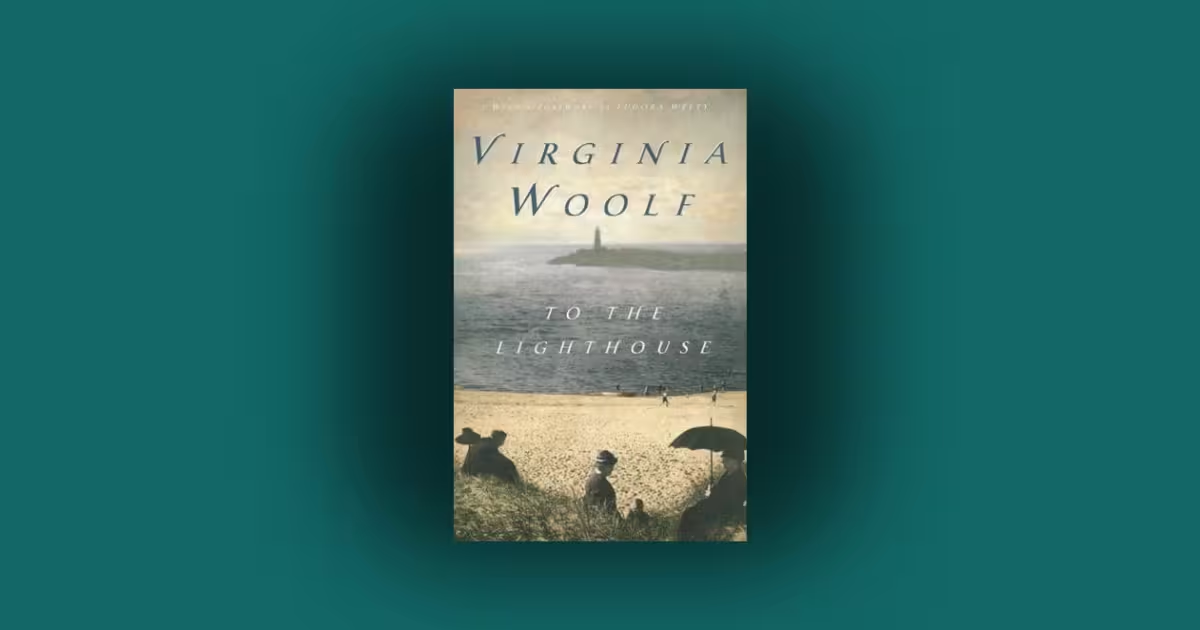
Do you ever feel that one small family moment can haunt a whole life? To the Lighthouse matters because Virginia Woolf shows how a postponed trip, a mother’s tenderness, and an artist’s unfinished painting can become the emotional map of memory.
To the Lighthouse is about how time destroys people, but memory and art quietly rescue what love could not hold.
To the Lighthouse is best for readers who love literary fiction, modernism, family psychology, feminist themes, grief narratives, symbolic novels, and slow, reflective prose.
Not for readers who want a fast plot, clear action, thriller pacing, or conventional chapter-by-chapter storytelling.
Table of Contents
1. Introduction
Virginia Woolf’s To the Lighthouse was first published in 1927 by Hogarth Press, the press run by Virginia and Leonard Woolf.
To the Lighthouse is now considered one of the central works of literary modernism, and the Modern Library ranks it at No. 15 on its “100 Best Novels” list. P
enguin Random House’s Modern Library page captures the famous paradox of the book: externally, the plot is tiny—people plan to sail to a lighthouse, and later some of them do—but Woolf’s prose turns that tiny plot into an “expansive” meditation on family joy and heartbreak.
I read To the Lighthouse less as a story about a journey and more as a story about what happens when love cannot speak clearly. Mrs Ramsay loves, but she also manages everyone.
Mr Ramsay seeks truth, but wounds people with it. James wants the lighthouse, but really wants his mother’s promise to be protected. Lily Briscoe wants to paint, but must fight a world whispering that “Women can’t paint, women can’t write.”
2. Background: Historical and Literary Context
To the Lighthouse belongs to the high modernist period, beside works by James Joyce, Marcel Proust, and T. S. Eliot. Instead of building suspense through external events, Woolf builds meaning through perception, memory, interruption, silence, and inner life.
To the Lighthouse is set around the Ramsay family’s visits to a summer house in the Hebrides, before and after the First World War; public sources commonly describe the novel as centering on the Ramsays’ visits between roughly 1910 and 1920.
The historical shadow is crucial. The first part, “The Window,” feels almost Edwardian: large family, dinner table, guests, servants, marriage plots, men’s academic ambitions, women’s domestic duties.
Then “Time Passes” moves through war, death, decay, and absence with terrifying speed. Mrs Ramsay dies suddenly, Andrew is killed in war, and Prue dies in childbirth.
Woolf does not dramatize these tragedies in conventional scenes; she places them almost parenthetically, as if history itself has no time to grieve properly.
This makes the novel feel brutally modern: private sorrow is swallowed by impersonal time.
3. To the Lighthouse Summary
The novel opens with one of the most painful small promises in modern fiction. Mrs Ramsay tells her six-year-old son James that they may go to the lighthouse tomorrow “if it’s fine.”
To James, the promise is not small. It is almost sacred. It fills the ordinary room with “extraordinary joy,” turning even his catalogue pictures into objects glowing with happiness.
Then Mr Ramsay enters and says, flatly, “it won’t be fine.”
The father may be meteorologically right, but emotionally he is cruel. James feels a violent hatred toward him, and Woolf immediately shows us the emotional architecture of the Ramsay family: Mrs Ramsay protects hope; Mr Ramsay protects fact; the children suffer between them.
The first section, “The Window,” takes place over a single day in the Ramsays’ summer house.
The plot, in ordinary terms, is slight. People talk, walk, read, paint, prepare dinner, think about marriage, worry about weather, and watch the sea. But Woolf’s real plot happens inside consciousness.
Mrs Ramsay sits with James, knits a stocking for the lighthouse keeper’s sick child, manages everyone’s emotions, and tries to soften the harshness of Mr Ramsay and Charles Tansley.
She is beautiful, maternal, socially powerful, and inwardly tired. She holds the house together, but the holding exhausts her.
Mr Ramsay is a philosopher, a brilliant man who imagines thought as an alphabet. He has reached “Q,” perhaps, but fears he will never reach “R,” let alone “Z.”
His intellectual self-doubt turns into emotional neediness. He demands sympathy from his wife, often without directly asking for it.
He wants to be assured that he is great, necessary, loved. Mrs Ramsay gives him this reassurance, but the cost is high. She becomes, in one of the novel’s most painful insights, a sponge full of other people’s emotions.
Around them are guests and children. Charles Tansley is poor, awkward, resentful, intellectually ambitious, and often mean.
He repeats Mr Ramsay’s pessimism about the lighthouse and later becomes associated with the line that haunts Lily Briscoe: “Women can’t paint, women can’t write.”
Lily is a painter, unmarried, observant, inwardly rebellious. She loves Mrs Ramsay, resists Mrs Ramsay’s marriage-centered worldview, and tries to paint Mrs Ramsay and James.
Her painting is not realistic in the conventional sense; she sees forms, masses, colors, relations. This matters because Lily’s artistic struggle becomes the novel’s answer to time.
William Bankes, an old friend of Mr Ramsay, admires Mrs Ramsay almost religiously. Augustus Carmichael, a poet, remains detached and sleepy.
Minta Doyle and Paul Rayley move through a courtship that Mrs Ramsay quietly encourages. The Ramsay children—James, Cam, Prue, Andrew, Nancy, Rose, Jasper, Roger—form a restless world around their parents.
They are not all developed equally, but they matter as atmosphere: they are the future Mrs Ramsay wants to protect.
As the day moves toward evening, Mrs Ramsay’s consciousness becomes the emotional center of the novel.
She thinks about poverty, charity, hospitals, marriage, motherhood, class, beauty, and death. She worries that she may be domineering, especially in arranging Minta and Paul’s romance.
She wants her children to remain young and happy, yet she knows life will hurt them. She understands, perhaps more deeply than anyone else in the book, that happiness is temporary.
The dinner scene is one of the great social scenes in English fiction. At first the meal feels fragmented. People are isolated inside themselves.
Mrs Ramsay feels the difficulty of making a shared moment out of separate minds. Yet gradually, through food, talk, candlelight, and her own social art, the dinner becomes whole.
For a brief time, the group feels united. Mrs Ramsay senses that the moment has become permanent—not literally, but inwardly. It will remain in memory.
This is one of Woolf’s central ideas: life cannot be stopped, but some moments can be preserved in consciousness.
Later that night, Mrs Ramsay reads to James from “The Fisherman and His Wife.” The lighthouse light appears across the bay.
James still wants to know whether they will go. Mrs Ramsay knows she must disappoint him because Mr Ramsay has said no. She thinks he will remember this all his life.
Then comes the sentence that explains much of the novel’s emotional force: “children never forget.”
The second section, “Time Passes,” is devastating because it removes almost everyone from the center. The house becomes the main presence. Darkness, wind, decay, damp, silence, and emptiness take over. Human life, which seemed so urgent in “The Window,” becomes fragile and almost irrelevant. Mrs Ramsay dies suddenly.
Prue marries and dies in childbirth. Andrew is killed in the war. These events are not narrated in sentimental detail.
They appear abruptly, as if time reports them without compassion. The house falls into disrepair; Mrs McNab, the old housekeeper, struggles to clean and restore it. The war and years of absence change everything.
The great family stage of the first section becomes a haunted ruin.
This middle section is where Woolf’s genius feels coldest and largest. The novel stops behaving like a family story and becomes a meditation on time itself. What does the universe care for beauty, marriage, ambition, children, dinner parties, books, paintings? Almost nothing. The sea continues. The wind continues. The house decays. People die. The living are not ready, but time passes anyway.
The third section, “The Lighthouse,” returns years later. The survivors come back. Mrs Ramsay is gone, and her absence is everywhere.
Lily Briscoe returns to the old house and finds herself unable at first to feel properly. She repeats the facts—Mrs Ramsay dead, Andrew killed, Prue dead—but they do not produce the expected emotion.
This numbness feels psychologically true. Grief does not always arrive as tears; sometimes it arrives as blankness.
Mr Ramsay now wants to complete the old trip to the lighthouse with James and Cam. But what once belonged to James’s childhood desire now feels like an obligation imposed by the father. James and Cam resent him. They feel forced into a ritual of mourning that belongs more to Mr Ramsay than to them. In the boat, James steers with tense competence, still full of old anger. Cam, caught between rebellion and pity, watches her father and brother. The sea journey becomes a psychological crossing: from childhood hatred toward a more complicated recognition.
During the journey, James sees the lighthouse differently. From far away, it had been dreamlike, almost magical.
Up close, it is plain, stark, real. Then he realizes that both versions are true: “the other was also the Lighthouse.
For nothing was simply one thing.” This is one of the novel’s key revelations. People are never one thing either. Mr Ramsay is tyrannical and vulnerable, cruel and grieving, ridiculous and dignified. Mrs Ramsay was loving and controlling, selfless and self-dramatizing.
The lighthouse is both symbol and object. Memory and reality are both true.
Aboard the boat, Mr Ramsay finally praises James’s sailing.
This is quiet but enormous. James does not openly melt, but inwardly he receives what he has wanted for years: recognition from his father. The boat reaches the lighthouse.
Mr Ramsay steps onto the rock with the parcels for the lighthouse men. Lily, watching from the shore, senses that “he has landed” and that “It is finished.”
At the same time, Lily completes her painting. She has been struggling all morning with memory, grief, Mrs Ramsay’s absence, and the old problem of composition.
The solution comes suddenly: she draws a line in the center. “It was done; it was finished.”
The ending does not mean that grief is solved.
It means form has been found. Mr Ramsay reaches the lighthouse; James receives a fragment of paternal approval; Lily finishes the painting; Mrs Ramsay remains dead. The novel’s consolation is not resurrection.
It is a vision.
Lily cannot bring Mrs Ramsay back, but she can make something out of the emptiness Mrs Ramsay left behind.
4. To the Lighthouse Analysis
4.1 Characters
Mrs Ramsay is the emotional sun of the novel.
She is beautiful, generous, socially graceful, and almost mythically maternal.
Yet Woolf does not reduce her to saintliness. Mrs Ramsay can be manipulative; she pressures people toward marriage, believes women’s fulfillment depends on domestic life, and enjoys being needed.
Still, I found her deeply moving because her power is also her prison. She holds everyone together, but nobody really holds her.
Mr Ramsay is both villain and victim. As a father, he wounds James by destroying hope.
As a husband, he drains Mrs Ramsay with his need for sympathy. Yet he is not flatly cruel. He fears failure, obscurity, intellectual limits, and emotional abandonment. Woolf makes him unbearable and pitiable at once.
James Ramsay begins as the wounded child. His hatred for his father is extreme, but psychologically believable.
The cancelled lighthouse trip becomes a symbolic injury. By the end, steering the boat, he becomes capable, controlled, and still angry.
His father’s praise does not erase the past, but it complicates it.
Lily Briscoe is the novel’s quiet hero.
She resists marriage, resists male condescension, resists sentimental memory, and resists artistic failure. Her final line on the canvas is not merely a painterly gesture; it is her declaration that a woman can make form, meaning, and art from life.
Charles Tansley is irritating but not empty. His class insecurity and ambition make him defensive. He sneers at women partly because he is terrified of being dismissed himself. That does not excuse him, but it explains him.
Cam Ramsay represents the child caught between resistance and tenderness. In the boat, she makes a secret pact of resentment with James against their father, but she also feels the father’s sorrow.
Prue and Andrew matter partly because of how suddenly they vanish. Prue, associated with beauty and marriage, dies in childbirth. Andrew, associated with promise and intelligence, dies in war.
Woolf refuses to give death dramatic fairness.
4.2 To the Lighthouse Themes and Symbolism
1. The lighthouse: desire, distance, reality
The lighthouse begins as James’s dream. It is far away, glowing, almost holy. Later, it becomes a duty, a memory, and finally a real place.
Woolf’s deepest point is that the lighthouse is never only one thing. As James realizes, “nothing was simply one thing.”
2. Time and death
“Time Passes” is the novel’s most radical section. Human beings disappear; the house remains; nature continues.
Mrs Ramsay, Prue, and Andrew die almost offstage, which makes their deaths feel even more shocking.
3. Emotional labor
Mrs Ramsay’s work is not just cooking, arranging, mothering, or hosting. Her real labor is emotional regulation.
She protects James, flatters Mr Ramsay, includes Tansley, encourages marriages, notices servants, worries about the poor, and keeps the family atmosphere alive.
This is why the novel still feels contemporary.
4. Art as survival
Lily’s painting is Woolf’s answer to loss. Art cannot defeat death, but it can give shape to experience.
The final line in the center of the canvas is not decorative; it is existential.
5. Gender and creativity
Tansley’s “Women can’t paint, women can’t write” is the ugly social voice Lily must overcome. The novel answers him not through argument, but through Lily’s completed work.
6. Marriage and ambivalence
Woolf does not present marriage simply as oppression or fulfillment.
The Ramsays’ marriage contains tenderness, dependence, inequality, beauty, irritation, and emotional exhaustion. That complexity is why it feels real.
5. Evaluation: My Review and Commentary
To the Lighthouse is a marvellous, piercing, and quietly revolutionary novel. It made me feel that family life is not made of big events first, but of glances, interruptions, promises, disappointments, and the words we should have said more gently.
Strengths / Pleasant Experiences
The greatest strength is Woolf’s psychological precision. She notices the half-second before someone speaks, the resentment behind politeness, the sadness hidden inside beauty.
The prose is also extraordinary. The sea, the house, the dinner table, the lighthouse beam—everything becomes emotional weather.
Weaknesses / Negative Experiences
Some readers will struggle with the pacing.
The book has very little conventional action. The stream-of-consciousness technique can feel demanding, especially in the first half, where thought often matters more than event.
Charles Tansley and Mr Ramsay may also irritate readers who prefer emotionally generous characters.
Impact / Controversy
The book’s quiet controversy is its refusal to flatter family life.
Woolf shows that love can coexist with selfishness, that motherhood can be sacred and exhausting, and that a “great man” may depend on invisible female labor. That still stings.
Comparison with Similar Works
Readers of Mrs Dalloway will recognize Woolf’s fascination with one day, memory, and consciousness.
Readers of The Waves will find an even more experimental version of her lyrical method. C
ompared with Joyce’s Ulysses, To the Lighthouse feels less encyclopedic and more intimate. Compared with Proust, Woolf is sharper, colder, and more compressed.
Adaptation and Box Office
The main screen adaptation I could verify is the 1983 British television film To the Lighthouse, adapted by Hugh Stoddart, directed by Colin Gregg, and starring Rosemary Harris, Michael Gough, Suzanne Bertish, and Kenneth Branagh.
It was also listed among the 1984 BAFTA Best Single Drama nominees.
Because this was a television film rather than a normal theatrical release, I could not verify any conventional box-office gross for it. The likely reason is simple: TV films generally do not report box office in the way cinema releases do.
Book vs TV adaptation: the adaptation can show the house, sea, family tension, and period atmosphere, but Woolf’s real drama is internal.
The novel’s power lies in thought moving from one mind to another. Any screen version must translate inner weather into faces, pauses, voiceover, framing, and silence.
6. Personal Insight and Contemporary Educational Relevance: 5 Lessons
The most important contemporary lesson of To the Lighthouse is the invisibility of care. Mrs Ramsay’s work resembles what we now call emotional labor: remembering, soothing, arranging, noticing, protecting, and absorbing tension.
This is not merely a private theme. UN Women-related reporting has repeatedly noted that women globally do far more unpaid care and domestic work than men; TIME’s coverage of a UN Women report stated that women do about 2.5 times as much unpaid child care and domestic labor as men.
That statistic made me read Mrs Ramsay differently. She is not “just” a mother or hostess. She is the infrastructure of everyone else’s comfort. The tragedy is that her work becomes visible only after she is gone.
Five Lessons from To the Lighthouse
1. Children remember emotional weather. James remembers the cancelled lighthouse trip because disappointment, when given by a parent, becomes identity.
2. Truth without tenderness can become cruelty. Mr Ramsay is often factually right, but emotionally wrong.
3. Care work is real work. Mrs Ramsay’s invisible labor holds the family together.
4. Art gives grief a shape. Lily cannot save Mrs Ramsay, but she can complete her vision.
5. People are never only one thing. The lighthouse is dream and stone; Mr Ramsay is tyrant and sufferer; Mrs Ramsay is giver and controller.
7. To the Lighthouse Quotes
“’Yes, of course, if it’s fine tomorrow,’ said Mrs. Ramsay. ‘But you’ll have to be up with the lark,’ she added.”
“…and the passage to that fabled land where our brightest hopes are extinguished, our frail barks founder in darkness… one that needs, above all, courage, truth, and the power to endure.”
“So much depends then, thought Lily Briscoe, looking at the sea which had scarcely a stain on it… upon distance: whether people are near us or far from us…”
“He sat with his hand on the tiller sitting bolt upright… His father had praised him.”
“She looked at the steps; they were empty; she looked at her canvas; it was blurred. With a sudden intensity, as if she saw it clear for a second, she drew a line there, in the centre. It was done; it was finished. Yes, she thought, laying down her brush in extreme fatigue, I have had my vision.”
8. Conclusion
To the Lighthouse is not a novel to rush through. It is a book to sit with, almost the way Lily sits before her canvas.
At first, the story may seem slight: a family wants to visit a lighthouse; years pass; some survivors finally go.
But beneath that small plot, Woolf gives us one of the richest studies of time, grief, marriage, childhood, gender, and artistic vision in modern literature.
I would recommend it to readers who love introspective fiction, feminist classics, psychological realism, and novels where style is not decoration but meaning itself.
Read it especially if you have ever wondered why one sentence from childhood can stay alive for decades, or why finishing a piece of art can feel like surviving a loss.







